


Lebanese Parliament Defies Aoun: Solution Lies in Forming New Government

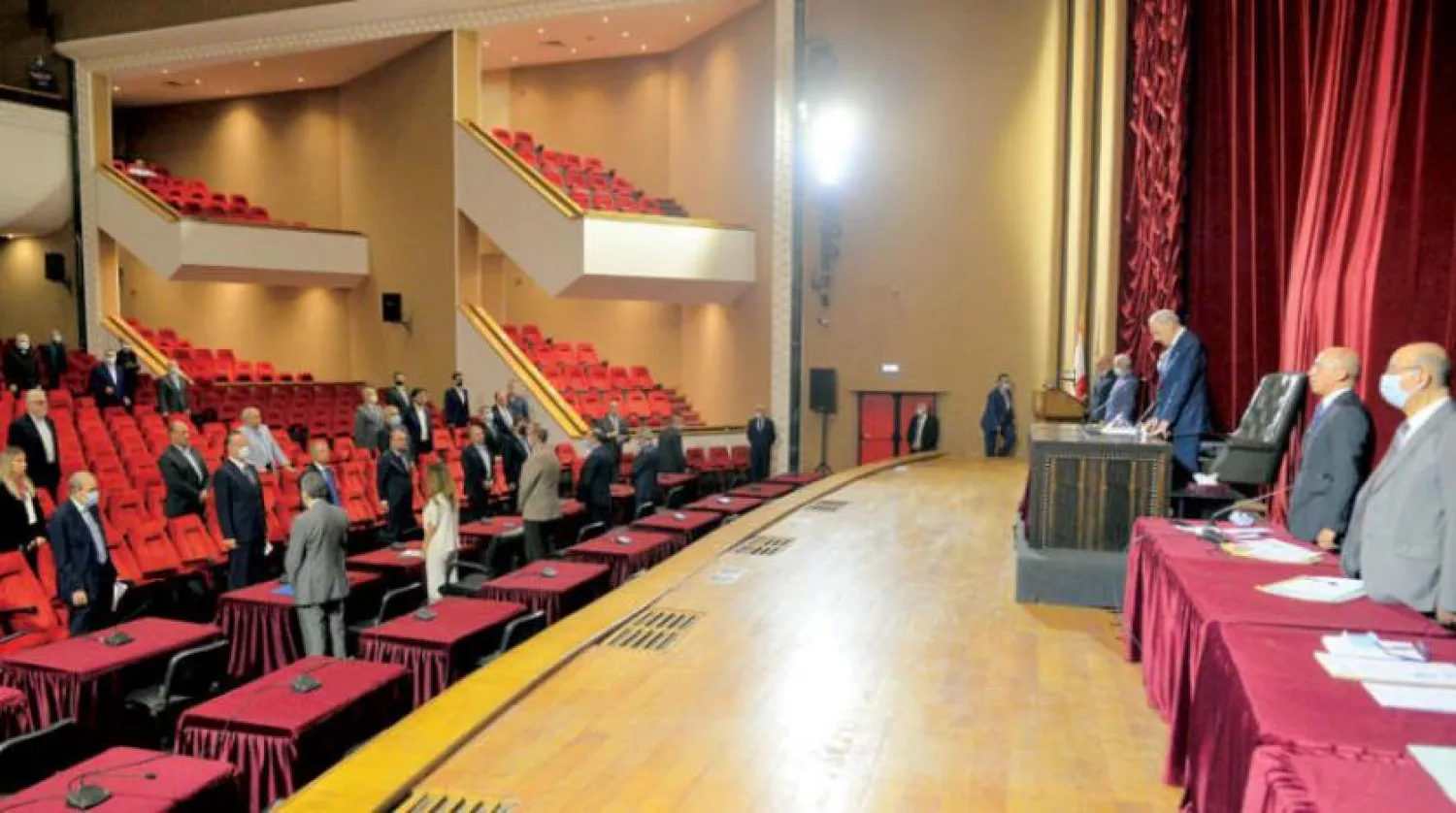
Speaker Nabih Berri and MPs at parliament on Friday. (Lebanese parliament)
TT

Lebanese Parliament Defies Aoun: Solution Lies in Forming New Government

Speaker Nabih Berri and MPs at parliament on Friday. (Lebanese parliament)

The Lebanese parliament ignored President Michel Aoun’s request to make a decision regarding the Central Bank’s move to lift fuel subsidies.

Rather it responded to Aoun’s letter to parliament by asking him to form a new government, speed up the distribution of the financing card and "liberate the market from monopolistic practices".

Aoun had sent a letter to parliament complaining about Banque du Liban’s announcement to lift fuel subsidies, asking the deputies to take the appropriate response in this regard and accusing the BDL governor, Riad Salameh, of not seeking advice from the political authority before making his decision.

Lebanon’s contentious files prevailed over the parliamentary session that was held on Friday. In a lengthy press conference, the head of the Free Patriotic Movement and Aoun's son-in-law, MP Gebran Bassil, threatened to resign from parliament if no decision was taken regarding Salameh’s move, prompting Speaker Nabih Berri to respond that parliament “cannot be threatened.”

“Whoever wants to resign, let him resign,” Berri stated.

The financing card represents one of the official mechanisms and topical solutions to alleviate the impact of the economic hardship that the country is witnessing, following the decline in the reserves of the BDL’s hard currencies, which it used to subsidize vital commodities imported from abroad in US dollars, especially flour, fuel, medicine and foodstuffs.

After the Central Bank stopped subsidizing foodstuffs and reduced the share of medicines from the subsidy, it announced two weeks ago that it was unable to provide hard currency to import fuels, which resulted in a political and social crisis that prompted Aoun to address parliament to find a solution.

Parliament, however, stressed that the only way out was to form a government, with the aim of “filling the void in the executive authority, and for the new cabinet to make key decisions, including lifting subsidies and implementing the financing card” approved by the legislature.

The card, which would be distributed to Lebanon’s needy households, would be funded by loans from the World Bank and the International Monetary Fund (IMF), with the aim of alleviating the suffering of the Lebanese whose purchasing abilities have greatly diminished.



Atrocities in Sudan's El-Fasher were 'Preventable Human Rights Catastrophe'

Sudanese displaced people who left El Fasher after its fall, sit in the shade in Tawila at the Rwanda camp reception point on December 17, 2025. (Photo by AFP)
TT

Atrocities in Sudan's El-Fasher were 'Preventable Human Rights Catastrophe'

Sudanese displaced people who left El Fasher after its fall, sit in the shade in Tawila at the Rwanda camp reception point on December 17, 2025. (Photo by AFP)

The atrocities unleashed on El-Fasher in Sudan's Darfur region last October were a "preventable human rights catastrophe", the United Nations said Monday, warning they now risked being repeated in the neighbouring Kordofan region.

"My office sounded the alarm about the risk of mass atrocities in the besieged city of El-Fasher for more than a year ... but our warnings were ignored," UN rights chief Volker Turk told the Human Rights Council in Geneva.

He added that he was now "extremely concerned that these violations and abuses may be repeated in the Kordofan region".


Arab League Condemns Israel's Decisions to Alter Legal, Administrative Status of West Bank

A general view shows the opening session of the meeting of Arab foreign ministers at the Arab League Headquarters (Reuters)
TT

Arab League Condemns Israel's Decisions to Alter Legal, Administrative Status of West Bank

A general view shows the opening session of the meeting of Arab foreign ministers at the Arab League Headquarters (Reuters)

The General Secretariat of the Arab League strongly condemned decisions by Israeli occupation authorities to impose fundamental changes on the legal and administrative status of the occupied Palestinian territories, particularly in the West Bank, describing them as a dangerous escalation and a flagrant violation of international law, international legitimacy resolutions, and signed agreements, SPA reported.

In a statement, the Arab League said the measures include facilitating the confiscation of private Palestinian property and transferring planning and licensing authorities in the city of Hebron and the area surrounding the Ibrahimi Mosque to occupation authorities.

It warned of the serious repercussions of these actions on the rights of the Palestinian people and on Islamic and Christian holy sites.

The statement reaffirmed the Arab League’s firm support for the legitimate rights of the Palestinian people, foremost among them the establishment of their independent state on the June 4, 1967 borders, with East Jerusalem as its capital.


UN: 53 Migrants Dead or Missing in Shipwreck Off Libya

(FILES) Migrants sit on board a RHIB (Rigid inflatable boat) after being evacuated by crew members of the “Ocean Viking” rescue ship from the oil tanker the 'Maridive 703' in the search-and-rescue zone of the international waters between Malta and Tunisia, on December 31, 2025. (Photo by Sameer Al-DOUMY / AFP)
TT

UN: 53 Migrants Dead or Missing in Shipwreck Off Libya

(FILES) Migrants sit on board a RHIB (Rigid inflatable boat) after being evacuated by crew members of the “Ocean Viking” rescue ship from the oil tanker the 'Maridive 703' in the search-and-rescue zone of the international waters between Malta and Tunisia, on December 31, 2025. (Photo by Sameer Al-DOUMY / AFP)

The UN migration agency on Monday said 53 people were dead or missing after a boat capsized in the Mediterranean Sea off the Libyan coast. Only two survivors were rescued.

The International Organization for Migration said the boat overturned north of Zuwara on Friday.

"Only two Nigerian women were rescued during a search-and-rescue operation by Libyan authorities," the IOM said in a statement, adding that one of the survivors said she lost her husband and the other said "she lost her two babies in the tragedy.”

According to AFP, the IOM said its teams provided the two survivors with emergency medical care upon disembarkation.

"According to survivor accounts, the boat -- carrying migrants and refugees of African nationalities departed from Al-Zawiya, Libya, at around 11:00 pm on February 5. Approximately six hours later, it capsized after taking on water," the agency said.

"IOM mourns the loss of life in yet another deadly incident along the Central Mediterranean route."

The Geneva-based agency said trafficking and smuggling networks were exploiting migrants along the route from north Africa to southern Europe, profiting from dangerous crossings in unseaworthy boats while exposing people to "severe abuse.”

It called for stronger international cooperation to tackle the networks, alongside safe and regular migration pathways to reduce risks and save lives.