

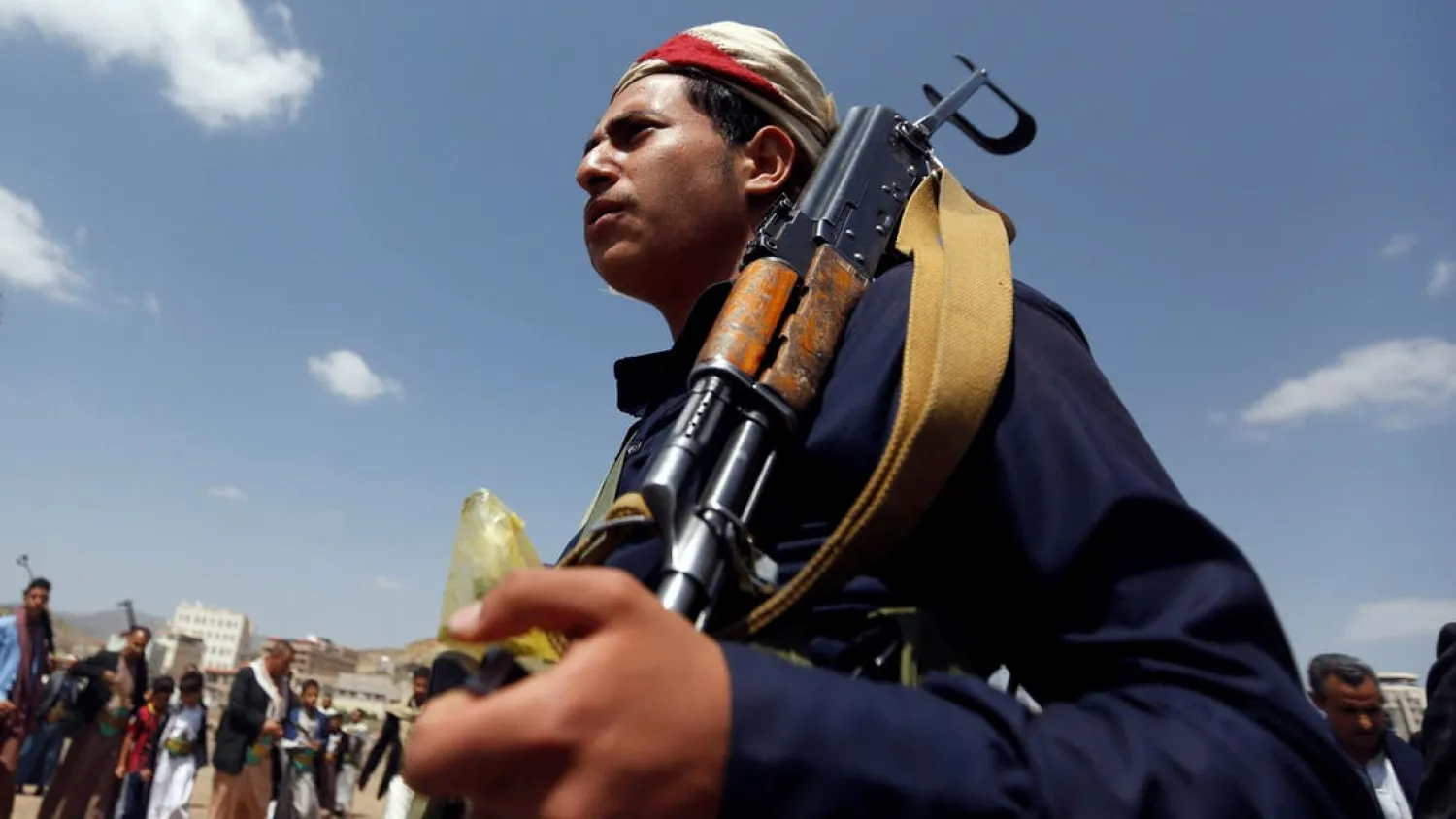

Houthi Militias Admit to Kidnapping 140 Civilians in a Week

Houthi militant carries a rifle during a ceremony in Sanaa, Yemen (File photo: Reuters)
TT

Houthi Militias Admit to Kidnapping 140 Civilians in a Week

Houthi militant carries a rifle during a ceremony in Sanaa, Yemen (File photo: Reuters)

The Iran-backed Houthi militias admitted to kidnapping 140 civilians after accusing them of collaborating with the legitimate government, according to well-informed Yemeni sources.

The sourced confirmed that the militias also abducted several women in several areas under their control.

Rights activists in Sanaa told Asharq Al-Awsat that the group's gunmen have carried out a massive arrest campaign targeting civilians, men, and women of different ages and political affiliations since the beginning of this month.

They indicated that the unjustified campaigns targeted homes, residential neighborhoods, schools, universities, markets, parks, cafes, and private businesses resulting in the arrest of hundreds of civilians.

The Houthi security media website confirmed that the group's gunmen kidnapped more than 140 citizens in Sanaa and other Yemeni cities during the second week of August.

The website explained that the persons were taken for their involvement in "sharing intelligence with the government and the Arab Coalition," one of the pretexts Houthis use to justify arbitrary arrests and abuses against civilians.

The militia media did not provide any information about the identity of the kidnapped civilians, their place of abduction, or their fate.

Human rights sources believe that the number of civilians recently arrested by the group is more than what it announced in its media.

Hundreds of Houthi detention centers, including secret prisons in Sanaa and other cities under its control, are established due to the group's intensification of its campaigns of prosecution and kidnapping, according to the sources.

The insurgents are accused of putting thousands of Yemenis in secret prisons for opposing the group and its methods.

Over the past few years, Houthi confessed to committing multiple kidnappings against Yemenis.

In April 2020, the group admitted that it had kidnapped more than 6,000 people in its areas after accusing them of supporting the legitimate Yemeni government and the Coalition while discussing the repressive actions of its security services, accomplished in three years.

The number of those forcibly disappeared by the group was limited to those kidnapped by the security services affiliated with its Ministry of Interior.

However, Yemeni human rights defenders, who spoke earlier with Asharq Al-Awsat, said that the group's intelligence services had kidnapped thousands of others, many of whom are civil activists or affiliated with various parties.

Over the past few years, local and international reports accused the Houthi militia of escalating crimes of persecution and kidnapping against civilians in the cities under their control, including women and children.

A recent report issued by the Yemeni Ministry of Human Rights revealed that about 1,635 Yemeni detainees were subjected to severe psychological and physical torture, while about 350 prisoners, including 33 women, died as a result of torture.



UK Sanctions Four Houthi Officials Over Torture, Sexual Violence Abuses

Britain's Foreign Secretary Ed Miliband poses during a meeting with his French counterpart at the Quai d'Orsay in Paris on July 29. (AFP)
TT

UK Sanctions Four Houthi Officials Over Torture, Sexual Violence Abuses

Britain's Foreign Secretary Ed Miliband poses during a meeting with his French counterpart at the Quai d'Orsay in Paris on July 29. (AFP)

Britain on Tuesday sanctioned four ‌senior ‌figures linked ‌to ⁠the terrorist Houthi militia in Yemen, accusing ⁠them of ⁠involvement ‌in ‌torture, rape ‌and ‌other serious abuses ‌against detainees held by ⁠the ⁠militia.

In a statement, the UK government said it is “stepping up its response to the crisis in Yemen targeting those who seek to undermine peace inside the country.”

It announced designations against the Houthis and four top officials, following the group’s decision to resume conflict across the region and inside Yemen.

“The reckless behavior of the Houthis in the Bab al-Mandeb Strait has continued to disrupt global supply chains and has put added pressure on the cost of living for British families,” it added.

“Backed by Iran, the Houthis have increased attacks against Saudi Arabia’s civilian infrastructure and renewed conflict inside Yemen,” it went on to say.

Foreign Secretary, Ed Miliband said: “The Houthis’ renewed aggression targeting our partners and innocent civilians is unacceptable and they must be held to account.”

“This government has today taken steps to do just that. We will not stand by whilst groups like the Houthis take action that drives up the cost of living for the British people while deliberately attempting to undermine the stability of the Middle East,” he said.

“Today’s measures send a clear message to the Houthis - we will always act in support of British values and interests,” he added.

Tuesday’s measures “underline the UK’s commitment to holding those to account who seek to undermine peace and security in Yemen and the region and reaffirm our support for the people of Yemen and Yemen’s internationally recognized institutions,” continued the government statement.

The package of designations also targets those who have been involved “in serious human rights abuses, including the cruel, inhuman and degrading treatment of prisoners in Yemen, which the UK condemns in all forms.”

The designations target Abdulkarim Amir al-Din Hussein Al-Houthi, who served as the so-called Houthi Minister of Interior in the illegal Houthi government in Sanaa since 2019.

He has been responsible for the police, security forces, Criminal Investigation Department, women’s security unit and detention facilities of the Ministry of Interior, in whose custody detainees have been subjected to torture and other cruel, inhuman or degrading treatment, including electric shocks, beatings and sexual violence, said the designation.

Another designation targeted Abdul Hakim Hashem Ali Al-Khaiwani, the Head of the Houthi Security and Intelligence Service and previously served as Houthi as Deputy Minister of Interior, and Mohammed Moufleh, a Houthi-appointed judge in Yemen who has been involved in a serious violation of an individual’s right to liberty and security of a person.

The fourth designation targets Sarim Al-Din Muffadal, a senior Houthi prosecutor in Yemen who is reasonably suspected of having directly perpetrated, or knowingly permitted or acquiesced in, sexual violence including rape, torture and other cruel, inhuman or degrading treatment of women detainees.

Tuesday's package of measures “reaffirms the UK’s position that Houthi aggression is unacceptable and that the group must be held to account, following years of efforts to secure peace and progress through dialogue,” said the government statement,

Alongside this, the UK recently led international efforts to strengthen the UN Yemen sanctions regime, using its role as UN Security Council penholder on Yemen to increase pressure on the Houthis to cease in their aggression.

“This government has repeatedly made clear that the Houthis must end their attacks immediately and allow safe, unimpeded humanitarian access,” it added.

“The decision to restart conflict in Yemen puts the most vulnerable at further risk and has displaced hundreds of thousands of Yemenis,” it stated.

In September, the government responded by announcing £10m in funding for the UN flash appeal as part of our £104 million humanitarian support to Yemen this year.

Moreover, the statement declared: “The UK stands with the Kingdom of Saudi Arabia and the people and government of Yemen in the wake of increased Houthi attacks.”

Minister for the Middle East Stephen Doughty recently visited Saudi Arabia to reiterate the UK’s solidarity to Saudi counterparts and long-standing support to the government of Yemen.


Houthis Expand Spy Network to Tighten Grip on Sanaa

The Houthis continue to recruit new members for their military effort. (Facebook)
TT

Houthis Expand Spy Network to Tighten Grip on Sanaa

The Houthis continue to recruit new members for their military effort. (Facebook)

The Houthis have intensified security measures in the Yemeni capital, Sanaa, expanding their network of informants to monitor residents, track their movements and gauge their views, amid continued airstrikes targeting their leaders and military positions.

The measures are aimed at suppressing potential opposition amid growing fears of security breaches that could expose military positions and leadership movements.

Local sources told Asharq Al-Awsat that the Houthis had deployed additional informants across Sanaa in recent days to track residents’ movements, gatherings and social activities, and collect information about their attitudes toward the militia and its practices before reporting to security and intelligence agencies.

Plainclothes operatives have been deployed along main streets, in working-class neighborhoods and markets, and around institutions as part of a covert surveillance network designed to pursue critics, identify signs of public opposition and detect activities that could threaten Houthi influence.

According to the sources, the measures are intended to instill fear among residents and tighten surveillance.

Most informants are affiliated with various security agencies. They operate within networks overseen by Houthi officials responsible for collecting, exchanging and forwarding information to the relevant authorities.

Sanaa residents say the growing presence of informants reflects Houthi efforts to tighten their grip on society, turning neighborhoods and markets into spaces of constant surveillance and espionage to contain public discontent amid worsening living conditions, escalating abuses and shrinking freedoms.

One resident, speaking on condition of anonymity for fear of persecution, explained that the widespread deployment of informants had prompted many citizens to avoid speaking in public or expressing their opinions, fearing their remarks could be reported to security agencies.

Plainclothes operatives monitoring residents’ movements and gatherings have fostered an atmosphere of suspicion and apprehension, forcing people to exercise caution even in everyday conversations.

A shopkeeper in Sanaa told Asharq Al-Awsat that the Houthis were no longer content with pursuing opponents and activists, but sought to subject society as a whole to a network of surveillance and espionage.

He noted that some informants deliberately monitored conversations and gatherings in markets, reporting their observations to Houthi supervisors, who subsequently passed the information to security agencies.

The expansion of the spy network comes as the Houthis face sustained airstrikes targeting gatherings of their leaders, military positions, and missile and drone launch sites.

According to the sources, the strikes have prompted the group to reinforce security measures, intensify surveillance and pursue what it describes as suspicious activities to prevent its military positions and leadership movements from being exposed.

Meanwhile, the Houthis have stepped up accusations against residents in several parts of Sanaa of spying for the Yemeni government and the Coalition to Restore Legitimacy in Yemen, alleging that they track military movements and relay the coordinates of Houthi positions. Others have been accused of incitement and mobilizing opposition to the group.

Observers believe the expansion of the informant network reflects Houthi fears that growing public discontent could erupt into protests threatening their influence.


Suspects Arrested in Homs Church Robbery, Including Church Guard

Syrian security forces in Homs. (Government media)
TT

Suspects Arrested in Homs Church Robbery, Including Church Guard

Syrian security forces in Homs. (Government media)

Internal security forces in the central Syrian province of Homs announced the arrest of several suspects in connection with the armed robbery of Our Lady of Peace Church in the city’s Bustan al-Diwan neighborhood, including the church’s own guard.

Homs Internal Security Chief Brig. Gen. Bassem Shaaban said in a statement on Telegram that specialized security teams had begun investigating as soon as the crime was reported, tracing leads and gathering information and evidence that led to the arrest of several members of the group implicated in the theft of cash and valuables from the church.

Investigations remain ongoing to establish the full circumstances of the crime, determine each suspect’s role and locate and recover the stolen property.

Security forces are also pursuing the remaining members of the group to bring them before judicial authorities.

Our Lady of Peace Church, the seat of the Melkite Greek Catholic Archeparchy of Homs, Hama, Nabek, Yabroud and surrounding areas, was the target of an armed raid on November 14. The assailants attacked and bound Archbishop Jean-Abdo Arbach before stealing his cross and cash from his office.

The incident sparked widespread outrage and concern among Christians, particularly as it coincided with mounting alarm over the kidnapping of Christians in the Hama countryside and in rural Damascus, with abductors demanding exorbitant ransoms for their release.

The arrests came about a week after the heads of three churches in Syria issued a strongly worded joint statement expressing deep concern over a “series of heinous and recurring attacks targeting the Syrian people, particularly Christians.”

The statement was issued by John X, Greek Orthodox Patriarch of Antioch and All the East; Mor Ignatius Aphrem II, Syriac Orthodox Patriarch of Antioch and All the East; and Youssef Absi, Melkite Greek Catholic Patriarch of Antioch and All the East.

The three patriarchs stressed that the attacks had never been isolated incidents and constituted a violation of the most basic human rights. They warned that their recurrence without deterrence or tangible results from the authorities raised serious questions about the future of Christians in Syria.

The US State Department also expressed concern over attacks and kidnappings targeting Syria’s Christian community, calling for those responsible to be held accountable.

Christians are a historic and integral part of Syria’s social fabric, with their largest communities concentrated in Damascus, Aleppo, Homs, the northeastern Jazira region, coastal areas and the Hama countryside.

Since the outbreak of the Syrian conflict in 2011, their numbers have declined sharply amid waves of displacement and forced migration in search of safety and economic stability.

Following major political changes and the fall of the former regime in late 2024, Syria’s communities entered a new phase of cautious anticipation as they sought constitutional and security guarantees enshrining equal citizenship and protecting religious freedoms.

Despite positive steps by the new administration to return some confiscated church properties and offer assurances aimed at preserving civil peace, persistent security challenges, the proliferation of weapons and deteriorating living conditions continue to fuel genuine concerns.

Religious and civil leaders have called for the firm enforcement of the rule of law to stem the exodus and preserve Syria’s historic diversity.