


'Talking Movies': The Chinese Cinema Bringing Film to Blind Audiences

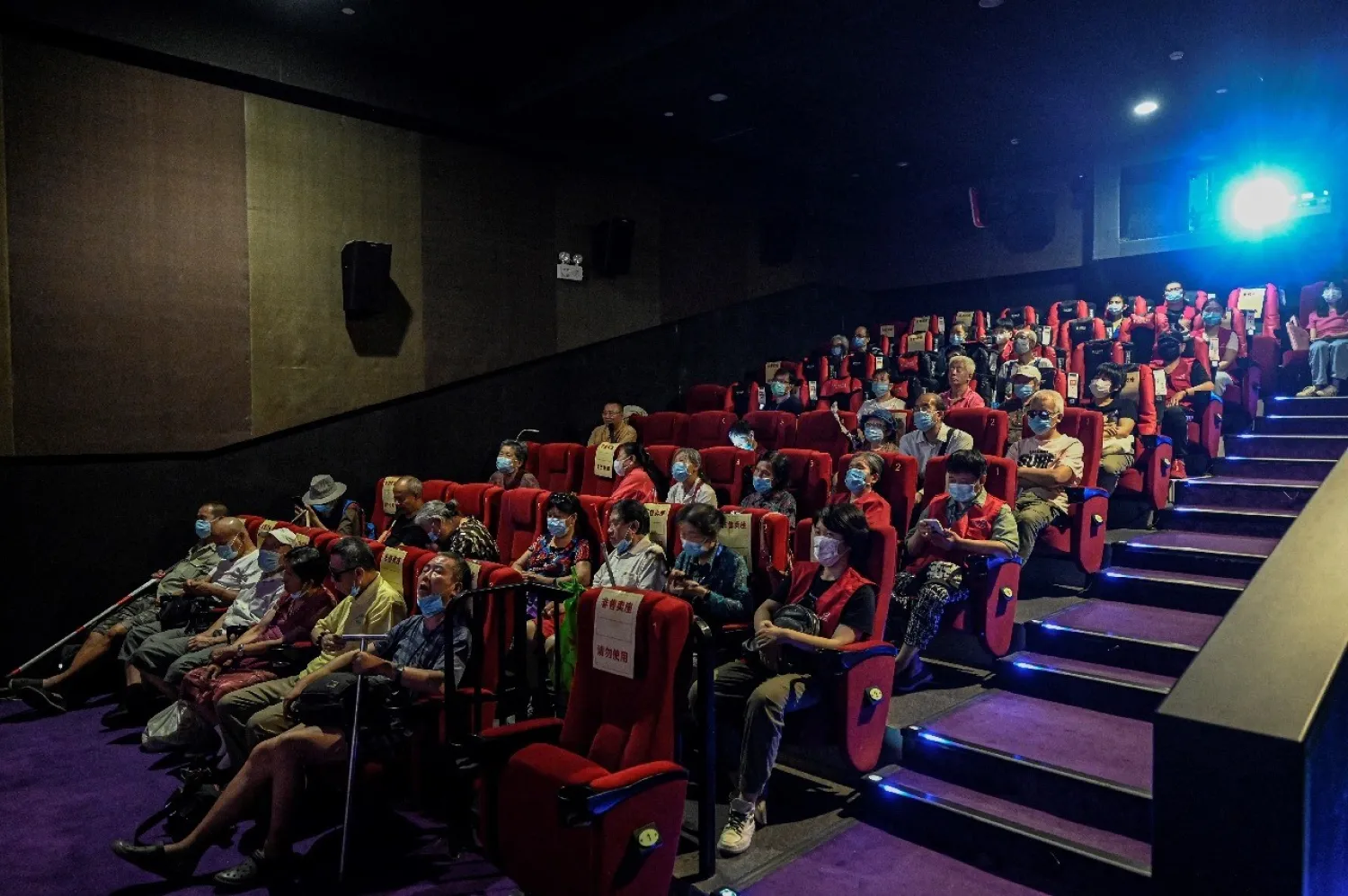
Dozens of blind moviegoers come to Saturday screenings organized by Xin Mu Theater. Jade GAO AFP
TT

'Talking Movies': The Chinese Cinema Bringing Film to Blind Audiences

Dozens of blind moviegoers come to Saturday screenings organized by Xin Mu Theater. Jade GAO AFP

Every Saturday, Zhang Xinsheng travels two hours for a movie date with friends, navigating Beijing's confusing subway system with his white cane and a speaking map that screams directions on his mobile phone.

Zhang lost his sight in his early twenties due to a degenerative condition, but since going blind has discovered a love for cinema at the "talking film" club, where volunteers give vivid narrations to an auditorium of blind or partially sighted cinemagoers, said AFP.

"After I listened to a film for the first time in 2014, it felt like a (new) world had opened up for me," he said.

"I felt I could understand the film despite my blindness. There were clear images forming in my mind's eye... as (the narrator) described the scenes... of laughter, the crying."

Now 51, he makes the weekly pilgrimage to a theatre in Qianmen, in the heart of old Beijing, without fail.

Dozens of blind moviegoers come to the Saturday screenings organized by Xin Mu Theater, a small group of volunteers who were the first to introduce films to blind audiences in China.

Their method is surprisingly low-tech. A narrator describes what is happening on screen, including facial expressions, unspoken gestures, the setting and costumes.

They relay visual clues that would otherwise be missed, like a sudden change of scenery from falling leaves to snow that conveys the passage of time.

Last month the group screened "A Street Cat Named Bob" -- a story of a ginger feline who helps a homeless man in London quit drugs and become a bestselling author.

Narrator Wang Weili described what is happening on-screen:

"There is snow falling over London, a city in England. It's a little like Beijing but the buildings aren't that tall," he says in between the dialogue dubbed in Chinese.

"A man with binoculars -- two long round cylinders used to see things that are far -- is watching James as he sings on a street corner with Bob the cat."

There was pin-drop silence as he spoke. No one whispered or crunched snacks -- instead, the audience listened intently.

- 'Tell me what you see' -
Wang was inspired to introduce films to blind audiences after narrating "The Terminator" to a friend.

"I saw sweat pouring from his forehead when I described the action scenes. He was so excited," he said. "He kept saying tell me what you see!"

Wang rented a small room in an old Beijing courtyard with his savings in 2005 and started the talking film club with a small flat-screen TV, a second-hand DVD player and about 20 chairs.

His 20-square-metre (215-square-foot) makeshift cinema was always packed.

Explaining films to blind audiences can be challenging, especially if the plot has historical or imaginary elements that audience members are yet to encounter.

Before screening "Jurassic Park" for instance, Wang lets the audience feel several dinosaur models.

"I watch a film at least six or seven times... and write my own detailed script," the businessman-turned-disability activist said.

Xin Mu now partners with bigger cinemas for their screenings. The pandemic has also pushed the team to introduce a streaming service with recorded audio narrations.

The group has screened nearly a thousand films over the past 15 years.

- 'Limited opportunities' –
China has more than 17 million people who are visually impaired. Eight million of them are completely sightless, according to The China Association for the Blind.

Over the past decade, cities across the country have built more blind walkways, added braille markings on elevator panels and allowed blind candidates to take exams for government jobs and colleges.

"But the blind community have limited opportunities to participate in cultural activities," said Dawning Leung, Founder of the Audio Description Association in Hong Kong.

"They are shut out of cinemas, theatres or art exhibitions because there is no awareness about the need for audio narrations."

"Even audio descriptions at museums are written with sighted people in mind. They tell you about the history of an object or where it was found but rarely describe what it looks like," she said.

Activists have for years pushed for legislation mandating audio descriptions for films, television programs or artwork in mainland China, like those in Hong Kong, with little progress.

The free film screenings by Xin Mu offer a rare chance for blind moviegoers to be part of the world's biggest box office.

"Movies help enrich my life... they help me understand life's challenges," Zhang said.

His favorite film is Bollywood blockbuster "Dangal," where a strict dad coaches his daughters to overcome social taboos and become champion wrestlers.

"At times I think, just like the protagonists in that film, I can change my fate by working hard," he said.



Blake Lively, Justin Baldoni Agree to End Lengthy Legal Battle

 US actress Blake Lively arrives for the 2026 Met Gala celebrating "Costume Art" at the Metropolitan Museum of Art, in New York, on May 4, 2026. (AFP)
US actress Blake Lively arrives for the 2026 Met Gala celebrating "Costume Art" at the Metropolitan Museum of Art, in New York, on May 4, 2026. (AFP)
TT

Blake Lively, Justin Baldoni Agree to End Lengthy Legal Battle

 US actress Blake Lively arrives for the 2026 Met Gala celebrating "Costume Art" at the Metropolitan Museum of Art, in New York, on May 4, 2026. (AFP)
US actress Blake Lively arrives for the 2026 Met Gala celebrating "Costume Art" at the Metropolitan Museum of Art, in New York, on May 4, 2026. (AFP)

Actor Blake Lively and "It Ends with Us" co-star Justin Baldoni on Monday settled their acrimonious years-long legal battle, avoiding a costly civil trial.

A joint statement provided to AFP said the parties had resolved their dispute -- launched after Lively accused Baldoni of inappropriate on-set behavior -- without disclosing any settlement figure.

"The end product -- the movie 'It Ends with Us' -- is a source of pride to all of us who worked to bring it to life," Baldoni and Lively's attorneys said in a joint statement.

"We acknowledge the process presented challenges and recognize concerns raised by Ms. Lively deserved to be heard... It is our sincere hope that this brings closure and allows all involved to move forward constructively and in peace."

Hours after the announcement that the case was settled, Lively was all smiles as she unexpectedly appeared at the Met Gala in New York in a full ball gown that erupted in a cloud of pink, purple and yellow tulle.

Baldoni and the studio Wayfarer had previously countersued Lively and her husband Ryan Reynolds with claims of extortion and defamation, but a judge dismissed those claims last year.

Wayfarer previously insisted that neither the studio, its executives, nor its PR team did anything to retaliate against Lively.

A judge dismissed some of Lively's claims, but upheld her allegations of retaliation, which would have proceeded to trial on May 18.

Based on a best-selling novel by the US writer Colleen Hoover, "It Ends with Us" made more than $350 million at the box office in 2024, making it one of the biggest hits of the year.


Demi Moore Joins Cannes Festival Jury

US actress Demi Moore attends the Vanity Fair Oscar Party at the Los Angeles County Museum of Art (LACMA) in Los Angeles on March 15, 2026. (AFP)
TT

Demi Moore Joins Cannes Festival Jury

US actress Demi Moore attends the Vanity Fair Oscar Party at the Los Angeles County Museum of Art (LACMA) in Los Angeles on March 15, 2026. (AFP)

American actress Demi Moore, still riding high from the late-career boost of her Oscar-nominated turn in "The Substance", will join the jury for the Cannes Film Festival, which kicks off next week, organizers announced on Monday.

The film extravaganza on the French Riviera, one of the world's most important annual cinema events, hands out a host of prizes, including the prestigious Palme d'Or for best film, decided by a nine-person jury.

Moore, 63, along with Chinese filmmaker Chloe Zhao, whose films from "Nomadland" to "Hamnet" have become awards-season favorites, will add some A-list sparkle to the jury, which also includes Ivorian-American actor Isaach de Bankole, who is set to play in the upcoming third installment of the "Dune" franchise.

As previously announced, the jury will be headed by arthouse South Korean director Park Chan-Wook ("Oldboy").

The other jury members are Irish-Ethiopian actor Ruth Negga, Belgian director Laura Wandel, Chilean director Diego Cespedes, Irish screenwriter Paul Laverty and Swedish actor Stellan Skarsgard.

The Cannes Festival runs from May 12 to 23.


‘The Devil Wears Prada’ Struts to 1st Place with $77 Million Debut

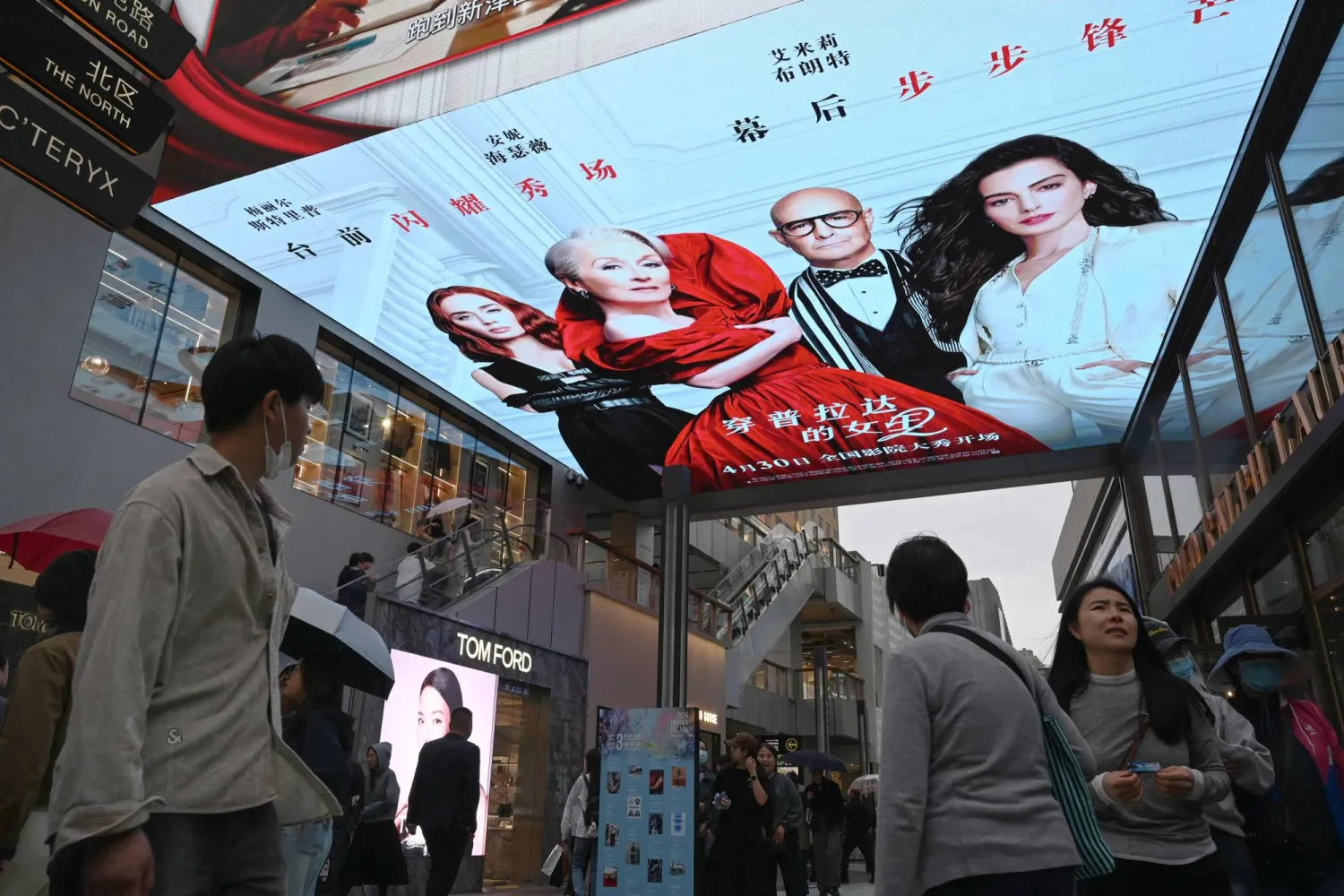
People walk below an electronic billboard advertising the movie "The Devil Wears Prada 2" at a shopping mall in Beijing on May 2, 2026, on the second day of a five-day national May Day holiday. (Photo by GREG BAKER / AFP)
TT

‘The Devil Wears Prada’ Struts to 1st Place with $77 Million Debut

People walk below an electronic billboard advertising the movie "The Devil Wears Prada 2" at a shopping mall in Beijing on May 2, 2026, on the second day of a five-day national May Day holiday. (Photo by GREG BAKER / AFP)

Twenty years after the original, the sequel to “The Devil Wears Prada” made a splash in its first weekend in theaters.

Driven largely by women, “The Devil Wears Prada 2” earned $77 million in the US and Canada, and $156.6 million internationally, according to studio estimates Sunday. It easily topped the box office and bumped “Michael” to second place, though the musical biopic held well in its second weekend, falling only 44%.

The Walt Disney Co.’s 20th Century Studios opened “The Devil Wears Prada 2” in 4,150 locations in North America. Women made up about 76% of the ticket buyers, according to PostTrak exit polls; 74% said they would “definitely recommend” the movie to friends.

According to The Associated Press, critics were a bit mixed on the sequel, which finds Anne Hathaway’s Andy Sachs working once more for Meryl Streep’s Miranda Priestly at the fictional “Runway” magazine in a much-depleted media landscape.

The movie cost a reported $100 million to produce — a significant boost from the first movie’s $35 million production budget. But as filmmaker David Frankel told AP recently, “As it turns out, you know, by the time you finish paying all the biggest movie stars in the world, you still end up with basically the same budget for making the movie as we did the first one.”

Stars Streep, Hathaway, Emily Blunt and Stanley Tucci have been on a fashion-forward global publicity blitz for weeks, with glamorous stops in Tokyo, London and New York. Even Anna Wintour, the inspiration for the Prada-clad devil, has been involved this time, appearing with Hathaway on the Oscars stage and with Streep on the cover of “Vogue.”

The first movie opened in June 2006 and would go on to earn over $326 million worldwide, not adjusted for inflation. And perhaps more importantly, it firmly became part of the culture thanks in part to its ever-quotable likes (“gird your loins,” “groundbreaking,” “that’s all”).

Legacy sequels are never a sure thing, but this time anticipation was high: According to Nielsen, streaming viewership for “The Devil Wears Prada” was up 428% from March 2026 to April 2026.

Second place went to Lionsgate’s Michael Jackson biopic “Michael,” which made $54 million in its second weekend in North America, where it’s playing on 3,955 screens. Its running worldwide total is already $423.9 million.

Universal Pictures is handling the international release.

This weekend marks the start of Hollywood’s summer movie season, a crucial 18-week corridor that runs through Labor Day and often accounts for around 40% of the annual box office. There are often Marvel blockbusters programmed as the season's kickoff, but the combined power of “The Devil Wears Prada 2” and “Michael” wasn't a shabby substitute.

“This is a really solid weekend,” said Paul Dergarabedian, the head of marketplace trends for Comscore. “It’s this irresistible combination that more than makes up for the fact that there’s not a Marvel movie to kick off the summer movie season.”

“Prada” alone actually did better business than last year’s summer kickoff Marvel movie, “Thunderbolts.” There were several other new films in theaters this weekend as well, including the Adam Scott-led horror movie “Hokum,” Andy Serkis’s animated adaptation of “Animal Farm” and the Aaron Eckhart- and Ben Kingsley-led survival movie “Deep Water.”

They all opened behind “The Super Mario Galaxy Movie,” which made $12.1 million in its fifth weekend, and “Project Hail Mary,” which made $8.6 million in its seventh weekend. Neon's “Hokum” led the newcomers with $6.4 million, rounding out the top five, followed by the very poorly reviewed “Animal Farm” with $3.4 million. “Deep Water” opened to $2.2 million.

In the top four movies, Dergarabedian has noticed a trend: “Over the past couple of months, moviegoers have really embraced pure, escapist entertainment,” he said.

The annual box office is currently running about 14% up from last year, with about $2.8 billion in domestic ticket sales to date.