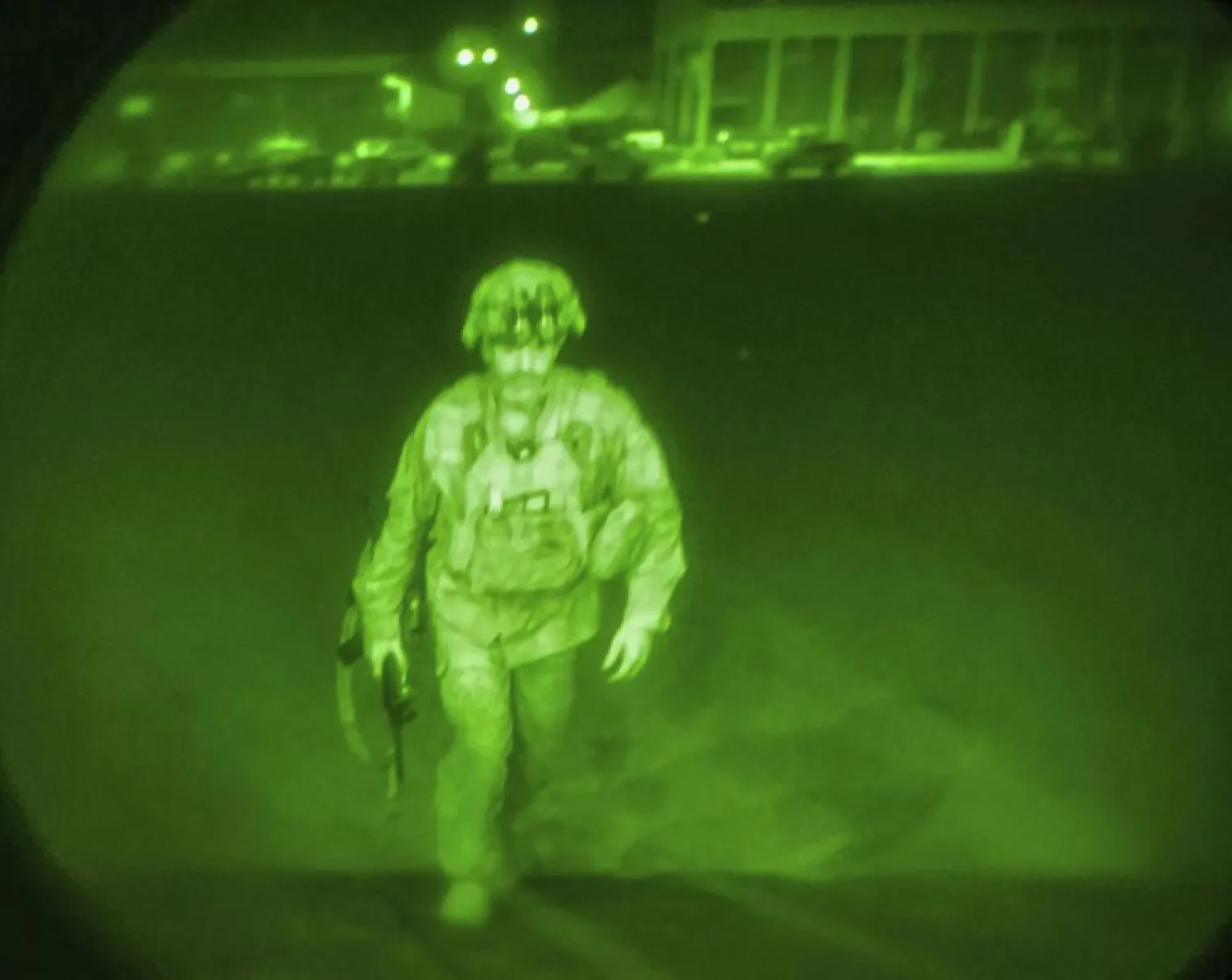
Last Troops Exit Afghanistan, Ending America’s Longest War

In this image made through a night vision scope and provided by the US Army, Maj. Gen. Chris Donahue, commander of the US Army 82nd Airborne Division, XVIII Airborne Corps, boards a C-17 cargo plane at Hamid Karzai International Airport in Kabul, Afghanistan, Monday, Aug. 30, 2021, as the final American service member to depart Afghanistan. (Master Sgt. Alexander Burnett/US Army via AP)
TT

Last Troops Exit Afghanistan, Ending America’s Longest War

In this image made through a night vision scope and provided by the US Army, Maj. Gen. Chris Donahue, commander of the US Army 82nd Airborne Division, XVIII Airborne Corps, boards a C-17 cargo plane at Hamid Karzai International Airport in Kabul, Afghanistan, Monday, Aug. 30, 2021, as the final American service member to depart Afghanistan. (Master Sgt. Alexander Burnett/US Army via AP)

The United States has completed its withdrawal from Afghanistan, ending America’s longest war and closing a chapter in military history likely to be remembered for colossal failures, unfulfilled promises and a frantic final exit that cost the lives of more than 180 Afghans and 13 US service members, some barely older than the war.

Hours before President Joe Biden’s Tuesday deadline for shutting down a final airlift, and thus ending the US war, Air Force transport planes carried a remaining contingent of troops from Kabul airport late Monday. Thousands of troops had spent a harrowing two weeks protecting the airlift of tens of thousands of Afghans, Americans and others seeking to escape a country once again ruled by Taliban militants.

In announcing the completion of the evacuation and war effort. Gen. Frank McKenzie, head of US Central Command, said the last planes took off from Kabul airport one minute before midnight in Kabul. He said some American citizens, likely numbering in “the very low hundreds,” were left behind, and that he believes they will still be able to leave the country.

Secretary of State Antony Blinken put the number of Americans still in Afghanistan at under 200, “likely closer to 100,” and said the State Department would keep working to get them out. He said the US diplomatic presence would shift to Doha, Qatar.

Jake Sullivan, Biden’s national security adviser, said Tuesday that the mission to get Americans out continues.

“It’s just that it has shifted from a military mission to a diplomatic mission,” Sullivan said on ABC’s “Good Morning America.” He cited “considerable leverage” over the Taliban to get Americans out.

Biden was set to address the nation on Afghanistan later Tuesday.

Biden said in a written statement Monday that military commanders unanimously favored ending the airlift, not extending it. He said he asked Blinken to coordinate with international partners in holding the Taliban to their promise of safe passage for Americans and others who want to leave in the days ahead.
The airport had become a US-controlled island, a last stand in a 20-year war that claimed more than 2,400 American lives.

The closing hours of the evacuation were marked by extraordinary drama. American troops faced the daunting task of getting final evacuees onto planes while also getting themselves and some of their equipment out, even as they monitored repeated threats — and at least two actual attacks — by the ISIS group’s Afghanistan affiliate. A suicide bombing on Aug. 26 killed 13 American service members and some 169 Afghans. More died in various incidents during the airport evacuation.

The final pullout fulfilled Biden’s pledge to end what he called a “forever war” that began in response to the attacks of Sept. 11, 2001, that killed nearly 3,000 people in New York, Washington and rural Pennsylvania. His decision, announced in April, reflected a national weariness of the Afghanistan conflict. Now he faces criticism at home and abroad, not so much for ending the war as for his handling of a final evacuation that unfolded in chaos and raised doubts about US credibility.

The US war effort at times seemed to grind on with no endgame in mind, little hope for victory and minimal care by Congress for the way tens of billions of dollars were spent for two decades. The human cost piled up — tens of thousands of Americans injured in addition to the dead.

More than 1,100 troops from coalition countries and more than 100,000 Afghan forces and civilians died, according to Brown University’s Costs of War project.

In Biden’s view the war could have ended 10 years ago with the US killing of Osama bin Laden, whose al-Qaeda extremist network planned and executed the 9/11 plot from an Afghanistan sanctuary. Al-Qaeda has been vastly diminished, preventing it thus far from again attacking the United States.

Congressional committees, whose interest in the war waned over the years, are expected to hold public hearings on what went wrong in the final months of the US withdrawal. Why, for example, did the administration not begin earlier the evacuation of American citizens as well as Afghans who had helped the US war effort?

It was not supposed to end this way. The administration’s plan, after declaring its intention to withdraw all combat troops, was to keep the US Embassy in Kabul open, protected by a force of about 650 US troops, including a contingent that would secure the airport along with partner countries. Washington planned to give the now-defunct Afghan government billions more to prop up its army.

Biden now faces doubts about his plan to prevent al-Qaeda from regenerating in Afghanistan and of suppressing threats posed by other extremist groups such as the ISIS group’s Afghanistan affiliate. The Taliban are enemies of the ISIS group but retain links to a diminished al-Qaeda.

The speed with which the Taliban captured Kabul on Aug. 15 caught the Biden administration by surprise. It forced the US to empty its embassy and frantically accelerate an evacuation effort that featured an extraordinary airlift executed mainly by the US Air Force, with American ground forces protecting the airfield. The airlift began in such chaos that a number of Afghans died on the airfield, including at least one who attempted to cling to the airframe of a C-17 transport plane as it sped down the runway.

By the evacuation’s conclusion, well over 100,000 people, mostly Afghans, had been flown to safety. The dangers of carrying out such a mission came into tragic focus last week when the suicide bomber struck outside an airport gate.

Speaking shortly after that attack, Biden stuck to his view that ending the war was the right move. The war’s start was an echo of a promise President George W. Bush made while standing atop of the rubble in New York City three days after hijacked airliners slammed into the twin towers of the World Trade Center.

Less than a month later, on Oct. 7, Bush launched the war. The Taliban’s forces were overwhelmed and Kabul fell in a matter of weeks. A US-installed government led by Hamid Karzai took over and bin Laden and his al-Qaeda cohorts escaped across the border into Pakistan.

The initial plan was to extinguish bin Laden’s al-Qaeda, which had used Afghanistan as a staging base for its attack on the United States. The grander ambition was to fight a “Global War on Terrorism” based on the belief that military force could somehow defeat extremism. Afghanistan was but the first round of that fight. Bush chose to make Iraq the next, invading in 2003 and getting mired in an even deadlier conflict that made Afghanistan a secondary priority until Barack Obama assumed the White House in 2009 and later that year decided to escalate in Afghanistan.

Obama pushed US troop levels to 100,000, but the war dragged on though bin Laden was killed in Pakistan in 2011.

When Donald Trump entered the White House in 2017 he wanted to withdraw from Afghanistan but was persuaded not only to stay but to add several thousand US troops and escalate attacks on the Taliban. Two years later his administration was looking for a deal with the Taliban, and in February 2020 the two sides signed an agreement that called for a complete US withdrawal by May 2021. In exchange, the Taliban made a number of promises including a pledge not to attack US troops.

Biden weighed advice from members of his national security team who argued for retaining the 2,500 troops who were in Afghanistan by the time he took office in January. But in mid-April he announced his decision to fully withdraw.

The Taliban pushed an offensive that by early August toppled key cities, including provincial capitals. The Afghan army largely collapsed, sometimes surrendering rather than taking a final stand, and shortly after President Ashraf Ghani fled the capital, the Taliban rolled into Kabul and assumed control on Aug. 15.

Some parts of the country modernized during the US war years, and life for many Afghans, especially women and girls, improved measurably. But Afghanistan remains a tragedy, poor, unstable and with many of its people fearing a return to the brutality the country endured when the Taliban ruled from 1996 to 2001.


Russia Says French Troops in Ukraine a ‘Direct Participation’ in War

Russian Foreign Minister Sergei Lavrov attends a joint press conference with the Secretary General of the Collective Security Treaty Organization (CSTO) Taalatbek Masadykov following the Joint Meeting of the CSTO Council of Foreign Ministers, Council of Ministers of Defense and Committee of Secretaries of Security Councils during the International Collective Security Forum in Moscow, Russia 10 November 2026. (EPA)
TT

Russia Says French Troops in Ukraine a ‘Direct Participation’ in War

Russian Foreign Minister Sergei Lavrov attends a joint press conference with the Secretary General of the Collective Security Treaty Organization (CSTO) Taalatbek Masadykov following the Joint Meeting of the CSTO Council of Foreign Ministers, Council of Ministers of Defense and Committee of Secretaries of Security Councils during the International Collective Security Forum in Moscow, Russia 10 November 2026. (EPA)

Russia said Tuesday it was aware of French troops having been sent to Ukraine, calling it "direct participation" in the war and saying a message had been issued to Paris.

"Not only French ones, we know this. We have conveyed our concern... this is no longer support for Ukraine, but direct participation in the war," Foreign Minister Sergei Lavrov told reporters.

His remarks come a day after a source told AFP and other media that French soldiers had been operating in Ukraine for several months to train Ukrainian personnel and help maintain equipment.

France on Tuesday rejected Lavrov's claim that the deployment amounted to "direct participation" in the Ukraine war as "absurd".

There is a "very limited" deployment of French troops in Ukraine for training and equipment maintenance, deputy defense minister Alice Rufo told parliament.

"There is the absence of any intention to fight, contrary to what the Russian foreign minister said this morning, which is absurd."

A source told AFP earlier the mission of a small contingent of French troops excludes any combat role.

They spoke on condition of anonymity after Radio France Internationale (RFI) first revealed the presence of French troops in the war-torn country earlier Monday.

"The rotation of French trainers supporting Ukraine in France, Poland, or occasionally in Ukraine is a reality," the source told AFP.

"But this is not a military operation. There is absolutely no intention of engaging in coercive actions."


US Attacks Iran’s Qeshm Island in Strait of Hormuz

An aerial view of the Iranian shores and the island of Qeshm in the Strait of Hormuz, December 10, 2023. (Reuters)
TT

US Attacks Iran’s Qeshm Island in Strait of Hormuz

An aerial view of the Iranian shores and the island of Qeshm in the Strait of Hormuz, December 10, 2023. (Reuters)

The United States on Tuesday carried out several attacks on Iran's southern Island of Qeshm, located in the Strait of Hormuz, a local Iranian official said.

"The American attack on locations on Qeshm island caused no damage to residential, commercial, or infrastructural areas," said Ahmad Nafisi, deputy provincial governor of the southern province of Hormozgan, quoted by the official IRNA news agency.

"The situation on Qeshm island is under control, and all relief, service, and executive agencies are on full alert," he added.

"The sounds of five to six explosions were heard on Qeshm on Tuesday evening," IRNA said.

Earlier in the day Iran's Revolutionary Guards said they had launched a drone attack targeting a radar system in Bahrain operated by the United States.

Since the outbreak of the Middle East war in late February, Tehran has attempted to restrict traffic through the strategic waterway, insisting vessels use only routes authorized by the country.

It has regularly targeted ships that transit without its authorization.

The United States has in response imposed a naval blockade on Iranian ports and helped tankers travel the strait, which normally carries about one-fifth of global oil supplies.

In recent weeks, Tehran has made multiple announcements saying ships have caught fire in the strait, often claiming they struck mines.

On Tuesday, the Iranian armed forces said three oil tankers struck naval mines while attempting to transit Hormuz.

The US military recently said it had cleared all mines from the main routes through the waterway.

US Central Command, which oversees US military operations in the region, said last month that it had helped Gulf countries export 1.5 billion barrels of oil via Hormuz since the summer.


4 Detained in North Macedonia for Alleged Iran-Backed Assassination Plot in Greece

Domestic security agency director Bojan Hristovski speaks to media after announcing the detention of four people implicated in an alleged Iran-backed assassination plot in neighboring Greece, in Skopje, North Macedonia, Tuesday, Nov. 17, 2026. (AP)
TT

4 Detained in North Macedonia for Alleged Iran-Backed Assassination Plot in Greece

Domestic security agency director Bojan Hristovski speaks to media after announcing the detention of four people implicated in an alleged Iran-backed assassination plot in neighboring Greece, in Skopje, North Macedonia, Tuesday, Nov. 17, 2026. (AP)

Authorities in North Macedonia have detained four people for questioning over an alleged Iran-linked assassination plot in neighboring Greece, officials said Tuesday.

Bojan Hristovski, director of North Macedonia's domestic security agency, said Tuesday that the suspects are all Macedonian citizens, adding that a fifth person had also been questioned and a sixth remained wanted by the authorities.

Hristovski named one of the Iranian recruiters as Naji Sharifi Zindashti, who is wanted in the United States for allegedly operating a criminal network that targets Iranian dissidents and activists abroad.

He did not give details of the alleged target in Greece, and Greek authorities did not immediately comment on the announcement.

“This concerns the dismantling of an Iranian proxy network involved in planning a terrorist attack,” Hristovski said.

“The network operating in Macedonia consisted of individuals embedded in criminal organizations within the country,” he said. “Acting on direct instructions from an Iranian national, they undertook preparatory and logistical activities for a terrorist act — an assassination targeting a previously identified individual located in Greece.”

Iran's mission to the United Nations did not immediately respond to a request for comment.