MoU Aims to Invest in Saudi Education Sector

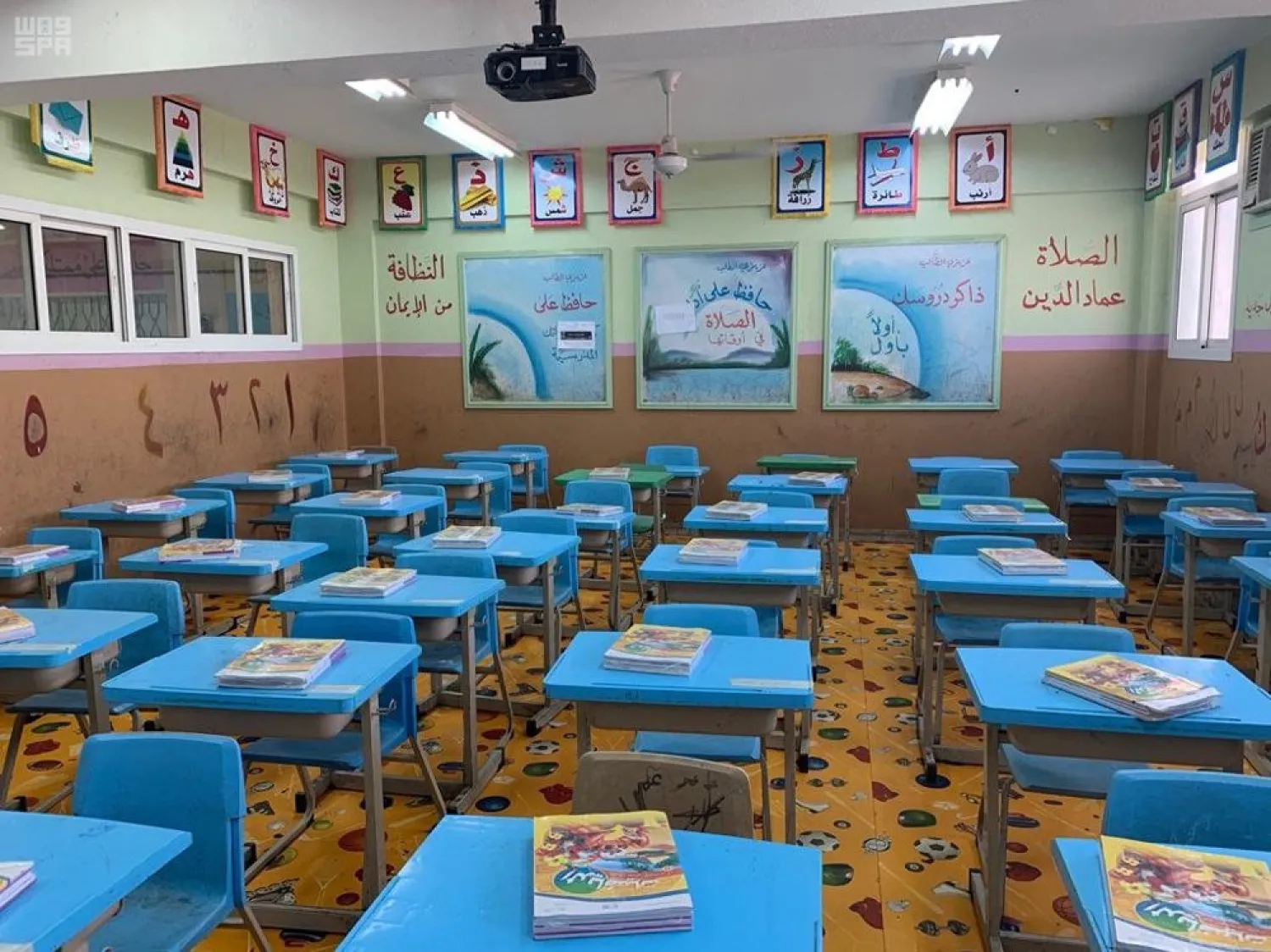
A classroom in Tabuk is readied for the new school year. (SPA)
TT

MoU Aims to Invest in Saudi Education Sector

A classroom in Tabuk is readied for the new school year. (SPA)

The Saudi Ministry of Education, represented by the General Department of Investment and Privatization, signed a memorandum of understanding (MoU) with the Projects Support Fund initiative at the Ministry of Finance.

The MoU aims to expand the scope of lending in the education sector and develop procedures to complete new and existing educational projects in line with Vision 2030.

The agreement includes cooperation in developing additional incentives for loans in the education sector to increase the investment attractiveness of significant projects and apply distinguished financial standards.

It also targets developing and improving procedures by sharing expertise, information, and business and processing funding requests, which increases the efficiency of support to increase competitiveness in the education sector.

The agreement aims to improve the environment and educational facilities, raise the competitiveness of the sector by maximizing its economic impact and provide funding for priority educational projects.

The Ministries of Education and Finance will exchange expertise in implementing joint initiatives, as per the MoU, to bolster the Ministry of Education’s role in supporting the use of local content in its projects.

The Project Support Fund is one of the initiatives of the Ministry of Finance’s stimulus packages, with a capital of SR10 billion allocated to provide financing and support for significant projects in the health, education, and real estate development sectors.


Saudi Central Bank Governor Says National Model Has Shielded Economy from Shocks

Saudi Central Bank Governor Ayman Alsayari. (International Monetary Fund)
TT

Saudi Central Bank Governor Says National Model Has Shielded Economy from Shocks

Saudi Central Bank Governor Ayman Alsayari. (International Monetary Fund)

Saudi Arabia’s economy has emerged as a model of resilience and crisis readiness, Central Bank Governor Ayman Alsayari said, citing steady progress under the Kingdom’s Vision 2030 reform agenda.

He stressed that continued implementation of the plan has helped protect the economy from regional shocks, underpinned by solid growth, contained inflation and prudent monetary and fiscal policies.

This strength, he noted, reflects decades of structural reforms and strategic investment in infrastructure and institutions, equipping the Kingdom with the capacity and flexibility to absorb shocks while sustaining investor and consumer confidence.

Addressing the International Monetary and Financial Committee of the International Monetary Fund, chaired by Saudi Finance Minister Mohammed Al-Jadaan, Alsayari highlighted the importance of Saudi Arabia’s diversified energy and trade infrastructure in maintaining supply flows under pressure.

He pointed to long-term investments such as the East-West pipeline, which runs to Red Sea ports in Yanbu, describing it as a vital artery for both Saudi exports and global energy supplies.

The ability to reroute exports and secure access to Red Sea ports and strategic facilities, he said, underscores the importance of long-term planning in preventing supply disruptions.

It also reinforces the need to treat energy security as integral to global financial stability, while avoiding policies that sideline the role of fossil fuels in sustaining trade and growth.

Alsayari warned that the war in the Middle East poses a serious test for the global economy and could revive conditions reminiscent of the stagflation era of the 1970s.

He welcomed progress on the “Diriyah Guiding Principles,” describing them as a milestone in efforts to reform IMF governance after nearly two decades of stagnation. The principles, reflecting the Diriyah Declaration, combine realism and ambition and provide a basis for strengthening the fund’s representation of the global economy.

Alsayari said that the step is essential to enabling the IMF to carry out its core functions in surveillance and lending, while keeping pace with technological shifts such as artificial intelligence and digital assets, and safeguarding the international monetary system against geopolitical risks and stagflation.

Saudi Arabia is translating its economic gains into tangible international support, including a $279 million pledge for IMF capacity development and the opening of a regional office in Riyadh to strengthen cooperation with countries in the region and beyond, Alsayari added.

He also cited platforms such as the AlUla Conference on Emerging Market Economies as tools to share expertise and advance reforms that support resilience and long-term growth.


IEA Proposes Building Iraq-Türkiye Pipeline to Bypass Hormuz

A general view of oil tanks at Türkiye's Mediterranean port of Ceyhan, February 19, 2014. (Reuters)
TT

IEA Proposes Building Iraq-Türkiye Pipeline to Bypass Hormuz

A general view of oil tanks at Türkiye's Mediterranean port of Ceyhan, February 19, 2014. (Reuters)

International Energy Agency Executive Director Fatih Birol proposed building a new oil pipeline linking Iraq’s Basra oil fields and Türkiye’s Mediterranean oil terminal in Ceyhan to bypass the Strait of Hormuz, according to Turkish newspaper Hürriyet.

“I believe a Basra-Ceyhan pipeline could be extremely attractive and a very important project for both Iraq and Türkiye, as well as for regional supply security, especially from Europe’s perspective,” Birol said in an interview with the newspaper.

“I also believe the financing issue can be overcome. Now is exactly the right time.”

He said, “The vase has been broken once, and it is very difficult to fix,” referring to the Strait of Hormuz.

A new oil pipeline “is a necessity for Iraq and an opportunity for Türkiye. It is also a major opportunity for Europe in terms of supply security. I think this should be considered a strategic project,” Birol added.

The war on Iran has disrupted shipping through the Strait of Hormuz, the strategic choke point through which 20% of the world’s oil supply flows, bringing global economic pain in the form of higher prices for gasoline, fertilizer and other staples.

Iraq and Türkiye share the Kirkuk-Ceyhan pipeline, a strategic corridor for transporting crude oil from northern Iraq to the Turkish port of Ceyhan, which began operation in 1976.

Iraq is seeking to rehabilitate the pipeline to overcome export problems, proposing to establish a new line from Basra to Ceyhan as a safe alternative to the Strait of Hormuz and to boost European energy security. On Sunday, Birol suggested building the new line.


Taiwan Business Group Urges Beijing, Taipei to Keep Politics Out of Trade

A person looks at a stock market graph inside the Taiwan Stock Exchange in Taipei, Taiwan, 20 April 2026. (EPA)
TT

Taiwan Business Group Urges Beijing, Taipei to Keep Politics Out of Trade

A person looks at a stock market graph inside the Taiwan Stock Exchange in Taipei, Taiwan, 20 April 2026. (EPA)

The head of one of Taiwan's top business groups said on Monday both Beijing and Taipei should leave politics out of resuming normal trade and tourism exchanges, after China unveiled new incentives for the island.

China, which views democratically-governed Taiwan as its own territory, announced measures this month which include easing tourism curbs and food imports, but said they had to be based on "opposing Taiwan independence".

China refuses to talk to Taiwan President Lai ‌Ching-te saying he ‌is a "separatist", and has stepped up political and economic ‌pressure ⁠in recent years, ⁠targeting tourism and imports of food, as well as holding regular war drills.

"As soon as there is an opening up, it should be as much as possible be systematic and normalized to maintain the long-term stability of business and trade exchanges," said Paul Hsu, chairman of the General Chamber of Commerce.

Flanked by representatives of the tourist and food sectors, he ⁠urged China to ensure stability in trade ties ‌rather than sudden stops and starts, in ‌comments to reporters in Taipei.

No matter which political party runs a city ‌or county, China should offer equal treatment, especially in southern Taiwan, ‌Hsu added, referring to a stronghold of Lai's Democratic Progressive Party.

China's Taiwan Affairs Office did not immediately respond to a request for comment.

China's new steps came at the end of a visit to Beijing by Taiwan opposition leader Cheng Li-wun, ‌which she described as a journey of peace, on which she met President Xi Jinping.

Taiwan's government should ⁠also "proactively face" China's offers ⁠of opening up, Hsu's group, which represents more than a million companies, said in a statement accompanying the remarks.

Group members' votes would go to whoever was good for Taiwan industry, Hsu said, adding that he was representing non-partisan industry voices.

"As long as you put forth good policies, we will offer support. But if you stand against us, I'm sorry, I can't support you. We have a vote - we are a democratic society."

Taiwan will hold key local elections in November, with the next presidential vote scheduled for early 2028.

On Sunday, Taiwan's China-policy making Mainland Affairs Council said the government would address the "reasonable demands" of industry, but warned it not to "become tools manipulated and exploited by the Chinese communists".