


Egypt Team Identifies Fossil of Land-roaming Whale Species

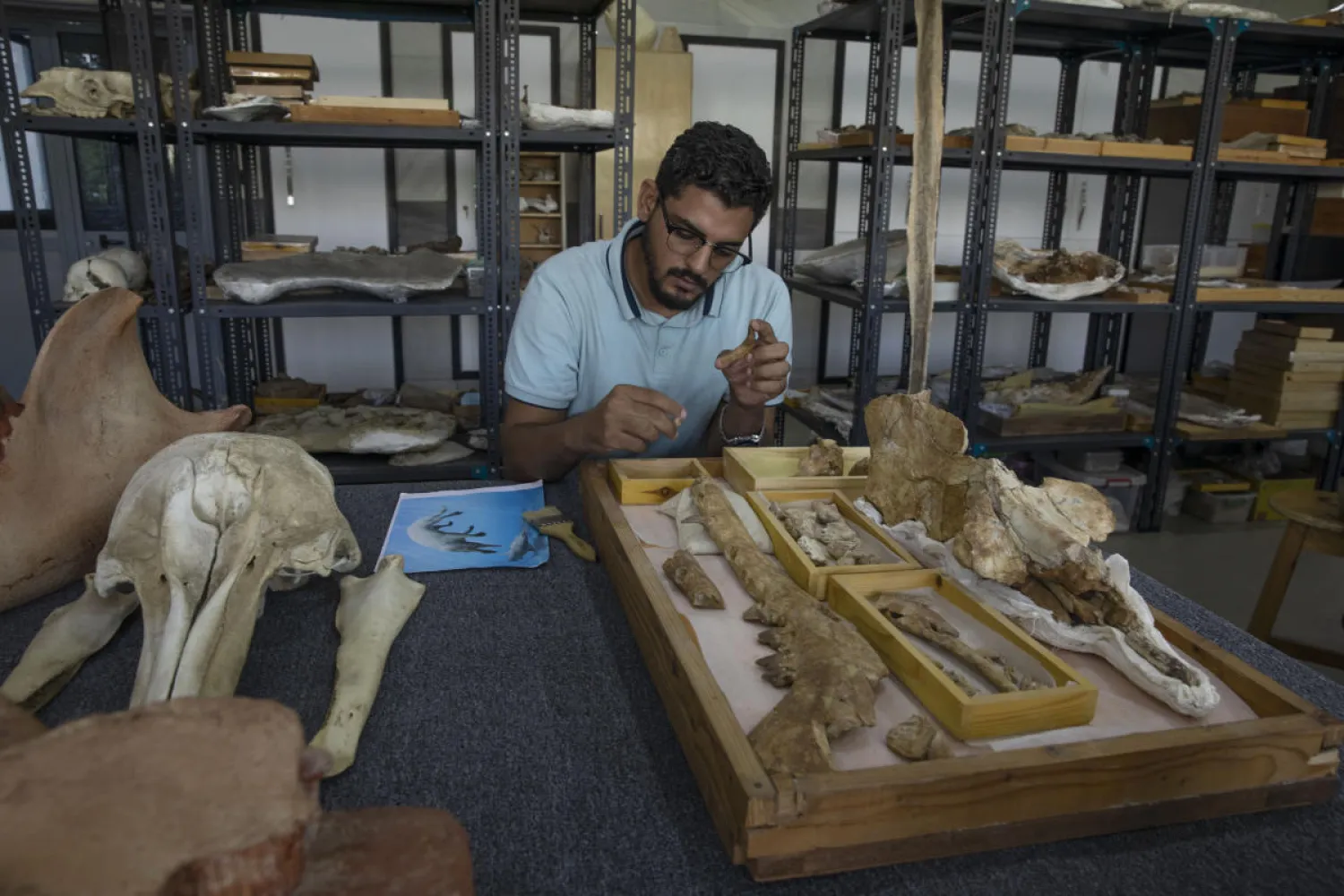
Egyptian researcher at Mansoura University Abdullah Gohar, shows the fossil of a 43 million-year-old four-legged prehistoric whale known as the "Phiomicetus Anubis," in an evolution of whales from land to sea, which was unearthed over a decade ago in Fayoum in the Western Desert of Egypt, at the university's paleontology department lab, in the Nile Delta city of Mansoura, 110 kilometers north of Cairo, Egypt, Sunday, Sept. 12, 2021. (AP Photo/Nariman El-Mofty)
TT

Egypt Team Identifies Fossil of Land-roaming Whale Species

Egyptian researcher at Mansoura University Abdullah Gohar, shows the fossil of a 43 million-year-old four-legged prehistoric whale known as the "Phiomicetus Anubis," in an evolution of whales from land to sea, which was unearthed over a decade ago in Fayoum in the Western Desert of Egypt, at the university's paleontology department lab, in the Nile Delta city of Mansoura, 110 kilometers north of Cairo, Egypt, Sunday, Sept. 12, 2021. (AP Photo/Nariman El-Mofty)

Egyptian scientists say the fossil of a four-legged prehistoric whale, unearthed over a decade ago in the country's Western Desert, is that of a previously unknown species. The creature, an ancestor of the modern-day whale, is believed to have lived 43 million years ago.

The prehistoric whale, known as semi-aquatic because it lived both on land and sea, sported features of an accomplished hunter, the team’s leading paleontologist, Hesham Sallam, told The Associated Press — features that make it stand out among other whale fossils.

The fossil was first found by a team of Egyptian environmentalists in 2008 in an area that was covered by seas in prehistoric times, but researchers only published their findings confirming a new species last month.

Sallam said that his team did not start examining the fossil until 2017 because he wanted to assemble the best and the most talented Egyptian paleontologists for the study.

“This is the first time in the history of Egyptian vertebrate paleontology to have an Egyptian team leading a documentation of a new genus and species of four-legged whale," said Sallam.

The fossil sheds light on the evolution of whales from herbivore land mammals into carnivorous species that today live exclusively in water. The transition took place over roughly 10 million years, according to an article published on the discovery in the journal Proceedings of the Royal Society B.

Egypt's Western Desert region is already known for the so-called Whale Valley, or Wadi Al-Hitan, a tourist attraction and the country's only natural World Heritage site that contains fossil remains of another type of prehistoric whales.

The newly discovered creature belongs to the family of Protecetids, extinct semi-aquatic whales that lived from 59 to 34 million years ago, Sallam said. It would have walked on land but also hunted in the water.

“This is yet another new species of early whales from the time when they retained four functional limbs,” said Jonathan Geisler, an expert on the evolutionary history of mammals with New York Institute of Technology.

He said that the location of the discovery in Egypt is also a clue as to when and how they spread around the globe. Geisler was not involved in the find.

The oldest fossil whales are about 50 million years old and are believed to have originated in modern-day Pakistan and India. However, scientists have not been able to reach a conclusive answer as to when whales moved out of their point of origin to all the world’s oceans.

“This new species by itself cannot answer that question, but when viewed in the context of other fossil discoveries, suggests that this dispersal occurred 43 million years ago,” said Geisler, adding the new find could possibly serve as a link between Indo-Pakistan and North American regions.

The fossil whale has been named Phiomicetus Anubis, after the god of death in ancient Egypt.

“We chose the name Anubis because it had a strong and deadly bite,” said Sallam, professor of paleontology at Mansoura University in Egypt. “It could kill any creature it crossed paths with.”

The new species stands out for its elongated skull and snout that suggest it was an efficient carnivore capable of grasping and chewing its prey, he said. It was about 3 meters and weighed around 600 kilograms, according to researchers. It is also believed to have had sharp hearing and sense of smell.

The discovery followed a four-year collaboration between Egyptian paleontologists and US-based scientists, Sallam added.

His team has previously made headlines worldwide with their 2018 discovery of Mansourasaurus, a new species of long-necked herbivorous dinosaurs that lived in the Nile Delta province of Mansoura.




Spain and Portugal Continue to Battle Storm Leonardo as New Storm Approaches

 A mountain landslide blocks railway tracks during heavy rains, as storm Leonardo hits parts of Spain, in Benaojan, Spain, February 6, 2026. (Reuters)
A mountain landslide blocks railway tracks during heavy rains, as storm Leonardo hits parts of Spain, in Benaojan, Spain, February 6, 2026. (Reuters)
TT

Spain and Portugal Continue to Battle Storm Leonardo as New Storm Approaches

 A mountain landslide blocks railway tracks during heavy rains, as storm Leonardo hits parts of Spain, in Benaojan, Spain, February 6, 2026. (Reuters)
A mountain landslide blocks railway tracks during heavy rains, as storm Leonardo hits parts of Spain, in Benaojan, Spain, February 6, 2026. (Reuters)

Storm Leonardo continued to batter the Iberian Peninsula on Friday, bringing floods and putting rivers at risk of bursting their banks while thousands of people were evacuated from their homes in Spain and Portugal.

In southern Spain's Andalusia region, some 7,000 people have had to leave their homes due to successive storms.

Among them were around 1,500 people ordered to evacuate the mountain village of Grazalema, where Andalusia's regional leader Juan Manuel Moreno warned that aquifers were "full to the brim with water,” and at risk of collapsing.

“It's raining on already saturated ground. The land is unable to drain," Moreno said. “We urge extreme caution. This is not over.”

Spanish police said Friday they had found a body located 1,000 meters (about 0.6 miles) away from where a woman had disappeared Wednesday after she fell into a river in Malaga province while trying to rescue her dog. Police said they had not yet identified the body, but believed it belonged to the 45-year-old woman.

Another storm front, Marta, was expected to arrive Saturday, with Spain's weather agency AEMET saying it would bring even more rain and heavy winds, including to areas already drenched by Storm Leonardo.

Marta is expected to affect Portugal, too.

Of particular concern was southern Spain's Guadalquivir River, which flows through Córdoba and Seville and eventually into the Atlantic Ocean, and whose water levels have dramatically risen in recent days.

Additional rain Saturday could leave many more homes at risk in Córdoba, local authorities warned.

In Portugal, parts of Alcacer do Sal were submerged after the Sado River overflowed, forcing residents to leave the city located 90 kilometers (about 56 miles) south of Lisbon.

Alerts were issued also for regions near the Tagus River due to rising water levels.

A separate storm in late January left a trail of destruction in Portugal, killing several people, according to Portuguese authorities.


AROYA Cruises Debuts Arabian Gulf Voyages for 2026

AROYA offers a curated experience featuring culturally inspired entertainment and diverse dining options - SPA
TT

AROYA Cruises Debuts Arabian Gulf Voyages for 2026

AROYA offers a curated experience featuring culturally inspired entertainment and diverse dining options - SPA

AROYA Cruises, a subsidiary of the PIF-owned Cruise Saudi, has officially launched its inaugural season in the Arabian Gulf.

Running from February 21 to May 8, the season marks a milestone in regional tourism by blending authentic Saudi hospitality with international maritime standards, SPA reported.

AROYA offers a curated experience featuring culturally inspired entertainment and diverse dining options.

The season is designed to provide guests with a dynamic way to explore the Gulf, setting a new benchmark for luxury travel that reflects the Kingdom's heritage on a global stage.


Snowstorm Brings Much of Denmark to a Halt

A car drives in heavy snow at Store Heddinge in South Zealand, Denmark, 05 February 2026.  EPA/Mads Claus Rasmussen
A car drives in heavy snow at Store Heddinge in South Zealand, Denmark, 05 February 2026. EPA/Mads Claus Rasmussen
TT

Snowstorm Brings Much of Denmark to a Halt

A car drives in heavy snow at Store Heddinge in South Zealand, Denmark, 05 February 2026.  EPA/Mads Claus Rasmussen
A car drives in heavy snow at Store Heddinge in South Zealand, Denmark, 05 February 2026. EPA/Mads Claus Rasmussen

Denmark authorities halted public transport, closed schools and cancelled flights on Friday as heavy snowfall blanketed much of the country.

The Nordic country's meteorological institute DMI warned that heavy snow would likely continue until Friday evening in the east, where the capital Copenhagen is located.

Police said people should avoid going outdoors unless necessary and stay indoors in the capital and the surrounding region.

Copenhagen's airport cancelled flights to Paris and Berlin and warned of "delay and cancellation risks because of snowy conditions." Many schools were closed.

In the second-largest city of Aarhus, bus services were cancelled.