


Somali-American Supermodel Reinvents Modest Fashion

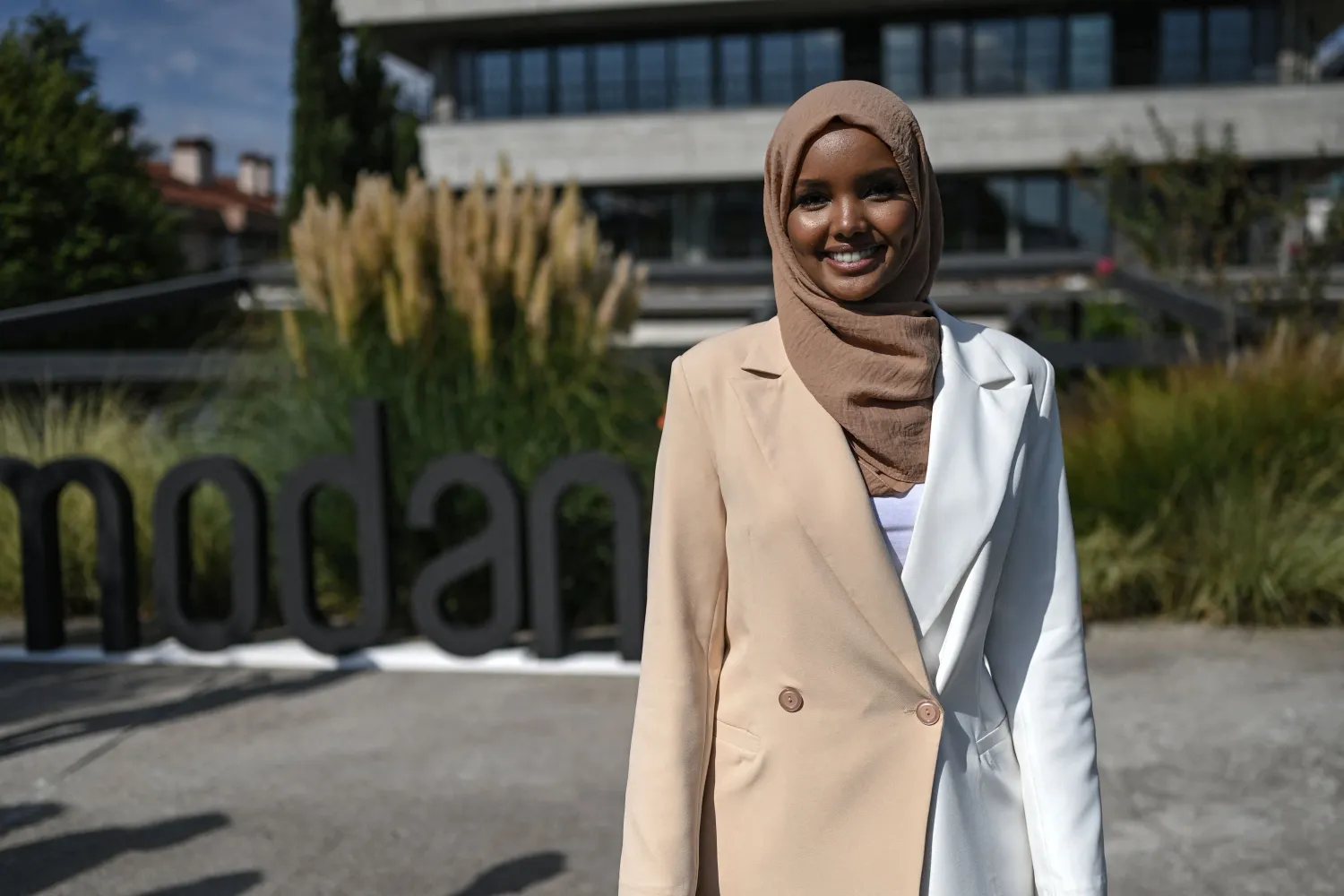
Somali-American former model Halima Aden poses for a photo, during an event in Istanbul, Turkey, Sept. 14, 2021. AFP
TT

Somali-American Supermodel Reinvents Modest Fashion

Somali-American former model Halima Aden poses for a photo, during an event in Istanbul, Turkey, Sept. 14, 2021. AFP

Halima Aden, the first supermodel to wear a hijab and pose in a burkini, has ripped up her lucrative contracts in an industry she feels lacks "basic human respect" and entered the world of modest fashion design instead.

For the Somali-American who was born in a refugee camp in Kenya, it was a matter of preserving her self-worth and well-being in a fast and loose sector that increasingly clashed with her Muslim values.

"Since I was a little girl, this quote -- 'don't change yourself, change the game' -- has gotten me through so much in life," she told AFP in an interview in Istanbul.

"When I took the decision to quit, that is exactly what I did," she said. "So I am very, very proud."

Aden's departure last November delivered a shock to fashionistas and Muslim influencers who have admired her trailblazing career.

Aden, who turns 24 on Sunday, broke ground in Minnesota, where she became the first contestant to wear a hijab and a burkini in a US state beauty pageant in 2016.

She posed in them again for Sports Illustrated's annual swimsuit issue when her fame was spreading in 2019.

But personally, Aden felt increasingly boxed in -- sometimes literally.

"I was always given a box, a private place to change in, but many times I was the only one given the privacy," she said.

"I got to see my fellow young women having to undress and change in public, in front of media personalities, cooks and staff, designers and assistants," she recalled.

"To me, it was very jarring," she said. "I couldn't be in an industry where there is no basic human respect."

Aden sounded liberated when she announced her decision to abandon photo shoots and catwalks last year. She is becoming a designer instead.

"Wow this is actually the most RELIEF I felt since I started in 2016. Keeping that in was literal POISON!" she said on Instagram.

She felt her traditions, starkly different from those of most other supermodels, were caricatured and turned into a gimmick by some brands.

One, American Eagle, replaced a headscarf with a pair of jeans on her head in a 2017 campaign.

"But... this isn't even my style??" she protested on Instagram at the time.

"I got to a place where I couldn't recognize my hijab the way I would traditionally wear it," Aden told AFP.

Aden looked far more at ease in Istanbul, surrounded by Middle Eastern fashionistas while attending an event organized by Modanisa, her new home.

She will be designing collections exclusively for the Turkish online brand, which is one of the biggest names in the modest fashion industry, valued at $277 billion in 2019.

It already makes up more than a tenth of the $2.2 trillion global fashion industry, with plenty of room to grow, according to DinarStandard, an advisory firm specializing in emerging Muslim markets.

World capitals as diverse as Moscow, Riyadh and London have staged modest fashion shows in the past few years.

Soft-spoken but smiley, Aden sounds confident in modest fashion's ability to withstand crises like the coronavirus pandemic and changing fads.

"It is the oldest fashion staple, it's been around for hundreds of years, it will continue to be around for hundreds of years," she said.

Islam and fashion "are 100 percent compatible because there's nothing in our religion that says you can't be fashionable," she said.

Luxury brands such as DKNY and Dolce & Gabbana have already picked up on the trend, creating collections catered to modest women.

But Aden hit out at "a lot of tokenism, especially in the fashion industry, where they want our money but they don't want to support us in the issues that we are faced with."

"I think fashion needs to do a greater job," she said. "You are representing your clients who are Muslims, it is important to speak up when they are faced with injustices."



NASA to Wear Prada as Luxury Group Pushes Into Space Industry

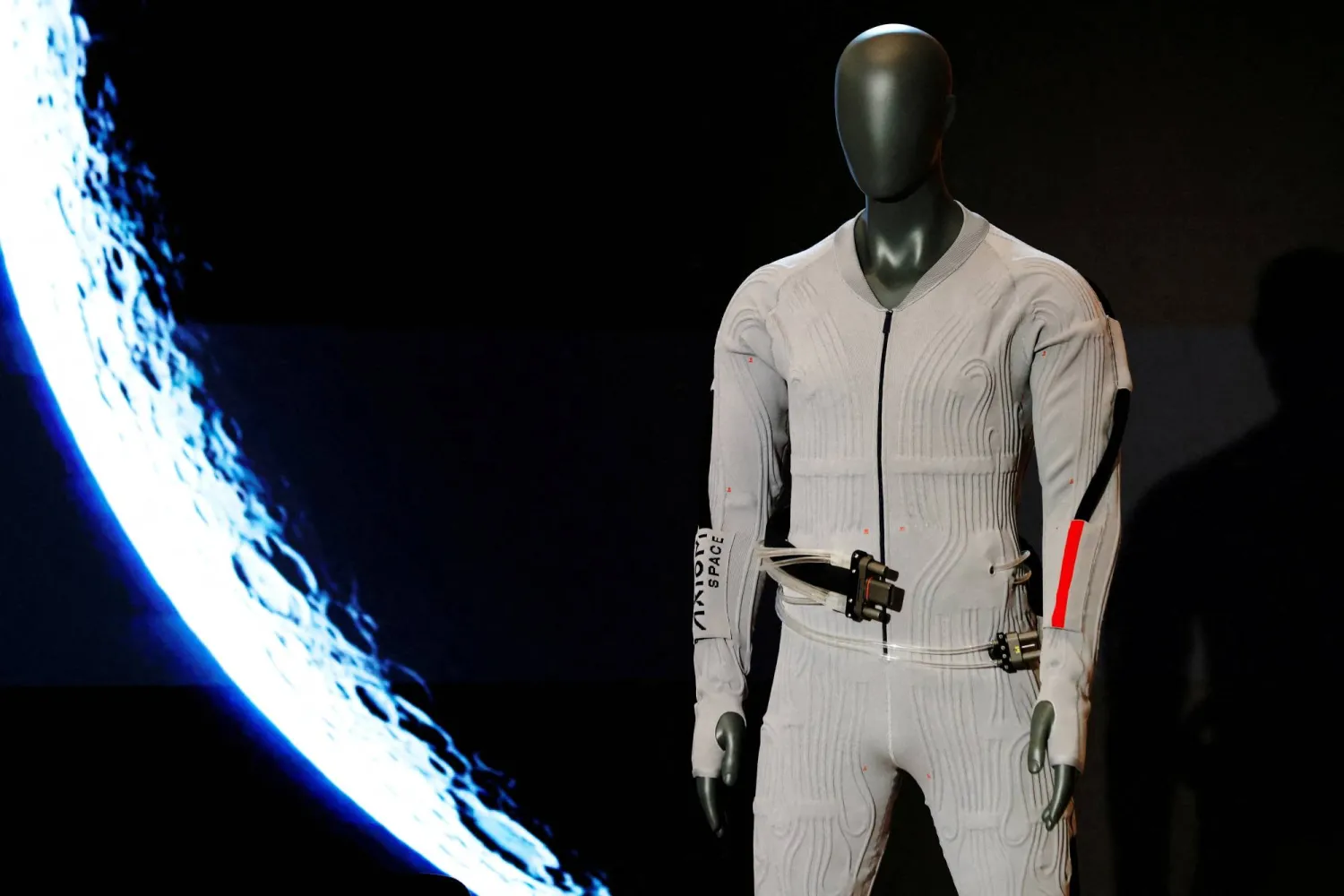
The inner-layer liquid cooling and ventilation garment designed by Prada and Axiom Space is unveiled at a press event in New York City, US, June 7, 2026. REUTERS/Heather Khalifa
TT

NASA to Wear Prada as Luxury Group Pushes Into Space Industry

The inner-layer liquid cooling and ventilation garment designed by Prada and Axiom Space is unveiled at a press event in New York City, US, June 7, 2026. REUTERS/Heather Khalifa

Italian fashion house Prada unveiled on Sunday the inner-layer garment set to be worn by NASA astronauts heading into space, underscoring the brand's push to be the first major luxury player to make inroads in the space industry.

The body-hugging suit, created in collaboration with Houston-based space infrastructure developer Axiom Space, features ventilation tubes knitted into the garment.

"We have really a broad spectrum of capability and know-how," Lorenzo Bertelli, Prada's chief marketing officer, said at an event at Prada's Manhattan store, sitting beside a mannequin donning the new Liquid Cooling and Ventilation Garment.

Expertise for developing space exploration products "can come from lots of seemingly unrelated industries," Reuters quoted Jonathan Cirtain, CEO of Axiom Space, as saying.

The new product follows Prada's splashy foray into space fashion in 2024 with the ⁠unveiling of a ⁠spacesuit that is expected to be used for NASA's Artemis 3 Earth orbit, set to launch in 2027, and the anticipated Artemis 4 moon landing in 2028. Luxury brands have long drawn inspiration from space travel.

But Prada has gone "beyond inspiration into an actual partnership" as the space exploration and tourism industries develop, said Thomai Serdari, a luxury brand strategist and marketing professor at New York University's Stern ⁠School of Business. Serdari pointed to two factors motivating Prada's interest in the space industry: to gain access to affluent consumers who are contemplating space travel, and to align the brand with avant-garde thought.

Companies from Jeff Bezos' Blue Origin to Elon Musk's SpaceX have leaned into space tourism for the wealthy.

The resumption of space exploration and human travel to the moon is "bound to attract a lot of eyeballs," said Luca Solca, global head of luxury goods at Bernstein. Luxury brands need to stay relevant and visible, he said. Prada's push comes against a backdrop of a struggling luxury goods sector.

After two years of contraction, the ⁠industry was showing signs ⁠of stabilization until the Iran war began at the end of February, disrupting travel and denting luxury spending far beyond the Middle East.

WILL LUXURY PEERS FOLLOW? Other fashion and apparel companies have jumped on the space bandwagon. Under Armour has partnered with spaceflight company Virgin Galactic to create space apparel, while Columbia Sportswear has worked with space exploration company Intuitive Machines on space fabric technology.

But it remains unclear whether other luxury players might follow Prada's lead. "In luxury, it is important to be the first to do something, to be a trend-setter," Serdari said, noting that LVMH's Louis Vuitton, Hermès and Chanel are all interested in space travel but that they would likely find new ways to make inroads.

"You will never see the upper crust of the luxury sector copying each other," she added.


Lululemon Slides as Bleak Forecasts Deepen Turnaround Worries

FILE PHOTO: A logo is displayed inside a Lululemon outlet retail store at Bicester Village in Oxfordshire, Britain, August 21, 2024. REUTERS/Hollie Adams/File Photo
TT

Lululemon Slides as Bleak Forecasts Deepen Turnaround Worries

FILE PHOTO: A logo is displayed inside a Lululemon outlet retail store at Bicester Village in Oxfordshire, Britain, August 21, 2024. REUTERS/Hollie Adams/File Photo

Lululemon Athletica shares dropped 12% in ‌premarket trade on Friday after bleak quarterly and annual profit outlooks deepened concerns over the yoga apparel maker's turnaround amid slowing US demand, competition and tariff costs.

The stock is on track to lose more than $1.7 billion from its market value of $14.44 billion if losses hold.

The weak forecasts intensified pressure on the stock, which has lost nearly 63% of its value in the last 12 months, as investors question how quickly Lululemon can revive product momentum in its ‌key US market, ‌while competing with newcomers like Alo Yoga ‌and ⁠Vuori.

"Lulu has just ⁠entered the 'trap' phase, where fundamentals are deteriorating as competition in all categories remains stiff and pricing power is fleeting for its core franchises," Barclays analysts said.

Lululemon, known for its pricey leggings and athleisure wear, has joined peers in feeling the pinch from muted spending on higher-margin products. Waning brand ⁠appeal in North America, design missteps and a ‌lack of fresh styles ‌have also added to the pressure amid a leadership transition.

Investors are ‌watching whether incoming CEO Heidi O'Neill, a former executive ‌at struggling Nike, can revive sales after she takes over in September, a task eased by the May resolution of a months-long proxy fight with founder Chip Wilson that had weighed on ‌the stock.

"A full strategic reset under the new CEO is required," Jefferies analysts said.

NEGATIVE BRAND ⁠BUZZ ADDS ⁠WORRIES

Meghan Frank, interim co-CEO and chief financial officer, said its yoga campaign rolled out to win back shoppers "hasn't had the expected halo effect on other areas of our assortment" and cited "negative commentary" as a headwind.

The spike in negative brand sentiment across media and social channels was evident in key markets, Barclays said, including the United States and China, and was primarily related to recent concerns about material composition and product safety.

The company's forward price-to-earnings multiple is 10.06, compared with 22.85 for Nike and 15.10 for Adidas , according to LSEG data.


Designer Gabriela Hearst Still Believes in 'Brilliance of Humanity' Despite AI

Uruguayan-US fashion designer Gabriela Hearst gestures during an interview after presenting the official suits for Uruguay's national football team ahead of the 2026 FIFA World Cup at the Centenario Stadium in Montevideo, on June 2, 2026. (Photo by Eitan ABRAMOVICH / AFP)
TT

Designer Gabriela Hearst Still Believes in 'Brilliance of Humanity' Despite AI

Uruguayan-US fashion designer Gabriela Hearst gestures during an interview after presenting the official suits for Uruguay's national football team ahead of the 2026 FIFA World Cup at the Centenario Stadium in Montevideo, on June 2, 2026. (Photo by Eitan ABRAMOVICH / AFP)

The "brilliance of humanity" will matter more, not less, in an AI world, Uruguayan designer Gabriela Hearst told AFP in an interview.

Natural materials and handmade craftsmanship are the hallmarks of Hearst's luxury brand, whose commitment to environmentally friendly fashion has secured her status as a sustainable style icon.

With celebrities including Kate Middleton, Julia Roberts and former US first lady Jill Biden wearing her personal brand, Hearst was also the first Latin American woman to lead the French fashion house Chloe from 2020 to 2023.

In a world threatened by climate crisis and the emergence of artificial intelligence, "there will be a genuine need for handmade creation," Hearst told AFP during a recent trip to Montevideo to present World Cup uniforms to the Uruguayan team.

"The human part, the part of our brain that is unique to us, the part that represents the brilliance of humanity, is going to matter more and more," she said.

The designer on the cusp of 50 prizes quality over quantity, and obstinately opposes fast fashion fads.

"There are so many clothes in the world," she said. "There's always a way to have a small amount, but of good quality."

Now based in New York, Hearst said she owes her intimate knowledge of quality, sustainability and "true beauty" to her native Uruguay.

"When I was little, I wanted to go travel, to see the world," she said.

"After traveling," she continued, "I was able to appreciate what it means to grow up with those star-filled skies, the nature, eating food from the land, the quality, the natural luxury that surrounded me."

"Clothes were passed down" in Hearst's community, she said, recalling picking through her mother's wardrobe filled with garments made by the family seamstress.

In her native country of 3.4 million people, hundreds of weavers work for Manos del Uruguay, a network of cooperatives that produces handcrafted garments for Hearst's brand.

The finished products end up on runways, Vogue magazine covers and even on-screen in "Sex and the City" movie sequel, where a multi-colored blanket designed by Hearst appears draped over Sarah Jessica Parker's legs.

"It's incredible that our craftsmanship reaches so far," said 60-year-old weaver Mabel Bargas, who works in one of the Manos del Uruguay workshops.

Hearst wants to leave a legacy of positive social impact by creating jobs and doing her bit for the environment.

"We can't afford to lose our human connection," she said, adding that people with privilege "have a responsibility to help others."