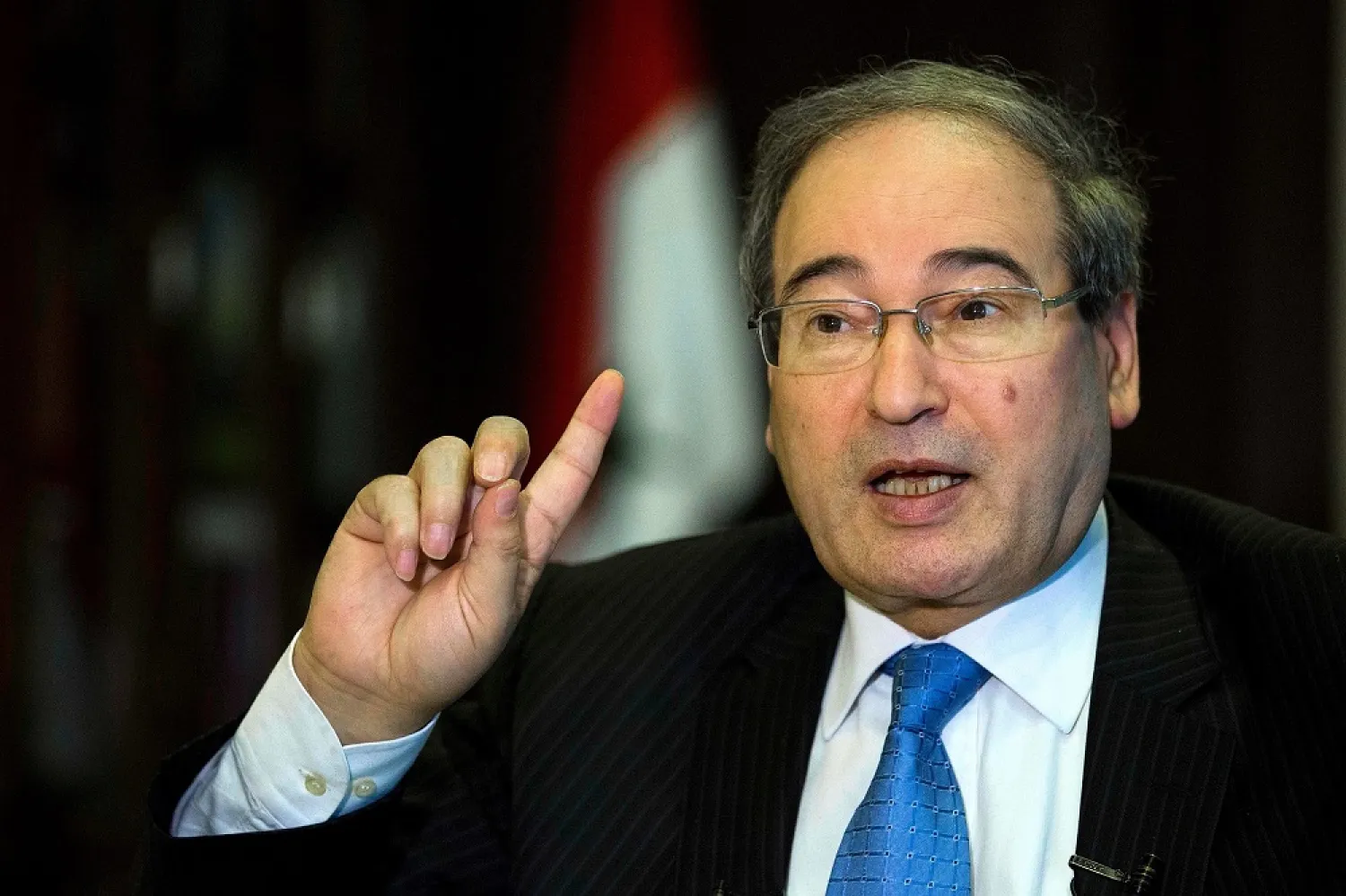
Syrian FM Holds Meetings on Sidelines of UN General Assembly

Syrian Foreign Minister Faisal Mikdad. (AP)
TT

Syrian FM Holds Meetings on Sidelines of UN General Assembly

Syrian Foreign Minister Faisal Mikdad. (AP)

Syrian Foreign Minister Faisal Mikdad met Friday with his Egyptian counterpart, Sameh Shoukry, on the sidelines of the 76th UN General Assembly in New York.

During the meeting, Mikdad stressed the importance of the relations binding the two brotherly countries, said an official Syrian statement carried by the SANA news agency.

The minister briefed his Egyptian counterpart on the developments related to the crisis in Syria and the need to intensify efforts to resolve it while respecting the country’s sovereignty and territorial integrity.

Egyptian Foreign Ministry Spokesperson Ahmed Hafez wrote on Twitter Friday that the officials discussed ways to resolve the conflict.

Separately, Mikdad declared that the US must withdraw its forces from Syria.

“The presence of US forces in Syria is illegal and they must leave as soon as possible,” he told Russia 24 TV channel.

“If they do not, they will end up just like in in Afghanistan or any other country,” he added.

During a meeting on Thursday, Russian Foreign Minister Sergei Lavrov and Mikdad underlined the need to continue fighting terrorism until it is completely eliminated, ending the illegitimate foreign presence on Syrian territory and lifting sanctions imposed on Syria.

A Syrian statement said both ministers discussed solutions to the Syrian crisis.

Mikdad told reporters that the international community would have to intervene if Turkish troops were not withdrawn from Syria.


Iraq Pushes to Centralize War Powers Under State Control

Relatives of a soldier killed in an airstrike on Habbaniyah base carry the Iraqi flag during his funeral (AFP)
TT

Iraq Pushes to Centralize War Powers Under State Control

Relatives of a soldier killed in an airstrike on Habbaniyah base carry the Iraqi flag during his funeral (AFP)

Iraqi security sources reported a breakthrough in investigations into rocket and drone attacks on diplomatic and security sites, as political and legal pressure intensifies to confine decisions of war and peace to the state.

A security source familiar with the probe told Asharq Al-Awsat that authorities have begun identifying those behind the launches. The information was obtained after the arrest of three members of an armed faction, who were already subject to arrest warrants.

Security forces also detained another group suspected of involvement in attacks targeting the US embassy in Baghdad, the source said.

More arrest warrants are expected as investigators pursue others suspected of carrying out rocket and drone attacks in violation of the law.

Judicial warnings

The government has not named those responsible, but armed factions have repeatedly claimed similar operations through statements and online platforms, complicating the security landscape and weakening state control over weapons.

The developments follow a warning from Supreme Judicial Council President Faiq Zidan of “serious repercussions” from unilateral military decisions by factions and non-official entities. He said such actions violate the constitution and risk exposing Iraq to international isolation and sanctions.

Zidan said declaring a state of war requires a constitutional process, including approval by two-thirds of parliament based on a joint request from the president and prime minister.

The escalation underscores growing tension between the state and armed factions, as authorities seek to reassert institutional control amid rising domestic and international criticism over fragmented security decision-making and continued attacks on diplomatic missions.

Regional war dynamics

Officials describe the situation as indirect involvement in the region’s “geography of war,” with repeated attacks on sites linked to the US presence in Baghdad and Erbil, alongside airstrikes on military positions inside Iraq.

Since the start of the Middle East war, Iraqi factions have claimed attacks on US interests.

Iran has struck Iranian Kurdish opposition groups in northern Iraq, while sites linked to the Popular Mobilization Forces and Iran-aligned factions have been hit by airstrikes attributed to the United States and Israel.

War powers debate

Calls are growing within Iraq to reaffirm that decisions of war and peace rest solely with constitutional institutions.

Prime Minister Mohammed Shia al-Sudani said the government is “the sole authority” empowered to take such decisions, despite operating in a caretaker capacity following recent parliamentary changes.

The Foreign Ministry reiterated Baghdad’s firm rejection of any attacks targeting Gulf states, stressing solidarity with sister countries and commitment to their security and stability. It said Gulf security is inseparable from Iraq’s national security and that regional stability serves all.

Saudi Arabia, the United Arab Emirates, Kuwait, Bahrain, Qatar and Jordan have condemned attacks by Iran-aligned Iraqi factions on regional countries and infrastructure, calling them violations of international law.

Energy risks

President Abdul Latif Rashid reiterated Iraq’s rejection of war, voicing deep concern over the widening conflict and calling for an immediate halt to military operations and a return to dialogue.

In a phone call with Iranian President Masoud Pezeshkian, Rashid said continued war serves no country in the region and threatens Middle East stability.

He added that Iraq, both its people and government, calls for peace and expresses solidarity with the Iranian people, praising their resilience in the face of “attacks.”

In Geneva, Iraq’s mission to the United Nations warned that expanding the conflict would deepen crises and undermine stability. Jaafar Mohammed, second secretary at Iraq’s mission, cautioned that disruptions to energy supply chains through the Strait of Hormuz could have global economic repercussions.


Lebanese Army ‘Repositions’ Itself in the South to Avoid Contact with Israel

A Lebanese army patrol in southern Lebanon. (Lebanese army file photo)
TT

Lebanese Army ‘Repositions’ Itself in the South to Avoid Contact with Israel

A Lebanese army patrol in southern Lebanon. (Lebanese army file photo)

The Lebanese army and security forces are carrying out a “preventive” redeployment of units in the south under Israeli fire, in a move seen as aimed at avoiding direct contact or friction with Israeli forces.

The step comes amid the absence of a political decision to confront Israeli incursions militarily, and is viewed as the adoption of “protective tactics” for personnel in an area witnessing ongoing clashes.

A Lebanese security source familiar with the matter told Asharq Al-Awsat that the forces follow a fixed field principle of remaining alongside residents until the last moment before they need to evacuate an area.

“Personnel stay where civilians are, and withdraw only after displacement is complete, and before any potential Israeli advance, ensuring neither they nor residents are exposed to danger,” the source said.

Deployment is directly tied to displacement patterns and conditions in each town, the source said, noting that “the presence of residents is a decisive factor in the Internal Security Forces maintaining their posts.”

“Posts are not evacuated under a declared central plan, but based on changing field data,” the source added. “Every town that is emptied of its residents is automatically followed by the evacuation of its police post, with personnel joining the nearest military point.”

The town of Khiam was “among the last locations to maintain a security presence alongside residents until the final stages of displacement, before it was evacuated” as Israeli forces advanced.

Military pullback, local pushback

The town of Debel highlights the complexity of the situation between the military and civilians. A local source said the army had maintained an advanced position on its outskirts, but as limited Israeli incursions began nearby, the position was withdrawn overnight into the town, specifically to the public school.

“The withdrawal did not stop there,” the source said. “The following day, personnel were completely pulled out of Debel toward Rmeish, leaving no effective military presence inside the town, while personnel from Debel remained in their homes in civilian clothing.”

The most sensitive step was a proposal to relocate soldiers from the town, along with their families, outside the area, a move locally seen as a prelude to emptying the town. It was met with widespread rejection.

About 200 security personnel from Debel serve in the army and security forces, meaning their departure with their families would have led to the near-total evacuation of the town. Political and local efforts, involving the defense and interior ministries and religious authorities, led to the plan being frozen.

Despite the tension, the source said the town is not under siege, noting that the Debel-Rmeish road remains open, easing pressure for evacuation. Residents and personnel remain in their homes, while military positions and police posts continue operating in nearby towns, such as Ain Ebel and Rmeish.

Local media reported that the army repositioned at the Khardali checkpoint, the main gateway to the southern Litani area from the eastern sector, and is preparing to redeploy at the Kafra checkpoint, as Israeli forces advance toward Beit Lif and the facing Wadi al-Oyoun from the south.

Lebanese army commander General Rodolphe Haykal inspected units in Beirut and the southern city of Sidon and reviewed security measures within their areas of responsibility.

He urged troops to maintain readiness “to prevent any breach of security, and to act firmly against any attempt to undermine internal stability.”

“Despite rumors and incitement campaigns aimed at undermining the sacrifices and efforts of soldiers, the army will not hesitate to carry out its national duties,” he said, calling on troops “not to be influenced by such rumors, to adhere to their doctrine, and remain committed to performing their national duty.”

Preventive strategy

Former MP and retired brigadier general Chamel Roukoz said the moves “cannot be described as a traditional military withdrawal,” but rather a calculated field redeployment shaped by an asymmetric confrontation, given Israeli air and firepower superiority and the risk of direct targeting of exposed positions.

He said the army operates within a margin set by political authority, noting that no decision has been issued by the government to engage or confront Israeli forces directly.

“The military institution manages its deployment accordingly, balancing field presence with safety requirements,” he said.

On the evacuation of positions, including those reported in Debel, Roukoz said the measures “do not reflect abandonment of territory or a collapse of the front,” but rather precautions imposed by field realities, where some positions become easy targets under bombardment.

He said the redeployment carries operational and morale dimensions, aiming to avoid direct friction in the absence of a political decision, preserve troop morale, and avoid pushing forces into unequal confrontations.

The army command, he added, is showing “high flexibility” in managing deployment, shifting from exposed positions to safer ones.

Roukoz said the developments fall within “protection and redeployment tactics adopted in high-risk environments,” reflecting careful management of the balance between political decision-making and field realities.


Israeli Military Kills Two in Raid, Says Palestinian Ministry

 A man sits near a street in Jerusalem's Old City, following restrictions on large gatherings amid the US-Israel conflict with Iran, March 27, 2026. (Reuters)
A man sits near a street in Jerusalem's Old City, following restrictions on large gatherings amid the US-Israel conflict with Iran, March 27, 2026. (Reuters)
TT

Israeli Military Kills Two in Raid, Says Palestinian Ministry

 A man sits near a street in Jerusalem's Old City, following restrictions on large gatherings amid the US-Israel conflict with Iran, March 27, 2026. (Reuters)
A man sits near a street in Jerusalem's Old City, following restrictions on large gatherings amid the US-Israel conflict with Iran, March 27, 2026. (Reuters)

Israeli forces killed two Palestinian men on Friday during a raid north of Jerusalem, the Ramallah-based health ministry and relatives said, while the army said troops had shot at instigators of stone throwing.

"The young man Mustafa Asaad Hamad (22 years old) was killed by Israeli gunfire in Kufr Aqab," the ministry said in a statement.

In a separate statement, it announced the death of 46-year-old Sufyan Abu Leil, who died "of critical wounds he sustained after being shot by Israeli forces in Qalandia camp this Friday afternoon".

The Palestinian entity in charge of the area, the Jerusalem governorate, reported that Israeli forces had raided the Qalandia refugee camp, adjacent to Kufr Aqab, and wounded several Palestinians with live fire early Friday.

The Israeli military said its forces had twice in 24 hours carried out "operational activities in the Qalandia area... during which violent disturbances developed, including the throwing of stones at the forces."

"The soldiers responded by firing at key instigators and hits were identified," it said in a statement.

Hamad's father Asaad Hamad told AFP at the funeral that the army entered the area at around midnight, causing clashes with local residents, during which his son was shot.

"My son was shot twice in the leg. The bullet hit an artery and he died a martyr," Asaad Hamad told AFP.

Hundreds of young men attended Hamad's funeral as his body was carried through the streets of Qalandia camp on a stretcher, wrapped in a Palestinian flag, an AFP journalist reported.

Qalandia refugee camp, Kufr Aqab and other areas around Jerusalem have seen increased Israeli raids since the beginning of 2026 after Israel launched operation "Capital Shield", which it says aims to make Jerusalem safer.

Since the operation began, the military has arrested dozens of Palestinians and destroyed several buildings it said had been illegally built in Kufr Aqab and Qalandia camp.

Palestinians fear the demolitions will pave the way for Israeli settlers to move into the area, as has happened in parts of east Jerusalem in recent months.

Violence in the West Bank, which Israel has occupied since 1967, has soared since the Hamas attack on Israel triggered the Gaza war in October 2023. It has continued despite an October 2025 ceasefire.

Israeli troops or settlers have killed at least 1,053 Palestinians, many of them gunmen, but also scores of civilians, in the West Bank since the Gaza war began, according to an AFP tally based on Palestinian health ministry figures.