


Iran and Venezuela Strike Oil Export Deal

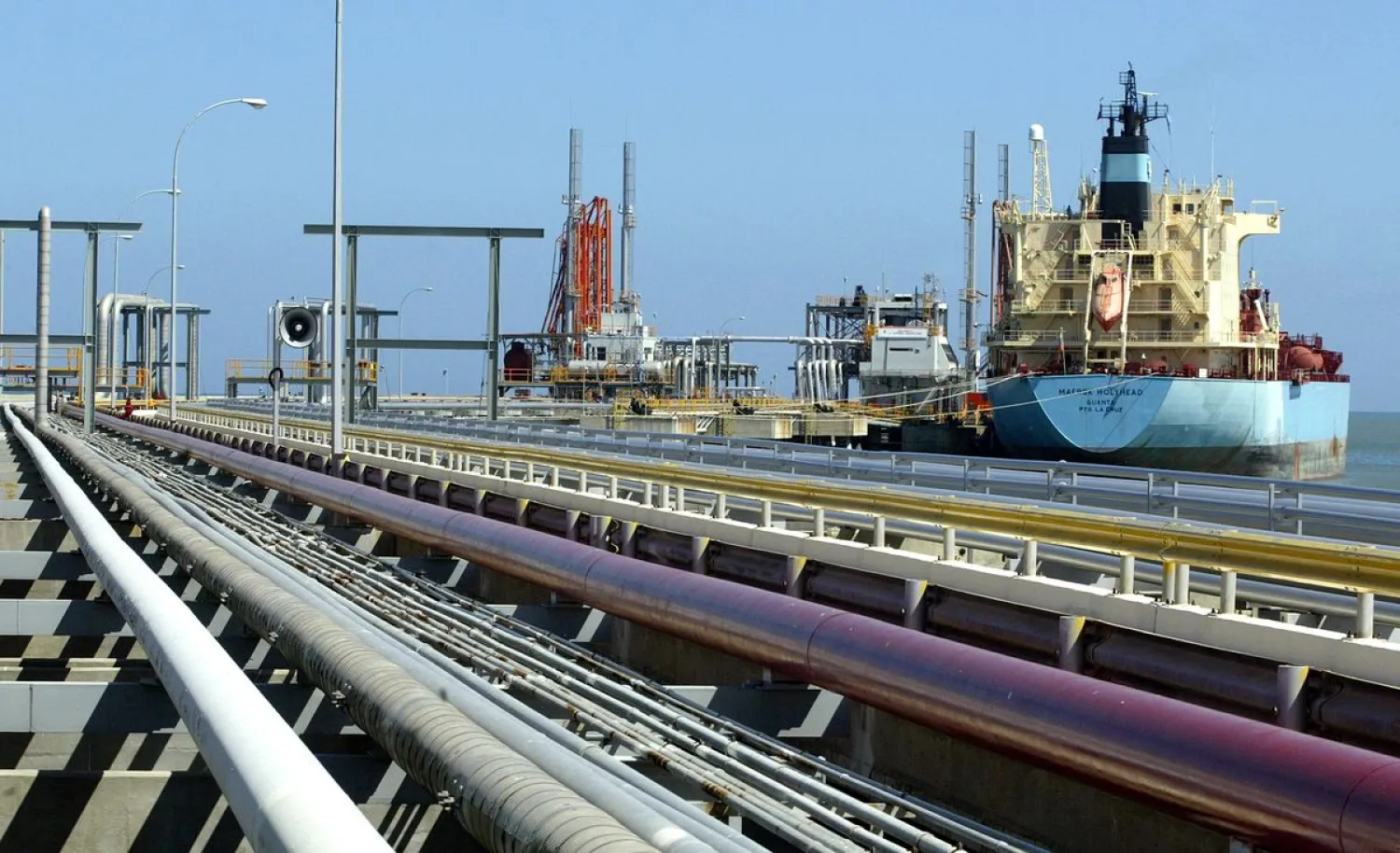
An oil tanker is seen at Jose refinery cargo terminal in Venezuela in this undated file photo. Reuters/File Photo
TT

Iran and Venezuela Strike Oil Export Deal

An oil tanker is seen at Jose refinery cargo terminal in Venezuela in this undated file photo. Reuters/File Photo

Venezuela has agreed to a key contract to swap its heavy oil for Iranian condensate that it can use to improve the quality of its tar-like crude, with the first cargoes due this week, five people close to the deal said.

As the South American country seeks to boost its flagging oil exports in the face of US sanctions, according to the sources, the deal between state-run firms Petroleos de Venezuela (PDVSA) and National Iranian Oil Company (NIOC) deepens the cooperation between two of Washington's foes.

One of the people said the swap agreement is planned to last for six months in its first phase, but could be extended. Reuters could not immediately determine other details of the mwpact.

The oil ministries of Venezuela and Iran, and state-run PDVSA and NIOC did not reply to requests for comment.

The deal could be a breach of US sanctions on both nations, according to a Treasury Department email to Reuters which cited US government orders that establish the punitive measures.

US sanctions programs not only forbid Americans from doing business with the oil sectors of Iran and Venezuela, but also threaten to impose "secondary sanctions" against any non-US person or entity that carries out transactions with either countries' oil companies.

Secondary sanctions can carry a range of penalties against those targeted, including cutting off access to the US financial system, fines or the freezing of US assets.

Any "transactions with NIOC by non-US persons are generally subject to secondary sanctions," the Treasury Department said in response to a question about the deal. It also said it "retains authority to impose sanctions on any person that is determined to operate in the oil sector of the Venezuelan economy," but did not specifically address whether the current deal is a sanctions breach.

US sanctions are often applied at the discretion of the administration in power. Former US President Donald Trump's government seized Iranian fuel cargoes at sea bound for Venezuela for alleged sanction busting last year, but his successor Joe Biden has made no similar moves.

In Washington, a source familiar with the matter said the swap arrangement between Venezuela and Iran has been on the radar screens of US government officials as a likely sanctions violation in recent months and they want to see how far it will go in practical terms.

US officials are concerned, the source said, that Iranian diluent shipments could help provide President Nicolas Maduro with more of a financial lifeline as he negotiates with the Venezuelan opposition towards elections.

Sanctions on both nations have crimped their oil sales in recent years, spurring NIOC to support Venezuela - including through shipping services and fuel swaps - in allocating exports to Asia.

In a meeting at the UN General Assembly in New York on Wednesday, the foreign ministers of Venezuela and Iran publicly stated their commitment to stronger bilateral trade, despite US attempts to block it.

Trump's tightening of sanctions contributed last year to a 38% fall in Venezuela's oil exports - the backbone of its economy - to their lowest level in 77 years and curtailed sources of fuel imports, worsening gasoline shortages in the nation of some 30 million people.

A US Treasury spokesperson said the department was "concerned" about reports of oil deals between Venezuela and Iran, but had not verified details.

"We will continue to enforce both our Iran and Venezuela-related sanctions," the spokesperson said. Treasury "has demonstrated its willingness" to blacklist entities who support Iranian attempts to evade US sanctions and who "further enable their destabilizing behavior around the world," the official added.

The swap contract would provide PDVSA with a steady supply of condensate, which it needs to dilute output of extra heavy oil from the Orinoco Belt, its largest producing region, the people said. The bituminous crude requires mixing before it can be transported and exported.

In return, Iran will receive shipments of Venezuelan heavy oil that it can market in Asia, said the people, who declined to be identified as they were not authorized to speak publicly.

CARGOES THIS WEEK
PDVSA has boosted oil swaps to minimize cash payments since the US Treasury Department in 2019 blocked the company from using US dollars. Washington has also sanctioned foreign companies for receiving or shipping Venezuelan oil.

Since last year, PDVSA has imported two cargoes of Iranian condensate in one-off swap deals to meet specific needs for diluents, and it has also exchanged Venezuelan jet fuel for Iranian gasoline.

The new contract would help PDVSA secure a source of diluents, stabilizing exports of the Orinoco's crude blends, while allowing its own lighter oil to be refined in Venezuela to produce badly needed motor fuel, three of the people said.

The first 1.9 million barrel cargo of Venezuela's Merey heavy crude under the new swap set sail earlier this week from PDVSA's Jose port on the very large crude carrier (VLCC) Felicity, owned and operated by National Iranian Tanker Co (NITC), according to the three people and monitoring service TankerTrackers.com.

NITC, a unit of NIOC, did not reply to a request for comment.

The vessel was not included in PDVSA's monthly port schedules for September, which lists planned imports and exports. However, TankerTrackers.com identified it while at Jose this month.

The Venezuelan crude shipment is a partial payment for a cargo of 2 million barrels of Iranian condensate that arrived in Venezuela on Thursday, according to the three sources and one of PDVSA's port schedules.

LITTLE ENFORCEMENT

Last year, the previous Trump administration seized over 1 million barrels of Iranian fuel bound for Venezuela and blacklisted five tanker captains, as part of a "maximum pressure" strategy, but the United States has not interdicted recent Iranian supplies to Venezuela.

The US State Department declined to comment on the deal. A Treasury spokesperson did not respond to a Reuters question on how concerned the government might be that Iran-Venezuela deals would allow PDVSA to step up exports.

US government officials have insisted they do not plan to ease sanctions on Venezuela unless Maduro takes definitive steps toward free and fair elections.

Trump's curbs on established companies doing business with PDVSA prompted the socialist-ruled nation to turn to swaps with Iran and other countries, while trading with a series of little-known customers.

PDVSA's new customers and swaps have allowed it to keep exports stable around 650,000 barrels per day (bpd) this year, after they zigzagged in 2020.

However, a worsening shortage of diluents has recently limited oil exports, placing the Orinoco Belt production in an "emergency", according to PDVSA documents from August and September related to its output status that were reviewed by Reuters.

PDVSA plans to mix the Iranian condensate with extra heavy oil to produce diluted crude oil, a grade demanded by Asian refiners that it has struggled to export since late 2019 when suppliers halted diluent shipments due to sanctions, the three sources said.



Thousands Protest Israeli President Herzog’s Visit to Australia

 Demonstrators gather at Town Hall Square to protest against Israeli President Isaac Herzog's state visit to Australia following a deadly mass shooting during a Jewish Hanukkah celebration at Bondi Beach on December 14, 2025, in Sydney, Australia, February 9, 2026. (Reuters)
Demonstrators gather at Town Hall Square to protest against Israeli President Isaac Herzog's state visit to Australia following a deadly mass shooting during a Jewish Hanukkah celebration at Bondi Beach on December 14, 2025, in Sydney, Australia, February 9, 2026. (Reuters)
TT

Thousands Protest Israeli President Herzog’s Visit to Australia

 Demonstrators gather at Town Hall Square to protest against Israeli President Isaac Herzog's state visit to Australia following a deadly mass shooting during a Jewish Hanukkah celebration at Bondi Beach on December 14, 2025, in Sydney, Australia, February 9, 2026. (Reuters)
Demonstrators gather at Town Hall Square to protest against Israeli President Isaac Herzog's state visit to Australia following a deadly mass shooting during a Jewish Hanukkah celebration at Bondi Beach on December 14, 2025, in Sydney, Australia, February 9, 2026. (Reuters)

Thousands gathered across Australia on Monday to protest the arrival of Israeli President Isaac Herzog, who is on a multi-city trip aimed at expressing solidarity with Australia's Jewish community following a deadly mass shooting last year.

Herzog is visiting Australia this week following an invitation from Australian Prime Minister Anthony Albanese in the aftermath of the December 14 shooting at a Hanukkah event at Sydney's Bondi Beach that killed 15.

The visit has attracted the ire of some people in Australia, who accuse Herzog of being complicit in civilian deaths in Gaza. Pro-Palestine groups have organized protests ‌in cities and ‌towns across the country on Monday evening.

In Sydney, thousands gathered ‌in ⁠a square ‌in the city's central business district, listening to speeches and shouting pro-Palestine slogans.

"The Bondi massacre was terrible but from our Australian leadership there’s been no acknowledgment of the Palestinian people and the Gazans," said Jackson Elliott, a 30-year-old protestor from Sydney.

"Herzog has dodged all the questions about the occupation and says this visit is about Australia and Israeli relations but he is complicit."

There was a heavy police presence with a helicopter circling overhead and officers patrolling on horseback.

About 3,000 police personnel ⁠will be deployed across Sydney during Herzog's visit to the city.

PRESIDENT COMMEMORATES LIVES LOST

Herzog began his visit at Bondi ‌Beach, where he laid a wreath at a memorial for ‍the victims of the attack. He ‍also met survivors and the families of 15 people killed in the shooting.

"This was ‍also an attack on all Australians. They attacked the values that our democracies treasure, the sanctity of human life, the freedom of religion, tolerance, dignity and respect," Herzog said in remarks at the site.

In a statement, the Executive Council of Australian Jewry Co-Chief Executive Alex Ryvchin said Herzog's visit "will lift the spirits of a pained community."

Some Jews oppose the visit.

The Jewish Council of Australia, a vocal critic of the Israeli government, released an open letter ⁠on Monday signed by over 1,000 Jewish Australian academics and community leaders, urging Albanese to rescind Herzog's invitation.

POLICE DEPLOY SPECIAL POWERS

Authorities in Sydney have declared Herzog's visit a major event and have been authorized to use rarely invoked powers during the visit, including the ability to separate and move crowds, restrict their entry to certain areas, direct people to leave and search vehicles.

The Palestine Action Group organizing the protest failed in a legal challenge in a Sydney court on Monday against restrictions placed on the expected demonstration.

"We're hoping we won't have to use any powers, because we've been liaising very closely with the protest organizers," New South Wales Police Assistant Commissioner Peter McKenna told Nine News on Monday.

"Overall, it is all of the community that we ‌want to keep safe ... we'll be there in significant numbers just to make sure that the community is safe."


Crackdown on Dissent After Nationwide Protests in Iran Widens to Ensnare Reformist Figures

Iranians cross a road near an anti-US and anti-Israeli billboard reading "You start... we finish it" in Palestine Square in Tehran, Iran, 09 February 2026, amid heightened regional tensions. (EPA)
TT

Crackdown on Dissent After Nationwide Protests in Iran Widens to Ensnare Reformist Figures

Iranians cross a road near an anti-US and anti-Israeli billboard reading "You start... we finish it" in Palestine Square in Tehran, Iran, 09 February 2026, amid heightened regional tensions. (EPA)

Iranian security forces have launched a campaign to arrest figures within the country's reformist movement, reports said Monday.

That widens a crackdown on dissent after authorities earlier put down nationwide protests in violence that killed thousands and saw tens of thousands more detained.

Detained Nobel Peace Prize laureate Narges Mohammadi has received another prison sentence of over seven years. It signals a widening effort to silence anyone opposed to the bloody suppression of unrest by Iran's theocracy as it faces new nuclear talks with the United States. President Donald Trump has repeatedly warned he could launch an attack on the country if no deal is reached.

Media reports quoted officials within the reformist movement, which seeks to change Iran's theocracy from inside, as saying at least four of their members had been arrested. They include Azar Mansouri, the head of the Reformist Front, which represents multiple reformist factions; and former diplomat Mohsen Aminzadeh, who served under reformist President Mohammad Khatami.

Also detained was Ebrahim Asgharzadeh, who led students who stormed the US Embassy in Tehran in 1979, sparking the 444-day hostage crisis.

Their arrests likely stem from a reformist statement in January that called for Iran's 86-year-old Supreme Leader Ali Khamenei to resign from his position and have a transitional governing council oversee the country.

Iran's state-run IRNA news agency quoted a statement from prosecutors in Tehran, the country's capital, saying four people had been arrested and others summoned to meet authorities. It accused those allegedly involved of “organizing and leading ... activities aimed at disrupting the political and social situation in the country amid military threats from the United States and the Zionist regime.”

“Having bludgeoned the streets into silence with exemplary cruelty, the regime has shifted its attention inward, fixing its stare on its loyal opposition,” wrote Ali Vaez, an Iran expert at the International Crisis Group.

“The reformists, sensing the ground move beneath them, had begun to drift — and power, ever paranoid, is now determined to cauterize dissent before it learns to walk.”

However, it remains unclear just how much political support reformists have within Iran. The anger on the streets of Iran during the demonstrations, heard in people shouting “Death to Khamenei!” and in support of the country's exiled crown prince, appeared to lump reformists in with all other politicians now working in the country.

Iran and the US held new nuclear talks last week in Oman. Foreign Minister Abbas Araghchi, speaking Sunday to diplomats at a summit in Tehran, signaled that Iran would stick to its position that it must be able to enrich uranium — a major point of contention with Trump, who bombed Iranian atomic sites in June during the 12-day Iran-Israel war.

Israeli Prime Minister Benjamin Netanyahu is to travel to Washington this week, with Iran expected to be the major subject of discussion, his office said.

The US has moved the aircraft carrier USS Abraham Lincoln, ships and warplanes to the Middle East to pressure Iran into an agreement and have the firepower necessary to strike the country should Trump choose to do so.

Meanwhile, Iran issued a warning to pilots that it planned “rocket launches” Monday into Tuesday in an area over the country’s Semnan province, home to the Imam Khomeini Spaceport. Such launches have corresponded in the past with Iran marking the anniversary of its 1979 revolution.


China Vows ‘Resolute Response’ to Any Reckless Acts After Japan Election

 Japan's Prime Minister Sanae Takaichi, leader of the ruling Liberal Democratic Party (LDP), arrives at the Prime Minister's office after her party's historic election win in Sunday's poll in Tokyo, Japan, February 9, 2026. (Reuters)
Japan's Prime Minister Sanae Takaichi, leader of the ruling Liberal Democratic Party (LDP), arrives at the Prime Minister's office after her party's historic election win in Sunday's poll in Tokyo, Japan, February 9, 2026. (Reuters)
TT

China Vows ‘Resolute Response’ to Any Reckless Acts After Japan Election

 Japan's Prime Minister Sanae Takaichi, leader of the ruling Liberal Democratic Party (LDP), arrives at the Prime Minister's office after her party's historic election win in Sunday's poll in Tokyo, Japan, February 9, 2026. (Reuters)
Japan's Prime Minister Sanae Takaichi, leader of the ruling Liberal Democratic Party (LDP), arrives at the Prime Minister's office after her party's historic election win in Sunday's poll in Tokyo, Japan, February 9, 2026. (Reuters)

Beijing warned Tokyo on Monday that reckless actions would be met with a "resolute response", a day after Japan's Prime Minister Sanae Takaichi, who is viewed as critical of China, won a landslide election.

China and Japan have been locked in a spat over comments by Takaichi in November that Tokyo could intervene militarily in any attack on self-ruled Taiwan.

China claims the democratic island as part of its territory and has not ruled out force to annex it.

A spokesman for China's foreign ministry on Monday urged Japan to retract the comments and warned of consequences for any rash actions.

"If the far-right forces in Japan misjudge the situation and act recklessly, they will inevitably face resistance from the Japanese people and a resolute response from the international community," spokesman Lin Jian told a regular news conference.

"We once again urge the Japanese side to retract the erroneous remarks made by Takaichi regarding Taiwan and demonstrate basic sincerity in safeguarding the political foundation of China-Japan relations, through concrete actions," he said.

In the wake of Takaichi's comments in November, China has discouraged its nationals from travelling to Japan, citing deteriorating public security and criminal acts against Chinese nationals in the country.

In the latest escalation of the row in December, Chinese military aircraft locked radar onto Japanese jets, prompting Tokyo to summon Beijing's ambassador.

Beijing also reportedly choked off exports to Japan of rare-earth products crucial for making everything from electric cars to missiles.

And last month, two popular pandas departed Tokyo for China, leaving Japan without any of the beloved bears for the first time in 50 years.