

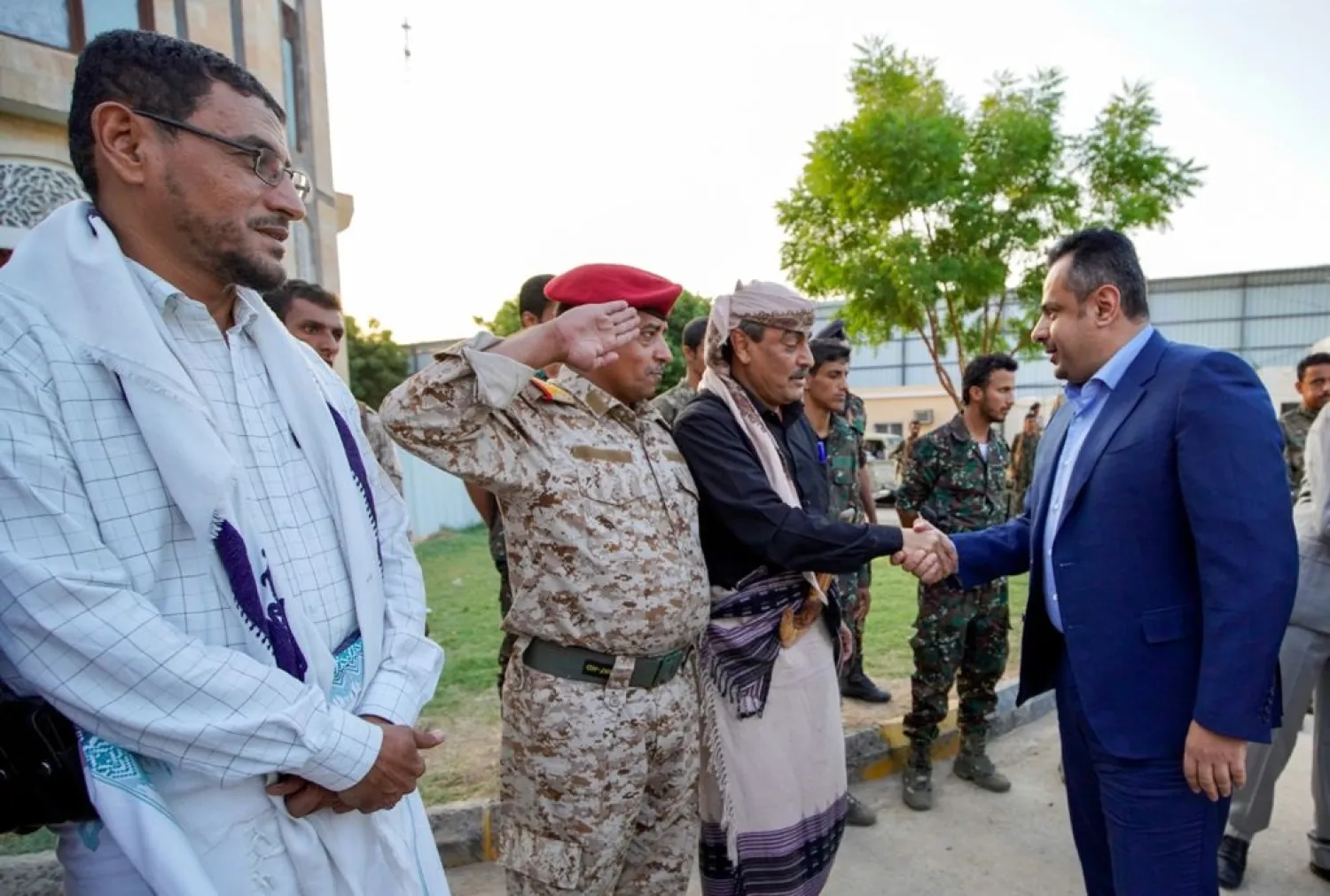

Yemen PM Returns to Aden to Save Crumbling Economy

PM Abdulmalik in Shabwa. (Saba)
TT

Yemen PM Returns to Aden to Save Crumbling Economy

PM Abdulmalik in Shabwa. (Saba)

Yemeni Prime Minister Maeen Abdulmalik returned to the interim capital Aden on Tuesday to address the crisis stemming from the crumbling economy and the drop in the value of the local currency.

The PM had been unable to return to Aden due to disputes with the Southern Transitional Council (STC) and failure to implement the security and military aspects of the Riyadh Agreement.

The Yemeni people have pinned hope on the government taking the necessary measures on the economic, services and military levels as the Iran-backed Houthi militias intensified their attack on the Marib and Shabwa provinces.

The collapse of the rial sparked angry protests in liberated Yemeni provinces in recent days.

Before arriving in Aden, Abdulmalik visited the city of Atq in Shabwa where he presided over a meeting of the local and executive authority and military and security leaderships. The meeting addressed military, security, economic and services affairs.

Talks focused on providing government support to various parties in Shabwa, in coordination with the Saudi-led Arab coalition, against the Houthi attack so that they can claim victory in this fateful battle, reported the Saba news agency.

“Shabwa and Marib are the spirit of Yemen and beating heart of resistance and hope,” said the PM. “There can be no backing down from the battle, regardless of the challenges.”

“The battle is not just about Shabwa and Marib, but it is a battle of all Yemenis as they seek to preserve their dignity, republic and state,” he added, while stressing the importance of unifying ranks.

“This battle will decide the fate of Yemen for several years to come,” he declared, warning that internal differences have allowed the Houthis room to maneuver.

Moreover, he stressed the importance of political unity and the implementation of the Riyadh Agreement that will help improve conditions in the country.



EU Condemns Israel's West Bank Control Measures

The Israeli settlement of Har Homa, seen from the West Bank city of Bethlehem, Tuesday, Dec. 17, 2024. (AP)
TT

EU Condemns Israel's West Bank Control Measures

The Israeli settlement of Har Homa, seen from the West Bank city of Bethlehem, Tuesday, Dec. 17, 2024. (AP)

The European Union on Monday condemned new Israeli measures to tighten control of the West Bank and pave the way for more settlements in the occupied Palestinian territory, AFP reported.

"The European Union condemns recent decisions by Israel's security cabinet to expand Israeli control in the West Bank. This move is another step in the wrong direction," EU spokesman Anouar El Anouni told journalists.


Atrocities in Sudan's El-Fasher Were 'Preventable Human Rights Catastrophe'

Sudanese displaced people who left El Fasher after its fall, sit in the shade in Tawila at the Rwanda camp reception point on December 17, 2025. (Photo by AFP)
TT

Atrocities in Sudan's El-Fasher Were 'Preventable Human Rights Catastrophe'

Sudanese displaced people who left El Fasher after its fall, sit in the shade in Tawila at the Rwanda camp reception point on December 17, 2025. (Photo by AFP)

The atrocities unleashed on El-Fasher in Sudan's Darfur region last October were a "preventable human rights catastrophe", the United Nations said Monday, warning they now risked being repeated in the neighbouring Kordofan region.


"My office sounded the alarm about the risk of mass atrocities in the besieged city of El-Fasher for more than a year ... but our warnings were ignored," UN rights chief Volker Turk told the Human Rights Council in Geneva.


He added that he was now "extremely concerned that these violations and abuses may be repeated in the Kordofan region".


Arab League Condemns Israel's Decisions to Alter Legal, Administrative Status of West Bank

A general view shows the opening session of the meeting of Arab foreign ministers at the Arab League Headquarters (Reuters)
TT

Arab League Condemns Israel's Decisions to Alter Legal, Administrative Status of West Bank

A general view shows the opening session of the meeting of Arab foreign ministers at the Arab League Headquarters (Reuters)

The General Secretariat of the Arab League strongly condemned decisions by Israeli occupation authorities to impose fundamental changes on the legal and administrative status of the occupied Palestinian territories, particularly in the West Bank, describing them as a dangerous escalation and a flagrant violation of international law, international legitimacy resolutions, and signed agreements, SPA reported.

In a statement, the Arab League said the measures include facilitating the confiscation of private Palestinian property and transferring planning and licensing authorities in the city of Hebron and the area surrounding the Ibrahimi Mosque to occupation authorities.

It warned of the serious repercussions of these actions on the rights of the Palestinian people and on Islamic and Christian holy sites.

The statement reaffirmed the Arab League’s firm support for the legitimate rights of the Palestinian people, foremost among them the establishment of their independent state on the June 4, 1967 borders, with East Jerusalem as its capital.