

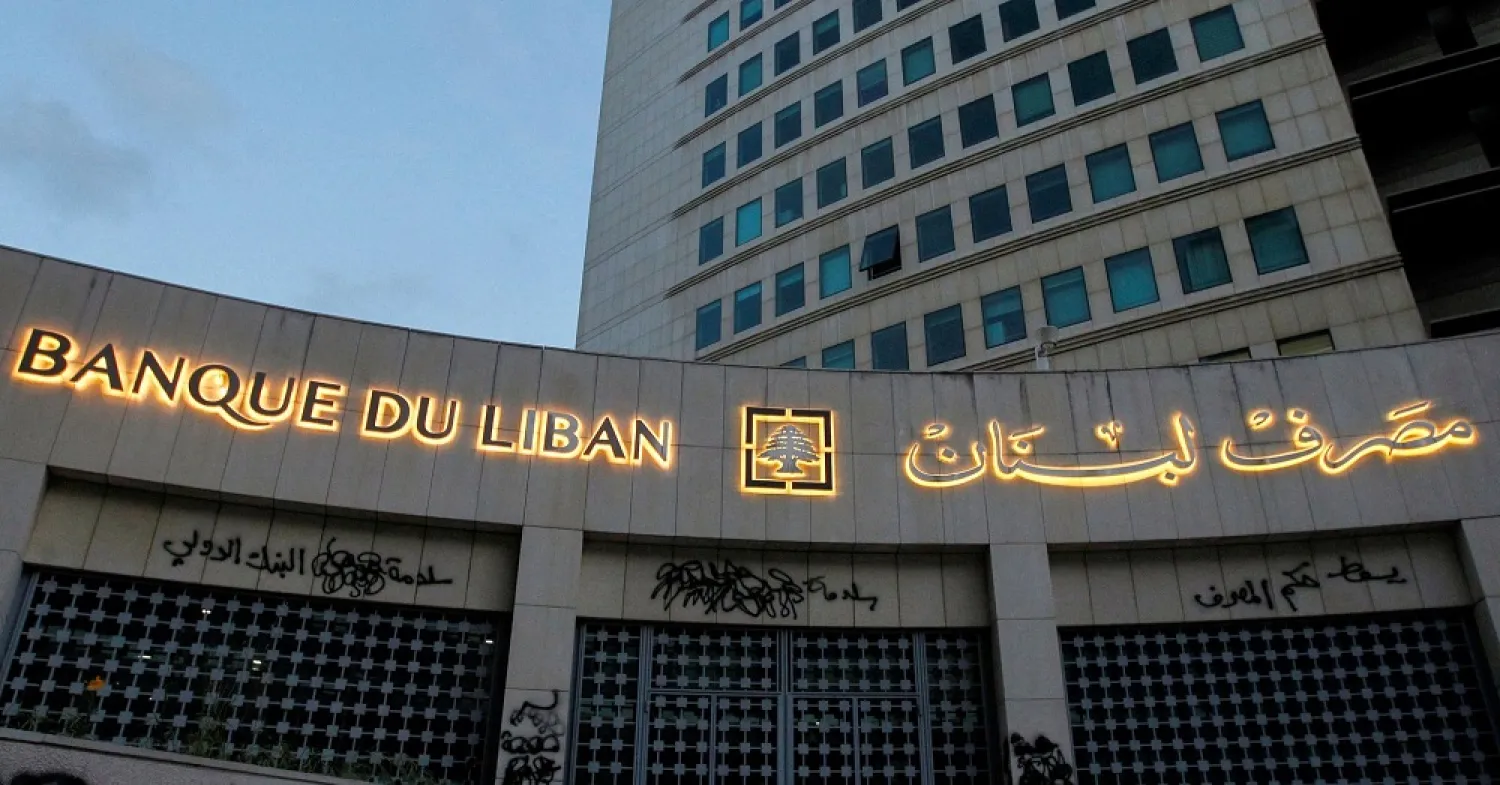

Lebanon's Central Bank Denies Swiss Report about 2016 IMF Paper

A view of Lebanon's Central Bank building in Beirut, Lebanon April 23, 2020. (Reuters)
TT

Lebanon's Central Bank Denies Swiss Report about 2016 IMF Paper

A view of Lebanon's Central Bank building in Beirut, Lebanon April 23, 2020. (Reuters)

Lebanon's central bank denied on Friday a Swiss newspaper report that alleged the International Monetary Fund had removed information from a 2016 report on the country at the request of its governor, Riad Salameh.

Switzerland's Le Temps said in a report on Thursday that in 2016, as Lebanon was headed towards financial ruin, 14 pages containing vital information were removed from an IMF assessment through the intervention of Salameh.

Reuters could not independently verify the report.

Salameh did not respond to a request from Reuters for comment.

The IMF did not immediately respond to a Reuters request for comment.

"This article and everything that was mentioned in it has nothing to do with the truth," the Lebanese central bank said in a statement.

"What was reported in Le Temps newspaper makes clear the article is not serious as it says the governor of the central bank of Lebanon personally omitted 14 pages from a report of an international and respectable organization like the IMF."

Lebanon is suffering what the World Bank has described as one of the deepest depressions in modern history. Its economic meltdown has thrown three-quarters of the population into poverty and the Lebanese pound currency has lost 90% of its value in the past two years.

The financial system collapsed in 2019 following decades of corruption and waste in the state and the unsustainable way it was financed.

Lebanon's woes were aggravated by political deadlock which lasted for over a year, with bickering politicians unable to form a government.

Prime Minister Najib Mikati's cabinet, formed this September, has said it will resume negotiations with the IMF for a funding program and technical talks are expected to begin soon.



Iraqi Judiciary Opens Door to 'Conditional Settlements' to Recover Corruption Funds

 Iraqi Prime Minister Ali al-Zaidi receives Supreme Judicial Council President Faiq Zaidan in Baghdad. (Government press office)
Iraqi Prime Minister Ali al-Zaidi receives Supreme Judicial Council President Faiq Zaidan in Baghdad. (Government press office)
TT

Iraqi Judiciary Opens Door to 'Conditional Settlements' to Recover Corruption Funds

 Iraqi Prime Minister Ali al-Zaidi receives Supreme Judicial Council President Faiq Zaidan in Baghdad. (Government press office)
Iraqi Prime Minister Ali al-Zaidi receives Supreme Judicial Council President Faiq Zaidan in Baghdad. (Government press office)

Iraq’s Supreme Judicial Council announced Friday that it is coordinating with the government on legal mechanisms aimed at combining accountability for corruption with the recovery of public funds.

The proposal could allow reduced legal measures or lighter sentences for defendants who voluntarily return embezzled money under amendments to the General Amnesty Law.

Meanwhile, the recent security operation, dubbed Dawn Assault, has exposed divisions within the ruling Coordination Framework, according to political sources and public statements.

In a statement, the council said its objective is to both hold perpetrators of financial and administrative corruption accountable and recover state funds, adding that these goals could be achieved by easing legal procedures or reducing sentences “within constitutional and legal limits.”

The council noted that the approach was first adopted in the Tax Deposits case, widely known as the “Heist of the Century.” The case centers on the fraudulent withdrawal of tax deposits lodged by foreign companies with the General Commission for Taxes as guarantees for project implementation.

The funds were allegedly siphoned off through irregular procedures involving brokerage firms, including Al-Qant and Al-Mubdeoon Oil Services Company, owned by businessman Noor Zuhair, with the help of government employees.

According to the council, the head of the Supreme Judicial Council and then-Prime Minister Mohammed Shia al-Sudani agreed, with the approval of the investigating judge, to release Zuhair on bail in exchange for repaying the money in installments and receiving a reduced sentence.

The arrangement led to the recovery of 365 billion Iraqi dinars (about $252 million) out of 1.618 trillion dinars (about $1.12 billion) owed by the two companies. Overall, about 3.831 trillion dinars (roughly $2.64 billion) were withdrawn from Rafidain Bank through multiple companies.

According to the council, Zuhair later left Iraq, bringing repayments to a halt. He was subsequently tried in absentia, sentenced to 10 years in prison, and became the subject of extradition proceedings through Arab and international police channels.

Following amendments to the General Amnesty Law, Zuhair’s lawyer requested that his client be covered by the legislation in exchange for repaying the remaining funds. The court sought the Finance Ministry’s opinion, as the injured party, on the proposed repayment mechanism but has yet to receive a response, leaving the request pending.

The council added that 12 employees of the General Commission for Taxes have been sentenced to prison for facilitating the withdrawals and may qualify under the amended amnesty law after paying compensation determined by the Finance Ministry.

An photo released by the Iraqi judiciary shows cash seized inside boxes and bags marked with the Iraqi Central Bank's seal.

It also noted that an investigation into former Prime Minister Mustafa al-Kadhimi, whose government was in office when the crime occurred, was closed for lack of evidence.

The same approach could also be applied in the North Refineries Company case involving detained suspect Adnan al-Jumaili and several current and former lawmakers, provided the alleged offenses predated the amended amnesty law and the outstanding funds are repaid.

Crimes committed after the law took effect are not eligible for amnesty.

The judiciary is now coordinating with Prime Minister Ali al-Zaidi on a constitutional and legal “roadmap” aimed at recovering public funds while easing legal measures against those who voluntarily return them.

Separately, the June 28 Dawn Assault operation inside Baghdad’s Green Zone, which resulted in the arrest of dozens of corruption suspects, triggered criticism within the Coordination Framework.

An informed source told Asharq Al-Awsat that several alliance leaders were caught off guard by the operation and the deployment of tanks and armored vehicles, raising concerns that military force could be used more broadly in the future.

The source added that al-Zaidi defended the measures during his first meeting with Coordination Framework leaders after the operation, arguing that the armored deployment was necessary to seal off the Green Zone while the arrests were carried out.

The source also said several lawmakers managed to leave the Green Zone minutes before the operation began, some of them affiliated with armed factions.

The absence of any response from those groups during the operation further heightened concerns among some Coordination Framework leaders.

Legal expert Jamal al-Asadi told Asharq Al-Awsat that Iraqi law has no provision allowing financial settlements in corruption cases or other criminal offenses.

He noted, however, that the amended General Amnesty Law includes specific provisions covering those convicted of embezzlement or squandering public funds, subject to prescribed legal conditions.

In televised remarks, leading member of the Coordination Framework Amer al-Fayez said all alliance leaders except former PM al-Sudani criticized the government for failing to notify them in advance of the operation.

While backing efforts to pursue corruption suspects, he objected to the use of tanks during the arrests, arguing that although the prime minister was under no obligation to disclose operational details, the Coordination Framework, as “the state’s highest governing authority,” should have been informed.


Aoun Rejects Linking Lebanon to Iran Talks, Says Hezbollah Must Prove it Prioritizes Lebanon

Lebanese President Joseph Aoun meets with Army Commander Gen. Rodolphe Haykal to discuss ongoing preparations for implementing the provisions of the framework agreement in the pilot areas. (Lebanese Presidency)
TT

Aoun Rejects Linking Lebanon to Iran Talks, Says Hezbollah Must Prove it Prioritizes Lebanon

Lebanese President Joseph Aoun meets with Army Commander Gen. Rodolphe Haykal to discuss ongoing preparations for implementing the provisions of the framework agreement in the pilot areas. (Lebanese Presidency)

Lebanese President Joseph Aoun rejected attempts to tie Lebanon’s future to the Iranian negotiations, declaring that “we are now separate from the Iranian situation and the Islamabad agreement.”

He also urged all parties to give the US-sponsored framework agreement between Lebanon and Israel a chance, accusing both Tehran and Tel Aviv of trying to undermine it. Hezbollah has also rejected it.

Aoun warned that if Hezbollah refuses to cooperate with efforts to end the war in South Lebanon, “it will bear responsibility for its decision” and prove that it places Iran’s interests above Lebanon’s.

The Lebanese state is pressing ahead with US-mediated negotiations with Israel despite Hezbollah’s continued rejection and insistence on retaining its weapons.

The diplomatic track has won broad international backing and growing support among Lebanon’s Christian parties. On Friday, the Lebanese Forces reiterated that “there is currently no alternative to negotiations.”

Speaking to journalists on Friday, Aoun said war had proved futile and that negotiations, backed by US guarantees, offered the best path forward.

He noted that Hezbollah’s stated objectives — an Israeli withdrawal from southern Lebanon, the return of bodies, and reconstruction — are the same goals Lebanon has pursued in talks with Israel under US mediation.

“The difference is the means,” Aoun said, reiterating that war “is not a good option.”

He urged all parties to give the agreement a chance while warning that Israeli Prime Minister Benjamin Netanyahu “always wants to complicate matters,” adding that Iran is doing the same.

Turning to Hezbollah’s weapons, Aoun said: “As long as the party’s choice is Iranian, there will be no point. Matters will be resolved only when its choice becomes Lebanese rather than Iranian.”

He stressed that Hezbollah cannot be dealt with by force because it is not just an armed groups “but also a social constituency.”

Trump meeting

Ahead of his July 21 meeting with US President Donald Trump in Washington, Aoun said he would present “the true reality in Lebanon today,” seek continued US support for the Lebanese Armed Forces, and call for an international conference to support Lebanon.

He described Trump’s invitation to the White House as a “golden opportunity” to tell the US administration that “America’s credibility is at stake” in implementing the framework agreement.

He added that resolving Hezbollah’s weapons issue requires cooperation with the group rather than simply talking about “disarmament,” noting that the weapons are concealed in numerous locations rather than stored in identifiable military barracks.

Aoun also revealed that Lebanon has yet to appoint its representative to the committee established under the Washington-Tehran memorandum of understanding following the Islamabad negotiations, pending a formal US request, particularly since Iran has not yet named its own representative.

He stressed that he, Prime Minister Nawaf Salam, and Parliament Speaker Nabih Berri “do not want sedition or internal fighting,” adding: “We are now separate from the Iranian situation and the Islamabad agreement.”

At the same time, he cautioned that any broader regional conflict would inevitably spill over into Lebanon.

On the border issue, Aoun said talks with Israel would be confined to the 13 disputed border points. He also disclosed that Lebanon had sent Syria a border file and was still awaiting a response.

Geagea

Meeting a delegation from the Lebanese Forces led by party chief Samir Geagea, Aoun pledged not to retreat from negotiations, saying the framework agreement could restore Lebanon’s rights through diplomacy, provided Israel respects it.

He argued that criticism of the process stems from attempts to place the Lebanese file back in Iran’s hands.

Geagea endorsed the negotiating track, saying Lebanon cannot function without “one army and one set of arms.”

Decisions on national issues and the Israeli presence must be made by the Lebanese state, not by any political party, he urged.

“None of us is enamored with the agreement, but at present we have no alternative but negotiations,” he remarked.

In contrast, Hezbollah MP Hussein Hajj Hassan dismissed the agreement as one imposed by the United States on both Israel and Lebanon’s authorities, which he said lack negotiating experience and represent only part of the Lebanese people.

Rejecting what he described as threats to bring in foreign forces to disarm Hezbollah, he said neither foreign troops nor the Lebanese authorities would succeed in stripping the “resistance” of its weapons.


Can ISIS Breach Syrian Security at Will?

Syrian security personnel inspect a burned-out car near the Four Seasons Hotel in Damascus, where French President Emmanuel Macron stayed. (AP)
TT

Can ISIS Breach Syrian Security at Will?

Syrian security personnel inspect a burned-out car near the Four Seasons Hotel in Damascus, where French President Emmanuel Macron stayed. (AP)

Two days after two bombs exploded in Damascus during French President Emmanuel Macron’s visit, Syrian security forces said on Thursday they had arrested the cell behind the attacks. Initial investigations found that it was affiliated with ISIS.

The blasts were especially sensitive because they struck near the luxury Four Seasons Hotel in central Damascus, where Macron was staying.

His visit was the first by the leader of a major Western power since President Ahmed al-Sharaa took office in late 2024.

The attacks have fueled unease among Damascus residents and raised a pressing question: Does the cell’s link to ISIS mean the group can breach security at will?

Ismat al-Absi, a strategic security and military expert close to the Defense Ministry, rejected that conclusion.

“The two explosions cannot in any way be seen as a sign of weakness or incapacity,” he said. “Rather, they confirm the nature of the asymmetric war Syrian security and military authorities are fighting against ISIS, which relies on suicide attacks and indiscriminate violence to spread fear.”

Speaking to Asharq Al-Awsat, Absi said the incident was “not a security breach in the technical sense, but a failed terrorist attempt that was uncovered and dealt with in record time.”

The bombs exploded several hundred meters from the hotel, minutes after Macron’s convoy left for the presidential palace.

He was heading to an expanded meeting with Sharaa, attended by delegations from both countries.

The twin blasts were caused by two improvised explosive devices. They killed one person and wounded 36 others, according to the Health Ministry.

The French presidency said Macron was safe and would continue his visit.

Macron later wrote on X that the trip “will continue.”

Absi said the visit had been protected by tight and complex security measures.

“The fact that the devices were detonated away from the official guest’s route, followed by the immediate arrest of those responsible, proves that the red line of national security was not breached,” he said.

“It also shows that the state can separate the enemy’s noise from the performance of its sovereign duties.”

The attacks came days after an explosion inside a cafe near the Palace of Justice in Damascus killed 10 people last Friday.

Absi drew a distinction between infiltration and the establishment of a foothold.

“The organization has no popular base and no real civilian presence,” he said. “It depends on scattered sleeper cells trying to exploit the temporary security vacuum left by years of war.”

The appearance of such cells around Damascus reflects desperate attempts by ISIS to restore its presence before the state eliminates it completely, he said.

It does not, he added, point to broad infiltration.

Absi said security agencies were now working through pre-emption and close surveillance.

That approach, he said, had allowed them to turn each case of infiltration into an arrest-and-prosecution operation, rather than letting it grow into a lasting threat.

Asked whether ISIS had a large number of cells in and around Damascus, Absi said numbers alone did not define the danger.

“One well-organized cell can be more harmful than dozens of scattered operatives,” he said.

“We are dealing with the remnants of an organization that was defeated militarily but has not yet been fully eliminated through judicial and security measures.”

Some remaining members, he said, were still looking for opportunities to take revenge or destabilize the new political order.

But their capabilities were now far more limited than before.

“Our task is to cut off the sources of this activity through community cooperation and intelligent monitoring,” he said. “We are seeing the results of this approach every day, as this operation showed.”

The bombings came as the Interior Ministry stepped up counterterrorism operations with the General Intelligence Service and the Counterterrorism Directorate.

On June 9, the ministry said it had dismantled seven ISIS cells and arrested 235 members of the group over the previous three months.

Absi said the latest attack would accelerate structural security reforms already underway.

“We will see stronger cooperation between the Internal Security Forces and the General Intelligence Service to build a unified and rapidly responsive information network,” he said.

Preventive operations would also be intensified in rural areas and towns surrounding the capital to stop cells from re-forming.

“The goal is not only a rapid response,” Absi said. “It is to build an integrated security system that makes the environment unsuitable for any terrorist activity.”

That, he added, would send a clear message to international partners that Syria was safe and stable for investment and political engagement.

On Thursday, the Interior Ministry also said that, working with the General Intelligence Service, it had dismantled several ISIS cells in southern Syria.

It announced the arrest of senior ISIS figure Firas al-Dagher and several prominent figures responsible for assassinations and financing.

Political researcher Diaa Qaddour, who specializes in security affairs, said ISIS was now waging a low-intensity escalation campaign against the Syrian state.

The group, he said, remained a persistent threat, continuing to exploit security gaps and vulnerable areas.

“The two recent explosions were painful and shocking,” Qaddour told Asharq Al-Awsat. “But the large security operations carried out by the security forces have also revealed their growing ability to fight the organization.”

He said the simultaneous arrest of so many cells showed the Interior Ministry had built a precise intelligence database and developed strong logistical capabilities to track its targets.

Qaddour said the main aim of the bombings was not necessarily to cause casualties.

Rather, he said, they were intended to disrupt Macron’s visit, portray the Syrian state as weak and undermine the current political phase.

He said the cell was linked to ISIS, but added that major intelligence agencies that did not want Syria to become calm and stable could also be behind it.

Despite talk of the group’s growing capabilities, Qaddour said the attacks did not mark a full return by ISIS.

The group was not trying to seize territory or rebuild the “ISIS,” he said.

Instead, it was trying to obstruct those rebuilding the state.

“This is ISIS’s strategy today: attrition and raising the cost,” he said.

As the security forces improve their technological capabilities and sanctions are lifted, it will become harder for the group to strike city centers, Qaddour said.

That could push it towards the suburbs and open areas.

“The security threat remains,” he said. “The state and its security agencies need a comprehensive and integrated response to the continuing ISIS threat.”

Statistics for 2026, he said, showed that ISIS operations had declined compared with the previous two years.

But the group could still exploit security gaps and carry out painful, shocking attacks.

The Syrian state, he said, needed to address the threat through a broader security formula.

That response should not rely only on stronger military, technological and security tools.

It should also tackle economic conditions and social and economic grievances.

“Security is an integrated equation,” Qaddour said.

“We are facing a long-term phase, and the battle is difficult. We may face setbacks and obstacles.”

“But with stronger expertise and capabilities, and greater intelligence cooperation with countries in the region, I believe we will reach an important result.”