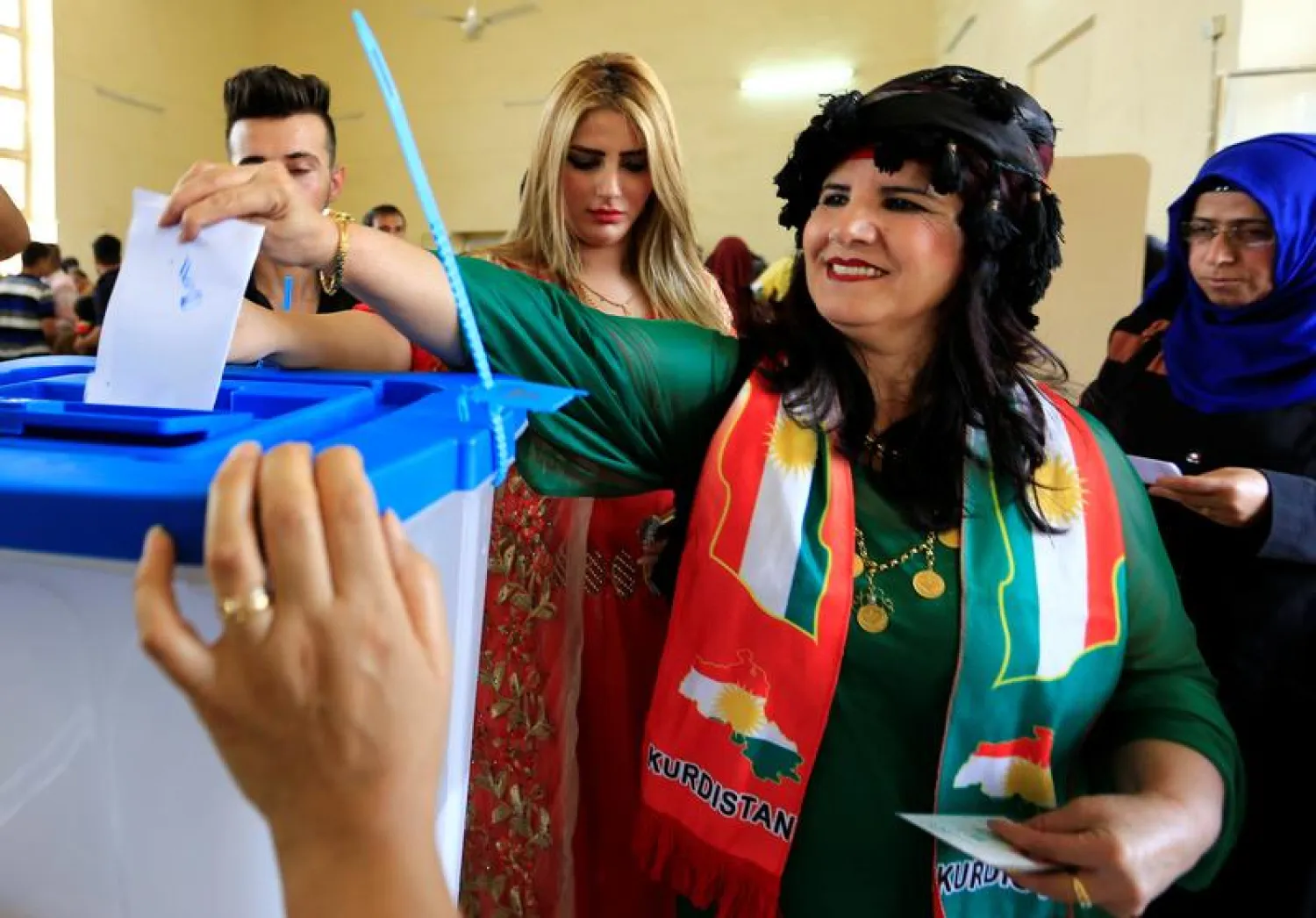
Voter Turnout Drops 18% in Kurdistan's 'Special Elections'

A woman casts her vote at a polling station in Kirkuk (Reuters)
TT

Voter Turnout Drops 18% in Kurdistan's 'Special Elections'

A woman casts her vote at a polling station in Kirkuk (Reuters)

Voter turnout in the special elections of the Kurdistan region dropped significantly to 74 percent, compared to previous figures registered in 2018 at 94 percent.

Iraq's Independent High Electoral Commission (IHEC) announced that participation in the special voting declined 18 percent, compared to the 2018 polls.

In an official statement on its website, the Commission announced that the highest participation rate was in Sulaymaniyah, which recorded 78 percent.

Erbil, the capital of the Kurdistan Region, ranked second with a participation rate of 75 percent, and the Dohuk governorate recorded a participation rate of 69 percent.

Shams Network for monitoring the elections announced that it had observed several violations during the special polls of the region, and opposition forces said that over half of the security forces did not vote for the authority’s parties.

During a press conference in Erbil, the network's coordinator, Hoshyar Malo, said the voting took place without significant security breaches. But he observed other complications like the absence of some voters’ names, and malfunction in some machines.

Malo also noted a disparity in the application of procedures between centers.


Board of Peace Delivers Bleak Report on Gaza, Warning of Ceasefire Collapse without Immediate Action

Palestinians walk past the rubble of destroyed buildings and displacement tents in Khan Younis in the southern Gaza Strip on November 17, 2026. (AFP)
TT

Board of Peace Delivers Bleak Report on Gaza, Warning of Ceasefire Collapse without Immediate Action

Palestinians walk past the rubble of destroyed buildings and displacement tents in Khan Younis in the southern Gaza Strip on November 17, 2026. (AFP)

The body overseeing the US-brokered ceasefire in Gaza delivered another bleak report Tuesday on its progress to the United Nations Security Council, warning diplomats of a collapse of the fragile agreement if steps are not taken for full implementation.

The Board of Peace report — its first annual assessment — calls on both Israel and Hamas to uphold the commitments made last year under the agreement and urges the UN's most powerful body to lend its support to the execution.

“The distance between what has been agreed and what is happening on the ground nonetheless remains the principal risk to the process,” the report says in its conclusion, a copy of which was obtained by The Associated Press.

It is the latest admonishment from the board in recent weeks as deadly Israeli strikes and the continued blocking of humanitarian aid to Gaza have caused widespread devastation to the civilian population, which the board says is set to face “another winter in tents and rubble.”

The report goes on to point out how continued Israeli strikes in Gaza and Hamas military activity have stalled efforts for both sides to adhere to the road map.

“A ceasefire that delivers nothing visible cannot be sustained indefinitely,” the report said. “Should it collapse, there would be no road map to return to, no administration to deploy and no enabling environment to rebuild.”

Apart from continued fighting, the report laments that the technocratic civil administration body the board created to run Gaza on an interim basis has still not been allowed by Israel to take up its job in the territory.

This, in turn, has delayed deployment of an international stabilization force, which is key to Israel’s withdrawing troops from Gaza, the disarmament of Hamas and the start of reconstruction.

To get things moving, the board appealed to the Security Council to put its full weight behind the agreement it endorsed last year and urged the parties to stop delays.

“Neither party may treat the other’s delay as license for its own inaction, and together these obligations are the only route to Israeli withdrawal and reconstruction at scale,” the report said.

It added that the end result “must lead to the credible pathway to Palestinian self-determination and statehood ... and no unilateral step should be allowed to foreclose it.”


Syria, Türkiye Hold Talks to Expand Cooperation Across Sectors

Syrian Foreign Minister Asaad al-Shaibani and his Turkish counterpart Hakan Fidan during a joint press conference in Ankara. (SANA via Anadolu)
TT

Syria, Türkiye Hold Talks to Expand Cooperation Across Sectors

Syrian Foreign Minister Asaad al-Shaibani and his Turkish counterpart Hakan Fidan during a joint press conference in Ankara. (SANA via Anadolu)

Syrian Foreign Minister Asaad al-Shaibani and his Turkish counterpart Hakan Fidan pledged on Tuesday to deepen bilateral ties and expand cooperation across various sectors, while calling for an end to Israeli attacks on Syria and respect for its sovereignty and territorial integrity.

The two ministers stressed the need to uphold the 1974 Disengagement Agreement to bolster regional stability.

Their remarks came at a joint press conference in Ankara following talks on strengthening the Syrian-Turkish partnership and addressing regional issues of mutual concern.

Shaibani said discussions covered bilateral relations, regional developments and the final steps toward establishing and activating a joint higher committee, reported Syria’s state news agency SANA.

He said the growing partnership between Damascus and Ankara was already yielding tangible results.

Shaibani cited the completed rehabilitation of the Aleppo-Birecik electricity interconnection line, with plans to boost its capacity to 500 megawatts, and the launch of direct flights from Damascus to Antalya and Izmir.

Work is also accelerating to rehabilitate border crossings, with the Qamishli-Nusaybin crossing expected to reopen soon.

"At the strategic level, we discussed ways to strengthen cooperation in training and capacity building and enhance coordination in combating terrorism and organized crime, based on the principle of Syrian state sovereignty over its entire territory," Shaibani said.

Rail, energy projects

Shaibani said Syria and Türkiye's strategic location as a vital corridor between Europe and the Gulf placed a shared responsibility on both countries.

The two sides agreed to accelerate a railway project linking Türkiye through Syria to Jordan and Gulf states.

Talks also focused on digital connectivity as "essential infrastructure for supporting trade and investment," alongside efforts to draft a strategic framework for linking regional electricity and gas networks.

Water security was another priority, with the ministers discussing ways to ensure "fair and stable water releases into the Euphrates River that meet farmers' needs," SANA quoted Shaibani as saying.

Trade nears $3.7 billion

Shaibani said bilateral trade approached $3.7 billion in 2025, surging more than 40% and moving the two neighbors closer to their shared target of $10 billion.

Efforts are underway to ease Syrian products' entry into Turkish markets and establish a legal framework to protect investors, facilitate financing and streamline visa procedures.

The two countries are also working to create conditions for the voluntary, sustainable and dignified return of Syrian refugees, he added.

Syria, Türkiye align on regional security

Turning to regional developments, Shaibani reaffirmed Syria's solidarity with Gulf countries over Iranian attacks targeting them since February, declaring Gulf security an integral part of Syria's national security.

He said Damascus and Ankara shared a commitment to a negotiated settlement that would end the wars and safeguard freedom of navigation through international waterways, particularly the Hormuz and Bab al-Mandeb Straits.

"A recovering Syria today stands as a strong bulwark against chaos and a bridge for trade and stability linking the Gulf with Türkiye and Europe," Shaibani said.

He described Syria's stability as the cornerstone of Middle East stability and Türkiye as an indispensable partner in achieving it.

Shaibani also announced that Syria's embassy in Ankara was expected to open early next month.

Fidan: Israel seeking to destabilize Syria

For his part, Fidan said relations between Türkiye and Syria were "deepening and growing stronger," pointing to the completion of numerous healthcare and education projects in Syria.

He reaffirmed Ankara's commitment to supporting Damascus across all sectors.

Fidan said the talks covered the full range of bilateral relations, including security and defense, and reiterated the importance of respecting Syria's sovereignty and territorial integrity.

He also stressed the need to strengthen Syria's capacity to clear remnants of war left by the former regime.

Fidan accused Israel of seeking to destabilize Syria, urging it to halt attacks on Syrian territory and comply with the 1974 Disengagement Agreement.


Ibb Records Highest Number of Cancer Cases in Yemen

A cancer treatment center in Ibb receives five to 10 new cases daily. (Local media)
TT

Ibb Records Highest Number of Cancer Cases in Yemen

A cancer treatment center in Ibb receives five to 10 new cases daily. (Local media)

Health fears are mounting in Yemen’s Houthi-controlled Ibb governorate, 192 kilometers south of Sanaa, as cancer cases are rising at an alarming rate, with five to 10 new cases recorded daily.

Residents are demanding an investigation into the surge amid growing concerns that it may be linked to crops irrigated with untreated sewage.

According to the National Cancer Control Foundation, based in the Houthi-controlled capital Sanaa, its Al-Amal Oncology Center in Ibb receives between five and 10 new confirmed cancer cases a day, raising alarm over the health situation.

The concerns come amid worsening environmental conditions across Yemen since the outbreak of the conflict. Weak government oversight and soaring energy and fuel costs have driven farmers on the outskirts of major cities, including Ibb, to irrigate crops with untreated sewage.

While no official scientific findings have established the direct causes of the surge, residents suspect a link to vegetables irrigated with sewage over the years.

Since the Houthis coup, the indiscriminate use of banned pesticides and chemical fertilizers has spread, turning the country's food supply into a source of serious health concerns.

Houthis accused of neglect

Residents estimate that around 60% of Yemeni cancer patients traveling to Egypt for treatment come from Ibb governorate.

They accuse the Houthis of turning a blind eye to agricultural practices that contaminate their food and failing to take decisive action to stop them.

Residents told Asharq Al-Awsat that the authorities had done little beyond directing a local university to hold a discussion on the issue, without taking practical steps to address the use of contaminated water for irrigation.

Meanwhile, cancer patients face worsening conditions at Al-Amal Oncology Center, where growing numbers arriving from across the governorate are straining already limited resources.

Medical sources told Asharq Al-Awsat that the center was under mounting pressure from rising patient numbers, while patients and their families struggled with treatment costs and difficulties obtaining essential medicines and medical services.

The sources said Ibb had recorded 9,000 cancer cases, the most across the country.

Despite its limited resources, the center's medical staff strive to provide free diagnostic and treatment services, including medical consultations, laboratory tests, chemotherapy, inpatient care and medication, as well as psychological support for patients.

Residents demand action

Medical sources warn that the center’s ability to sustain these services is increasingly at risk as patient needs outpace available support.

Residents are demanding urgent investigations into the rise in cancer cases, testing of water sources used to irrigate crops and tighter oversight of farms and markets. They are also calling for greater support for Al-Amal Oncology Center to strengthen its capacity to provide free treatment.

The plight of cancer patients in Yemen has deepened amid the collapse of the public healthcare system and the suspension of international support for dozens of medical facilities.

This has left charitable and community-run facilities, such as Al-Amal Oncology Center, as the only line of defense for thousands of impoverished patients unable to afford treatment abroad or costly chemotherapy drugs, amid unpaid salaries and deteriorating living conditions.