


Lebanese Forces Denies Hezbollah Claim it Planned Beirut Bloodshed

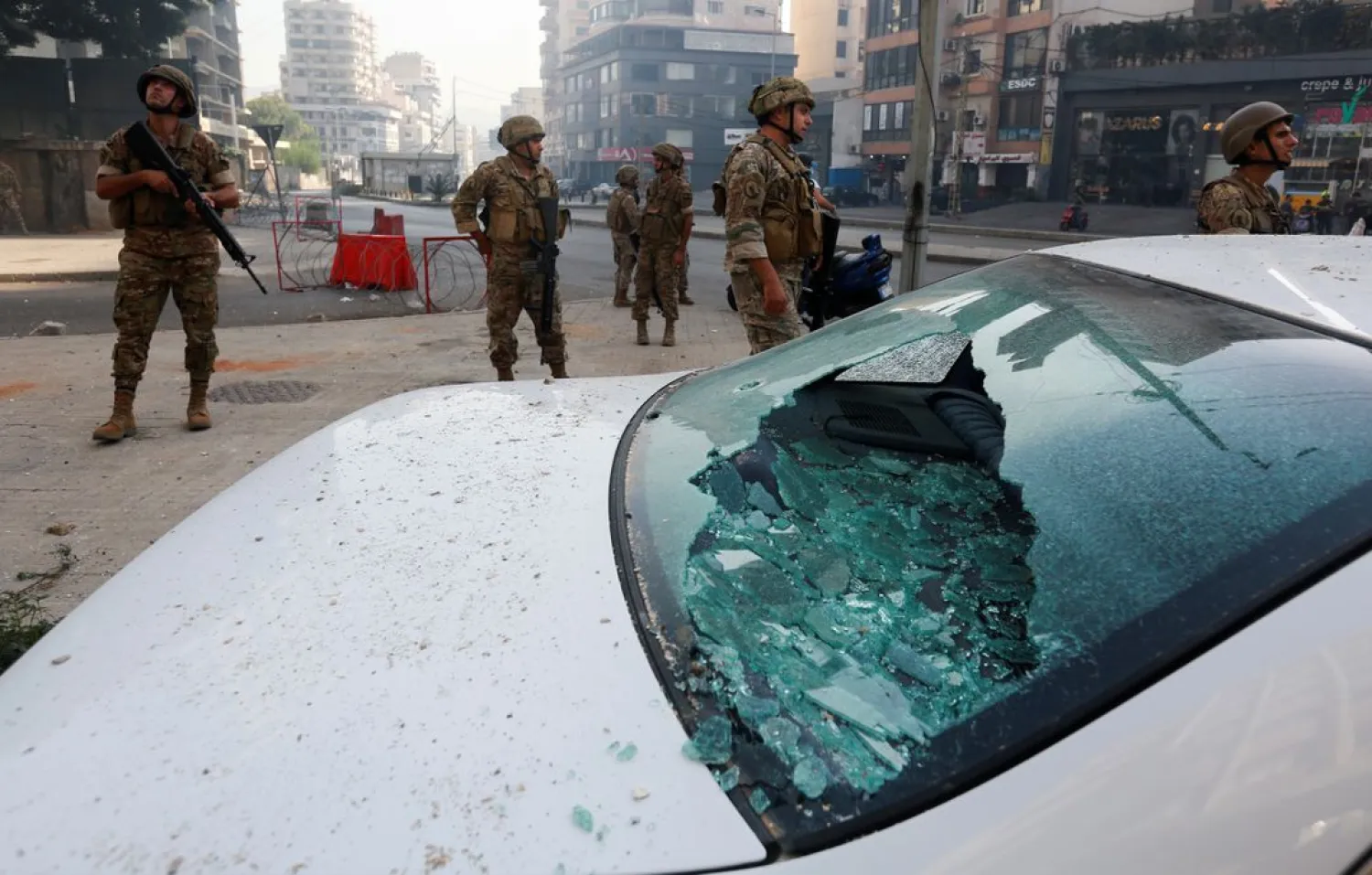
A damaged vehicle is pictured as soldiers are deployed after gunfire erupted in Beirut, Lebanon October 14, 2021. (Reuters)
TT

Lebanese Forces Denies Hezbollah Claim it Planned Beirut Bloodshed

A damaged vehicle is pictured as soldiers are deployed after gunfire erupted in Beirut, Lebanon October 14, 2021. (Reuters)

The head of the Christian Lebanese Forces party (LF) denied late on Friday his group had planned street violence in Beirut that killed seven people, and said a meeting held the day before was purely political.

Thursday's violence, which began as people were gathering for a protest called by Shiite group Hezbollah against the judge investigating last year's Beirut port blast, was the worst in over a decade and stirred memories of the country's ruinous sectarian civil war from 1975-90.

Samir Geagea told Voice of Beirut International radio that a meeting held on Wednesday by a political grouping the LF belongs to had discussed action options should Iran-backed Hezbollah succeed in efforts to remove the judge.

Geagea said the option agreed upon in that event was to call for a public strike, and nothing else.

The Hezbollah party stepped up accusations against the LF on Friday, saying it killed the seven Shiites to try to drag the country into a civil war.

The violence, which erupted at a boundary between Christian and Shiite neighborhoods, has added to concerns over the stability of a country that is awash with weapons and grappling with one of the world's worst ever economic meltdowns.

Asked whether the presence of LF members in the areas of Ain al-Remmaneh and Tayouneh, where the shooting erupted, meant the incident was planned, Geagea said they were always present in these areas.

The security coordinator in the party contacted the authorities when they heard a protest was planned and asked for a heavy military presence in the area "as our priority was for the demonstration to pass by simply as a demonstration and not affect civil peace," Geagea said.

Geagea said his party was assured that would be the case.

"The army has arrested snipers so they need to tell us who they are and where they came from."

Nineteen people have been detained so far in relation to the incident.

Geagea also criticized President Michel Aoun over a phone call between the two during the incident.

Aoun's party, the Free Patriotic Movement (FPM), Lebanon's largest Christian bloc, is an ally of Hezbollah.

"I didn't like this call at all," Geagea said, saying Aoun implicitly made the same accusations of involvement that Hezbollah has by asking him to calm down the situation.

"This is totally unacceptable."


US Forces Withdraw from Syria's Al-Tanf Base

An American soldier shakes hands with a member of the Syrian Democratic Forces (SDF) in the Al-Tanf region - December 28, 2024 (US Army)
TT

US Forces Withdraw from Syria's Al-Tanf Base

An American soldier shakes hands with a member of the Syrian Democratic Forces (SDF) in the Al-Tanf region - December 28, 2024 (US Army)

US forces have withdrawn to Jordan from Syria's Al-Tanf base, where they had been deployed as part of the international coalition against the ISIS group, two Syrian military sources told AFP on Wednesday.

One source said "the American forces withdrew entirely from Al-Tanf base today" and decamped to another in Jordan, adding Syrian forces were being deployed to replace them.

A second source confirmed the withdrawal, adding the Americans had been moving equipment out for the past 15 days.

The second source said the US troops would "continue to coordinate with the base in Al-Tanf from Jordan".

During the Syrian civil war and the fight against ISIS, US forces were deployed in the country's Kurdish-controlled northeast and at Al-Tanf, near the borders with Jordan and Iraq.

The Kurdish-led Syrian Democratic Forces (SDF) had been a major partner of the anti-ISIS coalition, and were instrumental in the group's territorial defeat in Syria in 2019.

However, after the fall of longtime ruler Bashar al-Assad over a year ago, the United States has drawn closer to the new government in Damascus, recently declaring that the need for its alliance with the Kurds had largely passed.

Syria agreed to join the anti-ISIS coalition when President Ahmed al-Sharaa visited the White House in November.

As Sharaa's authorities seek to extend their control over all of Syria, the Kurds have come under pressure to integrate their forces and de facto autonomous administration into the state, striking an agreement to do so last month after losing territory to advancing government troops.

Since then, the US has been conducting an operation to transfer around 7,000 suspected extremists from Syria -- where many were being held in detention facilities by Kurdish fighters -- to neighboring Iraq.

Following the withdrawal from Al-Tanf and the government's advances in the northeast, US troops are mainly now based at the Qasrak base in Hasakeh, according to the Syrian Observatory for Human Rights.

Despite ISIS's territorial defeat, the group remains active.

It was blamed for a December attack in Palmyra in which a lone gunman opened fire on American personnel, killing two US soldiers and a US civilian.

Washington later conducted retaliatory strikes on ISIS targets in Syria.


UN: Syria's President and 2 Top Ministers Were Targets of 5 Foiled Assassination Attempts

Syrian President Ahmed al-Sharaa gestures speaking with Russian President Vladimir Putin during their meeting at the Kremlin in Moscow, Russia, 28 January 2026. MAXIM SHIPENKOV/Pool via REUTERS
TT

UN: Syria's President and 2 Top Ministers Were Targets of 5 Foiled Assassination Attempts

Syrian President Ahmed al-Sharaa gestures speaking with Russian President Vladimir Putin during their meeting at the Kremlin in Moscow, Russia, 28 January 2026. MAXIM SHIPENKOV/Pool via REUTERS

Syria’s president, interior minister and foreign minister were the targets of five foiled assassination attempts last year, the UN chief said in a report on threats posed by ISIS militants released Wednesday.

The report said President Ahmad al-Sharaa was targeted in northern Aleppo, the country’s most populous province, and southern Daraa by a group assessed to be a front for the ISIS group.

The report, issued by Secretary-General António Guterres and prepared by the UN Office of Counter-Terrorism, gave no dates or details of the attempts against al-Sharaa or Syrian Interior Minister Anas Hasan Khattab and Foreign Minister Asaad al-Shibani.

The assassination attempts are more evidence that the militant group remains intent on undermining the new Syrian government and “actively exploiting security vacuums and uncertainty” in Syria, the report said.

It said al-Sharaa was “assessed to be a primary target” of the ISIS. And it said the front group provided ISIS with plausible deniability and "improved operational capacity.”

Al-Sharaa has led Syria since his opposition forces ousted longtime Syrian President Bashar Assad in December 2024, ending a 14-year civil war.

In November, his government joined the international coalition formed to counter the ISIS group, which once controlled a large part of Syria.

The UN counter-terrorism experts said the militant group still operates across the country, primarily attacking security forces, particularly in the north and northeast.

In one ambush attack on Dec. 13 on US and Syrian forces near Palmyra, two US servicemen and an American civilian were killed and three Americans and three members of Syria's security forces were wounded. President Donald Trump retaliated, launching military operations to eliminate ISIS fighters.

According to the UN counter-terrorism experts, the ISIS group maintains an estimated 3,000 fighters across Iraq and Syria, the majority of them based in Syria.

The US military in late January began transferring ISIS detainees who were held in northeastern Syria to Iraq to ensure they remain in secure facilities. Iraq has said it will prosecute the militants.

Syrian government forces had taken control of a sprawling camp housing thousands of ISIS detainees following the withdrawal of the US-backed Syrian Democratic Forces as part of a ceasefire with the Kurdish fighters.

The report released Wednesday to the UN Security Council said as of December, before the ceasefire deal, more than 25,740 people remained in the al-Hol and Roj camps in the northeast, more than 60% of them children, with thousands more in other detention centers.


Lebanon to Decide on Plan to Control Arms North of Litani Next Week, Minister Says

FILE PHOTO: Lebanese army members stand on a military vehicle during a Lebanese army media tour, to review the army's operations in the southern Litani sector, in Alma Al-Shaab, near the border with Israel, southern Lebanon, November 28, 2025. REUTERS/Aziz Taher/File Photo
TT

Lebanon to Decide on Plan to Control Arms North of Litani Next Week, Minister Says

FILE PHOTO: Lebanese army members stand on a military vehicle during a Lebanese army media tour, to review the army's operations in the southern Litani sector, in Alma Al-Shaab, near the border with Israel, southern Lebanon, November 28, 2025. REUTERS/Aziz Taher/File Photo

Lebanon’s ‌government will decide next week how to move to the second phase of a plan to extend its authority and place all arms under state control in areas north of the Litani River, its information minister said on Wednesday.

The decision will be based on a presentation by the army outlining its needs and capabilities, the minister, Paul Morcos, told reporters during a visit to Kuwait, where he was attending an ‌Arab meeting.

The ‌Lebanese army said in January that ‌it ⁠had taken operational control ⁠in the area between the Litani River and the border with Israel. The cabinet asked the army to brief it in early February on how to pursue disarmament in other parts of the country, Reuters reported.

"We have completed the first phase, south of the ⁠Litani River. Next week the government will ‌take a decision regarding the ‌second phase considering what the army commander sets out ‌in terms of needs and capabilities, so that ‌we can decide accordingly, based on that explanation," Morcos said.

Lebanon has been seeking to place all arms under state control, in line with a November 2024 US-brokered ceasefire that ended ‌a war between Israel and the Iran-backed Hezbollah group.

Morcos ruled out ⁠the ⁠possibility of any confrontation between the Lebanese army and Hezbollah, saying the objective was "to extend state authority and achieve stability, and insofar as these goals can be achieved together, we will proceed".

Israel has carried out regular strikes in Lebanon since the end of the war with Hezbollah, killing around 400 people since the ceasefire, according to a toll from Lebanese security sources.

Israel has accused Hezbollah of seeking to rearm in violation of the ceasefire agreement with Lebanon. Hezbollah says it has respected the ceasefire in southern Lebanon.
