

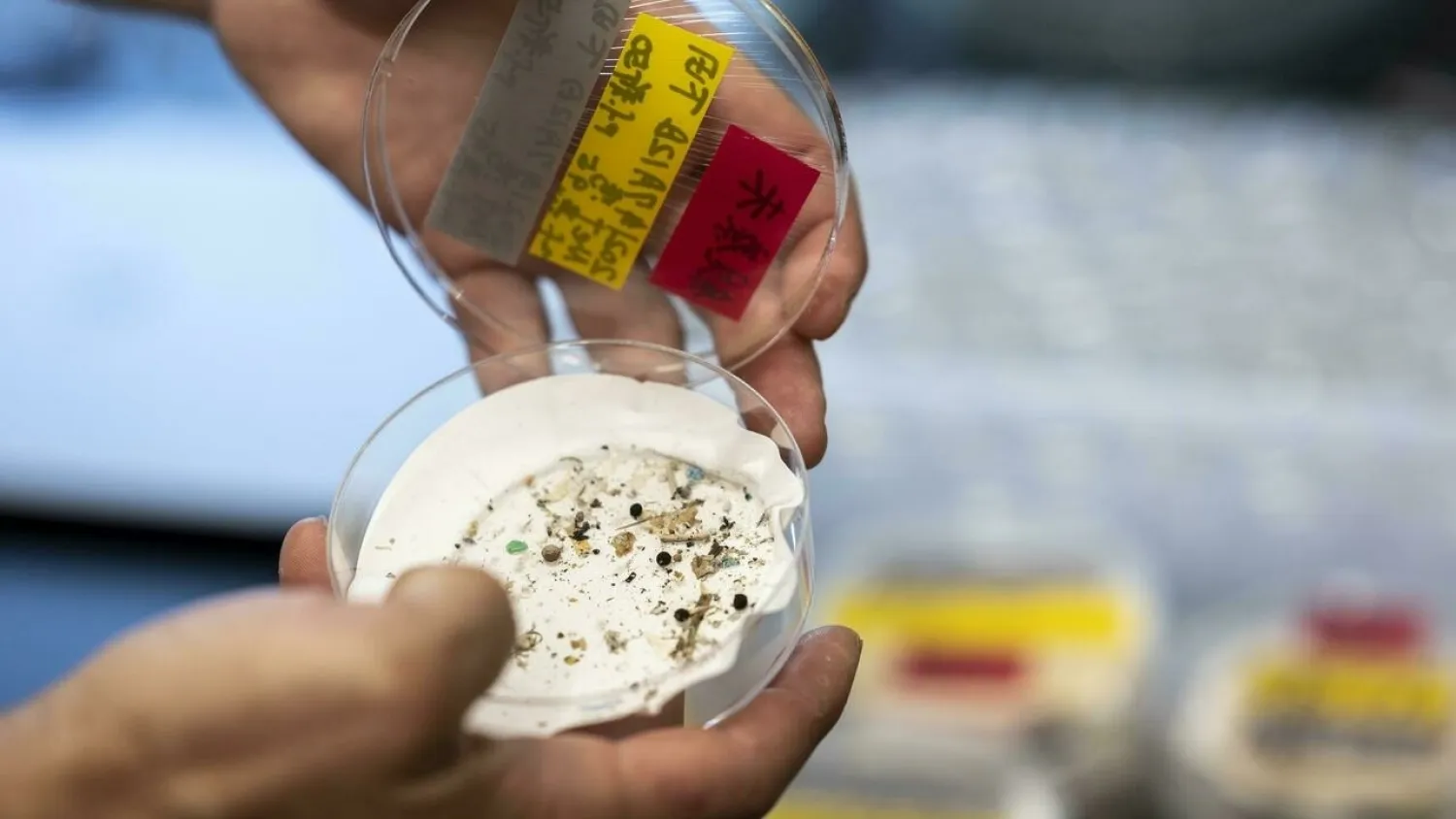

Into the 'Plastisphere': Scientists Comb Japan Waters to Study New Eco Threat

Tiny floating fragments from plastic packaging, synthetic clothing and fishing nets have proliferated over the past four decades, and are now found in every part of the world's oceans. Charly TRIBALLEAU AFP
TT

Into the 'Plastisphere': Scientists Comb Japan Waters to Study New Eco Threat

Tiny floating fragments from plastic packaging, synthetic clothing and fishing nets have proliferated over the past four decades, and are now found in every part of the world's oceans. Charly TRIBALLEAU AFP

A boat's crew casts a net into the seemingly clean waters off Japan's Izu peninsula, but not to catch fish -- they are scooping up microplastics to learn more about the pollution's impact on marine life.

Tiny floating fragments from plastic packaging, synthetic clothing and fishing nets have proliferated over the past four decades, and are now found in every part of the world's oceans -- even the deepest trench.

The planet's seafloor is littered with an estimated 14 million tons of microplastics, according to a study released last year, and scientists say more research on them is urgently needed, including their effect on ecosystems, the food chain and human health.

So a team of French and Japanese researchers is analyzing samples from the archipelago's coastal waters to study how microplastics make their way into the sea, and how much seeps into the ocean floor.

They are also examining the so-called "plastisphere", where micro-organisms live among discarded plastic.

"It's a new ecosystem that didn't exist before the 1970s. So we don't really know which types of microbes are associated with this plastic," Sylvain Agostini, scientific director of the Tara-Jambio project, told AFP.

Having left the funnel-shaped net nicknamed "the sock" to drift for 15 minutes near the surface, the crew hoisted it back on deck to inspect their catch.

"This blue stuff is microplastics, and that's polystyrene, I believe," Agostini said.

They have collected more than 200 samples since their study began in April 2020, all of which contain microplastics.

Jonathan Ramtahal, a student from Trinidad and Tobago taking part in the research, said the team aims to determine whether the bacteria they find is "harmful to the wider food chain".

"Is it something we should be worried about -- do they transport any vectors for diseases? The diversity of bacteria can give us an idea of how it changes in different environments," he said.

- 'Lead by example' -
Other studies have shown that microplastics have infiltrated the planet's most remote regions, and France's Tara Ocean Foundation has previously researched them in the Mediterranean and large European rivers.

Now the foundation is in Japan, the second-biggest producer of plastic packaging waste per capita according to the United Nations.

The Japanese government says its vast waste management scheme stops plastic from finding its way to the sea, and industry research shows 85 percent of plastic waste in Japan is recycled -- although much is burnt for energy, emitting carbon dioxide.

Keiji Nakajima, director of marine plastic pollution control at the environment ministry, said Japan's waters are also affected by the waste of its neighbors.

"Japan's streets and streams are cleaner than those of other countries," he said.

The nation sits "downstream of a major oceanic current that sweeps in plastic waste produced in Southeast Asia and China", Nakajima added.

A 2018 UN report named the United States as the biggest generator of plastic packaging waste per capita, with China the largest overall.

Agostini, an assistant professor at the University of Tsukuba northeast of Tokyo, said that while "there is some truth" in this explanation, it is not watertight.

When plastic waste is found at a river's estuary, or a secluded bay, it's clear that "it doesn't come from thousands of kilometers away", he said.

The Tara-Jambio project is unlikely to settle that debate when its findings are published in several years time, but Agostini argues that if even a small proportion of Japan's plastic waste seeps into the ocean, it is still an "enormous quantity".

Japan is taking small steps to reduce its reliance on plastic: in 2019, it set a target to recycle 100 percent of new plastic by 2035, and last year, stores began charging for plastic bags.

"Packaging habits are ingrained" in Japan, said Kazuo Inaba, head of the Japanese marine-station network Jambio, but he and the team say change is necessary.

"If developed countries don't lead by example, no one will do it," Agostini said.


Spain and Portugal Continue to Battle Storm Leonardo as New Storm Approaches

 A mountain landslide blocks railway tracks during heavy rains, as storm Leonardo hits parts of Spain, in Benaojan, Spain, February 6, 2026. (Reuters)
A mountain landslide blocks railway tracks during heavy rains, as storm Leonardo hits parts of Spain, in Benaojan, Spain, February 6, 2026. (Reuters)
TT

Spain and Portugal Continue to Battle Storm Leonardo as New Storm Approaches

 A mountain landslide blocks railway tracks during heavy rains, as storm Leonardo hits parts of Spain, in Benaojan, Spain, February 6, 2026. (Reuters)
A mountain landslide blocks railway tracks during heavy rains, as storm Leonardo hits parts of Spain, in Benaojan, Spain, February 6, 2026. (Reuters)

Storm Leonardo continued to batter the Iberian Peninsula on Friday, bringing floods and putting rivers at risk of bursting their banks while thousands of people were evacuated from their homes in Spain and Portugal.

In southern Spain's Andalusia region, some 7,000 people have had to leave their homes due to successive storms.

Among them were around 1,500 people ordered to evacuate the mountain village of Grazalema, where Andalusia's regional leader Juan Manuel Moreno warned that aquifers were "full to the brim with water,” and at risk of collapsing.

“It's raining on already saturated ground. The land is unable to drain," Moreno said. “We urge extreme caution. This is not over.”

Spanish police said Friday they had found a body located 1,000 meters (about 0.6 miles) away from where a woman had disappeared Wednesday after she fell into a river in Malaga province while trying to rescue her dog. Police said they had not yet identified the body, but believed it belonged to the 45-year-old woman.

Another storm front, Marta, was expected to arrive Saturday, with Spain's weather agency AEMET saying it would bring even more rain and heavy winds, including to areas already drenched by Storm Leonardo.

Marta is expected to affect Portugal, too.

Of particular concern was southern Spain's Guadalquivir River, which flows through Córdoba and Seville and eventually into the Atlantic Ocean, and whose water levels have dramatically risen in recent days.

Additional rain Saturday could leave many more homes at risk in Córdoba, local authorities warned.

In Portugal, parts of Alcacer do Sal were submerged after the Sado River overflowed, forcing residents to leave the city located 90 kilometers (about 56 miles) south of Lisbon.

Alerts were issued also for regions near the Tagus River due to rising water levels.

A separate storm in late January left a trail of destruction in Portugal, killing several people, according to Portuguese authorities.


AROYA Cruises Debuts Arabian Gulf Voyages for 2026

AROYA offers a curated experience featuring culturally inspired entertainment and diverse dining options - SPA
TT

AROYA Cruises Debuts Arabian Gulf Voyages for 2026

AROYA offers a curated experience featuring culturally inspired entertainment and diverse dining options - SPA

AROYA Cruises, a subsidiary of the PIF-owned Cruise Saudi, has officially launched its inaugural season in the Arabian Gulf.

Running from February 21 to May 8, the season marks a milestone in regional tourism by blending authentic Saudi hospitality with international maritime standards, SPA reported.

AROYA offers a curated experience featuring culturally inspired entertainment and diverse dining options.

The season is designed to provide guests with a dynamic way to explore the Gulf, setting a new benchmark for luxury travel that reflects the Kingdom's heritage on a global stage.


Snowstorm Brings Much of Denmark to a Halt

A car drives in heavy snow at Store Heddinge in South Zealand, Denmark, 05 February 2026.  EPA/Mads Claus Rasmussen
A car drives in heavy snow at Store Heddinge in South Zealand, Denmark, 05 February 2026. EPA/Mads Claus Rasmussen
TT

Snowstorm Brings Much of Denmark to a Halt

A car drives in heavy snow at Store Heddinge in South Zealand, Denmark, 05 February 2026.  EPA/Mads Claus Rasmussen
A car drives in heavy snow at Store Heddinge in South Zealand, Denmark, 05 February 2026. EPA/Mads Claus Rasmussen

Denmark authorities halted public transport, closed schools and cancelled flights on Friday as heavy snowfall blanketed much of the country.

The Nordic country's meteorological institute DMI warned that heavy snow would likely continue until Friday evening in the east, where the capital Copenhagen is located.

Police said people should avoid going outdoors unless necessary and stay indoors in the capital and the surrounding region.

Copenhagen's airport cancelled flights to Paris and Berlin and warned of "delay and cancellation risks because of snowy conditions." Many schools were closed.

In the second-largest city of Aarhus, bus services were cancelled.
