Rights Group: Israeli Settler Violence Tool to Seize Palestinian Landshttps://english.aawsat.com/home/article/3303846/rights-group-israeli-settler-violence-tool-seize-palestinian-lands
Rights Group: Israeli Settler Violence Tool to Seize Palestinian Lands
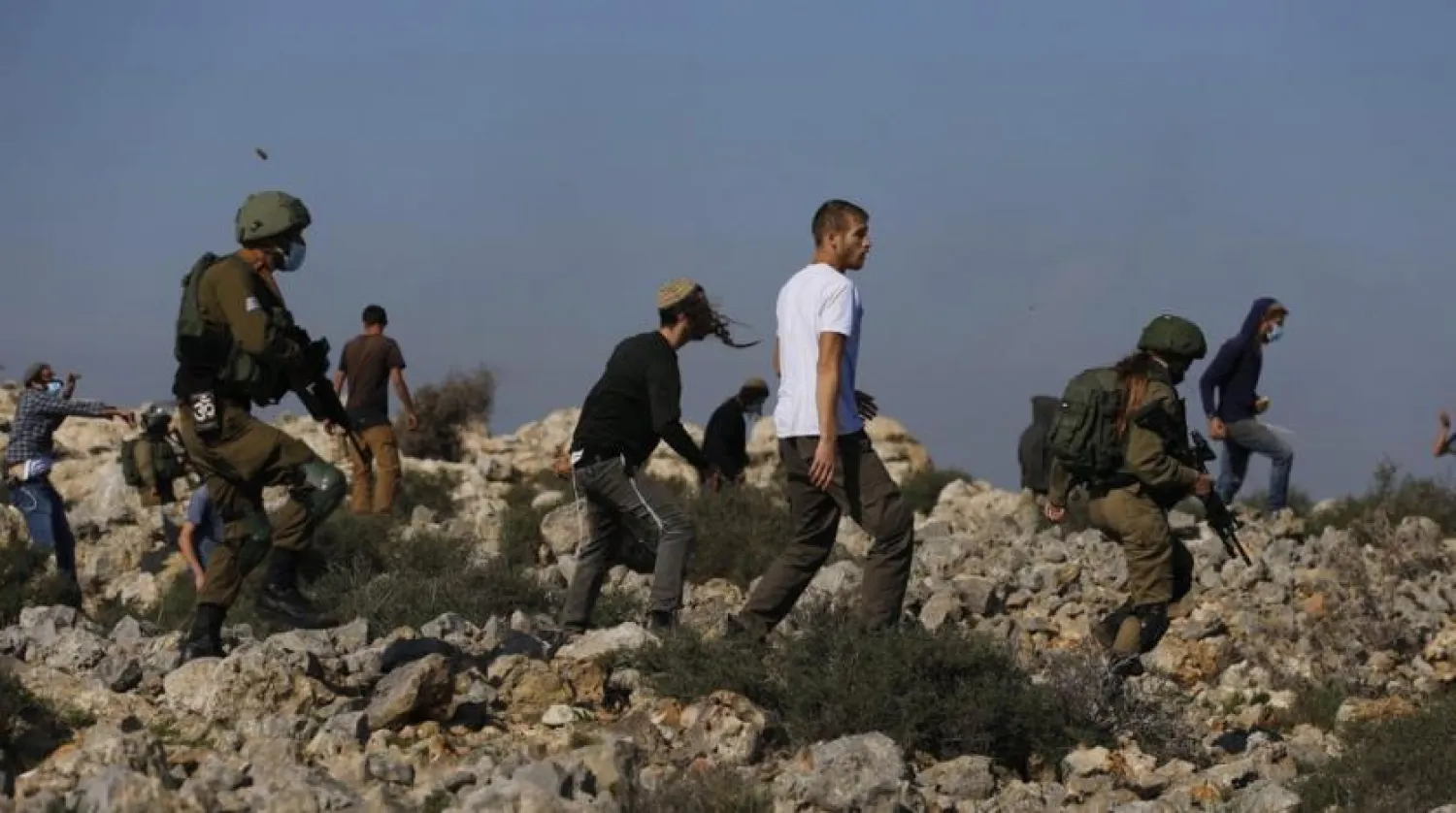
Israeli soldiers and settlers clash with Palestinians during a protest against the expansion of Jewish settlements near the West Bank town of Salfit, Monday, Nov. 30, 2020. (AP Photo/Majdi Mohammed)
Rights Group: Israeli Settler Violence Tool to Seize Palestinian Lands
Israeli soldiers and settlers clash with Palestinians during a protest against the expansion of Jewish settlements near the West Bank town of Salfit, Monday, Nov. 30, 2020. (AP Photo/Majdi Mohammed)
Israel has been using settler violence as a "major informal tool" to drive Palestinians from farming and pasture lands in the occupied West Bank, an Israeli rights group said Sunday.
A report by the group B´Tselem detailed the takeover of nearly 11 square miles (30 square kilometers) of farm and pasture land in the territory by settlers over the past five years. That's an area around half the size of the island of Manhattan, The Associated Press reported.
B´Tselem also challenged repeated claims by the government that violence against Palestinians is carried out by a violent fringe among the settlers and security forces are doing their best to stop it.
Recent months have seen a steep increase in violence committed by Jewish settlers in the West Bank against Palestinians. Last week, a group of Israeli settlers vandalized dozens of cars in a town near Ramallah, and in September, dozens of Israeli settlers attacked a Bedouin village in the southern West Bank, leaving several injured, including a Palestinian toddler.
B'Tselem said the military "does not prevent the attacks, and in some cases, soldiers even participate in them." It says that law enforcement does little to take action against settlers who commit violent acts against Palestinians "and whitewashes the few cases it is called upon to address."
"When the violence occurs with permission and assistance from the Israeli authorities and under its auspices, it is state violence. The settlers are not defying the state; they are doing its bidding," the organization said in its report.
The Israeli military did not immediately respond to a request for comment on the report.
Israel captured the West Bank in the 1967 Mideast war. In the decades since, it has built dozens of settlements - now home to nearly 500,000 Israelis - that most of the international community considers illegal and an obstacle to peace. The Palestinians seek the West Bank, along with east Jerusalem and the Gaza Strip, as part of their future state.
On Friday, a group of Jewish settlers attacked Palestinians harvesting olives who were accompanied by Israeli activists. Two Israelis, including a prominent rabbi and peace activist, were injured in the incident.
Neta Ben Porat, one of the injured activists, said she suffered injuries to her head and arm. She said the entire area is video monitored by the army, and soldiers chose not to come to their aid. The military said in a statement to Army Radio that troops "separated between the sides and dispersed the confrontation" and arrested three settlers.
Rabbis for Human Rights in Israel said in a statement Friday that "the state and its enforcement agencies are failing time after time to ensure the safety of farmers and activists in the harvest, and the blood spilled today is also on their hands."
Last month, Israeli Defense Minister Benny Gantz called on the military to combat rising settler attacks against Palestinians and Israeli troops in the West Bank to react "systematically, aggressively and uncompromisingly" to such behavior.
Iraqi Counter-Terrorism Force Clashes with Faction in Baghdad, Oil Smugglers Arrestedhttps://english.aawsat.com/arab-world/5291788-iraqi-counter-terrorism-force-clashes-faction-baghdad-oil-smugglers-arrested
Iraqi Counter-Terrorism Force Clashes with Faction in Baghdad, Oil Smugglers Arrested
An Iraqi security personnel stands guard along a street in Baghdad on June 28, 2026. (AFP)
An Iraqi Counter-Terrorism Service force carried out a pre-dawn operation on Friday in Dora, south of Baghdad, targeting a farm believed to be under the control of an armed faction and triggering a firefight between the two sides, Iraqi security sources said.
The sources said the farm belonged to an Iraqi citizen, but preliminary information indicated that control of it had passed to one of the armed factions active in the area. The full circumstances of the operation were still unclear.
A source familiar with the matter said the operation may have been limited to retaking the farm from an armed group that had refused, according to the source, to hand over its weapons to government authorities.
Other unconfirmed information suggested the raid may have targeted a leader from one of the factions operating under the Popular Mobilization Forces.
The source described the operation as the “first of its kind” since the launch on Sunday of a campaign known as “Dawn Assault.” It noted the possibility of tensions between the Counter-Terrorism Service, which has led arrests in recent days, and an armed formation.
The source explained that the operation could test the balance of power between the two sides.
Iraqi authorities have not issued an official statement clarifying the nature or outcome of the operation.
In a related development, a security source said five people were arrested in a special operation in the same area near in Dora.
The source said the detainees were accused of seizing land. Other sources said arrests linked to an oil-smuggling case targeted wanted individuals connected to people detained last Sunday.
Local reports, citing security sources, said Thursday night into Friday saw arrests in Baghdad, Maysan, and Salahuddin of suspects accused of “corruption,” as well as clashes with people accused of oil smuggling from an armed faction linked to Iran.
“A number of the detainees are relatives of people being held for questioning over corruption suspicions arising from oil smuggling,” sources said.
Anti-corruption drive expands
Meanwhile, thousands of followers of influential cleric Moqtada al-Sadr ralied to “support the government’s efforts to pursue the corrupt.”
In a unified address read after Friday prayers in several Iraqi provinces, Sadr said: “We have been and remain advocates of reform, and we do not gather with the corrupt.”
“You have been and remain with me in hardship and ease. Let us continue our path in support of reform and the new reform campaign whose light has begun to shine through our Iraq,” he urged.
Addressing his supporters, he said: “Rise for a peaceful stand that supports reform and the soldier of reform, our brother Ali al-Zaidi, the Iraqi prime minister, to strengthen his resolve and weaken the resolve of the corrupt, who are trying to pressure him and deter him from the brave and fruitful raids that have terrified and disturbed many inside and outside the country.”
Separately, a statement from al-Zaidi's office said he chaired a security and economic meeting attended by security and oversight chiefs.
He ordered anti-corruption measures expanded to all state institutions without exception and called for stronger coordination between law enforcement agencies and oversight bodies to track suspects and recover public funds.
The prime minister reiterated that the government would continue implementing its reform program, pursuing those involved in corruption cases and referring them to the judiciary, while adopting preventive measures to strengthen oversight bodies.
After 1,000 Days, Israel Shifts ‘Yellow Line’ to Expand Control in Gazahttps://english.aawsat.com/arab-world/5291785-after-1000-days-israel-shifts-%E2%80%98yellow-line%E2%80%99-expand-control-gaza
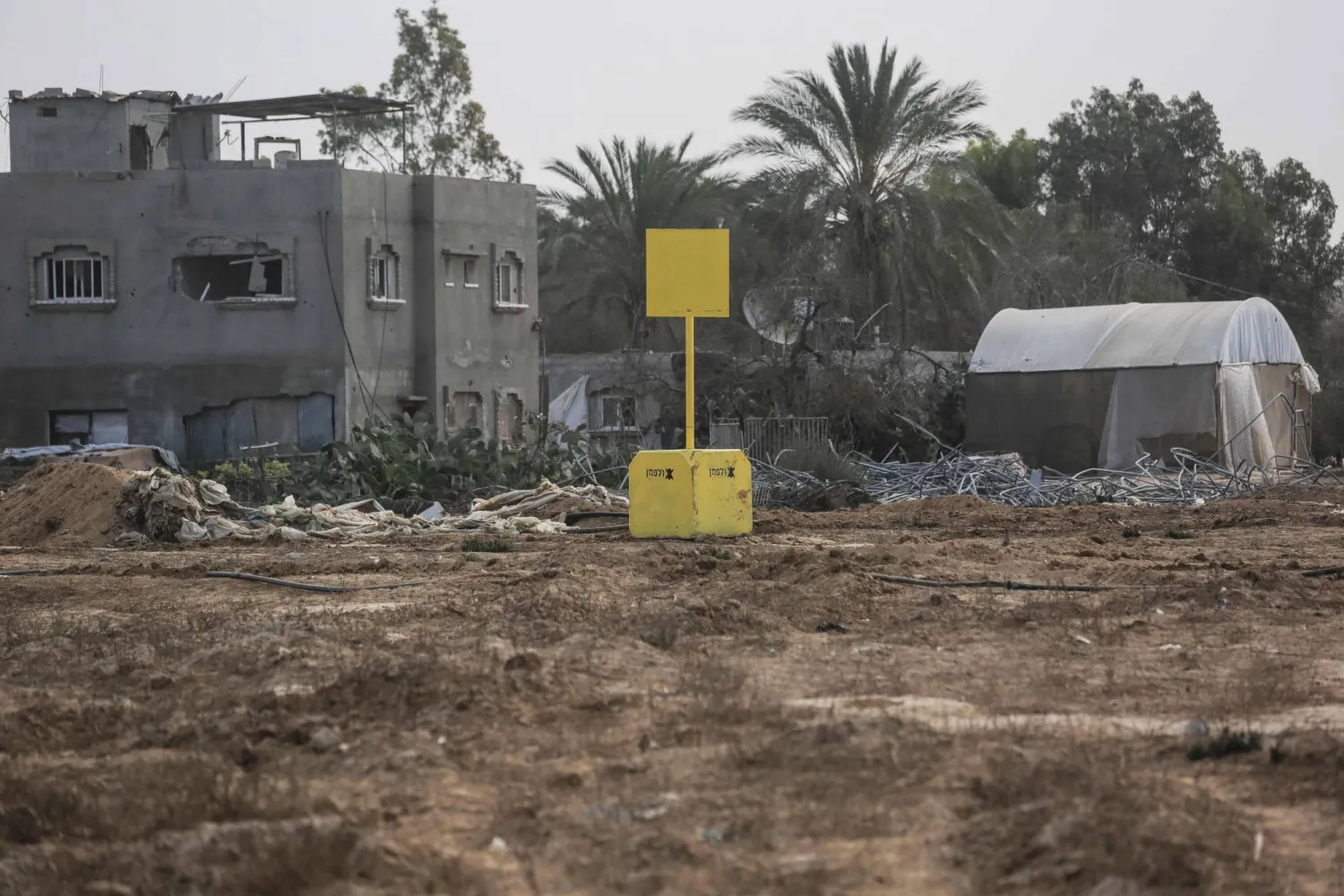
A general view of a concrete block (back) marking the "yellow line" drawn by the Israeli military in Bureij, central Gaza Strip, on November 4, 2025. (AFP)
After 1,000 Days, Israel Shifts ‘Yellow Line’ to Expand Control in Gaza
A general view of a concrete block (back) marking the "yellow line" drawn by the Israeli military in Bureij, central Gaza Strip, on November 4, 2025. (AFP)
Recent remarks by Israeli Prime Minister Benjamin Netanyahu that his forces intended to expand their control inside Gaza to 70% of the territory, in a bid to tighten pressure on Hamas and force it to disarm, were not merely media threats.
In recent days, they have become a clear reality on the ground.
A field review by Asharq Al-Awsat of the situation before and after Netanyahu’s remarks showed that Israel has significantly expanded its control over new areas inside the enclave by pushing the “yellow line” deeper into Gaza.
As the war marked 1,000 days since Oct. 7, 2023, Israeli Defense Minister Israel Katz said 83% of tunnels behind the “yellow line” had been destroyed so far. He stressed that Israeli forces would not withdraw from the security zone in Gaza.
Wide control
Four field sources, speaking separately to Asharq Al-Awsat, said Israeli ground control operations had reached almost every part of Gaza, with most extending to Salah al-Din Street, the main road running from the south to the north of the enclave.
The sources said the operations hit Khan Younis in southern Gaza from several directions, as well as Deir al-Balah, the village of al-Masdar, al-Maghazi, Wadi Gaza in central Gaza, Kuwait Roundabout, Dawla, the Shujaiyya and Tuffah neighborhoods of Gaza City, Jabalia camp, and al-Atatra in northern Gaza.
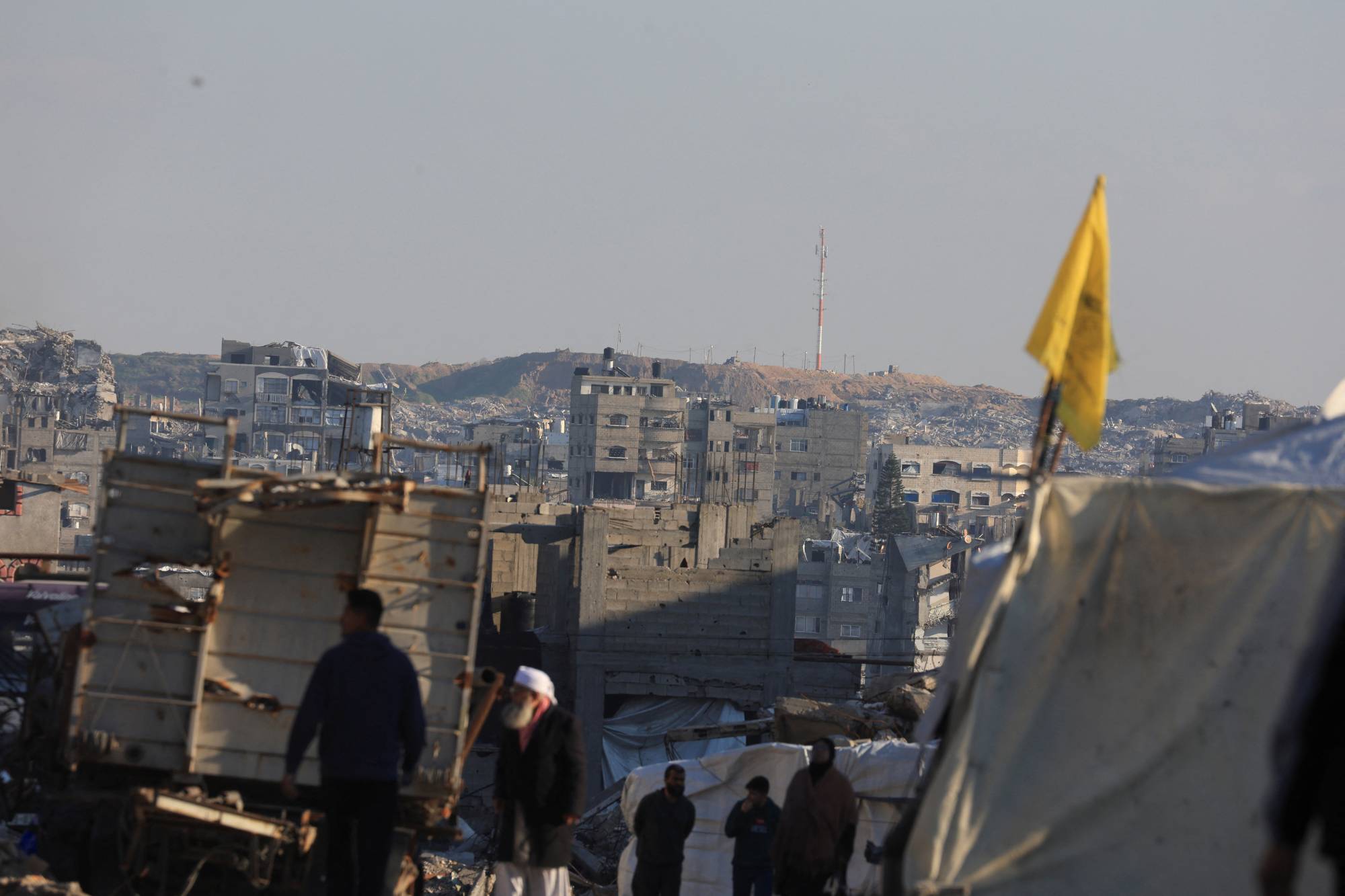
Displaced Palestinian people walk near the area marked as "yellow line" by the Israeli military, in east of Gaza City, January 16, 2026. (Reuters)
The operations have centered on expanding the “yellow line,” which was set as the first withdrawal line under the maps agreed in the October 2025 ceasefire agreement.
They have been carried out amid artillery shelling and fire from military vehicles and drones, intended to keep any threat away from advancing forces as they widen Israel’s security control.
With this advance, Israel has effectively secured full control from Salah al-Din Street to the border areas it held before October 7, 2023, covering at least 4 to 6 kilometers, depending on the area.
Palestinian movement along Salah al-Din Street has stopped completely, especially near areas where the “yellow line” has been pushed forward. The same applies to other areas where new military positions have been established.
Their number has reached 40, leaving the coastal al-Rashid Street as the only road linking northern Gaza with the center and south of the enclave.
Central Gaza
The latest Israeli ground control operation came on Monday in central Gaza, where the “yellow line” was expanded again. Yellow blocks marking the line were moved to just 3 meters east of Salah al-Din Street, at the entrance to Gaza’s only power plant, which has been out of service since the start of the war, one field source said.
The operation was carried out amid artillery shelling and major demolitions throughout the night and into early Monday. Drone fire continued without pause, providing cover for ground forces by widening the range of fire to areas on the outskirts of Bureij and Nuseirat camps.
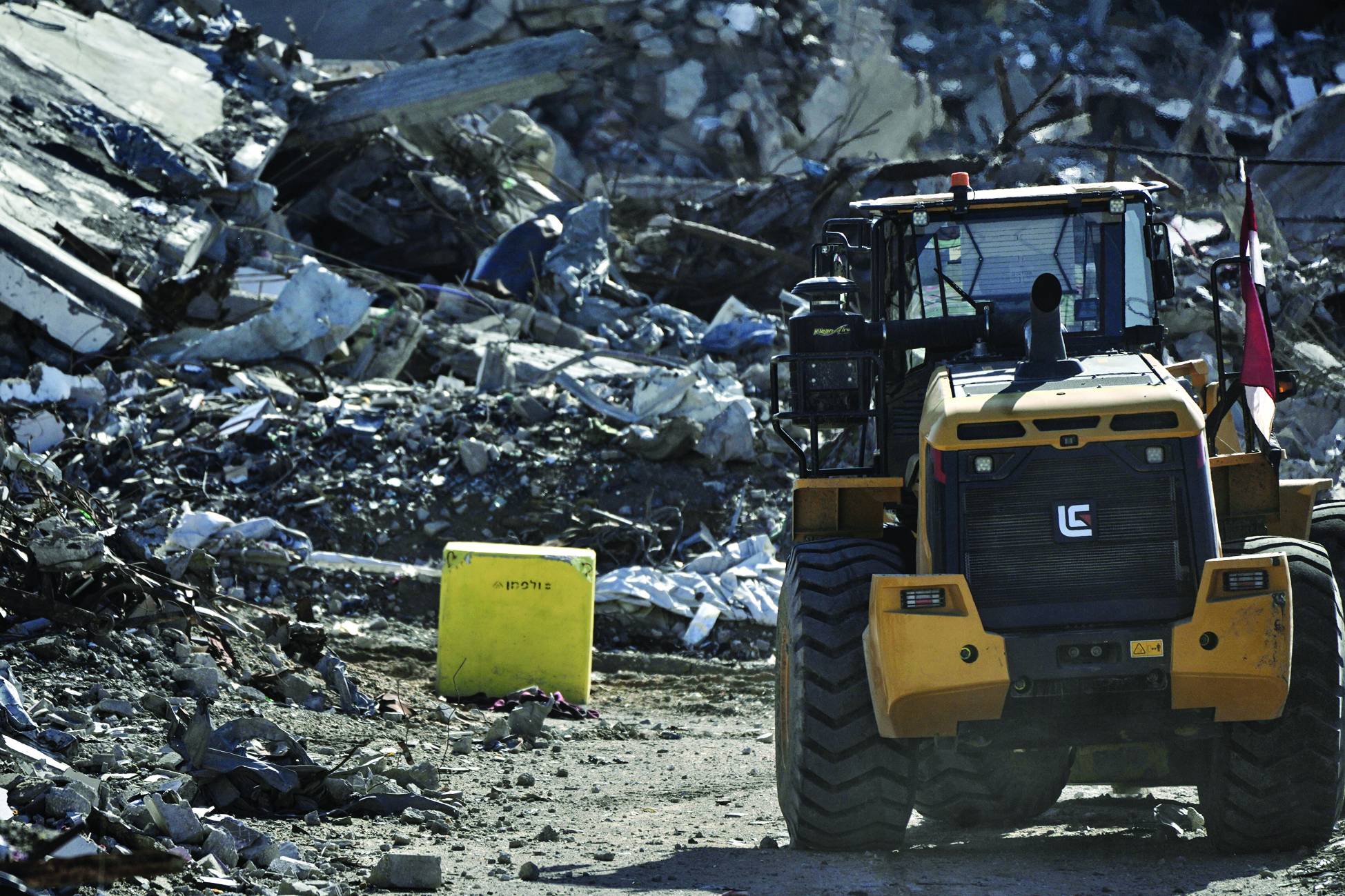
A yellow block demarcating the "yellow line," which has separated the Gaza Strip's Israeli-held and Palestinian zones since the October ceasefire, is visible in Jabalia, northern Gaza Strip. where Hamas militants are searching for the remains of hostages, Monday, Dec. 1, 2025. (AP)
Days earlier, Israeli forces expanded security control east of Deir al-Balah and the village of al-Masdar. Israeli vehicles advanced into an area known as the factories zone, about 400 meters from the main Salah al-Din Street, carrying out wide-scale bulldozing and demolitions in several areas.
A field source said Israeli forces carried out major demolitions because they believed tunnels were located in the area.
In recent days, Israel flooded tunnels in al-Masdar and around al-Maghazi camp with cement, it added
“There are fears this could extend to entire residential areas, raising concerns that these areas may later be destroyed all the way to Salah al-Din Street, as Israeli forces have done in other parts of Gaza, such as Khan Younis, Gaza City and elsewhere.”
Northern Gaza
The operations in central Gaza coincided with those in the neighboring towns of al-Atatra and al-Salatin in northwestern Gaza.
In recent days, Israeli forces intensified their targeting of the two towns with artillery shelling and, at times, airstrikes, as well as fire from drones and military vehicles, causing deaths and injuries.
Several Israeli vehicles advanced into al-Atatra and bulldozed open areas before moving the yellow blocks forward to expand control over the area.
Families fled from the vicinity to areas south of the new “yellow line,” but artillery shells followed them in what a second field source described as another attempt to force residents deeper into areas south of northern Gaza, specifically toward al-Saftawi and al-Sudaniya.
Days earlier, the “yellow line” had been advanced inside Jabalia camp, specifically in the al-Trans area and near al-Awda Mosque. That allowed Israeli forces to control about half of the camp, which has been almost completely destroyed. Hundreds of families live in displacement camps there.
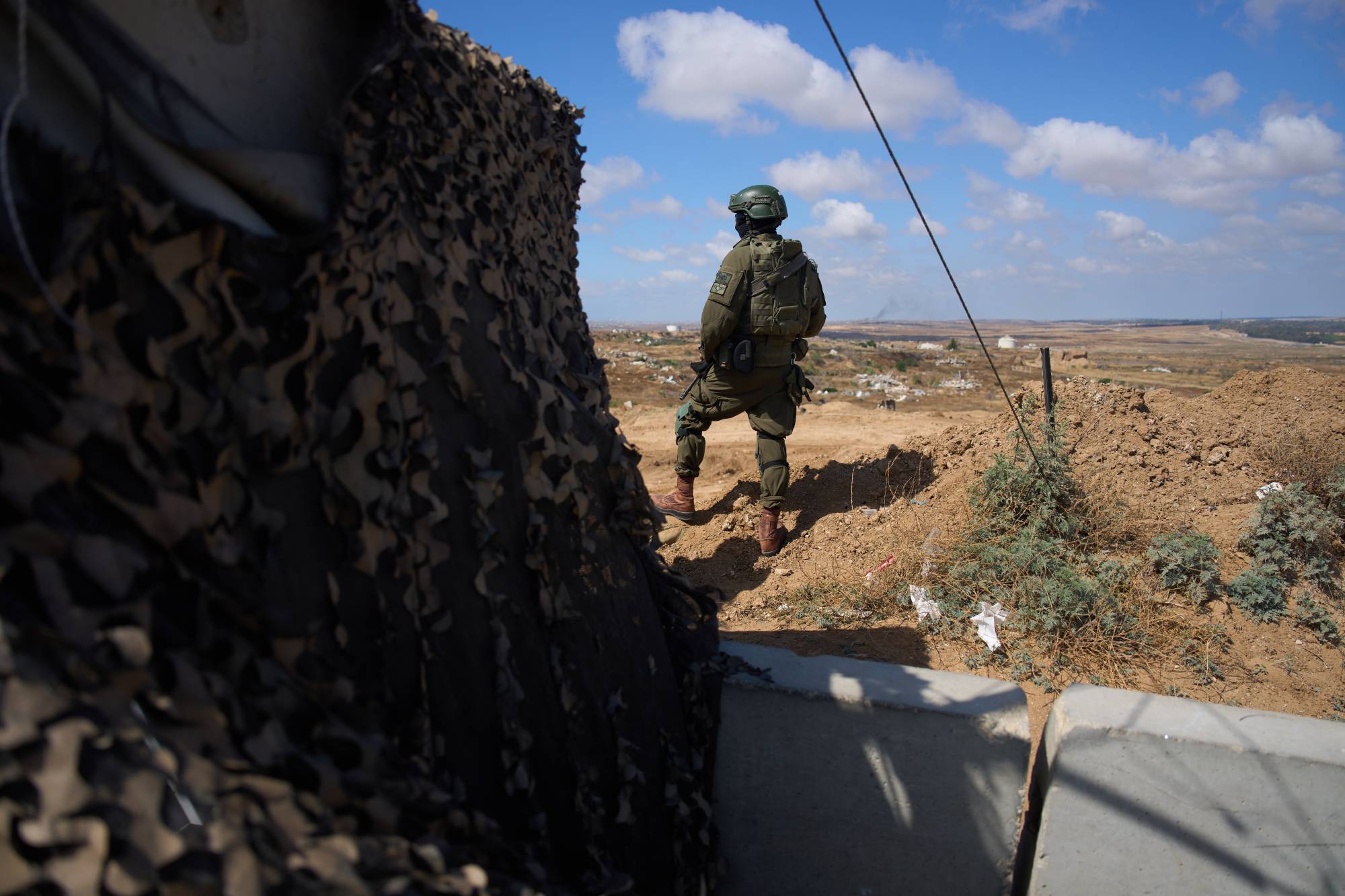
An Israeli soldier occupies a military position overlooking the so-called yellow line in the central Gaza Strip, Tuesday, May 26, 2026. (AP)
Gaza City
Before that, the “yellow line” had been pushed forward and Israeli forces had expanded control over new areas in the Zeitoun, Shujaiyya and Tuffah neighborhoods in eastern Gaza City.
Israeli forces took control of areas on Salah al-Din Street, making life harder for displaced people living nearby.
Demolitions, artillery shelling and drone fire have continued, while drones also drop explosives almost every night in areas where residents remain, in an attempt to force them to leave, according to a third source from the city.
Khan Younis
The movements in Gaza City coincided with similar advances in Khan Younis from several directions: east, south and northeast.
Israel has maintained remote security control by using drones and artillery shelling to target areas around its positions. The attacks have repeatedly caused deaths and injuries, including in tents housing displaced people in al-Mawasi and central Khan Younis.
Over 600,000 Displaced Lebanese Return Home Amid Ceasefire, Says IOMhttps://english.aawsat.com/arab-world/5291762-over-600000-displaced-lebanese-return-home-amid-ceasefire-says-iom
Relatives of missing victims weep, as they gather at the site of destroyed buildings that were hit in an Israeli airstrike in Qannarit village, southern Lebanon, Saturday, June 20, 2026. (AP)
TT
TT
Over 600,000 Displaced Lebanese Return Home Amid Ceasefire, Says IOM
Relatives of missing victims weep, as they gather at the site of destroyed buildings that were hit in an Israeli airstrike in Qannarit village, southern Lebanon, Saturday, June 20, 2026. (AP)
More than 640,000 displaced people in Lebanon have returned home, according to the International Organization for Migration (IOM), as clashes between Hezbollah and Israel have wound down following a deal to end the Middle East war.
Lebanon was drawn into the regional war on March 2 when Tehran-backed group Hezbollah fired rockets at Israel to avenge the killing of Iran's supreme leader in US-Israeli strikes.
Israel responded with heavy airstrikes and an invasion of southern Lebanon, where its troops still occupy swathes of territory.
Lebanese authorities say Israeli attacks have killed around 4,300 people and displaced over one million, particularly from southern Lebanon and Beirut's southern suburbs.
In a report on Thursday, the IOM said "646,107 IDPs (internally displaced persons) have begun returning to their communities", while about 500,000 other people remain displaced, based on data collected in coordination with local authorities since June 22.
An agreement signed by Tehran and Washington last month established a ceasefire in Lebanon starting June 21.
Since then, hundreds of thousands of people have returned to their homes in southern Lebanon and Beirut's southern suburbs.
Lebanese authorities say they have worked to remove informal tent encampments in and around Beirut and reduce the number of official shelters.
But it remains impossible to return to dozens of towns and villages near the southern border, many of which have suffered massive destruction.
Israeli officials have also vowed that their forces will remain in an occupied "security zone" 10 kilometers (six miles) deep, despite the ceasefire.
- 'Indefinite forced displacement' -
Last week Lebanon and Israel concluded a US-backed framework agreement aiming to pave the way for a permanent end to the war.
The agreement calls for the disarmament of Hezbollah, a gradual Israeli withdrawal from southern Lebanon and the deployment of the Lebanese army there -- starting with two "pilot" areas.
However, the agreement -- rejected by Hezbollah -- does not set a timetable for Israeli withdrawal.
Instead, it makes Israeli withdrawal contingent on Hezbollah's disarmament first, a tall order that experts say the Lebanese state cannot meet.
Reacting to criticism of the agreement, particularly from Hezbollah, Lebanese President Joseph Aoun insisted on Friday that the document "does not legitimise the continuation of the Israeli occupation in Lebanon".
He said the absence of a timetable was because it was a "framework formula" rather than a final agreement.
"Our shared objective is one: to secure Israel's withdrawal," he said, according to a statement from the presidency.
Amnesty International and five other NGOs warned on Friday that the framework agreement "threatens to betray war crimes victims in Lebanon".
They argued that "parts of the text appear to be aimed at preventing victims of serious international crimes from seeking justice before international forums".
Aoun responded to this criticism of article 13 of the framework agreement by saying that "it affirms the suspension of legal proceedings between the two states during the negotiation period" but "does not preclude" any private entity from taking legal action.
The NGOs added that other parts of the text "seem to acquiesce to the prolonged and indefinite forced displacement of tens of thousands of residents of vast swathes of southern Lebanon occupied by Israeli forces".
لم تشترك بعد
انشئ حساباً خاصاً بك لتحصل على أخبار مخصصة لك ولتتمتع بخاصية حفظ المقالات وتتلقى نشراتنا البريدية المتنوعة