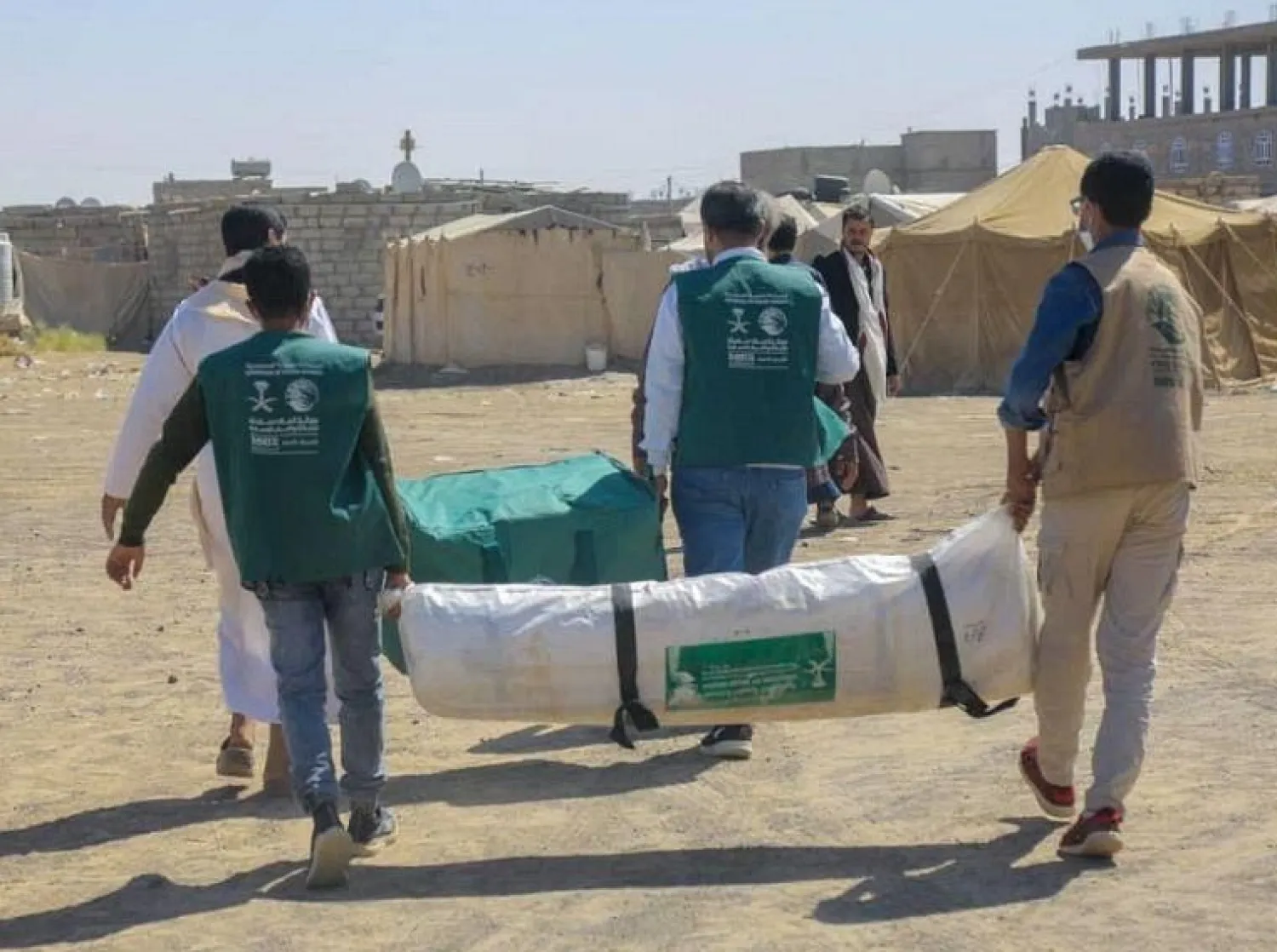
KSrelief Inaugurates Project to Distribute Emergency Shelter Aid in Yemen's Marib

KSrelief delivers aid to the displaced in Yemen's Marib - SPA
TT

KSrelief Inaugurates Project to Distribute Emergency Shelter Aid in Yemen's Marib

KSrelief delivers aid to the displaced in Yemen's Marib - SPA

The King Salman Humanitarian Aid and Relief Center (KSrelief) launched a project to distribute emergency shelter aid to the displaced and affected people in Yemen's Marib Governorate.

The aid provided 1,000 tents and 1,400 shelter bags, benefiting 1,400 displaced and affected families.

This comes within the framework of the humanitarian and relief projects provided by the Kingdom of Saudi Arabia, represented by the KSrelief, to the Yemeni people.

For his part, Marib Deputy Governor Dr. Abd-Rabbo Miftah said thousands of families who were recently displaced by the Iranian-backed Houthi militia from the southern districts of Marib are still living without shelter and lack the most basic elements of a decent living.

He called on humanitarian organizations and partners to provide more support and expand their interventions by providing shelter, food and water, in addition to health services to the needy.

Miftah also stressed the need to provide relief aid to all families who were recently forced by the coup militias to leave their homes, highlighting the Houthis’ continued military escalation and the shelling of villages and homes in Marib.


US Troops to Leave Al-Shaddadi Base in Syria

US soldiers patrol the countryside of Rumaylan in Syria's northeastern Hasakeh province on June 7, 2023. (AFP) 
TT

US Troops to Leave Al-Shaddadi Base in Syria

US soldiers patrol the countryside of Rumaylan in Syria's northeastern Hasakeh province on June 7, 2023. (AFP) 

US troops at Al-Shaddadi base in Syria's northeastern Al-Hasakah province are preparing to withdraw completely in the coming hours.

“The US forces at the base are preparing for a complete withdrawal outside Syrian territories in the next 24 hours,” a source told Syria TV on Wednesday.

Earlier, the Hasaka Media Center reported that a truck convoy belonging to the international coalition entered from Iraq through the Yaarabiya crossing and headed to Al-Shaddadi base south of Al-Hasakah province.

Civilian sources in the area said the empty trucks were sent to load military equipment from the base.

Local eyewitnesses also reported that the international coalition is evacuating the Kharab al-Jir base, a key United States military installation located in northeastern Al-Hasakah.

Since Tuesday, the sources added, the sound of drones in Qamishli were heard. They said gunshots were also heard intermittently, signaling that international coalition forces were destroying some of their positions in the Kharab al-Jirb base.

Late last month, the Turkish Anadolu Agency said heightened military activity was seen at Al-Shaddadi air base, which is used by the US-led anti-ISIS coalition, according to local sources.

It said observers have reported the landing of a US cargo aircraft.

Syrian government forces entered the Kurdish-majority city of Qamishli on Tuesday as part of a deal agreed last week to gradually integrate the Kurds' forces and institutions into the state and began preparing to take over the airport.

Kurdish forces have ceded swathes of territory to advancing government troops in recent weeks following months of tension and sporadic clashes as Syria's new authorities have sought to impose their authority across the country.

“A convoy of internal security forces began entering the city of Qamishli,” the official SANA news agency said.

Sources explained that the Syrian security forces stopped at the entrance of the Qamishli airport in preparation to enter the facility, in addition to government buildings.

Few people were seen on the streets inside the city amid a curfew in place until Wednesday morning, with Kurdish security forces also lightly deployed.


Saudi Support Puts Yemen’s Socotra Back on Global Tourism Map

Direct Jeddah-Socotra flights aim to revive Yemen archipelago economy (X)
TT

Saudi Support Puts Yemen’s Socotra Back on Global Tourism Map

Direct Jeddah-Socotra flights aim to revive Yemen archipelago economy (X)

Saudi Arabia has taken a new step to restore Yemen’s Socotra Archipelago to international air traffic by launching a direct flight linking the island with Jeddah, following the resumption of operations at the governorate’s public hospital and government university under a Saudi-backed development program.

The move was described as a qualitative shift that restores the archipelago to the global tourism map.

Yemen’s national carrier, Yemenia Airways, operated its first direct flight between King Abdulaziz International Airport and Socotra International Airport, marking the return of Socotra to international air traffic after years of absence, during which tourism flights were limited to a small number of regional routes.

The direct air link is expected to help revive tourism and open broader prospects for the flow of foreign tourists who visit the island each year, drawn by its pristine nature and rare environmental diversity.

Officials from the local authority in the Socotra Archipelago governorate and the Ministry of Transport said the launch of the route represents a qualitative addition to strengthening air connectivity, supporting tourism and service activities, and easing residents' movement.

They added that the move also carries economic and development dimensions that enhance the archipelago’s stability and sustainable development.

Socotra International Airport hosted an official reception ceremony for the first group of tourists arriving on the new route, attended by Mohammed Al-Yahya, representative of the Saudi Program for the Development and Reconstruction of Yemen, along with several Yemeni officials.

The event included artistic and heritage performances reflecting the island’s unique cultural legacy, in a message underscoring Socotra’s readiness to receive global tourism.

Yemeni officials said relevant authorities are working to operate direct flights from several Arab countries in the coming phase, which would help double visitor numbers and stimulate accommodation, services, and eco-tourism sectors.

They said the launch of the new air route would open promising economic horizons, ease travel for citizens, and enhance the archipelago’s integration into its regional and international surroundings.

This development coincides with the Saudi Program for the Development and Reconstruction of Yemen announcing the resumption of operations at Socotra General Hospital, with full coverage of its operating costs, as part of a package of vital development projects provided by the Kingdom to Yemen.

The program said restarting the hospital would enhance its capacity to meet the growing health needs of residents and help reduce medical referrals outside the governorate, easing the burden on citizens.

Deputy Governor of the Socotra Archipelago governorate, Raed Al-Juraibi, praised the step, saying it represents an essential addition to reviving tourism and strengthening the archipelago’s presence as a global tourist destination, given its natural assets and unique environmental diversity.

The deputy director of Socotra International Airport also commended the Saudi role in facilitating procedures for operating the route and linking Socotra with the Kingdom, confirming the airport’s readiness to receive flights and provide the necessary facilities for passengers.

This followed the reopening of the University of Socotra Archipelago, which resumed operations after a several-week suspension due to a funding halt, following the withdrawal of Emirati forces from the governorate at the request of the Yemeni government.

The university’s return marked a pivotal step in supporting higher education and maintaining stability in the archipelago's educational process.

The Saudi-led coalition supporting legitimacy continues efforts to normalize life in the temporary capital Aden, improve services, oversee the restructuring of security agencies, and remove military camps from the city.

In this context, work has begun on rehabilitating and upgrading the main runway at Aden International Airport, less than a week after the foundation stone for the third phase of the rehabilitation project was laid.

The phase includes supplying modern navigation equipment and communications systems, raising the readiness of infrastructure and logistics services, and improving passenger experience and service quality.

Acting Minister of Transport Nasser Sharif said rehabilitating the airport would improve its operational efficiency and strengthen its position as the country's main air gateway.

Amid improving security and services in Aden, Minister of State and Aden Governor Abdul Rahman Sheikh renewed his call on the UN to relocate the headquarters and operations of international organizations from Houthi-controlled areas to Aden, saying this would improve the effectiveness of humanitarian work and ensure aid reaches those who need it.

During a meeting with the UN senior adviser for security and safety, Jorge Alturas, the governor discussed ways to enhance joint coordination with international organizations, affirming the local authority’s readiness to provide necessary facilities to help ease citizens’ suffering and promote stability.


Maliki Nears Exit From Race to Form Iraqi Gov’t

Iraqi Prime Minister Mohammed Shia al-Sudani, with Nouri al-Maliki to his left in the picture (AFP)
TT

Maliki Nears Exit From Race to Form Iraqi Gov’t

Iraqi Prime Minister Mohammed Shia al-Sudani, with Nouri al-Maliki to his left in the picture (AFP)

Former Iraqi Prime Minister Nouri al-Maliki is seeing his bid for a third term unravel, undermined by rising US pressure and deepening splits within the Shiite Coordination Framework, as Kurdish parties insist the presidency cannot be decided until agreement on the next prime minister is reached.

A senior figure in the Coordination Framework told Asharq Al-Awsat that Maliki’s prospects for a third term had “fallen dramatically,” saying his continued insistence on running was aimed less at returning to office than at blocking Mohammed Shia al-Sudani from becoming prime minister.

The source, who requested anonymity, said Sudani had previously stepped aside in Maliki’s favor in exchange for a pledge of support if Maliki failed to form a government, an understanding Maliki is now trying to exploit politically.

Even if he does not win, the source said, Maliki wants to retain decisive influence over the choice of an alternative candidate.

The source added that all factions within the Coordination Framework were aware of US messages rejecting Maliki’s candidacy even before he formally announced it.

In a televised interview, Maliki denied that Sudani had sought guarantees in return for backing him, saying Sudani had voluntarily withdrawn from the race for prime minister, a move that “surprised me,” he said.

Efforts in Kurdistan fall short

Meanwhile, a Coordination Framework delegation's visit to Erbil and Sulaimaniyah failed to soften the Kurdish position on the presidency, according to informed political sources.

The delegation, led by Sudani and including Hadi al-Amiri, head of the Badr Organization, and Muhsin Al-Mandalawi, leader of the Al-Asas Alliance, had sought to resolve a dispute over the presidency. Instead, it returned facing two interconnected crises from the Kurdish perspective: the presidency and the premiership.

Sources said Kurdish leaders felt that Shiite factions had effectively settled the choice of prime minister.

In Erbil and Sulaimaniyah, the delegation encountered a unified Kurdish stance calling for deciding on the prime minister first, particularly amid US pressure following a tweet by US President Donald Trump warning of the consequences of appointing Maliki as prime minister.

The two main Kurdish parties fear being placed on the front line of confrontation with Washington, the sources said, especially after the arrival of a new US envoy who visited Baghdad, met Sudani in his capacity as caretaker prime minister, and spoke by phone with Masoud Barzani, leader of the Kurdistan Democratic Party, one day after Trump’s tweet.

Two-day deadline

After returning to Baghdad, Coordination Framework factions decided to give Kurdish parties an additional two days to reach a consensus on a presidential candidate before moving toward a parliamentary majority option that could cost one of the Kurdish parties the post.

At the same time, Kurdish political and media discourse has grown more ambiguous, with both the Kurdistan Democratic Party and the Patriotic Union of Kurdistan insisting the presidency is their established entitlement.

In this connection, Farhad al-Atrash, second deputy speaker of the Iraqi parliament and a senior Kurdistan Democratic Party figure, denied any internal party disputes over the presidency, describing media reports as “far from the truth and reality.”

In a statement, Atrash said any decision taken by the Kurdish leadership, including Masoud Barzani, would be respected and pursued in the public interest.

Maliki deepens rifts

Maliki’s recent televised remarks have further complicated matters within the Coordination Framework, with informed sources describing them as confused and contradictory, deepening internal divisions.

While some Framework factions have sought to downplay Trump’s tweet, dismissing it as paid for or written from inside Iraq, sources said the greater damage stemmed from Maliki’s own statements rather than from external pressure.

In a notable development, Bloomberg reported that Washington had warned Iraqi officials it could restrict Iraq’s access to oil export revenues if Maliki were appointed prime minister, citing his perceived closeness to Iran.

The warning was conveyed during a meeting last week in Türkiye between Iraqi Central Bank Governor Ali al-Allaq and senior US officials, coinciding with Trump’s tweet that said Iraqi politicians could not choose Maliki.

Sources familiar with Tehran’s strategy said Iran had urged its allies in Iraq to resist Trump’s pressure, adding that Supreme Leader Ali Khamenei had last month dispatched Esmail Qaani, commander of the Quds Force, to Baghdad with a message congratulating Maliki on his nomination, a move that angered Washington.

“Ready to step aside under conditions”

In the interview, Maliki said he was ready to withdraw his candidacy if a majority within the Coordination Framework requested it, denying that his nomination would trigger US sanctions on Iraq.

He said his candidacy was “a purely Iraqi matter,” adding that internal and external parties had misled the US president, and suggesting the tweet may have been written from inside Iraq.

With the political deadlock continuing, the battle over the premiership appears set to grow more complex as external pressure intersects with internal calculations and consensus within the Shiite camp continues to erode.