Security Forces Disperse Student Demonstration in Iraqi Kurdistan
Riot police confront students protesting against cutting their stipends in Sulaymaniyah (AFP)
Security forces in the northern city of Sulaymaniyah in the Kurdistan region of Iraq, on Tuesday, dispersed thousands of students partaking in a demonstration demanding the restoration of monthly payments.
Riot police disbanded the protest, firing shots in the air and a volley of tear gas canisters.
Such turmoil and severe social inequalities affect the image of the Kurdistan region, which is trying to emerge as a haven for stability and economic prosperity in an Iraq that repeated wars have undermined.
According to AFP, thousands of students gathered on Tuesday for the third day in a row in front of Sulaymaniyah University and blocked the highway linking Sulaymaniyah to the city of Kirkuk.
Demonstrators are demanding the repayment of $40-$66 monthly allowances that were granted to students but have been suspended since 2014.
The financial stipend program was frozen after the collapse of global oil prices and due to budget disputes between Kurdistan and Baghdad.
Security forces fired tear gas canisters at the demonstrators several times before firing warning shots into the air to force the students to disperse.
This was followed by hit-and-run raids in the city featuring security forces and protesters who set piles of trash on fire.
“We, as students, are demonstrating because of the six-year cut-off in stipends,” said one of the protesters under the conditions of anonymity.
“We desperately need this small amount. There are students among our colleagues who are unable to travel to their home in the districts and sub-districts due to the lack of sufficient funds for that,” they added.
“There are other students who can’t eat three meals a day,” revealed the protester.
“The protesters’ demands are legitimate. Students are suffering from a difficult economic situation, and the government must respond to their demands,” said Sara Qadr, a PhD student at the Sulaymaniyah University.
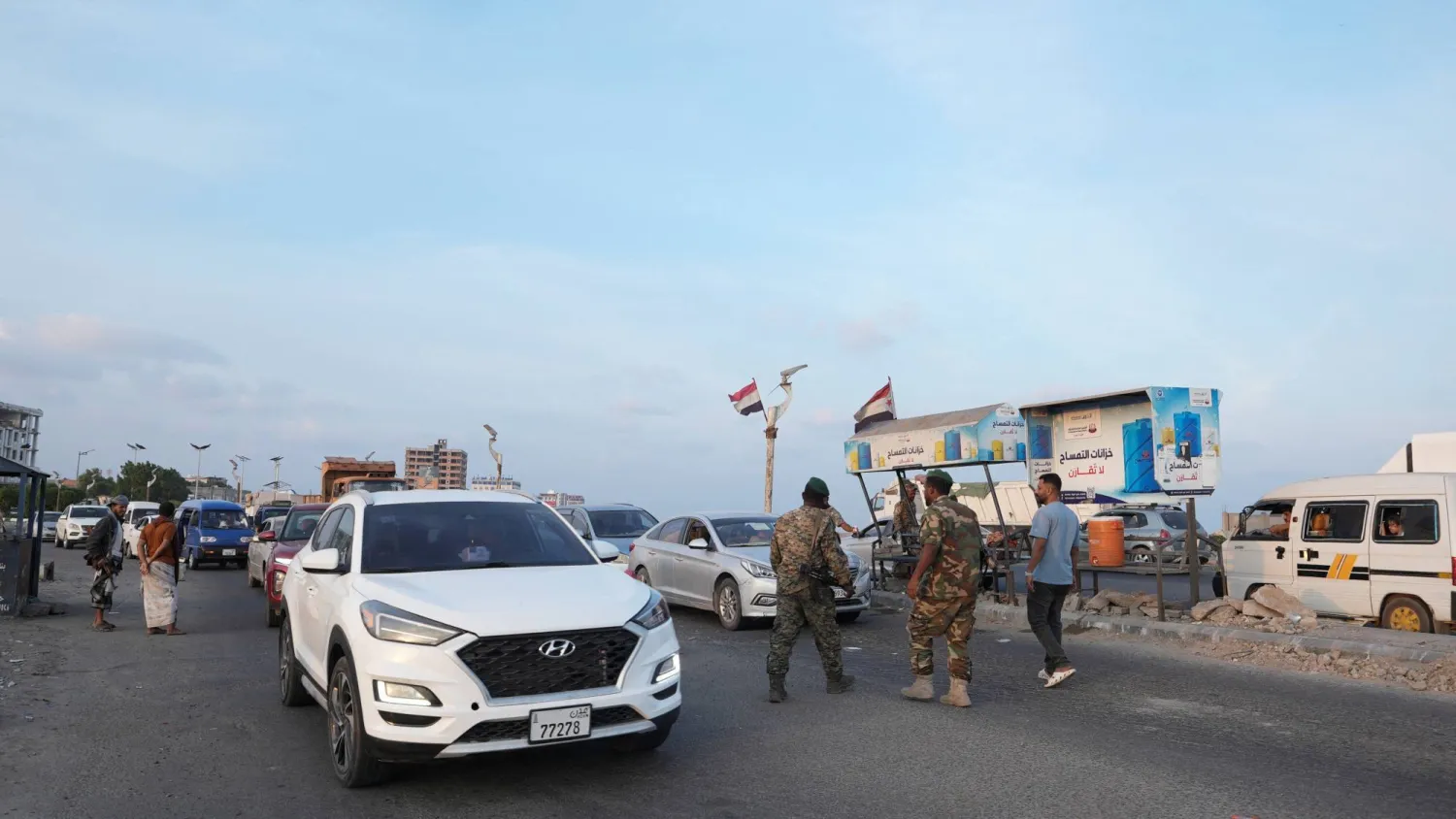
Yemeni government forces man a checkpoint on a road leading to the interim capital Aden. (Reuters)
Military operations against the terrorist Houthi militia in Yemen have continued, with airstrikes targeting the group’s positions, reinforcements, and combat capabilities across the Taiz and Lahj fronts, extending to Sanaa, Mokha, and Hodeidah.
The strikes come as the group faces sustained government resistance on the fronts surrounding Taiz, which is entering its third month under siege and attacks.
On Monday, airstrikes hit Houthi weapons depots, gatherings, and military reinforcements in east and west of Taiz. The raids coincided with ongoing clashes on the fronts in northern Lahj province, where government forces are reorganizing their ranks and repelling infiltration and advance attempts by the militants.
Field military sources said that the strikes targeted Houthi capabilities along the contact lines surrounding Taiz and Lahj, as well as military positions and supplies in Mokha and Hodeidah.
The raids form part of ongoing air and military operations under Operation Dawn of Yemen, conducted by government forces with support from the Coalition to Restore Legitimacy.
227 civilian casualties
Alongside the military clashes, civilian casualties persist due to Houthi shelling and sniper fire in the Taiz countryside. On Sunday, six civilians, including a young girl, were wounded in shelling and sniper attacks targeting villages and residential areas across several districts of Sabr.
Figures released by the governorate's Office of Siege Affairs recorded 227 civilian casualties between November 1 and 20, comprising 80 killed and 147 wounded, in ongoing attacks on residential areas as military operations widen along the front lines.
The city of Taiz, which has been under a Houthi siege for years, faces mounting pressure as main roads remain closed and supply movements falter, while government forces attempt to hold their positions and prevent the militia from making new breakthroughs on the city's outskirts.
Ongoing operations
In a development reflecting the scale of the military operations, the Yemeni Armed Forces announced they had carried out 639 strikes over the preceding hours as part of Operation Dawn of Yemen, backed by aircraft from the Coalition. The operations targeted Houthi positions, gatherings, fortifications, and artillery emplacements.
Armed Forces spokesperson Staff Colonel Majid al-Nuzaili stated that the operations comprised 24 airstrikes by warplanes, 560 field artillery strikes, 27 drone operations, and 28 rocket launcher strikes.
In a daily statement, al-Nuzaili added that the strikes neutralized 86 of the group's leaders and operatives and destroyed or disabled 64 military vehicles and pieces of equipment.
He said that government forces in Marib and al-Jawf provinces are continuing their offensive operations while clearing liberated areas of mines and explosive devices. Government troops and the Popular Resistance in Taiz are engaged in clashes to break the siege, repel Houthi attacks, and thwart infiltration attempts, recapturing several key positions.
Al-Zaidi’s First Visit to Egypt... A Boost to Cooperation Amid Regional Turmoilhttps://english.aawsat.com/arab-world/5344793-al-zaidi%E2%80%99s-first-visit-egypt-boost-cooperation-amid-regional-turmoil
Iraqi Prime Minister Ali al-Zaidi meets Egypt's President Abdel Fattah al-Sisi, in Cairo, Egypt, November 23, 2026. (Iraqi Prime Minister's Media Office/Handout via Reuters)
Al-Zaidi’s First Visit to Egypt... A Boost to Cooperation Amid Regional Turmoil
Iraqi Prime Minister Ali al-Zaidi meets Egypt's President Abdel Fattah al-Sisi, in Cairo, Egypt, November 23, 2026. (Iraqi Prime Minister's Media Office/Handout via Reuters)
Iraqi Prime Minister Ali al-Zaidi kicked off on Monday a visit to Egypt - his first since taking office in May - amid escalating regional challenges, in a move experts and analysts described as a boost to cooperation and coordination in light of regional tensions.
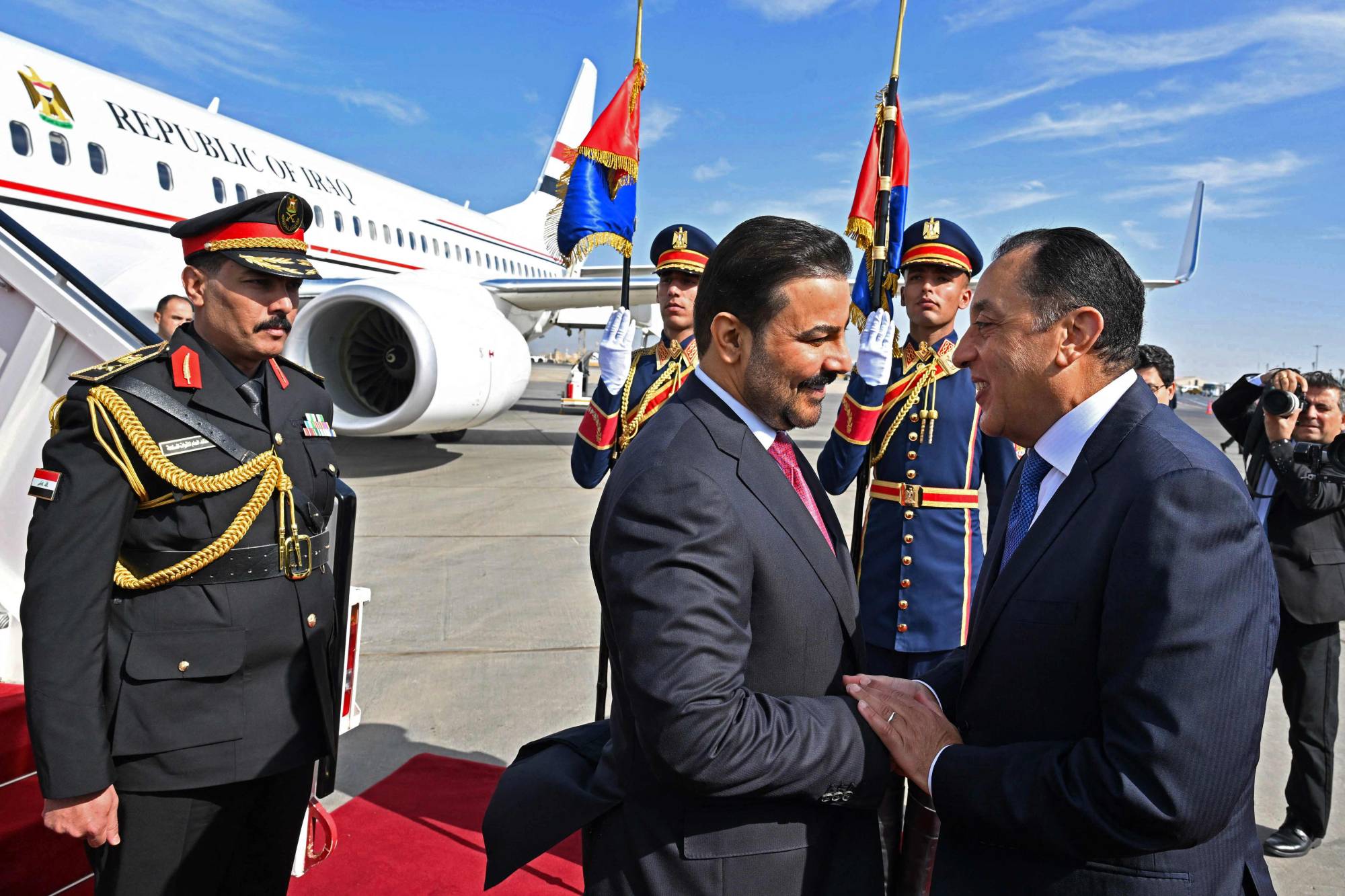
Egyptian Prime Minister Mostafa Madbouly received al-Zaidi at Cairo International Airport before he met with Egyptian President Abdel Fattah al-Sisi.
On Monday evening, al-Zaidi and Madbouly are co-chairing the fourth session of the Joint Higher Committee between the two countries at the government headquarters in the New Administrative Capital.
In a statement, the Egyptian Cabinet said the two sides will witness the signing of several documents across various fields "supporting the enhancement of bilateral cooperation between the two brotherly countries," in addition to attending a business forum to review trade and investment opportunities in both nations.
The visit comes "as both countries seek to open new horizons for joint cooperation, particularly in light of the promising opportunities abundant in Egypt and Iraq across various economic, commercial, and investment fields, with a view to deepening the partnership between the two countries,” it added.
A day earlier, Egyptian Foreign Minister Dr. Badr Abdelatty met his Iraqi counterpart Fuad Hussein on the sidelines of the Aswan Forum, saying he was looking forward to al-Zaidi's visit and the convening of the fourth session of the Joint Higher Committee.
He noted that the visit would give strong momentum to bilateral ties, bolster cooperation across various sectors, and serve the mutual interests of Egypt and Iraq.
The FMs stressed the importance of prioritizing political and diplomatic solutions to resolve crises, and maintaining coordination and consultation on issues of mutual concern to support efforts aimed at achieving regional security and stability.
Region in focus
Al-Zaidi’s first visit to Egypt centers on the regional developments and tensions across the Middle East. His media office said in a statement on Monday that al-Zaidi will discuss ways to confront various challenges in a manner that strengthens regional security and stability.
According to an Egyptian presidential statement, the PM expressed during his meeting with Sisi his appreciation for Egypt’s efforts aimed at easing regional tensions and preserving stability.
He underlined Iraq’s desire to intensify political consultation to prevent renewed regional escalation.
Egypt's Prime Minister Mostafa Madbouly (R) shakes hands with his Iraqi counterpart Ali al-Zaidi upon his arrival at the airport in Cairo on November 23, 2026. (AFP)
On bilateral cooperation, the two sides discussed ways to deepen joint collaboration in energy, investment, trade, and military cooperation.
Sisi reaffirmed Egypt’s steadfast position in support of the security and stability of all Arab countries, saying their security is an extension of Egyptian national security.
He highlighted Egypt’s persistent efforts to resolve ongoing regional crises.
Significance of the visit
Mohammed Hegazy, a member of the Egyptian Council for Foreign Affairs and former assistant foreign minister, said al-Zaidi's visit reflects growing Iraqi recognition of the importance of revitalizing relations with its Arab neighborhood.
Speaking to Asharq Al-Awsat, he added that Iraq, by virtue of its geographical and political standing, as well as its economic weight and resources, "cannot remain detached from the equations of security and stability in the region.”
“Cairo is a key Arab partner for Baghdad with extensive political and diplomatic experience and the ability to engage with various regional and international actors,” he went on to say.
Al-Zaidi’s first visit reflects "a desire to elevate the relationship from routine political coordination to a deeper, more sustainable partnership, and to move toward a policy grounded in national interests, balance, and strengthening the Arab presence in confronting current challenges,” he added.
He noted that Egypt and Iraq have a significant opportunity to expand cooperation, "but its success hinges on moving from agreements and memoranda of understanding to concrete projects with measurable results."
Hegazy believes this momentum should be built upon by identifying priority projects, while expanding opportunities for cooperation in electricity, electrical interconnection, the exchange of expertise in the oil and gas sector, and renewable energy projects.
Egyptian-Iraqi trade exchange reached roughly $1.1 billion in 2024, according to official Egyptian figures.
Hegazy said this remains well below available potential, and therefore the objective should not merely be increasing trade volume, but diversifying it and boosting investment.
Lebanon: Number of Detainees in Al-Qaa Explosives Case Rises to Sixhttps://english.aawsat.com/arab-world/5344787-lebanon-number-detainees-al-qaa-explosives-case-rises-six
Lebanon: Number of Detainees in Al-Qaa Explosives Case Rises to Six
Lebanese soldiers deployed in southern Lebanon. (AP file)
The number of detainees held in connection with the explosives shipment arriving from Syria, which the Lebanese Army seized in the Mashari al-Qaa area of the Bekaa Valley on Sunday, has risen to six Lebanese nationals.
Security agencies are tracking down two Syrians suspected of having been set to receive the cargo.
Government Commissioner to the Military Court Judge Claude Ghanem ordered the preliminary investigation transferred from the Military Police to the Army's Intelligence Directorate in order to expand the probe and identify the party for which the shipment was intended.
The number of detainees will likely rise as the investigation unfolds.
A judicial source told Asharq Al-Awsat that preliminary information indicates the two Syrians "were supposed to handle transporting the explosives to warehouses in the Bekaa," noting that their arrest is expected to help "uncover the identity of the recipient."
The source confirmed that Judge Ghanem "requested that samples of the seized TNT and C-4 be sent to laboratories for analysis, in an effort to determine their origin and compare them with samples from the Dahr al-Baidar shipment."
He pointed to "similarities between the materials seized in both shipments, with tests awaited to determine whether they are identical."
The Lebanese Army's announcement on Sunday regarding the seizure coincided with a statement by Syrian security forces reporting the confiscation of a cache of weapons in the Damascus countryside that they said was destined for smuggling into Lebanon.
The Lebanese Army had previously intercepted roughly 200 kilograms of explosives near the Syrian border in the Lebanese area of al-Qasr, while the person transporting them fled toward Syria.
A security source told Asharq Al-Awsat that repeated seizures along the eastern and northern borders "call for strengthening field measures and maintaining continuous coordination between Lebanon and Syria to close the loopholes threatening the security of both countries."
The security source stressed "the need to raise the readiness of security agencies to thwart smuggling operations before shipments reach their destinations."
لم تشترك بعد
انشئ حساباً خاصاً بك لتحصل على أخبار مخصصة لك ولتتمتع بخاصية حفظ المقالات وتتلقى نشراتنا البريدية المتنوعة