


Swiss Museum Orders Experts to Review Nazi-era Art Collection

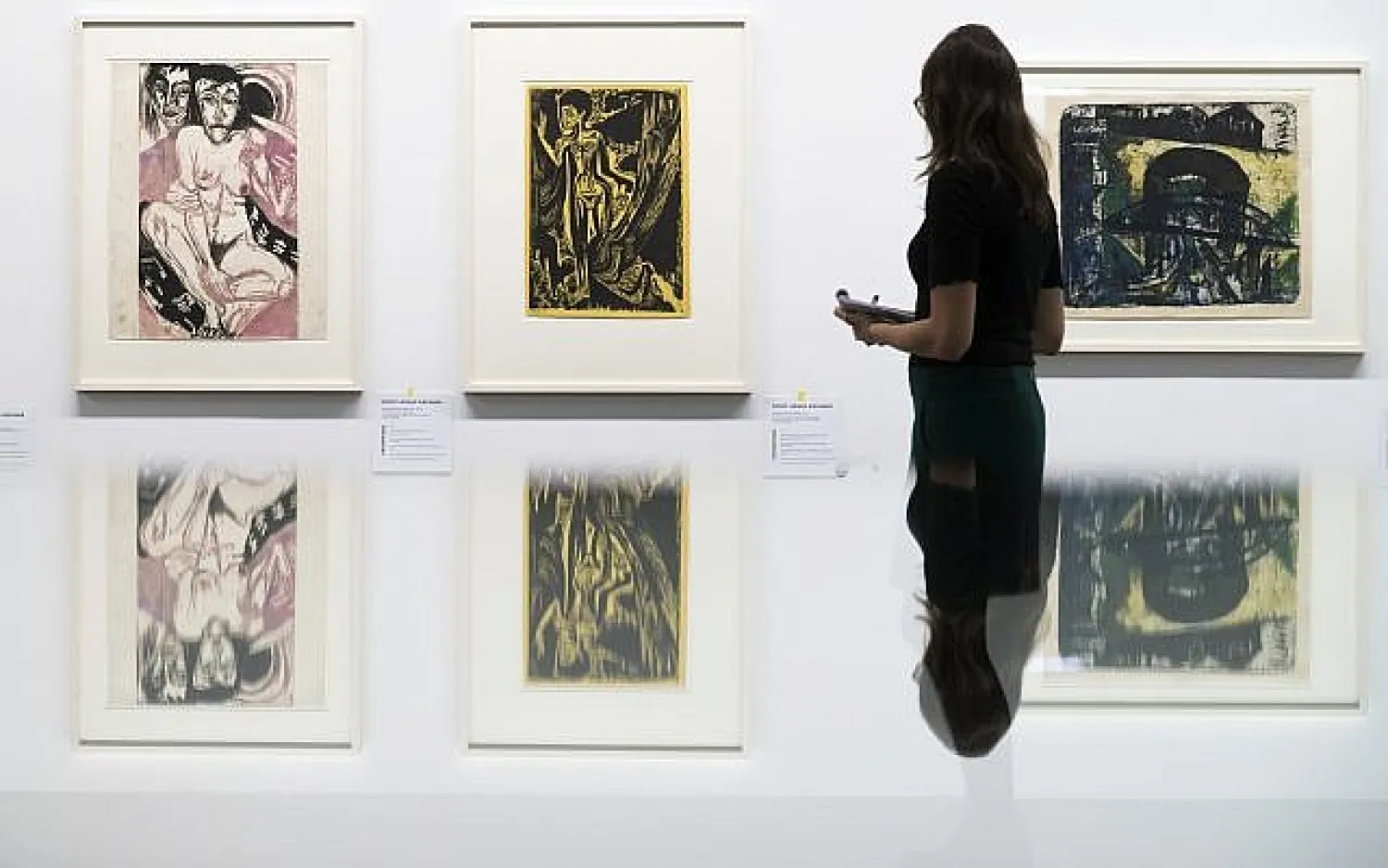
A visitor watches the paintings 'Melancholisches Maedchen' (left) and Nackte Frau im Walde" of German painter Ernst Ludwig Kirchner, in the exhibition 'Status Report Gurlitt. degenerate art - confiscated and sold' in the Kunstmuseum in Bern, Switzerland, on Wednesday, November 1, 2017. (Peter Klaunzer/Keystone via AP)
TT

Swiss Museum Orders Experts to Review Nazi-era Art Collection

A visitor watches the paintings 'Melancholisches Maedchen' (left) and Nackte Frau im Walde" of German painter Ernst Ludwig Kirchner, in the exhibition 'Status Report Gurlitt. degenerate art - confiscated and sold' in the Kunstmuseum in Bern, Switzerland, on Wednesday, November 1, 2017. (Peter Klaunzer/Keystone via AP)

Experts will review the methods used to determine the provenance of works in a vast private art collection acquired during World War II by Emil Buhrle, a Swiss museum said Wednesday.

The announcement by the Kunsthaus in Zurich came as renewed suspicions swirl around the Nazi-era origins of one of Europe's most prestigious private art collections, AFP said.

The late industrialist (1890-1956) amassed a fortune selling weapons to both the Nazis and the Allies during World War II, wealth that helped buy around 600 artworks by the end of his life.

The Buhrle Foundation itself confirms that 13 paintings bought by the German-born industrialist, who later acquired Swiss citizenship, had been stolen by the Nazis from Jewish owners in France.

Following a series of court cases after the war, Buhrle returned all 13 pieces to their rightful owners then repurchased nine of them, the foundation said.

But long-simmering suspicions around the provenance of other pieces in the collection, which includes famous works by the likes of Manet, Degas, Cezanne, Monet, Renoir, Gauguin and Picasso, have picked up steam in recent years.

The collection was long displayed at a discrete private museum on the outskirts of Zurich, but it was determined it should be moved following a spectacular 2008 heist of four 19th century masterpieces.

It was decided to move the collection to the Kunsthaus, one of Switzerland's leading museums, which this past October opened a new wing to permanently house the works, setting off fresh debate.

- Contaminated museum? -
A recent book by historian Erich Keller called "Das kontaminerte Museum", or The contaminated museum, raises questions around the provenance of the works and criticizes a lack of contextualisation.

The Buhrle Foundation meanwhile presented a report to the Kunsthaus Wednesday over the provenance research it had conducted over the past two decades, concluding that there were no indications of problematic circumstances nor problematic provenances for any of the 203 works in the current collection.

Even though Buhrle conducted business during World War II, "he has not left us a collection of Nazi art," collection director Lukas Gloor told a press conference, according to the ATS news agency.

The Kunsthaus meanwhile said it had strived to contextualise the collection, including through a historic study by experts at the University of Zurich.

And in a bid to remove any remaining doubts, it said it had appointed "an independent committee of experts".

They would evaluate whether the methodology and approach used by the Buhrle Foundation to determine the provenance of the works "were correct and whether the results were presented correctly," the Kunsthaus said.



Sudan's Historic Acacia Forest Devastated as War Fuels Logging

Little is left of the once sprawling acacia forest south of Sudan's capital. Ebrahim Hamid / AFP
TT

Sudan's Historic Acacia Forest Devastated as War Fuels Logging

Little is left of the once sprawling acacia forest south of Sudan's capital. Ebrahim Hamid / AFP

Vast stretches of a once-verdant acacia forest south of Sudan's capital Khartoum have been reduced to little more than fields of stumps as nearly three years of conflict have fueled deforestation.

What was once a 1,500-hectare natural reserve has been "completely wiped out", Boushra Hamed, head of environmental affairs for Khartoum state, told AFP.

Al-Sunut forest had long served as a haven for migratory birds and a vital green shield against the Nile's seasonal floods.

"During the war, Khartoum state has lost 60 percent of its green cover," Hamed said, describing how century-old trees "were cut down with electric saws" for commercial timber and charcoal production.

Where tall acacias once cast cool shade over a wetland just upstream from the confluence of the Blue and White Nile, barren ground now lies exposed, criss-crossed by people gathering whatever wood remains.

Hamed called it "methodical destruction", though the perpetrators remain unknown and there has been no investigation.

Similar devastation is unfolding across several regions -- including western Darfur, neighboring Kordofan and the central states of Sennar and Al-Jazirah -- as insecurity and economic collapse drive unchecked logging, according to Sudan's Forests National Corporation.

According to a 2019 study by the Nairobi-based African Forest Forum, Sudan had already lost nearly half of its forested land since 1960 due to agricultural expansion, firewood collection and overgrazing.

By 2015, the country ranked among Africa's least forested nations, with around 10 percent of its territory still covered by woodland, the study said.

The report had also warned of further degradation if reforestation and sustainable management efforts were not implemented -- concerns now compounded by the ongoing conflict.

- 'Barrier' -

Aboubakr Al-Tayeb, who oversees Khartoum's forestry administration, said the damage "affects not only Khartoum, but Sudan and the wider African continent."

"The forest was home to several migratory species from Europe," he told AFP.

More than a hundred bird species, including ducks, geese, terns, ibis, herons, eagles and vultures, had been recorded in the area, alongside monkeys and small mammals.

Al-Nazir Ali Babiker, an agronomist, said the loss of tree cover could cause more severe seasonal flooding because the "forest acted as a barrier" against rising waters.

Flooding strikes Sudan every year, destroying homes, farmland and infrastructure and leaving many families with no choice but to flee to safer areas.

The war in Sudan, which erupted in April 2023, has already killed tens of thousands, displaced 11 million and shattered critical infrastructure.

Before the fighting, forests supplied roughly 70 percent of Sudan's energy consumption, primarily through charcoal and firewood, according to data from the African Forest Forum.

Al-Sunut had also been a popular leisure spot for Khartoum residents.

"We used to come in groups to study and have a good time," recalls Adam Hafiz Ibrahim, a student at Omdurman Islamic University.

Today, wood gatherers have supplanted the usual walkers. Disregarding army notices alerting them to landmines, men and women traverse the dry, open ground that now stands where the ancient forest once grew.

"We're not cutting the trees. We just pick up whatever wood's already on the ground to use for the fire," said Nafisa, a woman in her forties navigating the dry grasslands.

"We found the trees down. We collect the wood to sell to bakeries and families," said Mohamed Zakaria, a construction worker who lost his job because of the war.

Experts say that the economic hardship caused by the war combined with a lack of enforcement has encouraged logging.

"The logging continues, because those responsible for forest protection cannot access many areas," said Mousa el-Sofori, head of Sudan's Forests National Corporation.

Efforts to replant acacias are underway, Tayeb of the Khartoum forestry administration said, but seedlings grow slowly and can take years to mature.

Restoring the lost woodlands would be "long and costly", said Sofori.

"Some of these forests were centuries old," he added.


Coffee Regions Hit by Extra Days of Extreme Heat, Say Scientists 

17 April 2012, North Rhine-Westphalia, Vluyn: A general view of Arabica Coffee beans. (dpa)
TT

Coffee Regions Hit by Extra Days of Extreme Heat, Say Scientists 

17 April 2012, North Rhine-Westphalia, Vluyn: A general view of Arabica Coffee beans. (dpa)

The world's main coffee-growing regions are roasting under additional days of climate change-driven heat every year, threatening harvests and contributing to higher prices, researchers said Wednesday.

An analysis found that there were 47 extra days of harmful heat per year on average in 25 countries representing nearly all global coffee production between 2021 and 2025, according to independent research group Climate Central.

Brazil, Vietnam, Colombia, Ethiopia and Indonesia -- which supply 75 percent of the world's coffee -- experienced on average 57 additional days of temperatures exceeding the threshold of 30C.

"Climate change is coming for our coffee. Nearly every major coffee-producing country is now experiencing more days of extreme heat that can harm coffee plants, reduce yields, and affect quality," said Kristina Dahl, Climate Central's vice president for science.

"In time, these impacts may ripple outward from farms to consumers, right into the quality and cost of your daily brew," Dahl said in a statement.

US tariffs on imports from Brazil, which supplies a third of coffee consumed in the United States, contributed to higher prices this past year, Climate Central said.

But extreme weather in the world's coffee-growing regions is "at least partly to blame" for the recent surge in prices, it added.

Coffee cultivation needs optimal temperatures and rainfall to thrive.

Temperatures above 30C are "extremely harmful" to arabica coffee plants and "suboptimal" for the robusta variety, Climate Central said. Those two plant species produce the majority of the global coffee supply.

For its analysis, Climate Central estimated how many days each year would have stayed below 30C in a world without carbon pollution but instead exceeded that level in reality -- revealing the number of hot days added by climate change.

The last three years have been the hottest on record, according to climate monitors.


Dog Gives Olympics Organizers Paws for Thought

A dog wanders on the ski trail during the women's team cross country free sprint qualification event of the Milano Cortina 2026 Winter Olympic Games at Tesero Cross-Country Skiing Stadium in Lago di Tesero (Val di Fiemme), on February 18, 2026. (Photo by Anne-Christine POUJOULAT / AFP)
TT

Dog Gives Olympics Organizers Paws for Thought

A dog wanders on the ski trail during the women's team cross country free sprint qualification event of the Milano Cortina 2026 Winter Olympic Games at Tesero Cross-Country Skiing Stadium in Lago di Tesero (Val di Fiemme), on February 18, 2026. (Photo by Anne-Christine POUJOULAT / AFP)

A dog decided he would bid for an unlikely Olympic medal on Wednesday as he joined the women's cross country team free sprint in the Milan-Cortina Games.

The dog ran onto the piste in Tesero in northern Italy and gamely, even without skis, ran behind two of the competitors, Greece's Konstantina Charalampidou and Tena Hadzic of Croatia.

He crossed the finishing line, his moment of glory curtailed as he was collared by the organizers and led away -- his owner no doubt will have a bone to pick with him when they are reunited.