UN Renews Mandate of Counter-Terrorism Committee Executive Directorate for 4 Years

FILE PHOTO: Members of the United Nations Security Council gather during a meeting, in New York, US, February 26, 2019. REUTERS/Shannon Stapleton
TT

UN Renews Mandate of Counter-Terrorism Committee Executive Directorate for 4 Years

FILE PHOTO: Members of the United Nations Security Council gather during a meeting, in New York, US, February 26, 2019. REUTERS/Shannon Stapleton

The Security Council has renewed the mandate of the Counter-Terrorism Committee Executive Directorate (CTED) for four years through a unanimous resolution.

The Council said in a statement on Friday that it decided to renew the mandate of the expert body that supports the United Nations counter-terrorism architecture until 31 December 2025, with an interim review slated to be conducted in December 2023.

The Council Unanimously adopted Resolution 2617 (2021) on the mandate renewal.

In a 30 December videoconference meeting, Abdou Abarry (Niger), Council President for December, announced the adoption of Resolution 2617 through which the Council renewed CTED’s mandate as a special political mission under the policy guidance of the Counter-Terrorism Committee, which was created by resolution 1373 (2001), following the 11 September terrorist attacks in the United States.


Pentagon Leaders Assert Destruction of Iran’s Military Capabilities, Threaten to Resume Operations

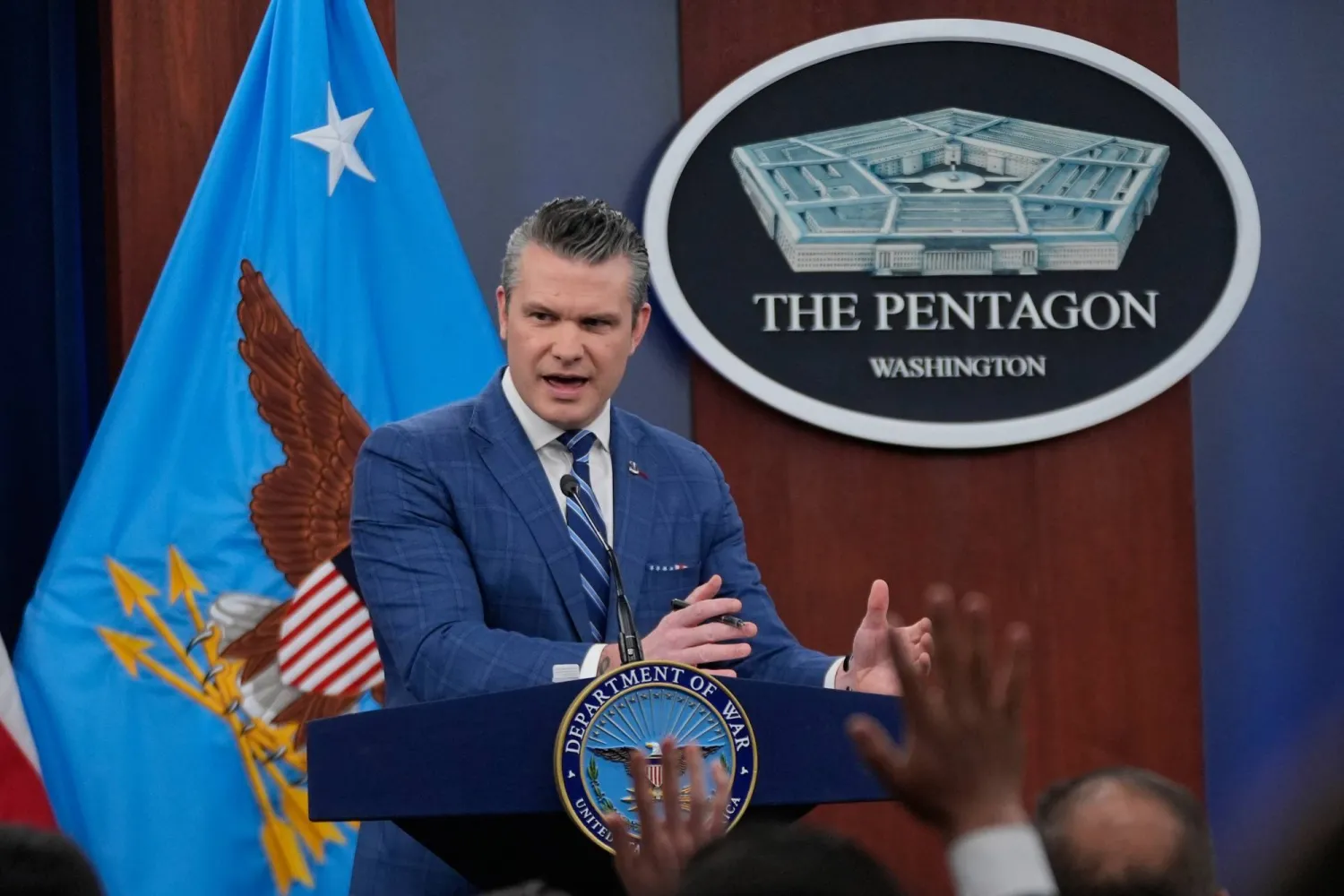
Defense Secretary Pete Hegseth speaks to members of the media during a press briefing at the Pentagon in Washington, Wednesday, April 8, 2026. (AP Photo/Manuel Balce Ceneta)
TT

Pentagon Leaders Assert Destruction of Iran’s Military Capabilities, Threaten to Resume Operations

Defense Secretary Pete Hegseth speaks to members of the media during a press briefing at the Pentagon in Washington, Wednesday, April 8, 2026. (AP Photo/Manuel Balce Ceneta)

The US war against Iran has "completely" destroyed the country's ability to build missiles or other sophisticated weaponry, Defense Secretary Pete Hegseth said Wednesday

"We finished completely destroying Iran's defense-industrial base, a core pillar of our mission," Hegseth told reporters.

"They can no longer build missiles."

For his part, Chairman of the Joint Chiefs of Staff Dan Caine said: “We attacked, along with our partners, approximately 90 percent of their weapons factories,” including facilities producing Shahed-type drones, as well as facilities manufacturing guidance systems used by these drones.

Regarding the naval fleet, Caine said that it will take years before Iran can rebuild its surface combatant capabilities.

The general added that approximately 80 percent of Iran’s nuclear industrial base was targeted, significantly undermining its nuclear weapons development efforts.

He warned that US forces remain ready to resume fighting with Iran if the ceasefire ends, stating: “Let’s be clear: the ceasefire is just a temporary pause. The armed forces remain ready, if ordered, to resume combat operations with the same speed and precision demonstrated over the past 38 days.”

Statements by Dan Caine, and his warning about a possible resumption of fighting, suggest that the announcement of a suspension of the war came under US pressure, according to Michael Rubin, a researcher at the American Enterprise Institute.

As for the restoration of freedom of navigation, military officials’ statements did not indicate that it has been fully secured, instead emphasizing the need to “ensure Iran’s compliance” and the safe passage of vessels.

At the same time, there were continued indications that ships received messages from Iranian forces stating that they require permission to transit the strait, suggesting that Tehran is seeking to establish a new equation: keeping Hormuz open on the condition of recognizing a supervisory or sovereign role for itself.

If that is the case, the region and the global economy would be entering a phase that goes beyond a mere ceasefire, as the risk shifts from missiles to the rules governing transit, insurance, pricing, and maritime fees.

Statements by Pentagon leaders, followed by remarks from Donald Trump, reveal that the real dispute is not over the ceasefire itself, but over what comes after it. Washington rejects the continuation of Iranian uranium enrichment and is demanding that the stockpile of highly enriched uranium be handed over, or “taken” by force if necessary.

By contrast, narratives circulating in Iranian media about the “ten points” of the ceasefire agreement point in a completely different direction: recognition of Iran’s right to enrich, the lifting of sanctions, and no clear position on the fate of the enriched stockpile.

This is precisely where the structural contradiction lies, one that could undermine the negotiating round from its very first day, according to Michael Rubin.

The second aspect of the dispute concerns the scope of de-escalation. The United States and Israel have made clear that a ceasefire with Iran does not mean a halt to Israeli operations in Lebanon against Hezbollah, while reports continued of missile and drone attacks on Gulf states in the hours following the truce. This suggests that the region is facing a form of “selective de-escalation,” according to observers: a direct easing between Washington and Tehran, while proxy arenas and exchanges of messages remain active.

Remarks by Hegseth that Washington had been prepared, just hours earlier, to strike power stations, bridges, and oil and energy infrastructure “that Iran cannot rebuild” indicate that the decision to halt hostilities did not stem from a fully realized settlement, but rather from the suspension of a massive escalatory strike against Tehran.

Accordingly, the ceasefire appears more like a testing window: if Tehran complies with conditions related to navigation and the transfer of uranium, the truce could hold and pave the way toward a definitive end to the war. If not, the United States may return to the option of large-scale destruction of infrastructure.



UK, Norway Led a Military Operation to Deter Russian Submarines in the North Atlantic

Britain's Defense Secretary John Healey delivers a statement on recent UK operational activity at 9 Downing Street in Westminster, central London, Britain, April 9, 2026. Yui Mok/Pool via REUTERS
TT

UK, Norway Led a Military Operation to Deter Russian Submarines in the North Atlantic

Britain's Defense Secretary John Healey delivers a statement on recent UK operational activity at 9 Downing Street in Westminster, central London, Britain, April 9, 2026. Yui Mok/Pool via REUTERS

British and Norwegian militaries led a weekslong operation to deter Russian submarines suspected of “malign activity” in the North Atlantic, the UK military said Thursday.

Defense Secretary John Healey said a frigate, planes and hundreds of personnel monitored a Russian attack sub and two spy submarines near undersea infrastructure north of the UK. He said the Russian vessels eventually left after the operation that lasted more than a month.

Healey said his message to Russia was “we see your activity over our cables and our pipelines and you should know that any attempt to damage them will not be tolerated and will have serious consequences.”

Representatives of Norway’s defense and foreign ministries, as well as the armed forces, did not immediately respond to requests for comment.

British officials have tried to keep Russia in the international spotlight even as the world’s attention is focused on conflict in the Middle East. They have also stressed the overlap between conflicts there and in Ukraine, saying Russia has supplied Iran with drone parts and other support.

Healey told a news conference that “Putin would want us to be distracted by the Middle East,” but Russia is the main threat to the UK and its allies.

“We will not take our eyes off Putin,” he said.

In late March, the UK said its military was ready to seize ships suspected to be part of Russia’s “shadow fleet” of vessels shipping oil in violation of international sanctions over Moscow’s war on Ukraine. Previously, Britain had only helped France and the US monitor ships before they were boarded.

“We are ready to take action" against the vessels, Healey said.


Pakistan Says Appreciates 'Restraint' ahead of US-Iran Talks

US and Iran flags are seen in this illustration taken June 18, 2025. REUTERS/Dado Ruvic/Illustration/File Photo
TT

Pakistan Says Appreciates 'Restraint' ahead of US-Iran Talks

US and Iran flags are seen in this illustration taken June 18, 2025. REUTERS/Dado Ruvic/Illustration/File Photo

Pakistan's prime minister and army chief said Thursday they "appreciated the restraint demonstrated by all sides", before Islamabad is expected to host talks between Iran and the United States, AFP reported.

"The two leaders expressed satisfaction over the de-escalation achieved so far and stressed upon the need for maintaining peace and ceasefire by all parties," the office of Prime Minister Shehbaz Sharif said, following his meeting with Field Marshal Asim Munir.