'No Path ahead But the Sea': Lebanese Join Migrant Flow to EU

Bilal Moussa, 34, smokes near the waters off Tripoli that almost swallowed him -- but he vows to try again to flee Lebanon's poverty (AFP/JOSEPH EID)
TT

'No Path ahead But the Sea': Lebanese Join Migrant Flow to EU

Bilal Moussa, 34, smokes near the waters off Tripoli that almost swallowed him -- but he vows to try again to flee Lebanon's poverty (AFP/JOSEPH EID)

If he wasn't making good money smuggling irregular migrants to the European Union by sea, Ibrahim himself might have joined the growing exodus from crisis-hit Lebanon.

"If I didn't work in this profession, I would have left, just like so many other people," said the 42-year-old trafficker, who asked to use a pseudonym when he spoke to AFP in the northern city of Tripoli.

"Maybe I would have turned to someone to smuggle me out," he said, his face hidden by an anti-Covid surgical mask and a hoodie.

Lebanon, in the throes of a brutal economic crisis, is no longer just a launchpad for Syrian refugees and other foreign migrants.

Its own desperate citizens now also risk drowning in the Mediterranean in their quest for a better life.

Ibrahim argues that, while having smuggled around 100 Lebanese nationals to Europe since 2019 makes him no angel, there is virtue in helping his compatriots.

"I get them out of here, out of this beggar's life," he said. "At least if they are put in a camp, they can eat and drink with dignity."

Ibrahim said he took pride in taking only Lebanese nationals on his boats, and even then, only those who can produce civil registry documents.

"I get requests from Palestinians and Syrians but I am responsible only for my own countrymen," said Ibrahim, a former school bus driver whose tumbling income led him to people smuggling.

"There are many Lebanese who want to leave... They are ready to sell their houses, sell their cars, sell everything, just to make it out."

- Sinking ship -
Lebanon, a country of around six million people, is like a sinking ship, grappling with an unprecedented financial crisis that the World Bank says is on a scale usually associated with wars.

The currency has crashed, people's purchasing power has plummeted and the monthly minimum wage is now worth $22.

The UN's refugee agency UNHCR said at least 1,570 individuals, including 186 Lebanese nationals, had embarked or tried to embark on illicit sea journeys from Lebanon between January and November 2021.

Most were hoping to reach European Union member Cyprus, an island 175 kilometers (109 miles) away.

This is up from 270 passengers, including 40 Lebanese in 2019, UNHCR spokesperson Lisa Abou Khaled told AFP.

"In previous years, the vast majority of passengers were Syrians, while in 2020 and 2021, a notable number of Lebanese joined these movements," she said.

Lives have been lost, including those of two little children, during attempted crossings over the past two years, though there is little data and no exact toll.

The Lebanese army said it is diligently monitoring the 225 kilometer coastline with radar systems and patrol boats.

A joint maritime operations room facilitates coordination between naval forces and other security agencies as well authorities in Cyprus.

"In 2020, the navy succeeded in seizing about 20 boats and detaining 596 people," the army said.

The army said that "Lebanese nationals who know their way around the country's coastline" are the most common smuggling culprits.

They include Ibrahim who said he organized an illicit sea crossing to Europe in 2019 for a Lebanese family of five now residing in Germany.

Since then, he said he has organized nine others, including his latest in September which saw 25 Lebanese nationals arrive in Italy.

With prices ranging from $2,500 per person for a trip to Cyprus to up to $7,000 to get to Italy, Ibrahim said he can make up to $5,000 profit from a single boat journey.

"We used to have to advertise our trips," he said. "Now people come running to us."

- 'No future' -
Sitting on a bench on Tripoli's coast, Bilal Moussa, 34, was watching the giant waves that almost swallowed him in November.

Taking a long drag from a cigarette, the father of three said he would try again.

"There is no future here, not for us and not for our children," said Moussa, who quit his supermarket job because his monthly salary of $55 barely paid for his commute.

In September, Moussa decided to attempt the sea voyage to Italy.

He sold his car and borrowed $1,500 from a friend to cover the $4,000 for the trip.

On November 19, Moussa packed a small duffel bag and left his home in the Dinniyeh region without even telling his wife.

When he reached the Tripoli meeting point, he found around 90 passengers clambering onto a truck that would drive them to the Qalamoun region from where they would depart.

They included 15 Palestinians and 10 Syrians, while the rest were Lebanese.

"We had 35 children on board, and around 20 women," he said.

Two hours after the 18-meter (60-foot) craft set sail, a navy boat took chase and ordered the captain back.

Their overcrowded craft started taking on water from the wake of the patrol boat, but the captain sped off and lost his tail after an hour-long white-knuckle chase.

The next terrifying moment came when the engine broke down and the boat started to sink, in the dark.

Panicked passengers started throwing suitcases and fuel tanks overboard.

Moussa and others contacted relatives back home to send help, which arrived several hours later.

A Lebanese army ship came and towed them back ashore, where passengers were interrogated and then released.

"I felt defeated because I came back, because I didn't make it," Moussa said.

"But I am going to leave again... We have no path ahead but the sea."


US Army Names 2 Iowa Guard Members Killed in Attack in Syria

 This undated combo photo created with images released by the Iowa National Guard shows Sgts. William Nathaniel Howard, left, and Edgar Brian Torres-Tovar. (Iowa National Guard via AP)
This undated combo photo created with images released by the Iowa National Guard shows Sgts. William Nathaniel Howard, left, and Edgar Brian Torres-Tovar. (Iowa National Guard via AP)
TT

US Army Names 2 Iowa Guard Members Killed in Attack in Syria

 This undated combo photo created with images released by the Iowa National Guard shows Sgts. William Nathaniel Howard, left, and Edgar Brian Torres-Tovar. (Iowa National Guard via AP)
This undated combo photo created with images released by the Iowa National Guard shows Sgts. William Nathaniel Howard, left, and Edgar Brian Torres-Tovar. (Iowa National Guard via AP)

The two Iowa National Guard members killed in a weekend attack that the US military blamed on the ISIS group in Syria were identified Monday.

The US Army named them as Sgt. Edgar Brian Torres-Tovar, 25, of Des Moines, and Sgt. William Nathaniel Howard, 29, of Marshalltown.

Iowa Gov. Kim Reynolds ordered all flags in Iowa to fly at half-staff in their honor, saying that, “We are grateful for their service and deeply mourn their loss.”

The Pentagon’s chief spokesman, Sean Parnell, has said a civilian working as a US interpreter also was killed. Three other Guard members were wounded in the attack, the Iowa National Guard said Monday, with two of them in stable condition and the other in good condition.

The attack was a major test for the rapprochement between the United States and Syria since the ouster of autocratic leader Bashar al-Assad a year ago, coming as the US military is expanding its cooperation with Syrian security forces. Hundreds of American troops are deployed in eastern Syria as part of a coalition fighting ISIS.

The shooting Saturday in the Syrian desert near the historic city of Palmyra also wounded members of the country's security forces and killed the gunman. The assailant had joined Syria’s internal security forces as a base security guard two months ago and recently was reassigned amid suspicions that he might be affiliated with ISIS, a Syrian official said.

The man stormed a meeting between US and Syrian security officials who were having lunch together and opened fire after clashing with Syrian guards, Interior Ministry spokesperson Noureddine al-Baba said Sunday.

Al-Baba acknowledged that the incident was “a major security breach” but said that in the year since Assad’s fall, “there have been many more successes than failures” by security forces.

The Army said Monday that the incident is under investigation, but military officials have blamed the attack on an ISIS member.

President Donald Trump said over the weekend that “there will be very serious retaliation” for the attack and that Syrian President Ahmed al-Sharaa was “devastated by what happened,” stressing that Syria was fighting alongside US troops.

Trump welcomed Sharaa, who led the lightning opposition offensive that toppled Assad's rule, to the White House for a historic meeting last month.


Western and Arab Diplomats Tour Lebanon-Israel Border to Observe Hezbollah Disarmament Efforts

 UN vehicles drive past buildings destroyed by Israel's air and ground offensive against Hezbollah in southern Lebanon, as seen from Israel's northernmost town of Metula, Sunday, Nov. 30, 2025. (AP)
UN vehicles drive past buildings destroyed by Israel's air and ground offensive against Hezbollah in southern Lebanon, as seen from Israel's northernmost town of Metula, Sunday, Nov. 30, 2025. (AP)
TT

Western and Arab Diplomats Tour Lebanon-Israel Border to Observe Hezbollah Disarmament Efforts

 UN vehicles drive past buildings destroyed by Israel's air and ground offensive against Hezbollah in southern Lebanon, as seen from Israel's northernmost town of Metula, Sunday, Nov. 30, 2025. (AP)
UN vehicles drive past buildings destroyed by Israel's air and ground offensive against Hezbollah in southern Lebanon, as seen from Israel's northernmost town of Metula, Sunday, Nov. 30, 2025. (AP)

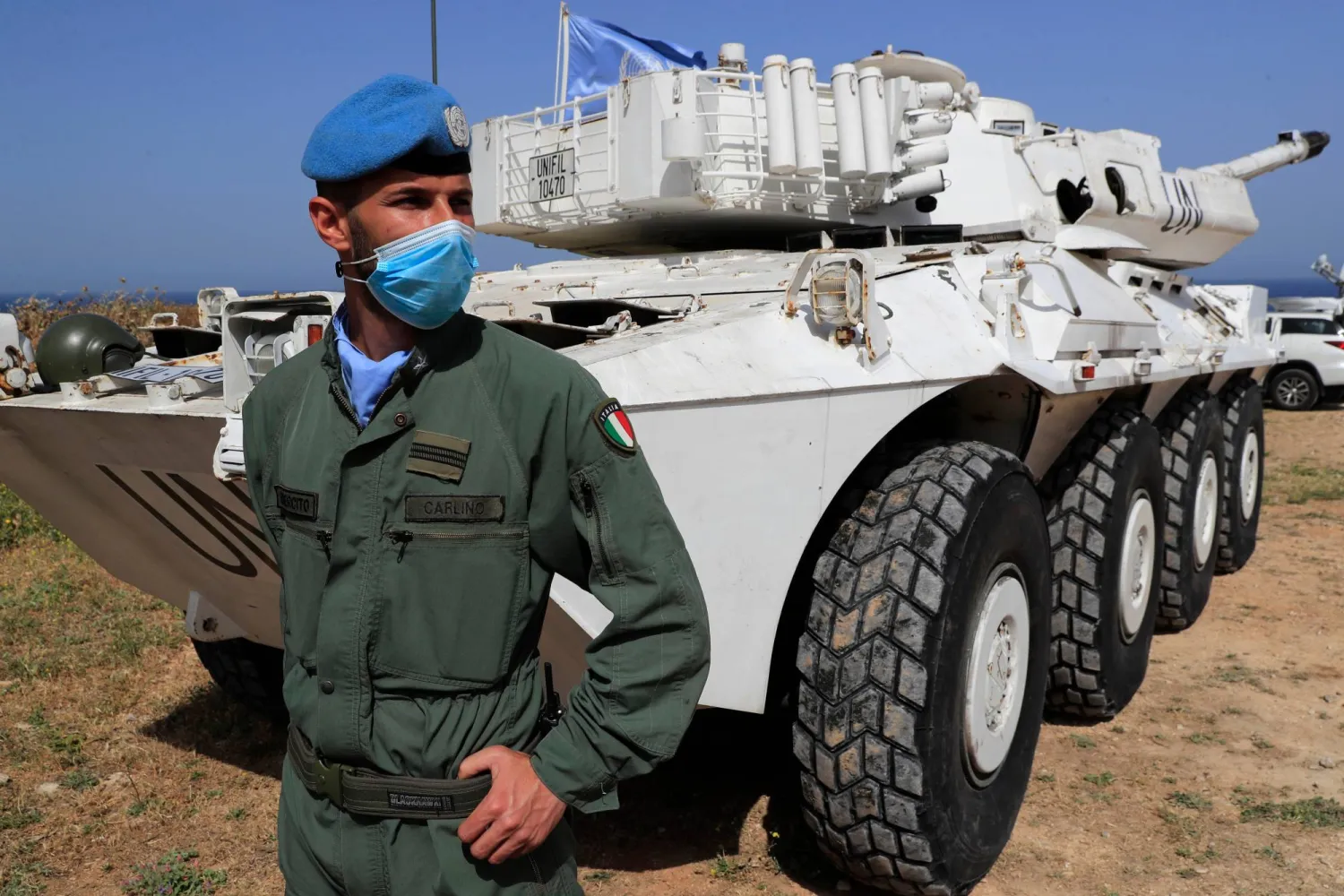
Western and Arab diplomats toured an area along Lebanon’s border with Israel Monday where Lebanese troops and UN peacekeepers have been working for months to end the armed presence of the militant Hezbollah group.

The delegation that included the ambassadors of the United States and Saudi Arabia was accompanied by Gen. Rodolphe Haykal, commander of the Lebanese Armed Forces, as well as top officers in the border region.

The Lebanese government has said that by the end of the year, the army should have cleared all the border area south of the Litani river from Hezbollah’s armed presence.

Hezbollah’s leader Sheik Naim Qassem had said that the group will end its military presence south of the Litani River but vowed again over the weekend that they will keep their weapons in other parts of Lebanon.

Parts of the zone south of the Litani River and north of the border with Israel were formerly a Hezbollah stronghold, off limits to the Lebanese national army and UN peacekeepers deployed in the area.

During the tour, the diplomats and military attaches were taken to an army post that overlooks one of five hills inside Lebanon that were captured by Israeli troops last year.

“The main goal of the military is to guarantee stability,” an army statement quoted Haikal as telling the diplomats. Haykal added that the tour aims to show that the Lebanese army is committed to the ceasefire agreement that ended the Israel-Hezbollah war last year.

There were no comments from the diplomats.

The latest Israel-Hezbollah war began Oct. 8, 2023, a day after Hamas attacked southern Israel, after Hezbollah fired rockets into Israel in solidarity with Hamas. Israel launched a widespread bombardment of Lebanon in September last year that severely weakened Hezbollah, followed by a ground invasion.

The war ended in November 2024 with a ceasefire brokered by the US.

Israel has carried out almost daily airstrikes since then, mainly targeting Hezbollah members but also killing 127 civilians, according to the office of the UN High Commissioner for Human Rights.

On Sunday, the Israeli military said it killed three Hezbollah members in strikes on southern Lebanon.

Over the past weeks, the US has increased pressure on Lebanon to work harder on disarming Hezbollah and canceled a planned trip to Washington last month by Haykal.

US officials were angered in November by a Lebanese army statement that blamed Israel for destabilizing Lebanon and blocking the Lebanese military deployment in south Lebanon.

A senior Lebanese army official told The Associated Press Monday that Haykal will fly to France this week where he will attend a meeting with US, French and Saudi officials to discuss ways of assisting the army in its mission. The officer spoke on condition of anonymity because he wasn’t authorized to speak publicly.

The Lebanese army has been severely affected by the economic meltdown that broke out in Lebanon in October 2019.


ICC Rejects Israeli Bid to Halt Gaza War Investigation

Tents of internally displaced Palestinian families seen among the ruins of destroyed buildings in Al-Zaitun neighborhood during a rainy day in the east of Gaza City on, 12 December 2025, amid a ceasefire between Israel and Hamas. (EPA)
TT

ICC Rejects Israeli Bid to Halt Gaza War Investigation

Tents of internally displaced Palestinian families seen among the ruins of destroyed buildings in Al-Zaitun neighborhood during a rainy day in the east of Gaza City on, 12 December 2025, amid a ceasefire between Israel and Hamas. (EPA)

Appeals judges at the International Criminal Court (ICC) on Monday rejected one in a series of legal challenges brought by Israel against the court's probe into its conduct of the Gaza war.

On appeal, judges refused to overturn a lower court decision that the prosecution's investigation into alleged crimes under its jurisdiction could include events following the deadly attack on Israel by the Palestinian group Hamas on October 7, 2023.

The ruling means the investigation continues and the arrest warrants issued last year for Israeli Prime Minister Benjamin Netanyahu and his former defense chief Yoav Gallant remain in place.

Israel rejects the jurisdiction of the Hague-based court and denies war crimes in Gaza, where it has waged a military campaign it says is aimed at eliminating Hamas following the October 7 attacks.

The ICC initially also issued a warrant for Hamas leader Ibrahim al-Masri for alleged war crimes and crimes against humanity, but withdrew that later following credible reports of his death.

A ceasefire agreement in the conflict took effect on October 10, but the war destroyed much of Gaza’s infrastructure, and living conditions are dire.

According to Gaza health officials, whose data is frequently cited with confidence by the United Nations, some 67,000 Palestinians have been killed by Israel in Gaza.

This ruling focuses on only one of several Israeli legal challenges against the ICC investigations and the arrest warrants for its officials. There is no timeline for the court to rule on the various other challenges to its jurisdiction in this case.