


North Korean Missile Tests Signal Return to Brinkmanship

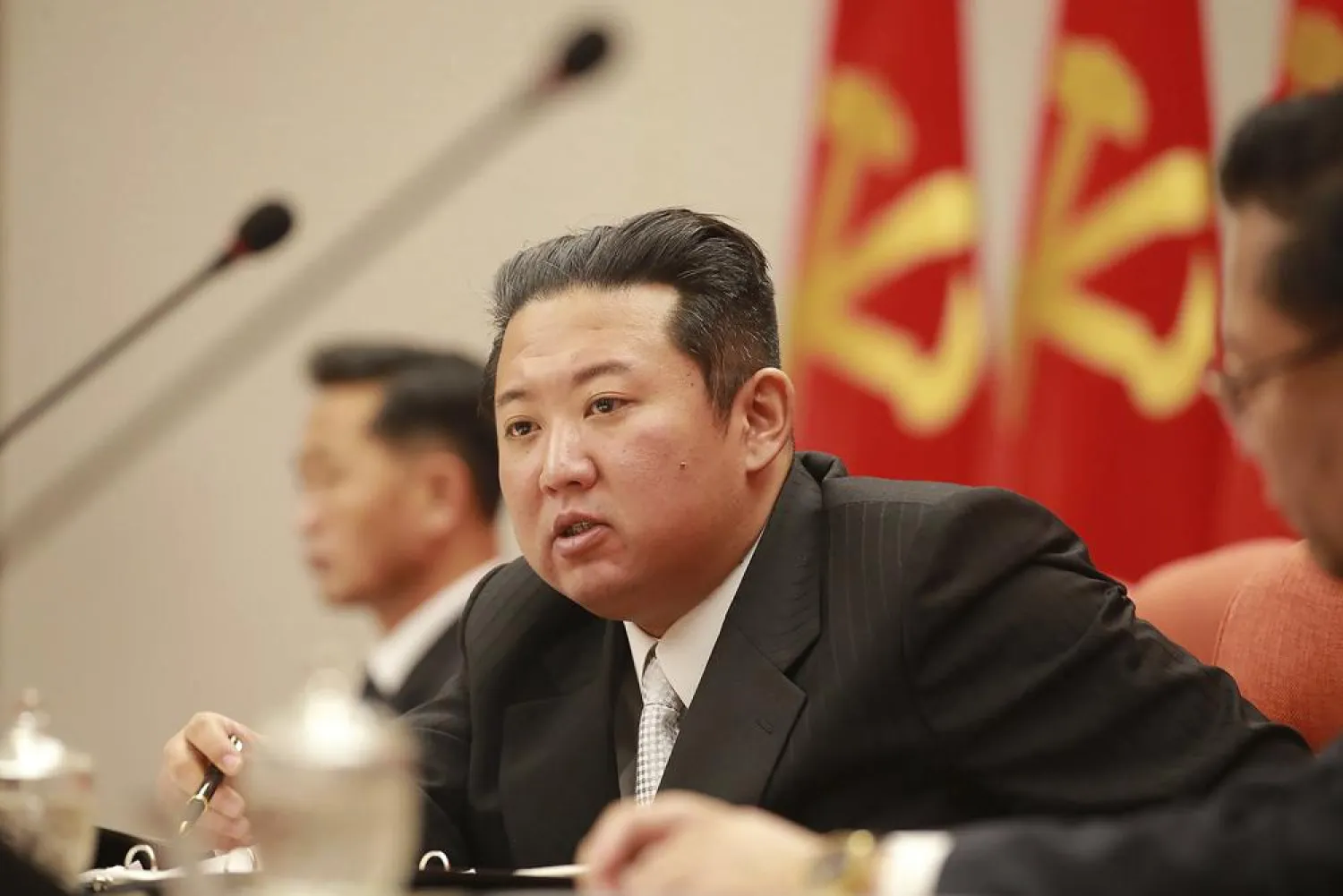
FILE - In this photo taken during Dec. 27 - Dec. 31, 2021 and provided by the North Korean government, North Korean leader Kim Jong Un, center, attends a meeting of the Central Committee of the ruling Workers' Party in Pyongyang, North Korea. Independent journalists were not given access to cover the event depicted in this image distributed by the North Korean government. The content of this image is as provided and cannot be independently verified. (Korean Central News Agency/Korea News Service via AP, File)
TT

North Korean Missile Tests Signal Return to Brinkmanship

FILE - In this photo taken during Dec. 27 - Dec. 31, 2021 and provided by the North Korean government, North Korean leader Kim Jong Un, center, attends a meeting of the Central Committee of the ruling Workers' Party in Pyongyang, North Korea. Independent journalists were not given access to cover the event depicted in this image distributed by the North Korean government. The content of this image is as provided and cannot be independently verified. (Korean Central News Agency/Korea News Service via AP, File)

Grappling with pandemic difficulties and US-led sanctions over his nuclear ambitions, North Korean leader Kim Jong Un could be reviving his 2017 playbook of nuclear and missile brinkmanship to wrest concessions from Washington and his neighbors.

North Korea’s short-range missile launches on Monday were its fourth round of missile tests this month and signaled a refusal to be ignored by the Biden administration, which has focused more on confronting bigger adversaries such as China and Russia.

The tests could also reflect a growing urgency in its need for outside relief after its economy decayed further under the severe sanctions and two years of pandemic border closures, experts say.

The two missiles launched Monday near the capital, Pyongyang, followed a resumption of railroad freight traffic with China that had been suspended over pandemic concerns, in what is likely an attempt to revive the desperate economy, according to The Associated Press.

Chinese Foreign Ministry spokesperson Zhao Lijian said Monday that trade between Dandong in China and Sinuiju in North Korea will be maintained while pandemic controls stay in place.

While North Korea is likely to continue showcasing its weapons in the coming weeks, it could keep things relatively quiet before the opening of the February Winter Olympics in China, its main ally and economic lifeline, launching known short-range missiles rather than more provocative systems.

But it could dramatically raise the ante once the Beijing Games end. Du Hyeogn Cha, an analyst at Seoul’s Asan Institute for Policy Studies, said Kim could resume testing nuclear explosives and intercontinental ballistic missiles.

Kim suspended nuclear and ICBM tests in 2018 while engaging in talks with former US President Donald Trump. But the diplomacy remains derailed since their second summit in 2019, when the Americans rejected North Korea’s demand for major sanctions relief in exchange for a partial surrender of its nuclear capabilities.

North Korea in recent months has ramped up tests of short-range missiles designed to defeat missile defenses in the region.

Its leaders may think it needs to stage more provocative tests to move the needle with the Biden administration, which has offered open-ended talks but has shown no willingness to ease sanctions unless Kim takes real steps to abandon his nuclear weapons program.

It’s unclear whether nuclear or ICBM tests would extract a compromise from Washington, which is more likely to respond with further sanctions and military pressure, possibly including a resumption of major military drills with South Korea, Cha said.

Nam Sung-wook, a North Korea expert at Seoul’s Korea University, said a nuclear test is more likely than an ICBM test because it would send a greater level of shock. The North may use that test to claim it has acquired an ability to produce a nuclear warhead small enough to fit on its purported hypersonic missile, which it first tested in September.

Nam said North Korea would time the test to maximize its political effect, with South Korean presidential elections scheduled in March and President Joe Biden facing crucial midterm elections in November. North Korea conducted its sixth and last test of a nuclear explosive device in September 2017.

“In Pyongyang’s mind, there is no other way to grab Washington’s attention than a major provocation,” Nam said.

North Korea strengthened efforts to expand its weapons capabilities following Kim’s 2021 announcement of a new five-year plan to develop his military forces, with an ambitious wish list that included hypersonic missiles, solid-fuel ICBMs, spy satellites and submarine-launched nuclear missiles.

However, the frequency of tests since then exceeds usual technological timelines and apparently reflects Kim’s desire to break out of the country’s current deepening economic problems and international isolation — what appears to be the toughest period of his decade-long rule.

“Externally, North Korea is trying to make a statement that it will continue to go its own way regardless of sanctions. Internally, the leadership is trying to tell its people that the supreme leader’s promises will be realized no matter what, whether they be weapons development or overcoming sanctions through a self-reliant economy,” Cha said.

“But they are proceeding with the tests at a very fast pace, and this reveals a sense of alarm within Pyongyang’s leadership, that they must get something done with the United States in 2022 or there could be trouble.”

According to South Korean estimates, North Korea’s trade with China shrank by about 80% in 2020 before plunging again by two-thirds in the first nine months of 2021. The contraction in 2020 was the biggest since 1997 as grain production dropped to the lowest level since Kim took power in 2011.

Describing its anti-coronavirus campaign as a matter of “national existence,” North Korea has severely restricted cross-border traffic and trade for the past two years and is even believed to have ordered troops to shoot on sight any trespassers who cross its borders.

Experts say a major COVID-19 outbreak would have devastating consequences because of North Korea’s poor health care system, and could even trigger instability.

Its resumption of the train route with China indicates how hard it has become for its leadership to withstand the economic strain caused by border closures, said Park Won Gon, a professor of North Korea studies at Seoul’s Ewha Womans University.

For decades, North Korea has mastered the art of brinkmanship, manufacturing diplomatic crises with weapons tests and threats before offering negotiations aimed at extracting concessions. Kim sped up the process in 2017 with a highly provocative run of nuclear and ICBM tests while exchanging threats of nuclear annihilation with Trump before beginning their diplomacy in 2018.

North Korea began 2022 with what it claimed were two successful tests of a hypersonic missile, which Kim said would significantly enhance his “war deterrent.” After the Biden administration imposed new sanctions over those launches, North Korea vowed stronger and more explicit action and fired two missiles from a train on Friday.

State media photos of Monday’s launch suggest the North tested a weapon that looks similar in appearance with the US MGM-140 Army Tactical Missile System. The missiles, which North Korea first tested in 2019, are part of the country’s expanding short-range weaponry designed to be maneuverable and fly at low altitudes, which potentially improves their chances of evading missile defense systems in South Korea and Japan.

Park said North Korea’s push to develop and mass-produce such missiles is a key part of its efforts to cement its status as a nuclear power. Its pressure campaign is not only aimed at winning economic benefits but also to negotiate with Washington from a position of power and convert the nuclear diplomacy into talks for mutual arms reduction, he said.



China Vows ‘Resolute Response’ to Any Reckless Acts After Japan Election

 Japan's Prime Minister Sanae Takaichi, leader of the ruling Liberal Democratic Party (LDP), arrives at the Prime Minister's office after her party's historic election win in Sunday's poll in Tokyo, Japan, February 9, 2026. (Reuters)
Japan's Prime Minister Sanae Takaichi, leader of the ruling Liberal Democratic Party (LDP), arrives at the Prime Minister's office after her party's historic election win in Sunday's poll in Tokyo, Japan, February 9, 2026. (Reuters)
TT

China Vows ‘Resolute Response’ to Any Reckless Acts After Japan Election

 Japan's Prime Minister Sanae Takaichi, leader of the ruling Liberal Democratic Party (LDP), arrives at the Prime Minister's office after her party's historic election win in Sunday's poll in Tokyo, Japan, February 9, 2026. (Reuters)
Japan's Prime Minister Sanae Takaichi, leader of the ruling Liberal Democratic Party (LDP), arrives at the Prime Minister's office after her party's historic election win in Sunday's poll in Tokyo, Japan, February 9, 2026. (Reuters)

Beijing warned Tokyo on Monday that reckless actions would be met with a "resolute response", a day after Japan's Prime Minister Sanae Takaichi, who is viewed as critical of China, won a landslide election.

China and Japan have been locked in a spat over comments by Takaichi in November that Tokyo could intervene militarily in any attack on self-ruled Taiwan.

China claims the democratic island as part of its territory and has not ruled out force to annex it.

A spokesman for China's foreign ministry on Monday urged Japan to retract the comments and warned of consequences for any rash actions.

"If the far-right forces in Japan misjudge the situation and act recklessly, they will inevitably face resistance from the Japanese people and a resolute response from the international community," spokesman Lin Jian told a regular news conference.

"We once again urge the Japanese side to retract the erroneous remarks made by Takaichi regarding Taiwan and demonstrate basic sincerity in safeguarding the political foundation of China-Japan relations, through concrete actions," he said.

In the wake of Takaichi's comments in November, China has discouraged its nationals from travelling to Japan, citing deteriorating public security and criminal acts against Chinese nationals in the country.

In the latest escalation of the row in December, Chinese military aircraft locked radar onto Japanese jets, prompting Tokyo to summon Beijing's ambassador.

Beijing also reportedly choked off exports to Japan of rare-earth products crucial for making everything from electric cars to missiles.

And last month, two popular pandas departed Tokyo for China, leaving Japan without any of the beloved bears for the first time in 50 years.


Russia's FSB Says Ukraine's SBU Was behind Assassination Attempt on Top General

In this image made from video and provided by the Russian Defense Ministry Press Service, on June 23, 2023, Lt. Gen. Vladimir Alexeyev speaks to servicemen in an undisclosed location. (Russian Defense Ministry Press Service via AP)
TT

Russia's FSB Says Ukraine's SBU Was behind Assassination Attempt on Top General

In this image made from video and provided by the Russian Defense Ministry Press Service, on June 23, 2023, Lt. Gen. Vladimir Alexeyev speaks to servicemen in an undisclosed location. (Russian Defense Ministry Press Service via AP)

Russia's Federal Security Service said on Monday that the men suspected of shooting one of the country's most senior military intelligence officer had confessed that they were carrying out orders from the Security Service of Ukraine (SBU).

Ukraine has denied any involvement in Friday's attempted assassination of Lieutenant General Vladimir Alexeyev, deputy head of Russia's ‌GRU military ‌intelligence service. Alexeyev has regained ‌consciousness ⁠after surgery, reported Reuters.

Russia ‌said that the suspected shooter, a Ukrainian-born Russian citizen named by Moscow as Lyubomir Korba, had been questioned after he was extradited from Dubai. A suspected accomplice, Viktor Vasin, has also been questioned.

The FSB said in ⁠a statement that both Korba and Vasin had "confessed their ‌guilt" and given details ‍of the shooting which ‍they said was "committed on behalf of ‍the Security Service of Ukraine."

The FSB did not provide any evidence that Reuters was able to immediately verify. It was not possible to contact the men while they were in detention in Russia. The SBU could ⁠not be reached for immediate comment on the FSB statement.

The FSB said Korba was recruited by the SBU in August 2025 in Ternopil, western Ukraine, underwent training in Kyiv and was paid monthly in crypto-currency. For killing Alexeyev, Korba was promised $30,000 by the SBU, the FSB said.

The FSB said Polish intelligence was involved in his recruitment. ‌Poland could not be reached for immediate comment.


Venezuela's Machado Says Ally 'Kidnapped' after His Release

Venezuelan political leader Juan Pablo Guanipa gestures after their release outside Zona 7 prison in Caracas on February 8, 2026.  (Photo by Juan BARRETO / AFP)
Venezuelan political leader Juan Pablo Guanipa gestures after their release outside Zona 7 prison in Caracas on February 8, 2026. (Photo by Juan BARRETO / AFP)
TT

Venezuela's Machado Says Ally 'Kidnapped' after His Release

Venezuelan political leader Juan Pablo Guanipa gestures after their release outside Zona 7 prison in Caracas on February 8, 2026.  (Photo by Juan BARRETO / AFP)
Venezuelan political leader Juan Pablo Guanipa gestures after their release outside Zona 7 prison in Caracas on February 8, 2026. (Photo by Juan BARRETO / AFP)

Venezuela's Nobel peace laureate Maria Corina Machado said on Monday that armed men "kidnapped" a close ally shortly after his release by authorities, following ex-leader Nicolas Maduro's capture.

The country's Public Prosecutor's Office confirmed later that same day that former National Assembly vice president Juan Pablo Guanipa, 61, was again taken into custody and to be put under house arrest, arguing that he violated the conditions of his release.

Guanipa would be placed under house arrest "in order to safeguard the criminal process," the office said in a statement on Monday. The conditions of Guanipa's release have yet to be made public.

Machado claimed that her close ally had been "kidnapped" in the capital Caracas by armed men "dressed in civilian clothes" who took him away by force.

"We demand his immediate release," she wrote on social media platform X.

The arrest came after his release from prison on Sunday along with two other opposition figures, and as lawmakers prepared to vote Tuesday on a historic amnesty law covering charges used to lock up dissidents in almost three decades of socialist rule, reported AFP.

Shortly after his release, Guanipa visited several detention centers in Caracas, where he met with relatives of political prisoners and spoke to the press.

Guanipa had appeared earlier Sunday in a video posted on his X account, showing what looked like his release papers.

"Here we are, being released," Guanipa said in the video, adding that he had spent "10 months in hiding, almost nine months detained here" in Caracas.

- 'Let's go to an electoral process' -

Speaking to AFP later on Sunday, he had called on the government to respect the 2024 presidential election, which opposition candidate Edmundo Gonzalez Urrutia was widely considered to have won. Maduro claimed victory and remained in power till January.

"Let's respect it. That's the basic thing, that's the logical thing. Oh, you don't want to respect it? Then let's go to an electoral process," Guanipa said.

The opposition ally of Machado was arrested in May 2025, in connection with an alleged conspiracy to undermine legislative and regional elections that were boycotted by the opposition.

He was charged with terrorism, money laundering and incitement to violence and hatred.

Guanipa had been in hiding prior to his arrest. He was last seen in public in January 2025, when he accompanied Machado to an anti-Maduro rally.

Following Maduro's capture by US special forces on January 3, authorities have started to slowly release political prisoners. Rights groups estimate that around 700 people are still waiting to be freed.

A former Machado legal advisor, Perkins Rocha, was also freed on Sunday. So was Freddy Superlano, who once won a gubernatorial election in Barinas, a city that is the home turf of the iconic late socialist leader Hugo Chavez.

"We hugged at home," Rocha's wife Maria Constanza Cipriani wrote on X, with a photo of them.

Machado, who was awarded the 2025 Nobel Peace Prize for her efforts to advance democracy in Venezuela, had initially celebrated Guanipa's release.

"My dear Juan Pablo, counting down the minutes until I can hug you! You are a hero, and history will ALWAYS recognize it. Freedom for ALL political prisoners!!" she wrote on X on Sunday.

NGO Foro Penal said it had confirmed the release of 35 prisoners on Sunday. It said that since January 8 nearly 400 people arrested for political reasons have been freed thus far.

Lawmakers gave their initial backing to a draft amnesty last week which covered the types of crimes used to lock up dissidents during 27 years of socialist rule.

But Venezuela's largest opposition coalition denounced "serious omissions" in the proposed amnesty measures on Friday.

Meanwhile, relatives of prisoners are growing increasingly impatient for their loved ones to be freed.

Acting president Delcy Rodriguez, who was Maduro's vice president, is pushing the amnesty bill as a milestone on the path to reconciliation.

Rodriguez took power in Venezuela with the blessing of US President Donald Trump, who is eyeing American access to what are the world's largest proven oil reserves.

As part of its reforms, Rodriguez's government has taken steps towards opening up the oil industry and restoring diplomatic ties with Washington, which were severed by Maduro in 2019.