

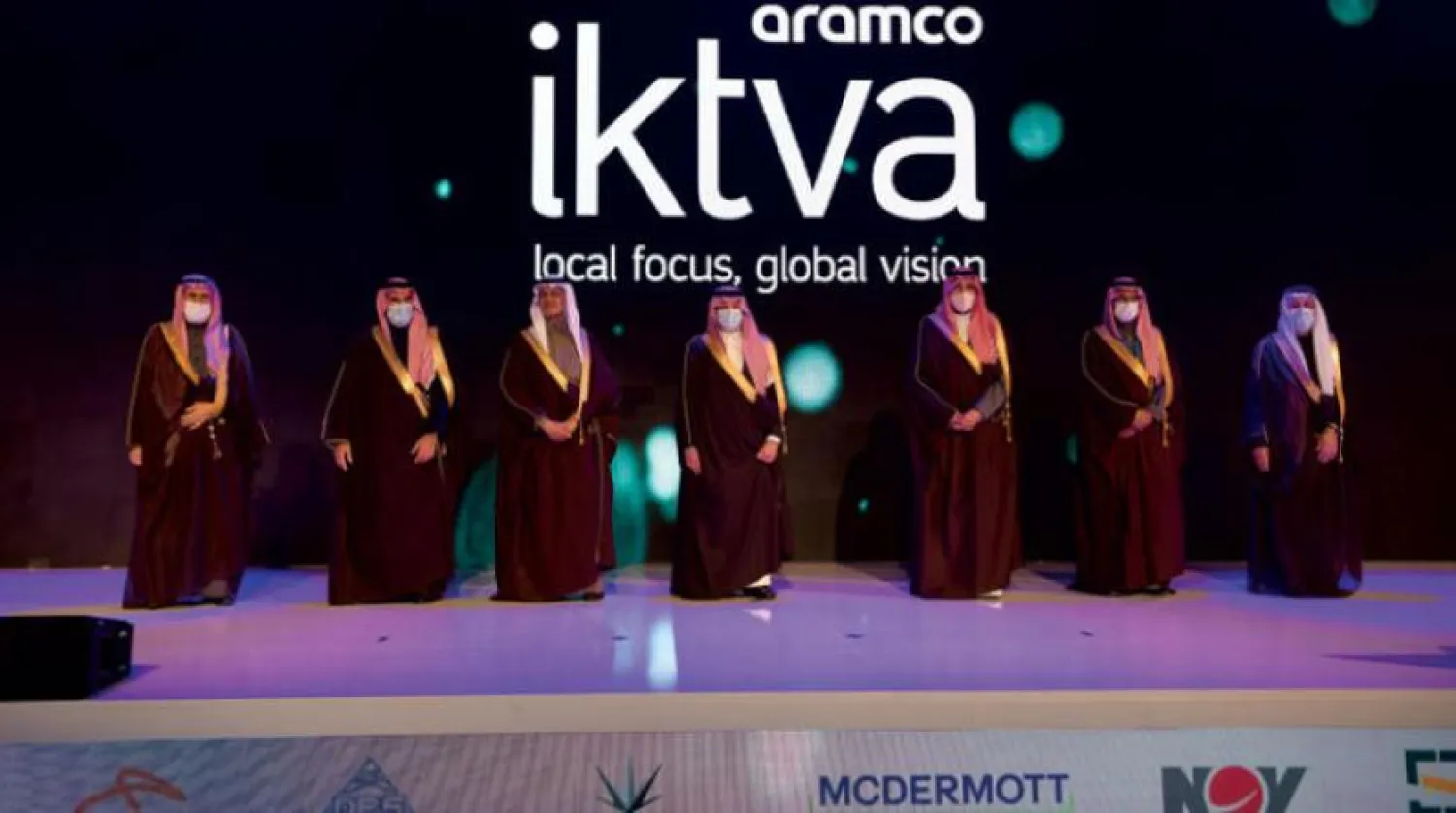

Special Saudi Committee Aims to Support Localization of Energy Sector

Officials attend the inauguration of the 6th edition of IKTVA. (Asharq Al-Awsat)
TT

Special Saudi Committee Aims to Support Localization of Energy Sector

Officials attend the inauguration of the 6th edition of IKTVA. (Asharq Al-Awsat)

Saudi Minister of Energy Prince Abdulaziz bin Salman revealed the imminent formation of a committee to localize the energy sector in the country under the umbrella of the Supreme Committee for Energy Mix Affairs for Electricity Production and Enabling Renewable Energy Sector, with the aim to achieve greater cohesion and enhance cooperation between the various stakeholders.

The minister stressed that the comprehensive and joint approach has made it possible to overcome the challenges facing large national projects, such as the Energy Efficiency Program, the Electricity Sector Integration, and the Circular Carbon Economy Initiative.

He was speaking during the inauguration of the sixth edition of the “In Kingdom Total Value Add” (IKTVA), which is organized by Saudi Aramco, in the presence of Prince Ahmed bin Fahd bin Salman bin Abdulaziz, deputy governor of the Eastern Province, Bandar Alkhorayef, Minister of Industry and Mineral Resources, and Yasir Al-Rumayyan, Chairman of the Board of Directors of Aramco.

According to information released on Monday, Saudi Aramco, through the IKTVA program, was able to achieve a major shift in increasing local content, by directing 59 percent of its spending during 2021 to local suppliers, compared to 35 percent when the first version of the program was launched in 2015.

Supply chains key to industry success

Prince Saud bin Nayef, governor of the Eastern Province, underlined the importance of the forum in promoting local content and localizing technology and industry.

“The world today is witnessing successive events and developments, which call for building a reliable and effective system for the local supply chain,” he stated, adding: “With the accelerating impact of globalization and the inevitable integration between local, regional and global supply chains, strengthening this system and its infrastructure has become an important pillar of the industry’s success…”

Attracting $7 billion
Yasir Al-Rumayyan, for his part, said that IKTVA’s investments have attracted capital expenditures estimated at $7 billion, which in turn helps establish a competitive industrial base in Saudi Arabia.

He indicated that IKTVA has contributed about $100 billion since its inception. He explained that the program provided an incentive for innovation inside the country, as the company’s suppliers have increased their spending on research and development from $21 million to $91 million.

Since the launch of the program, local content in the company’s supply chain has increased from 35 percent to nearly 60 percent, he emphasized, adding that Saudi employees now account for one in four people working in Aramco’s supply chain.

Fertile land for investment
Eng. Amin Al-Nasser, President and Chief Executive Officer of Saudi Aramco, noted that the sixth edition of IKTVA saw an increased volume of investment opportunities compared to the previous years, at a time when the world is witnessing continuous challenges in global supply chains due to the Covid-19 pandemic.

Saudi Aramco achieved greater reliability through the IKTVA program, which allowed it to respond swiftly to the market needs during the difficult times, he underlined.

“Saudi Arabia is witnessing major transformations and is a fertile land for investment opportunities. Saudi Aramco is proud to have a major role in enabling transformations and providing opportunities through the IKTVA program and the associated major local content projects, such as the King Salman Energy City, the King Salman International Complex for Maritime Industries and Services, and the Aramco Namaat Program,” Al-Nasser said.

The sixth edition of the IKTVA program will witness the signing of 50 new memoranda of understanding. The program aims to stimulate local value building, maximize long-term economic growth, and build a world-class supply chain that facilitates the development of a diversified, sustainable and competitive energy sector at the local and global levels.



Euro Zone Yields Fall after Iran Raises Prospect of Hormuz Reopening

Euro banknotes (Reuters)
TT

Euro Zone Yields Fall after Iran Raises Prospect of Hormuz Reopening

Euro banknotes (Reuters)

Euro zone bond yields fell for a second straight day on Tuesday, hitting their lowest in almost two weeks after Iran raised the prospect of reopening the Strait of Hormuz and Washington hinted it could restart talks with Tehran, pushing oil prices lower.

Germany's 10-year bond yield, the benchmark for the bloc, fell 1 basis point to 3.44% after rising as much as 4 bps earlier in the session. It fell 7 bps on Monday as energy prices retreated.

A senior Iranian official told Reuters that the strait, which carried about a fifth of global energy supplies before the war, could reopen within seven days if the US also lifts its blockade of Iranian ports.

The official added that Iran's delegation to a UN meeting in New York this week has full authority to revive diplomacy over the conflict.

US Secretary of State Marco Rubio told NBC's "Today" show that Washington was open to speaking with Tehran.

The dip in energy prices helped pull yields lower globally after a surge in recent weeks fuelled by expectations of further interest-rate hikes to combat energy-driven inflation. Traders are pricing in around 35 bps of additional European Central Bank tightening this year, down from 40 bps on Friday.

Germany's two-year bond yield, which is sensitive to interest-rate expectations, fell 1 bp to 3.19%, following a 6-bp drop on Monday.

Rabobank senior rates strategist Lyn Graham-Taylor said lower oil prices following the Iranian comments were weighing on bond yields.

Brent crude futures were last down 1% to $100 a barrel after earlier falling to $97.40, the lowest in two weeks.


Libya's NOC Says Sharara Crude Pipeline Closure Losses at 130,000 bpd

General view of the Sharara oil field in Libya (Reuters)
TT

Libya's NOC Says Sharara Crude Pipeline Closure Losses at 130,000 bpd

General view of the Sharara oil field in Libya (Reuters)

Libya's National Oil Corporation said on Tuesday that the Sharara-Zawiya crude loading pipeline closure has led to daily losses of about 130,000 barrels per day, Reuters reported.

An armed military group closed valve seven on the Sharara crude pipeline to Zawiya port on Monday, resulting in a significant decline in production at the Sharara oilfield, the National Oil Corporation said in a statement.


Sources: Saudi Arabia Restarts East-West Oil Pipeline

FILE PHOTO: A model of an oil pump is seen in front of a Saudi Arabian flag in this illustration taken January 9, 2026. REUTERS/Dado Ruvic/Illustration/File Photo
TT

Sources: Saudi Arabia Restarts East-West Oil Pipeline

FILE PHOTO: A model of an oil pump is seen in front of a Saudi Arabian flag in this illustration taken January 9, 2026. REUTERS/Dado Ruvic/Illustration/File Photo

Saudi Arabia has restarted operations at its East-West Pipeline and could resume exports from the Red Sea port of Yanbu later on Tuesday, three sources briefed on the matter said.

Drone attacks forced Saudi Arabia to shut its East-West Pipeline on September 13, halting crude loadings at the kingdom's Yanbu port.

The resumption of supplies on Tuesday helped to drive selling on global oil markets, traders said. Brent crude futures fell by more than $2 a barrel to its lowest since September 8.

Two trading sources said traders were getting ready for Saudi oil loadings by moving tankers to Egypt's Mediterranean Port Said for ship-to-ship transfers and also to Sidi Kerir.