

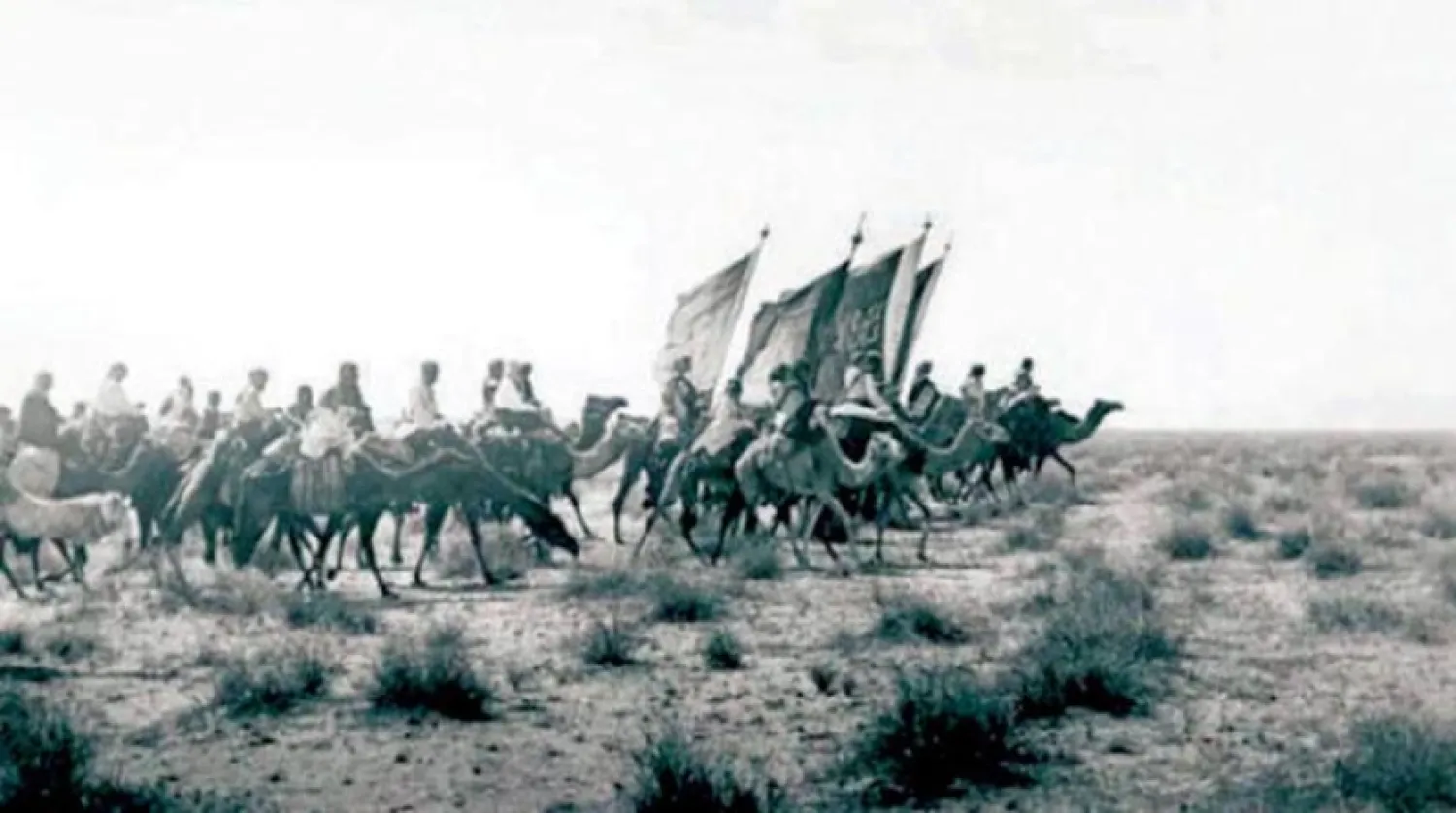

Saudi Arabia's Green National Flag Flutters for 3 Centuries

Saudi soldiers carry the Saudi flag and banners during the reign of King Abdulaziz in 1911. (Photo courtesy of Adnan al-Turaif to Asharq Al-Awsat)
TT

Saudi Arabia's Green National Flag Flutters for 3 Centuries

Saudi soldiers carry the Saudi flag and banners during the reign of King Abdulaziz in 1911. (Photo courtesy of Adnan al-Turaif to Asharq Al-Awsat)

Late historian Abdul Rahman Ruwaished has documented the evolution of the national banner over the centuries, with focus on the history of the Saudi national flag.

He has examined medals and military ranks that he believed were cornerstones of national devotion. He also studied the codes of flags, standards, medals and ranks.

In his book, "History of the Saudi Flag: National Flags, Decorations and Insignia," Ruwaished tackled the "code of ensigns, medals and ranks." He delved in detail into the etymology of the word "flag" in Arabic, saying it has numerous synonyms in the language, all of which denote a piece of colored cloth that is hoisted on a pole.

The flag is usually emblazoned with significant symbols and is carried by soldiers leading a parade. The flag is also hoisted at government buildings and during various occasions.

Saudi Arabia chose green as its national color and the color of its flag. In the center of the flag is the Islamic declaration of faith, Shahada, and below it is an image of a drawn sword.

The flag dates back to the First Saudi State. Ruwaished said the banner went through several transformations before the current form was adopted during the later years of the reign of late King Abdulaziz.

The Saudi flag was first flown in 1727 by founder of the First Saudi State Imam Mohammed bin Saud, who ruled for 40 years.

Journalist Adnan al-Turaif said King Abdulaziz adopted the flag of the first and second Saudi States during the early years of the Kingdom's founding.

He then ordered that a few changes be introduced to the flag, al-Turaif told Asharq Al-Awsat.

He cited Lebanese intellectual Ameen Rihani, who said that during the early years of King Abdulaziz's reign, the flag was square shaped, with the Shahada in the center and two crossed swords above it.

Changes were introduced soon after, with the two crossed swords being replaced by a single one. The sword was moved below the Shahada.

In 1925, King Abdulaziz ordered that a new flag be drawn up. In 1937, the Shura Council approved the dimensions of the flag at 150 cm in length and 100 cm in width. Later that year, a decree was issued over the national flag and over dedicating a flag to each of the king, crown prince, army, air force, internal flag, royal navy and marine trade.

In 1952, the Shura Council approved new measurements and modifications to the flags. In 1973, the government approved the flag code.

During the reign of King Fahd, specifically in 1991, modifications were made to the flag, whose width would be two thirds of its length. The Shahada would remain in the center and the sword just below it. In 1997, the government decreed that the national flag would be raised in the Kingdom from sunrise to sunset on weekends and holidays.



Coalition Intercepts Houthi Attacks as Resident Injured by Ballistic Missile Debris

 The directorate's teams responded to the incident and followed standard procedures - SPA
The directorate's teams responded to the incident and followed standard procedures - SPA
TT

Coalition Intercepts Houthi Attacks as Resident Injured by Ballistic Missile Debris

 The directorate's teams responded to the incident and followed standard procedures - SPA
The directorate's teams responded to the incident and followed standard procedures - SPA

The Coalition to Support Legitimacy in Yemen continued Wednesday to counter terrorist Houthi attacks on Saudi Arabia, announcing that it had intercepted and destroyed a ballistic missile launched by the terrorist Houthi militia toward Riyadh.

An Arab resident was injured and a home and a vehicle sustained limited material damage on Wednesday when debris fell in Riyadh following the interception of a ballistic missile, the Saudi General Directorate of Civil Defense reported.

On Tuesday, the coalition intercepted ballistic missiles, cruise missiles and drones launched toward the Riyadh region, the southern region, Al-Kharj Governorate, Haradh Center in Al-Ahsa Governorate, and the city of Dhahran in eastern Saudi Arabia.

The Saudi Civil Defense also reported that debris from the interception of two cruise missiles fell in Riyadh, injuring four people and causing limited material damage to 15 residential homes.

In a development reflecting the widening scope of military strikes against resources relied upon by the Houthi militia, the Coalition to Support Legitimacy carried out several airstrikes Tuesday on the Al-Sabaha Central Fuel Storage Station, west of the Yemeni capital, Sanaa, in an effort to disrupt a key Houthi fuel supply line that supports the group's military operations.


Saudi Crown Prince Meets with Iraqi Prime Minister in Riyadh

Saudi Crown Prince and Iraqi Prime Minister in Riyadh (SPA)
TT

Saudi Crown Prince Meets with Iraqi Prime Minister in Riyadh

Saudi Crown Prince and Iraqi Prime Minister in Riyadh (SPA)

Saudi Crown Prince and Prime Minister Mohammed bin Salman met with Iraqi Prime Minister Ali Faleh al-Zaidi on Wednesday following his arrival in Riyadh for a visit to the Kingdom.

During the meeting, the two leaders discussed regional developments and coordinated efforts to strengthen security and stability in the region. They also reviewed Saudi-Iraqi relations and ways to enhance cooperation across various fields, particularly security coordination between the two countries to address potential regional security challenges.

According to a statement issued by the Iraqi government, Prime Minister Ali Faleh al-Zaidi reaffirmed Iraq's firm position that it would not allow its territory to be used as a launching point for any attacks or actions that threaten the security of Saudi Arabia or other countries in the region.

He stressed Iraq's commitment to the principles of good neighborliness and respect for its own sovereignty and that of brotherly and friendly countries.

Al-Zaidi also expressed the Iraqi government's condemnation of the attack targeting King Khalid International Airport in Riyadh, as well as any harm inflicted on civilians and civilian facilities during conflicts, warning that such actions threaten regional security and stability.

The Iraqi prime minister had arrived in Riyadh earlier with an official delegation for the official visit to Saudi Arabia.


Coalition Continues to Intercept Houthi Terrorist Attacks

Damage to a residential home in Riyadh after debris fell from the interception of a missile on Tuesday (SPA)
TT

Coalition Continues to Intercept Houthi Terrorist Attacks

Damage to a residential home in Riyadh after debris fell from the interception of a missile on Tuesday (SPA)

Official Spokesperson for the Coalition to Restore Legitimacy in Yemen Major General Turki Al-Malki said Wednesday that a ballistic missile launched by the terrorist Houthi militia toward Riyadh was intercepted and destroyed.

Earlier Wednesday, the General Directorate of Civil Defense stated that its teams in Riyadh responded on Tuesday to falling debris from two cruise missiles launched by the Houthis after they were intercepted and destroyed.

Four people were injured — two women, a man, and a child — and 15 homes sustained limited material damage. Standard procedures for such incidents were followed.

On Tuesday, the Coalition intercepted several ballistic and cruise missiles, and drones.