


Beijing Olympics Closes after Golden Moments and Doping Storm

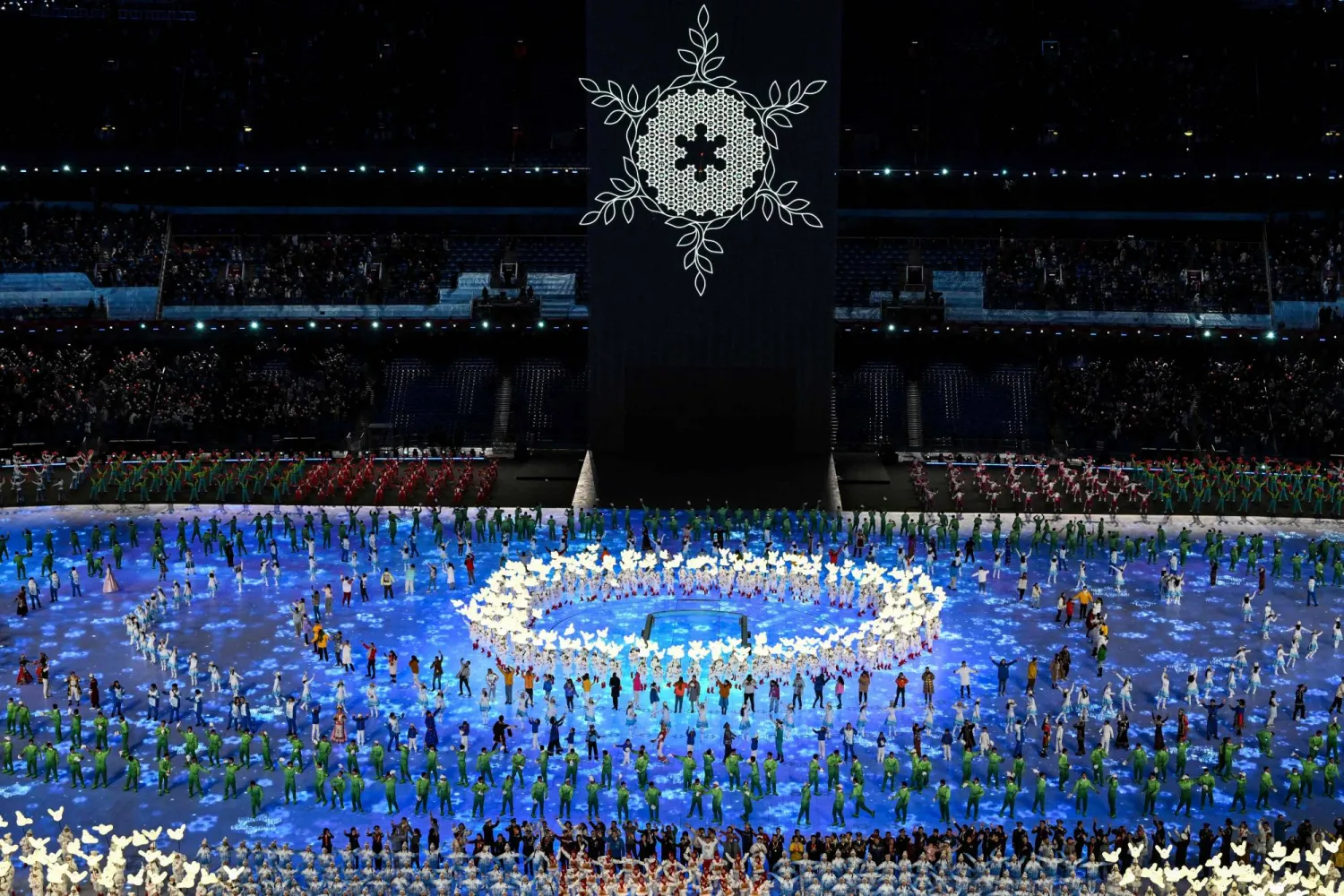
Performers dance during the opening ceremony of the Beijing Games on Friday. | AFP-JIJI
TT

Beijing Olympics Closes after Golden Moments and Doping Storm

Performers dance during the opening ceremony of the Beijing Games on Friday. | AFP-JIJI

The Beijing Winter Olympics have closed with IOC chief Thomas Bach hailing a smoothly run event and a "safe Games" in the midst of the Covid pandemic, but the gold medals were overshadowed by a doping controversy.

The Games ended on Sunday in the "Bird's Nest" stadium, just as they had when the Chinese capital hosted the 2008 Summer Olympics, in a snowflake-themed closing ceremony attended by President Xi Jinping and a socially-distanced crowd, AFP reported.

As he declared the Games over and handed over to 2026 hosts Milano-Cortina, the International Olympic Committee president Bach hailed an "unforgettable Olympic experience".

The Games produced bright new stars including China's Californian-born freestyle skier Eileen Gu, who won two gold medals to cement her huge popularity in the host nation.

The future of 15-year-old Russian figure skating prodigy Kamila Valieva is less certain after she failed a drugs test but was allowed to continue competing.

Then, after a week of intense pressure, she fell apart in an error-strewn performance that will go down as one of the saddest in Olympic history.

Chinese organizers will be quick to hail the success of the vast Covid-secure "bubble" that enveloped the Games, with up to 70,000 people sealed off.

There was no mass outbreak of Covid at the Games or in the wider Chinese capital, but Bach said: "If we want to finally overcome this pandemic, we must be faster, we must aim higher, we must be stronger -- we must stand together.

"In this Olympic spirit of solidarity, we call on the international community: give equal access to vaccines for everybody around the world."

With tensions rising between Russia and Ukraine, Bach said the athletes had "given peace a chance".

"May the political leaders around the world be inspired by your example of solidarity and peace," he said.

China and its ruling Communist Party will look back on a soft-power success.

The Global Times, a Chinese nationalist state-run tabloid, said on Monday the Olympics had shown the 'true nature' of China.

"The unexpected global popularity of the Beijing Winter Olympic Games declared the complete failure of the so-called diplomatic boycott, smashed the malicious slander of some Western media, and demonstrated the enduring charm of human resilience and unity," it said.

Echoing that theme, fireworks lit up the night sky at the ceremony, spelling out "ONE WORLD".

- Valieva's case dominated -
Gu, the 18-year-old who was born in California but switched to China in 2019, gave the hosts a significant medal bump, helping them finish third in the medals table with nine golds.

That was easily China's best performance at a Winter Games, a place ahead of chief geopolitical rival the United States, who claimed eight golds.

For the second Games in a row, Norway topped the medals table, with 16 golds, mainly thanks to their peerless cross-country skiers. Germany were second on 12.

A new men's figure skating champion emerged in 22-year-old Nathan Chen of the United States, who dethroned two-time Olympic champion Yuzuru Hanyu, in what could be the Japanese legend's final Games appearance.

Shaun White, the American who has defined snowboarding, bowed out after finishing without a medal. The 35-year-old three-time Olympic champion called the sport "the love of my life".

There was bitter disappointment for his fellow American and one of the biggest names of the Games, the alpine skier Mikaela Shiffrin, who also went home empty-handed.

But it was Valieva's story that dominated the Games, catapulting the teenage skater to the forefront of yet another Russian doping controversy to mar an Olympics.

After becoming the first woman in history to land a quadruple jump in Olympic competition to help Russia win the team event, it was revealed Valieva had tested positive for trimetazidine, a drug used to treat angina but which is banned for athletes because it can boost endurance.

To fury from the US team and others, the Court of Arbitration for Sport allowed her to continue competing at the Games, citing her young age, though without clearing her of doping.

In the final, Valieva fell several times, to audible gasps from the crowd, and was given a cold reception from her coach Eteri Tutberidze as she left the rink.

Bach called that reaction "chilling" and ordered the young skater's coaches and advisors be investigated.

Valieva's doping case looks certain to drag on for months.

For the first time in Olympic history, the IOC ruled that the skating team medals cannot be awarded until her case is settled.

Ice skating's governing body meanwhile said it would consider a proposal to raise the minimum competition age to 17.

- Rights protests muted -
While a Covid outbreak never materialized, some athletes did have the Olympics ruined by the virus and the pandemic was never far away -- Russia and Canada's women ice hockey teams played each other wearing medical masks after the results of their PCR tests failed to arrive in time.

Concerns about human rights had dominated the build-up, with the United States leading a diplomatic boycott by its closest allies over China's rights record, especially the fate of the Muslim Uyghur minority in Xinjiang.

China warned in the fraught lead-up that foreign athletes criticizing the authorities could face consequences, but any protests against the hosts were extremely muted.



Brazil, Morocco Headline Group C as Scotland and Haiti Return to the World Cup

Moroccan fans cheer during a friendly soccer match between Morocco and Ecuador in Madrid, Spain, Friday, March 27, 2026. (AP Photo/Manu Fernandez)
TT

Brazil, Morocco Headline Group C as Scotland and Haiti Return to the World Cup

Moroccan fans cheer during a friendly soccer match between Morocco and Ecuador in Madrid, Spain, Friday, March 27, 2026. (AP Photo/Manu Fernandez)

Five-time champion Brazil faces African powerhouse Morocco in Group C, which also includes Scotland and Haiti — two teams returning to the World Cup after long absences.

All matches will be played in the United States, with Brazil playing in New York, Philadelphia and Miami. Scotland will face both Haiti and Morocco in Boston, while Haiti and Morocco will play each other in Atlanta.

Brazil Brazil, the most successful nation in World Cup history, last won the title in 2002.

Since then it has been eliminated in the quarterfinal stage at every tournament except in 2014, when as host it reached the final four, but suffered a humiliating 7-1 loss to Germany.

Croatia sent the Brazilians home in a penalty shootout four years ago in Qatar.

This time Brazil will be led by Real Madrid’s Vinícius Júnior and Barcelona’s Raphinha. Madrid forward Rodrygo has been ruled out of the World Cup because of a knee injury.

The team was underperforming in World Cup qualifiers, including stinging losses to archrival Argentina, when the Brazilian soccer confederation recruited veteran coach Carlo Ancelotti from Real Madrid. Though he guided the team across the finish line, Brazil finished only fifth in South American qualifying.

Ancelotti has won five Champions League titles but at the World Cup his only coaching experience was as an assistant manager for Italy under Arrigo Sacchi during the 1994 tournament in the United States, when the Italians lost the final to Brazil.

Morocco finished fourth at the last World Cup — the best result ever by an African team. It beat Spain in the round of 16 and Cristiano Ronaldo’s Portugal in the quarterfinals before falling to eventual runner-up France in the last four.

The team is entering the World Cup fresh off a chaotic end to the Africa Cup of Nations, which it hosted in December and January. Morocco lost the final to Senegal but the result was overturned in March by the Confederation of African Football, which ruled that Senegal forfeited the final by leaving the field of play without the referee’s authorization.

Coach Walid Regragui quit after the final, and Morocco will have a new man in charge at the World Cup: Mohamed Ouahbi, who led Morocco’s under-20 team to the Youth World Cup title.

Morocco will co-host the 2030 World Cup with Spain and Portugal.

Haiti The Caribbean country is set to make its second World Cup appearance, and first since 1974, after winning its CONCACAF qualifying group.

In 1974, Haiti was eliminated after three consecutive losses against Italy, Poland and Argentina. The team is likely to struggle against its group-stage opponents this time around as well.

Coached by Frenchman Sebastien Migne, Haiti currently sits in 83rd place in FIFA's world rankings, ahead of only New Zealand among the 48 teams that have qualified for the World Cup.

The team will be led by 32-year-old Duckens Nazon, the joint-top scorer in CONCACAF qualifying with six goals, including a hat-trick while coming off the bench in a 3-3 draw at Costa Rica.

Scotland Scotland will be playing in its first World Cup since 1998 thanks to a late win over Denmark in its final qualifier last year.

The team will be led by Scott McTominay, who scored one of the goals in the dramatic 4-2 win over Denmark that sealed Scotland’s return.

Coach Steve Clarke has been in charge since 2019 and will be the first man to lead the nation at three major tournaments. Scotland was eliminated in the group stage at the 2020 and 2024 European Championships.

It has never made it past the group stage in its eight previous World Cup appearances. It also faced Brazil in 1998, being narrowly beaten 2-1 by the then defending champion.


Organizers Postpone Imane Khelif’s April 23 Paris Fight after Shoulder Injury

Paris 2024 Olympics - Boxing - Women's 66kg - Final - Roland-Garros Stadium, Paris, France - August 09, 2024. Imane Khelif of Algeria in action against Liu Yang of China. REUTERS/Peter Cziborra/ File Photo
TT

Organizers Postpone Imane Khelif’s April 23 Paris Fight after Shoulder Injury

Paris 2024 Olympics - Boxing - Women's 66kg - Final - Roland-Garros Stadium, Paris, France - August 09, 2024. Imane Khelif of Algeria in action against Liu Yang of China. REUTERS/Peter Cziborra/ File Photo

Olympic champion Imane Khelif injured her left shoulder while training over the weekend and was forced to postpone a professional fight scheduled for later this month in Paris.

Organizers said Monday that her April 23 fight at the iconic Salle Wagram in the French capital against German boxer Julia Igel was delayed to a date yet to be announced, The AP news reported.

“This decision follows the injury sustained by Imane Khelif during a training session this weekend in Paris,” the organizers said in a statement.

A medical examination carried out Monday revealed “a painful syndrome in the left shoulder,” they said. “Due to the intensity of the biomechanical demands involved in high-level boxing, the medical team deemed the athlete’s condition temporarily incompatible with competition.”

The event was also set to feature two bouts for WBA titles and organizers decided to reschedule the entire evening.

“The health and physical integrity of our athletes remain our absolute priority. We wish Imane Khelif a speedy recovery. At an event of this level, including WBA championships, it was essential to guarantee optimal conditions for all participating boxers,” said former boxer Brahim Asloum, the promoter of the gala.

Tickets already purchased will be refunded, organizers added.

Khelif won the Olympic gold at the 2024 Paris Games amid international scrutiny on her and Taiwan’s Lin Yu-ting — another gold medal winner — and misconceptions over both boxers’ sex.

Both fighters were allowed to compete by the IOC after being disqualified from the 2023 world championships by the Russian-dominated International Boxing Association. The IBA claimed the women failed unspecified eligibility tests.

However, the IOC applied sex eligibility rules used in previous Olympics and said Khelif and Lin passed.

World Boxing took over as the sport’s governing body last year, and it implemented a sex eligibility policy last August requiring all fighters to take a one-time genetic test designed to identify the presence of a Y chromosome. Khelif has not competed in World Boxing-sanctioned events since the implementation of the test.


Russian Swimmers to be Allowed to Compete with Flag and Anthem after Restrictions Dropped

Neutral Athlete Russia, Kliment Kolesnikov reacts after winning gold medal in the men’s 50-meter backstroke final at the World Aquatics Championships in Singapore, on Aug. 3, 2025. (AP Photo/Vincent Thian, File)
TT

Russian Swimmers to be Allowed to Compete with Flag and Anthem after Restrictions Dropped

Neutral Athlete Russia, Kliment Kolesnikov reacts after winning gold medal in the men’s 50-meter backstroke final at the World Aquatics Championships in Singapore, on Aug. 3, 2025. (AP Photo/Vincent Thian, File)

The governing body for international swimming and aquatic sports will allow athletes from Russia to compete without restrictions and with their national flag and anthem.

The decision marks a major shift in how a key sport treats Russia ahead of the Los Angeles Olympics in 2028.

World Aquatics said Monday it will remove restrictions which had required Russian and Belarusian athletes to be vetted and to compete under neutral status.

“Senior athletes with Belarusian or Russian sport nationality will be permitted to compete in World Aquatics events in the same way as their counterparts representing other sport nationalities, with their respective uniforms, flags and anthems,” World Aquatics said in a statement. It had previously relaxed the rules for junior athletes.

World Aquatics President Husain Al Musallam added: “We are determined to ensure that pools and open water remain places where athletes from all nations can come together in peaceful competition.”

Russian Sports Minister Mikhail Degtyaryov thanked Al Musallam “for his firm position on this issue” and said they'd discussed the issue together in January.

“It is very important that international sporting dialog is bearing fruit and enables the orderly restoration of sporting ties,” Degtyaryov, who also heads the Russian Olympic Committee, wrote on the social media app Max.

Ukraine has previously objected to efforts to allow Russian athletes to return to competition. Last month it led boycotts of the Paralympic opening and closing ceremonies after Russians were allowed to compete under their national flag.

Ukraine's men's water polo team appeared Monday to be forfeiting a scheduled World Cup game against a team of Russians competing as “Neutral Athlete B” in Malta, The AP news reported.

World Aquatics oversees sports like swimming, diving and water polo and is an influential voice in the Olympic movement. It says Russian and Belarusian athletes will have to undergo four anti-doping tests and “background checks” before competing after Monday's decision. It wasn't immediately clear what would be checked.

Its decision applies only to its own events like the world championships but could add momentum within the Olympic world for a full return of Russian athletes ahead of the 2028 Los Angeles Games.

There was no immediate response to a request for comment from the International Olympic Committee.

In December the IOC recommended removing restrictions on Russian and Belarusian athletes for international youth events and letting them compete under national flags. The IOC still kept its neutral requirements for senior competitions and Russians and Belarusians were officially referred to as “Individual Neutral Athletes” at the Winter Olympics in February.