
Made-in-Japan Manga Goes Global with Webtoon, Deadpool

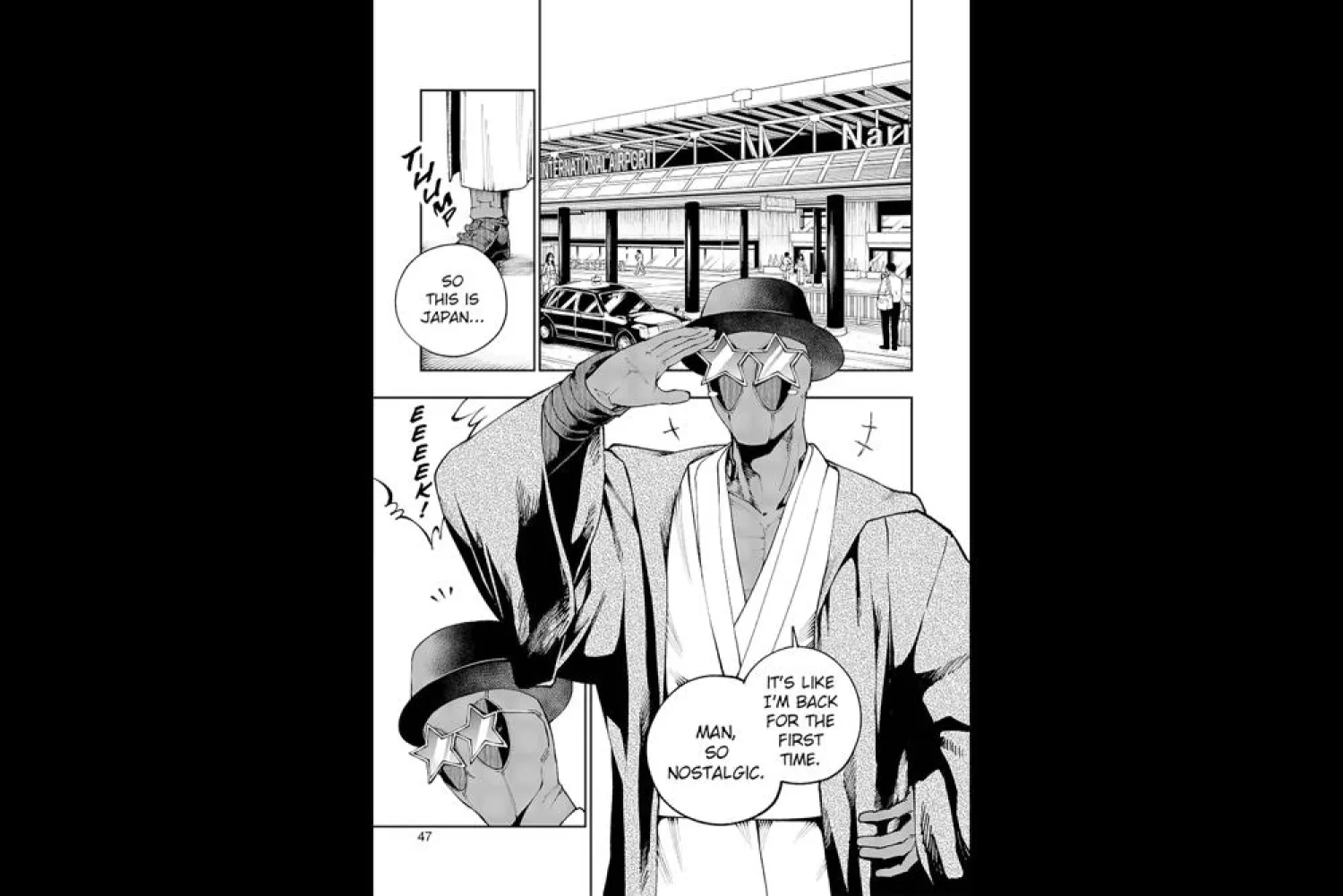
The image is from Sanshiro Kasama’s "Deadpool: Samurai," published in Japanese in 2021, and in English in February 2022. It marks the first partnership between Marvel and Japanese comics publisher Shonen Jump. (DEADPOOL: SAMURAI © 2022 MARVEL, Story by Sanshiro Kasama, Art by Hikaru Uesugi, Translated by Amanda Haley, Lettered by Brandon Bovia via AP)
TT

Made-in-Japan Manga Goes Global with Webtoon, Deadpool

The image is from Sanshiro Kasama’s "Deadpool: Samurai," published in Japanese in 2021, and in English in February 2022. It marks the first partnership between Marvel and Japanese comics publisher Shonen Jump. (DEADPOOL: SAMURAI © 2022 MARVEL, Story by Sanshiro Kasama, Art by Hikaru Uesugi, Translated by Amanda Haley, Lettered by Brandon Bovia via AP)

Deadpool, meet All Might.

Perhaps nothing highlights how the world of manga, the comics and cartoons originating in Japan, has gone global better than that coming together of superheroes, American and Japanese.

In “Deadpool: Samurai,” Marvel’s Deadpool gets help in his battle against evil from All Might, the muscular hero in “My Hero Academia,” a hit Japanese manga that’s sold 65 million copies worldwide.

“Deadpool: Samurai,” published in Japanese last year, came out in English translation this month. The Japanese “Deadpool: Samurai” was the best-selling Marvel comic last year, surpassing more than 1 million views online. It marks the first partnership between Marvel and Japanese comics publisher Shonen Jump.

Sanshiro Kasama, the author of “Deadpool: Samurai,” said he was thrilled to take on the job because he has always loved Marvel heroes and wanted more Japanese people to love Deadpool.

“I said, yes, yes, yes, yes! I really want to do it. It’s unbelievable the guy who always wanted to create a manga like Deadpool really gets to do Deadpool. I was so excited,” he told The Associated Press.

One challenge was that Marvel was protective of its characters and would often insist what he had Deadpool doing was out of character. In one scene, where he had Deadpool shooting someone, a gun had to be changed to a paint gun, said Kasama.

“Deadpool: Samurai” features drawings by Hikaru Uesugi, Kasama’s collaborator, but the scenes with All Might had drawings by its original manga artist Kohei Horikoshi. “Deadpool: Samurai” is the first collaboration between Marvel and US manga publisher and anime distributor VIZ Media.

Manga has quickly become the top adult fiction category in the US Sales in the graphic novel category — which includes manga and is exemplified by “My Hero Academia” — jumped 160% in 2021 on-year, growing 15 times faster than the total adult book market, according to The NPD Group, which tracks such trends.

Japan still makes up for the world’s biggest manga market at 45% in 2020, but the rest of the global market combined is quickly catching up, according to Grand View Research, a researcher and consultant based in San Francisco. The global manga market, valued at $23.5 billion in 2020, is expected to balloon to $48 billion in 2028, it said.

Julia Mechler, creator of the manga “Hymn of the Teada,” found that an American publisher was more interested in her work, which stars a woman from Okinawa, than were Japanese publishers, who saw it as niche and political.

Mechler wants her works to give a voice to Okinawa, a southwestern Japanese island where a gruesome land battle was fought in the closing years of World War II.

“I thought the beauty of Okinawa is that they really value peace,” said Mechler, whose mother is Okinawan and her father American.

“I was educated that peace is the most important thing in the world. Peace and life. And that sounds like a cliche, but, looking at the world, that’s actually really difficult to achieve.”

Mechler believes the boundaries between Japanese manga and works by non-Japanese are blurring, with the world of manga increasingly going global.

Japanese animation, known as anime, is popular on Netflix. Shows like “Demon Slayer” and “Attack on Titan” were first published as manga. Netflix is promising more anime this year, as are other streaming services like Hulu and Disney+.

Manga is also behind hit Netflix series that star human actors like “Fishbowl Wives,” which focuses on marital infidelity in a middle-class Tokyo neighborhood. Such shows are drawing not only Japanese but also American and other global viewers.
Another hit Neftlix show, “All of Us Are Dead,” in which zombies overrun a high school, is based on a Webtoon, a form of manga that started in South Korea.

Although manga has long been available online through Kindle, Apple Books, Google Play and other platforms, Webtoon caters its products for cellphone reading by rearranging the boxes to line up vertically, allowing readers to scroll from panel to panel with a flip of the finger.

When manga is read on paper pages, the story moves across from one box image to the other. Some Japanese manga fans still prefer reading the old way, even online, but newcomers appear to be rapidly adapting to enjoying manga Webtoon-style.

Webtoon Worldwide Service, which includes Naver Webtoon in South Korea, founded in 2004; Line Manga in Japan; and services in the US, Europe and other nations, recently hit 82 million users a month. Growth is especially strong in the US.

“As a platform, we wish to offer benefits for the artists in offering the best environment, in terms of readership size and profits, too, of course," said Baku Hirai, chief operating officer at Line Digital Frontier, which oversees the Webtoon business in Japan. "By being on our platform, the work is relayed both domestically and globally, offering the chance for becoming a global hit,”

Although taking off two decades later than in South Korea, Webtoons are here to stay in Japan.

Works are being developed in Japan that bring together the best of Webtoons and manga, says Kojuro Hagihara, chief executive of Tokyo-based Sorajima Studio, which produces Webtoon works for various platforms.

“All we need is a mass hit, something people who don’t usually read Webtoons will be interested in. To do that, we need to create a Webtoon work that will be turned into a series on Netflix or Amazon Prime,” he said.

The 2021 startup studio has gathered investment from traditional Japanese manga publishers like Shueisha and Shogakukan. The studio has three works out so far, all profitable, including one published in the US It plans 26 works for this year, and 50 for next year, which would rival the productivity of Webtoon studios in South Korea.

“Things are going super well,” said Hagihara.


Keke Palmer Is a Fish Out of Water in Horror-Comedy Series Based on Cult Movie ‘The ’Burbs’

Keke Palmer and Jack Whitehall attend Premiere Event Of Peacock's "The 'Burbs" at Universal Studios Backlot on February 05, 2026 in Universal City, California. (Getty Images/AFP)
TT

Keke Palmer Is a Fish Out of Water in Horror-Comedy Series Based on Cult Movie ‘The ’Burbs’

Keke Palmer and Jack Whitehall attend Premiere Event Of Peacock's "The 'Burbs" at Universal Studios Backlot on February 05, 2026 in Universal City, California. (Getty Images/AFP)

The suburbs are anything but bland in the new Peacock series “The 'Burbs,” where strange things are going on. Like how jokes mix with the dread.

Inspired by the 1989 Tom Hanks-led movie of the same name, “The 'Burbs” follows a new mom as she navigates a foreign world of white picket fences and manicured lawns while also investigating a possible murder.

“It’s got the comedy, it has the drama, it's got the mystery, it's got the horror, the thrills, the suspense — all of it,” says Celeste Hughey, the creator, writer and executive producer. All eight episodes drop Friday.

Hanks is replaced by Keke Palmer, who plays a newlywed and new mom who moves into her husband's family home in fictional Hinkley Hills, where everyone is in everybody else's business. “Suburbia is a spectator sport,” she is told.

Across the street is an abandoned home, where a local teen disappeared decades ago. Palmer's Samira soon joins forces with a band of off-beat suburbanites to help solve the case, even if her own husband had some sort of role.

“I really wanted to focus on that fish-out-of-water feeling, centering Samira as a Black woman in a white suburb who is a new mom, a new wife — new everything — and trying to figure out where she belongs in the environment,” says Hughey.

The cast includes Jack Whitehall as Samira's husband and the trio of Julia Duffy, Mark Proksch and Paula Pell as her wine-swilling, investigating neighbors who form a sort of found family.

“The movie came out when I was quite young, but I remember seeing it as a kid and it being like this terrifying movie to me,” says Hughey. “But revisiting it as an adult, it's just like the most timely movie.”

The scripts crackle with witty humor, from references to Marie Kondo to “Baby Reindeer,” and jokes often improvised by the actors. Chocolate brownies are described as “the Beyoncé of desserts” and there’s a joke about how white ladies love salad.

“The ’Burbs” also touches on more serious issues over its eight episodes — microaggressions, racial profiling, bullying and childhood trauma — but takes a kooky, off-beat approach.

“I always look at things with a sense of humor,” says Hughey. “I think comedy is a way to be able to examine all these pretty heavy subjects, but in a way that’s accessible, in a way that is clarifying.”

Palmer says she grew up watching Norman Lear shows and admired his ability to both entertain and address social tensions — something she found in “The 'Burbs.”

“When I read this script for the first time, then as we started doing the show, it started to become clear that we had an opportunity to do the same thing,” Palmer says. “We can expose cliches, we can lean into things, which is one of the greatest tools of satire and comedy in itself, and horror as well, because horror can play as a good allegory for the issues in our life.”

Whitehall, who grew up in the London suburb of Putney, says he appreciates that the social commentary never feels that heavy handed between the comedy and horror: “It was great to sort of be able to play in both genres.”

There are multiple nods to the original movie, like picking the last name Fisher after the late actor Carrie Fisher, who appeared in the Hanks-led version, and naming a dog Darla after the name of the pup who starred in the 1989 version. Hanks, himself, appears in a blink-or-you’ll-miss-it image.

There’s a scene where Samira steps onto her neighbor’s grass and leaves suddenly swirl around her feet menacingly, an echo to the original. And there’s a moment when sardines and pretzels are served, a riff off a classic moment in the movie. The creators even asked original actor Wendy Schaal to return to play the town librarian.

“I really wanted to honor the original fans of the movie and make sure that they see that someone who respects the original material and loves the movie had it in their hands,” says Hughey. “I see the fans.”

Hughey said she wrote the series with Palmer's voice in mind, a piece of manifesting that turned out to actually work when she first met Palmer over a year later.

The music ranges from Bill Withers' “Lovely Day” to Steve Lacy's “Dark Red” to Doechii’s “Anxiety” and Big Pun's “I'm Not a Player.”

“Music is very much a part of my creative process and something that I wanted to stand out in the show as well,” says Hughey. “I got to pull in so many of my inspiration songs.”


Kurt Cobain's 'Nevermind' Guitar Up for Sale

Guitars are displayed during a press preview of The Jim Irsay Collection at Christie's Los Angeles in Beverly Hills, California, on February 5, 2026. (Photo by VALERIE MACON / AFP)
TT

Kurt Cobain's 'Nevermind' Guitar Up for Sale

Guitars are displayed during a press preview of The Jim Irsay Collection at Christie's Los Angeles in Beverly Hills, California, on February 5, 2026. (Photo by VALERIE MACON / AFP)

The guitar played by late rock legend Kurt Cobain on the anthemic grunge track "Smells Like Teen Spirit" is going under the hammer next month.


The 1966 Fender Mustang is among a treasure trove of instruments and musical memorabilia that also includes the logo-emblazoned drum that announced The Beatles to the United States when the Fab Four played "The Ed Sullivan Show" in 1964.


The Jim Irsay collection -- put together by the one-time owner of the Indianapolis Colts NFL team -- includes guitars played by musicians who defined the 20th century, including Pink Floyd's Dave Gilmour, The Grateful Dead's Jerry Garcia, as well as Eric Clapton, John Coltrane and Johnny Cash.


But at the center of the collection are handwritten lyrics for The Beatles' smash "Hey Jude" as well as guitars played by John Lennon, Paul McCartney and George Harrison.


"I think it's fair to say that this collection of Beatles instruments...is the most important assembled Beatles collection for somebody who wasn't a member of the band," Amelia Walker, the London-based head of private and iconic collections at Christie's, told AFP in Beverly Hills.


"There are five Beatles guitars in his collection, as well as Ringo Starr's first Ludwig drum kit (and) John Lennon's piano, on which he composed several songs from Sergeant Pepper."


Also included is "the drum skin from Ringo's second Ludwig kit, which is the vision which greeted 73 million Americans who tuned in to watch 'The Ed Sullivan Show' on the ninth of February 1964 when the Beatles broke America."


The drum kit is expected to fetch around $2 million, while the guitars could sell for around $1 million at the auction in New York, Christie's estimates.

Perhaps the most expensive item in the collection is Cobain's guitar, which experts say might sell for up to $5 million.

"It's a talismanic guitar for people of my generation... who lived through grunge," said Walker.

"(Smells Like Teen Spirit) was the anthem of that generation. That video is so iconic.

"We're incredibly proud and privileged to have that here."


Movie Review: Caleb Landry Jones Is a Lovesick Vampire with a Fabulous Wig in Besson’s ‘Dracula’

Caleb Landry Jones attends a premiere for the film Dracula in Los Angeles, California, US, February 3, 2026. (Reuters)
TT

Movie Review: Caleb Landry Jones Is a Lovesick Vampire with a Fabulous Wig in Besson’s ‘Dracula’

Caleb Landry Jones attends a premiere for the film Dracula in Los Angeles, California, US, February 3, 2026. (Reuters)

“I haven’t eaten in centuries,” says the stooped, wrinkled man knocking at a convent door, seeking food and shelter.

LOL! It’s a funny line, given that this is a disguised Count Dracula — who indeed has not eaten in centuries, unless you count human blood. And it’s especially funny given that “Dracula” is not now, nor has ever been, a comedy.

But the humor’s a nice touch, as are the splashes of color, the lovely 19th-century gowns, the rendering of Parisian salons and vivid street celebrations that are part of Luc Besson’s reimagining of the oft-told tale (more like the told-all-the-time tale), starring Caleb Landry Jones. And yes, the story of Dracula is not usually set in Paris. There’s a lot that’s familiar in this version, but enough variety, panache and bravado to raise it up a notch and give it, well, a raison d’être.

Writer-director Besson’s calling card is romance. Unlike Robert Eggers’ 2024 “Nosferatu,” which was beautiful but bleak to look at and featured an ugly, fearsome vampire, Besson imbues his main character with a swashbuckling sexiness that suits his star's craggy appeal.

We begin back in the year 1480, in a remote castle, where a handsome prince — Vlad’s his name, for now — is with beautiful bride Elisabeta (Zoë Bleu). They are interrupted suddenly by Vlad’s men: War is at hand, and it’s time to fight.

Vlad’s main concern is his wife. He asks the Orthodox priest to protect the life of Elisabeta. Alas, escaping through the forest in the snow, Elisabeta is killed in an ambush. A grief-stricken Vlad returns to kill the priest and is thus cursed with immortal life. A life he will spend trying to find his wife, reincarnated.

Four hundred years later, Vlad, now Count Dracula, resides — shriveled but stylish, with an incredible flowing, white wig that looks like something Elvis might have worn if he were a 400-year-old vampire — in the Carpathian Mountains. But the action shifts to Paris, mainly just because Besson loves Paris, where citizens are joyously celebrating the centenary of the French Revolution.

Paris is also where we meet a prominent vampire-hunter from Bavaria — and unnamed priest — played by Christoph Waltz, who you might imagine is perfect for this role. Like Javert hunting Valjean in “Les Miserables,” this priest is determined to find his prey, wherever that takes him.

And Dracula's on his own mission. In his gloomy castle, where he lives with a gaggle of CGI gargoyles, he prepares to kill a young solicitor (Ewens Abid) who came to see him about his property, hanging him upside down until the blood pools in his head.

But then he sees a picture of the frightened young man’s intended, Mina, and becomes obsessed with finding her, certain she's his reincarnated bride. He spares the man’s life and heads to Paris.

The scenes in the French capital are full of welcome color and life — everything from receptions in salons or at Versailles to a street carnival to a mermaid swimming in an aquarium — all chances to display sumptuous costumes by Corinne Bruand.

When, aided by one of his vampire followers, Maria (Matilda De Angelis), Dracula finds Mina — also played by Bleu (the real-life daughter of Rosanna Arquette) — he immediately knows she’s his eternal love. Now, all he needs to do is win her heart, and get back to Transylvania to escape the vampire hunters. Luckily for him, he’s looking good — those nuns at the convent gave him all the fresh blood he needed to look young and handsome again.

There are plenty of Bessonian flourishes along the way — those gargoyles sure are weird, and they don't remain gargoyles — but in the end, it’s too bad there weren’t even more, to further distinguish this “Dracula” telling from many before it. In any case it all leads to a fairly satisfying confrontation between Dracula and the priest, saved until the very end, a la Pacino and De Niro in “Heat.”

Here, it’s fun to watch Jones and Waltz sink their teeth — well for Jones, his fangs — into a story that’s old as time, but can always use another fairly watchable remake.