


Russia’s Syria Intervention Provided Hints for Ukraine War

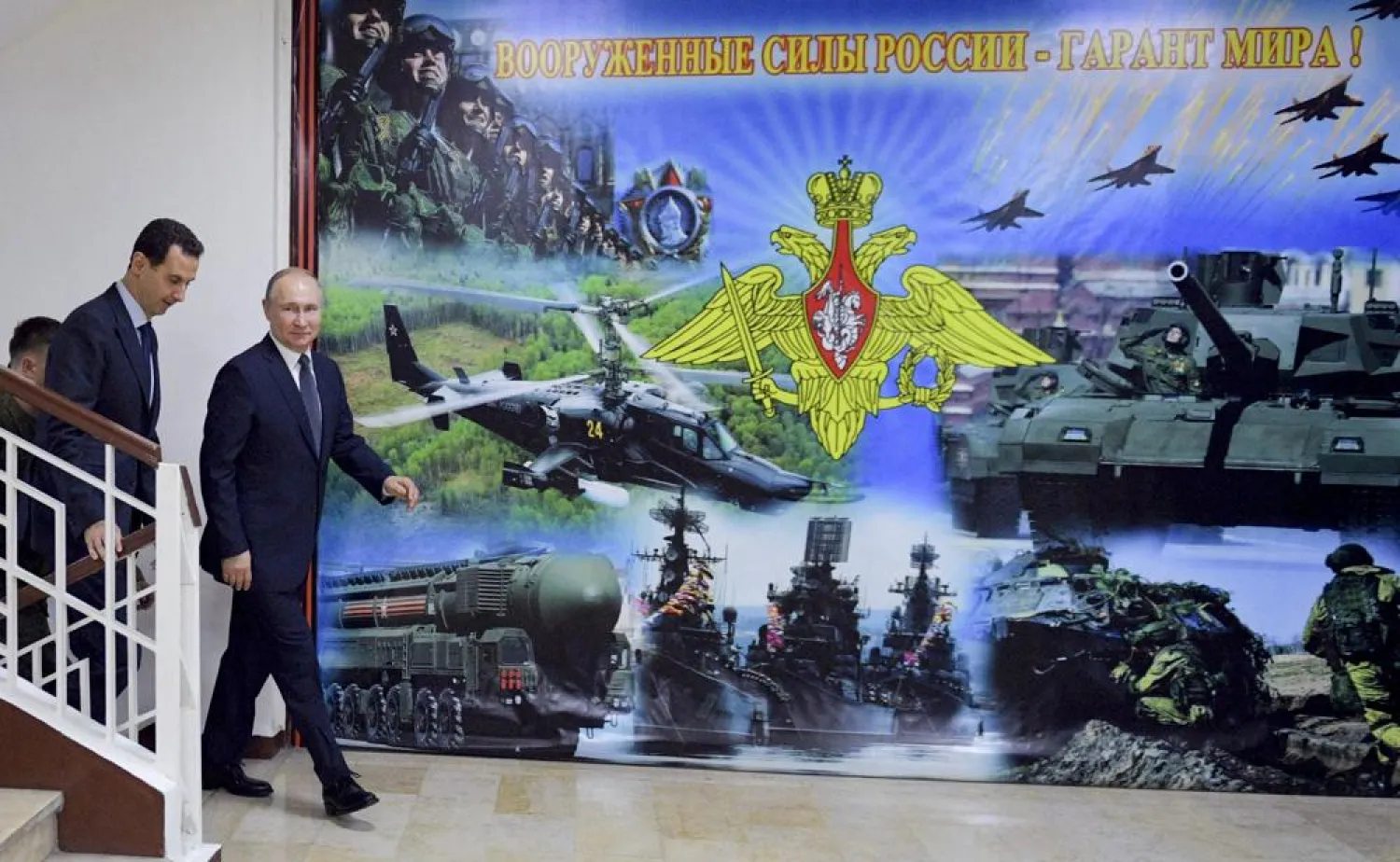
Syrian President Bashar Assad, left, gestures while speaking to Russian President Vladimir Putin during their meeting in Damascus, Syria, Jan. 7, 2020. (Sputnik, Kremlin Pool Photo via AP, File)
TT

Russia’s Syria Intervention Provided Hints for Ukraine War

Syrian President Bashar Assad, left, gestures while speaking to Russian President Vladimir Putin during their meeting in Damascus, Syria, Jan. 7, 2020. (Sputnik, Kremlin Pool Photo via AP, File)

From a tent in the opposition-held pocket of Syria, Ahmad Rakan has closely followed news of Russia’s invasion of Ukraine. More than two years ago, a Russian airstrike destroyed his house in a nearby village during a months-long Syrian government offensive backed by Moscow’s firepower that drove him and tens of thousands of others from their homes.

“We more than anyone else feel their pain,” he said of Ukrainian civilians currently under Russian bombardment.

For the past seven years, Syrians like Rakan have experienced first-hand Russia’s military might as it struck opposition strongholds, brokered mass surrender deals and deployed military police across their country, practically rendering it a Russian protectorate on the Mediterranean.

Observers say Russia’s brazen military intervention in Syria and the impunity with which it was met emboldened Vladimir Putin. They say it gave him a renewed Middle East foothold from where he could assert Russian power globally, and paved the way for his attack on Ukraine.

“There is no doubt that the Russian intervention in Ukraine is an accumulation of a series of Russian military interventions in Georgia in 2008, Crimea in 2014 and Syria in 2015,” said Ibrahim Hamidi, a Syrian journalist and senior diplomatic editor for Syrian affairs at Asharq Al-Awsat.

Putin “believes that America is regressing and China’s role is increasing and Europe is divided and preoccupied with its internal concerns … so he decided to intervene,” he said.

Moscow’s 2015 decision to join the war in Syria was its first military action outside the former Soviet Union since the federation’s collapse. It saved President Bashar Assad’s government and turned the tide of the war in his favor, enabling the Syrian leader to brutally reassert control over much of Syria. Russian airstrikes often indiscriminately hit hospitals, schools and markets.

The war-ravaged country became a testing ground for Russian weapons and tactics that it can now bring to bear in Ukraine.

Anna Borshchevskaya, a senior fellow at The Washington Institute focusing on Russia’s policy toward the Middle East, said Russia deployed a “multi-domain” approach in Syria, including long-range precision weapons and large-scale bombing campaigns, along with cyber warfare, disinformation and use of paramilitary forces.

Deploying its air power “has come to define Russia’s evolving way of war and Syria was an especially important illustration of this development,” she said.

Moscow also showed a canny diplomatic touch in Syria, creating arrangements with the West that forced an implicit acceptance of its intervention. It created joint patrols with NATO member Turkey which backed Syrian opposition factions, to enforce truces in some areas. It established understandings with Israel that allowed the latter to carry out airstrikes against Iran-linked targets in Syria. It set up a so-called de-confliction line with the US to prevent mishaps between American and Russian planes flying in Syria’s skies.

At the same time, it sought to defend Assad on the international scene, dismissing as fabrications Assad’s use of chemical weapons and barrel bombs against civilians. Within Syria, Russia added a soft power campaign. In some areas, festivals were put on to popularize Russian culture, Russian national songs were played on Syrian television, self-serving propaganda was churned out and hot meals were served to civilians.

Max, a dual Syrian-Ukrainian national who hails from Syria’s coastal province of Latakia, recalled working for a week as a social media troll disseminating the “truth” about Russia’s positive actions in Syria. He and other Russian-speaking Syrians worked from an office set up in a local university.

A member of Assad’s Alawite ruling sect, he said he and others in his hometown were grateful when Russia intervened militarily in 2015, particularly as extremists had been approaching the area.

“Then Russians came and the front line was pushed way back,” he told The Associated Press in a phone call from Ukraine, where he is now stuck in an Airbnb in a residential area of Kyiv.

Max, who is now working for an international organization in Lebanon, had flown to Ukraine to update his personal documents when he became trapped there by Russia's invasion. He spoke on condition his full name would not be used for his safety.

Today, Max no longer buys into the Russian narrative. Many in his hometown in Syria, though, support Russia’s war in Ukraine, as Moscow continues to mount a sophisticated disinformation effort about its invasion.

Images coming out of Ukraine, including the harrowing mass flight of civilians, are stirring intense and conflicting emotions among Syrians at home and refugees across the globe.

Resentment runs deepest in the northwest province of Idlib, Syria’s last opposition-held bastion, where Russian airstrikes continue to this day. In a statement issued Monday, the opposition’s civil defense group known as the White Helmets group, deplored Russia’s aggression against Ukraine.

“It pains us immensely to know that the weapons tested on Syrians will now be used against Ukrainian civilians,” it said, lamenting what it said has been a lack of support from the international community in holding Russia to account in Syria and elsewhere.

“Instead of standing up for international norms, such as those against the use of chemical weapons, the international community has tried to find ways to cooperate with Russia and to this day considers Russia a willing and essential partner in diplomacy,” it said.

Borshchevskaya said the lesson Putin took from Syria was that “the West will not oppose his military interventions” and it gave him a success to build on.

“Appetite comes with eating, and with each intervention he has grown increasingly more brazen, culminating in the tragedy we now see unfolding in Ukraine,” she said. “Just as what happened in Syria did not end in Syria, what is happening in Ukraine will not end in Ukraine.”

Rakan now lives in a tent with his wife and three kids near the Turkish border, where he runs a car spare parts shop. He said he hopes a Russian defeat in Ukraine could have positive repercussions for Syria’s opposition.

“We pray for God for victory for the people of Ukraine, and we hope that this war will mark the end of Russia,” he said.

“Maybe they (Ukrainians) can achieve the victory that was not achieved in Syria.”



What to Know About China’s Rare Ballistic Missile Test and Why It Raises Concerns

 In this photo released by Xinhua News Agency, a long-range ballistic missile bursts out of the sea during a test launched from a Chinese nuclear-powered submarines in the South Pacific on Monday, July 6, 2026. (Li Xiangchao/Xinhua via AP)
In this photo released by Xinhua News Agency, a long-range ballistic missile bursts out of the sea during a test launched from a Chinese nuclear-powered submarines in the South Pacific on Monday, July 6, 2026. (Li Xiangchao/Xinhua via AP)
TT

What to Know About China’s Rare Ballistic Missile Test and Why It Raises Concerns

 In this photo released by Xinhua News Agency, a long-range ballistic missile bursts out of the sea during a test launched from a Chinese nuclear-powered submarines in the South Pacific on Monday, July 6, 2026. (Li Xiangchao/Xinhua via AP)
In this photo released by Xinhua News Agency, a long-range ballistic missile bursts out of the sea during a test launched from a Chinese nuclear-powered submarines in the South Pacific on Monday, July 6, 2026. (Li Xiangchao/Xinhua via AP)

China's navy test-launched a long-range ballistic missile Monday from a nuclear-powered submarine — a move that experts said showed Beijing's increasing skill and capability as part of its nuclear deterrence strategy.

The move also drew protests from the US, as well as countries in Asia and the Pacific. It was the second time China had fired a ballistic missile into international waters in recent years.

While it gave some countries in the region prior notice, some said it was not enough notice, and experts say the launch exacerbates tensions around increasing militarization in Asia.

Here's what we know, and what we don't, about the missile launch.

Experts think it could be a JL-2 or a JL-3 ballistic missile

China announced the missile test publicly on Monday only after the launch, saying that it was fired into the Pacific Ocean. In a brief statement, the official Xinhua News Agency said the launch was part of routine annual training, complied with international law and practice, and was not directed against any country or target. It didn't provide details about the type of missile.

The missile was carrying a dummy warhead, not a nuclear one. The act of launching in international waters was rare, although the US has also done so with its own missile testing.

Xinhua published a photo of the missile on Tuesday without additional details. Experts say it could be either a JL-2 or a JL-3, both submarine-launched ballistic missiles, though most said the available imagery was not clear enough to tell.

The state-owned tabloid Global Times said it was “most likely” a JL-3 missile with a range exceeding 10,000 kilometers (6,200 miles). The JL-2 has a shorter range.

The New Zealand government said the missile was launched into treaty waters in the South Pacific Nuclear Free Zone, violating the intention of the agreement.

The zone was established by the 1986 Treaty of Rarotonga, which prohibits nuclear weapons throughout the region. China ratified the protocols in 1987, pledging not to test nuclear weapons within the zone or threaten to use them against signatories with territory in the region.

Australia, Japan, and other countries protest While China has told other countries to “avoid over-interpretation” in response to the criticism, experts say the concerns from other countries have some basis.

Much of the concern is a result of lack of clear information, said Drew Thompson, a senior fellow at the S. Rajaratnam School of International Studies in Singapore. “China’s military modernization and buildup have occurred without concurrent increases in openness and transparency, resulting in uncertainty about China’s intentions.”

Australian Prime Minister Anthony Albanese said that China did not provide enough notice to the government.

“There is no doubt that this is a provocative act by China which does destabilize the region,” he told reporters Tuesday while in Honiara, in the Solomon Islands.

“This was a test of a nuclear-capable intercontinental ballistic missile fired from a nuclear-powered submarine. That is of real concern because what we need is less nuclear weapons, certainly not more. And the fact that this test took place yesterday with very little notice is of real concern,” Albanese added.

New Zealand had said the same Monday, with Foreign Minister Winston Peters calling it “unwelcome and concerning.”

Solomon Islands Prime Minister Matthew Wale, also speaking to reporters in Honiara Tuesday, said that “China is a good friend of Solomon Islands, but this is not something a friend does. This is not ... good in our region.”

“We don’t want to see any more countries — China, America, anybody — we don’t want anybody testing their ICBMs in the Pacific Islands region. Be our friend, but don’t threaten us,” Wale added.

Test comes amid increasing militarization in Asia

China's leader Xi Jinping has made modernization of the People's Liberation Army a top priority in his rule.

China already has the largest standing army in the world and the world's largest navy. While its nuclear arsenal lags that of the US and Russia, it has been actively expanding its stock of nuclear warheads. It has also actively been developing new longer-range missiles and advanced drones.

China’s defense budget, which is projected to be at $270 billion in 2026, has grown at roughly 7% for the past four years, and hovers below 2% of its gross domestic product. However, independent analysis suggests the real spending could be much higher. For example, the Stockholm International Peace Research Institute estimates the overall figure for 2024 at $313.7 billion.

Much of the security worries about whether or not China's military would get involved in a war centers on Taiwan, the self-ruled island that China claims as its own and for which it has not ruled out the use of force to bring it under its control.

China also regularly sends warplanes and navy ships in the waters around the island in what it says are military exercises.

In response to China's expanding military and activity, countries in the region have increased their own defense spending, including Japan which is breaking with its long-held cap of 1% of GDP to double the budget to 2%.

Meanwhile, the Philippines agreed to allow the US to expand its military presence in the country by adding access to four more bases.

“The Chinese launch exacerbates already deeply strained relations between Beijing and Tokyo. Since (Prime Minister Sanae) Takaichi’s comments last year suggesting that Japan would engage in a conflict over Taiwan, China has tightened export controls on Japan and accused it of embracing a ‘new time of militarism,’” said Emma Chanlett-Avery, director of Political-Security Affairs at the Asia Society Policy Institute.


Lebanon’s South Takes a Breath as Families Return to Shattered Homes and Lives

This picture shows the destruction in the southern Lebanese village of Froun on June 30, 2026. (AFP)
TT

Lebanon’s South Takes a Breath as Families Return to Shattered Homes and Lives

This picture shows the destruction in the southern Lebanese village of Froun on June 30, 2026. (AFP)

On a beachfront in the coastal city of Tyre, war has finally abated just enough for children to play in the waves and families to gather under parasols as life slowly returns to southern Lebanon. But away from the shore, people coming home after months of exile are having to adapt to harsh new realities: the threat of conflict between Israel and Iran-backed Hezbollah flaring up again and the challenge of rebuilding from the destruction Israeli bombs have wreaked on their hometowns.

"People are coming back to Tyre to rebuild, to work — all the restaurants are open again," said local resident Ali Skaiky, wet from a swim in the sea and holding a rubber lilo.

"We still hear strikes and fighting at night, but it's far away. There's destruction beyond imagination, but we hope everything will stay calm."

Skaiky is among some 400,000 people who have returned to southern Lebanon in the weeks since a ceasefire between Israel and Hezbollah. The truce has not halted fighting, but it has lowered the ‌intensity.

Returnees are cleaning ‌debris from damaged homes, reopening businesses and trying to rebuild the routines the war ‌shattered. Yet ⁠for many, normality ⁠now means keeping a suitcase packed, following the news obsessively and never straying too far from home.

For Fadlallah Qassim, 42, returning home meant confronting the destruction the war had left behind, including a hit on his house.

"We returned to find the whole house caved in with rubble, and all the furniture ruined," he said. "I cleaned up, fixed it, and brought some basic things for the house, now my wife, children and I all live in one room."

In the nearby village of Srifa, where entire neighborhoods were damaged, Suzan Fakih, 55, said the hardest part of returning was realizing home no longer felt like home.

"The moment you arrive, it doesn't ⁠feel like your village anymore," she said. "Everything is black and grey. It hurts your soul. ‌You look around and think, 'This can't be the village I've lived in all ‌my life.'"

'YOU PACK YOUR BAGS AND RUN'

Srifa lies in the deep south of Lebanon, close to where Israeli troops occupy a strip ‌of territory and launch regular attacks on what the Israeli army says are Hezbollah targets. In areas nearby, Israel has ‌demolished almost entire villages.

Fakih said people remain haunted by the possibility they could be forced to flee again.

"I can't remember a time in my life when I wasn't living with a bag packed, ready to leave. A few quiet years pass, then you pack your bags and run again," she said.

The ongoing hostilities and levels of destruction have left 600,000 more people internally displaced, according to Lebanon's social ‌affairs ministry. Many families whose homes were destroyed are still living in schools or in the rented homes they fled to during the conflict.

Lebanon has suffered the deadliest spillover ⁠of the regional war triggered ⁠by the US-Israeli strikes on Iran in February.

The conflict spread to Lebanon on March 2, when Hezbollah fired on Israel in support of Tehran, triggering an Israeli air and ground campaign. More than 4,300 people have been killed in Lebanon, according to the country's health ministry.

RENTING BACKUP HOMES

Some 20 miles (32 km) farther north, Mohammad Sweid and other residents who recently returned to the Bekaa Valley town of Sohmor, said they live with the same uncertainty.

Sweid still pays rent for the house he and his family fled to during the war, keeping it as a backup home if they need to leave again.

"If something happens again, we may not find another place," the 31-year-old manual worker said.

In the Lebanese capital Beirut, whose Hezbollah-controlled southern suburb of Dahiyeh has been battered by Israel at intervals over the last two years for being home to Hezbollah's leadership, residents are also cautiously trying to rebuild their lives.

Moussa Ghamloush, 68, has been repairing his bomb-damaged home and reopening his restaurant, which was completely destroyed in a separate strike, but says his permanent home will always be Dahieh.

"We're not the kind of people who leave. Our roots are here. We stayed, and if there's a third war, we'll stay again."


Trump Won Big Spending Promises from NATO Last Year. This Week in Türkiye, He'll Try to Enforce Them

US President Donald Trump speaks during the Salute to America 250 celebration on the National Mall in Washington, DC, USA, 04 July 2026. EPA/JIM LO SCALZO / POOL
TT

Trump Won Big Spending Promises from NATO Last Year. This Week in Türkiye, He'll Try to Enforce Them

US President Donald Trump speaks during the Salute to America 250 celebration on the National Mall in Washington, DC, USA, 04 July 2026. EPA/JIM LO SCALZO / POOL

President Donald Trump got what he wanted from NATO at last year’s summit: an alliance whose members had largely acceded to his demands to step up their defense spending.

This week when he meets leaders in Türkiye, his mission is to enforce that pledge, The Associated Press said.

The speed with which most NATO countries have tried to heed Trump’s call to spend 5% of their annual gross domestic product on defense over the next decade underscores how the US president has reshaped the alliance and bent it to his will — even as he continues to spar with its members over the Iran war, his flirtation with annexing Greenland, and various personal tiffs.

“President Trump fully expects that all allies will step up immediately and get on the path to 5% and do it with urgency,” Matt Whitaker, the US ambassador to NATO, told reporters in a preview of the administration’s message before this week’s summit in Ankara.

Trump leaves Monday evening for the summit, and for days leading up to the trip has been airing grievances about how much the US spends on defense compared with other countries. That’s despite efforts from Mark Rutte, the alliance’s secretary-general, who tried to feed the ego of the tempestuous US leader in an Oval Office meeting last month. There, he displayed large charts on easels showing what he called “ The Trump Trillion ” — how much allies had boosted their spending commitments since 2017.

Luke Coffey, senior fellow at the Hudson Institute, a conservative think thank in Washington, described the Ankara gathering as the “first report card” after last year’s summit in The Hague.

“If NATO members play their cards right — if the leaders show up demonstrating a commitment and a reasonable plan to meet these spending targets — then it’ll allow President Trump to take a victory lap,” Coffey said.

Trump will meet with Ukraine's Zelenskyy Trump left last month’s G7 summit in France buoyed by support from his counterparts for his interim agreement to end the war with Iran. He praised unity among leaders — who also worked to bring Trump onside to boost security assistance for Ukraine in its fight with Russia.

That war, now in its fifth year, is expected to be a key focus at the Ankara summit. The White House said Trump will meet with Ukrainian President Volodymyr Zelenskyy on Wednesday. Trump spoke with both Zelenskyy and Russian President Vladimir Putin on July 4.

Trump also plans to meet on the sidelines of the summit with Syrian President Ahmad al-Sharaa. The White House has not provided goals for that discussion, but it comes as Trump has publicly mused about Syria playing a bigger role fighting Hezbollah in Lebanon. Al-Sharaa has said he has no interest in doing so.

The US president also plans a separate meeting with Turkish President Recep Tayyip Erdogan, the host of the summit whom Trump counts as a close friend.

But he has no bilateral meetings planned with other leaders. Despite the positive tone of the G7 summit, Trump resurrected feuds as soon as he returned stateside.

He proclaimed that Keir Starmer would resign as British prime minister before the embattled leader made it official, arguing that Starmer “failed badly” on immigration and energy. Meanwhile, Trump asserted that Italian Prime Minister Giorgia Meloni had begged him for a photo, prompting a ferocious denial by her and the cancellation of a US visit by the country’s foreign minister.

Despite the fallout, Trump egged it on further on Sunday when he posted a photo on social media of Meloni smiling at him, along with the words “RESTRAINING ORDER NEEDED.”

Trump has remained on tense terms with Canadian Prime Minister Mark Carney, and while French President Emmanuel Macron charmed Trump with a lavish dinner at the Palace of Versailles last month, it hasn’t always been smooth between the two leaders.

Aware of those tensions, a bipartisan group of senators is again headed to the summit this year, trying to represent the broad support for the alliance on Capitol Hill and to serve as a counterweight to Trump’s often caustic attitude toward NATO.

“They are our best allies, they are our best trading partners, they are critical to our national security, to our economic success, and we need to encourage those relationships,” said Sen. Jeanne Shaheen, D-N.H., who is leading the delegation to Ankara. “That’s part of what Congress understands that the administration doesn’t seem to.”

Trump’s team is making the case for more NATO changes

The summit comes as Trump’s administration makes the case for what it calls “NATO 3.0,” which envisions an alliance that has Europe taking on more of its security needs, allowing the US to shift its focus elsewhere.

The strategy was outlined by Elbridge Colby, a US undersecretary of defense, earlier this year at a gathering of NATO defense ministers.

Then, in a scathing speech to other NATO defense ministers last month, Defense Secretary Pete Hegseth added to the pressure by announcing that the US will conduct a six-month review of its forces in Europe. This surprised countries in the alliance that had anticipated coordinating with the Trump administration through the transition.

Trump himself sparked much confusion earlier this year when he seemed to send conflicting signals on the issue, announcing that he would send 5,000 US troops to Poland weeks after ordering the same number of forces pulled out of the continent.

Shaheen said the NATO 3.0 concept “fails to understand -- as this administration has consistently failed to understand -- the threat that Putin and Russia are to Europe and subsequently to the United States.”

Europe is boosting spending, but still counts on the US

The US president last year was the driving factor in a broad target reached in The Hague for NATO countries to spend 5% of their GDP on defense over the next decade.

Of that, 3.5% would be for core defense spending and the rest would be related expenses, such as infrastructure. Spain said at the time that it couldn’t meet those levels, and some others have voiced reservations about the ambitious goal.

Despite the increased pledges and spending, experts say many parts of the continent are nonetheless reliant on the US for their defense should they come under attack. The defining feature of the NATO alliance is the view that an armed attack on one member is an attack on all.

“This is the reality for most Europeans,” said Liana Fix, senior fellow for Europe at the Council on Foreign Relations. She said most are far from being able to defend themselves without the United States, “even if they’re starting to develop all that.”

Apart from the spending pledge, NATO has worked to accommodate Trump in other ways.

The alliance earlier this year introduced “Arctic Sentry,” a NATO-led military exercise aimed at countering Russian and Chinese activities in the region. It’s also meant to address Trump’s repeated threats to seize Greenland, since the Republican president has insisted the US needs to acquire the semiautonomous territory of Denmark for strategic security reasons.