

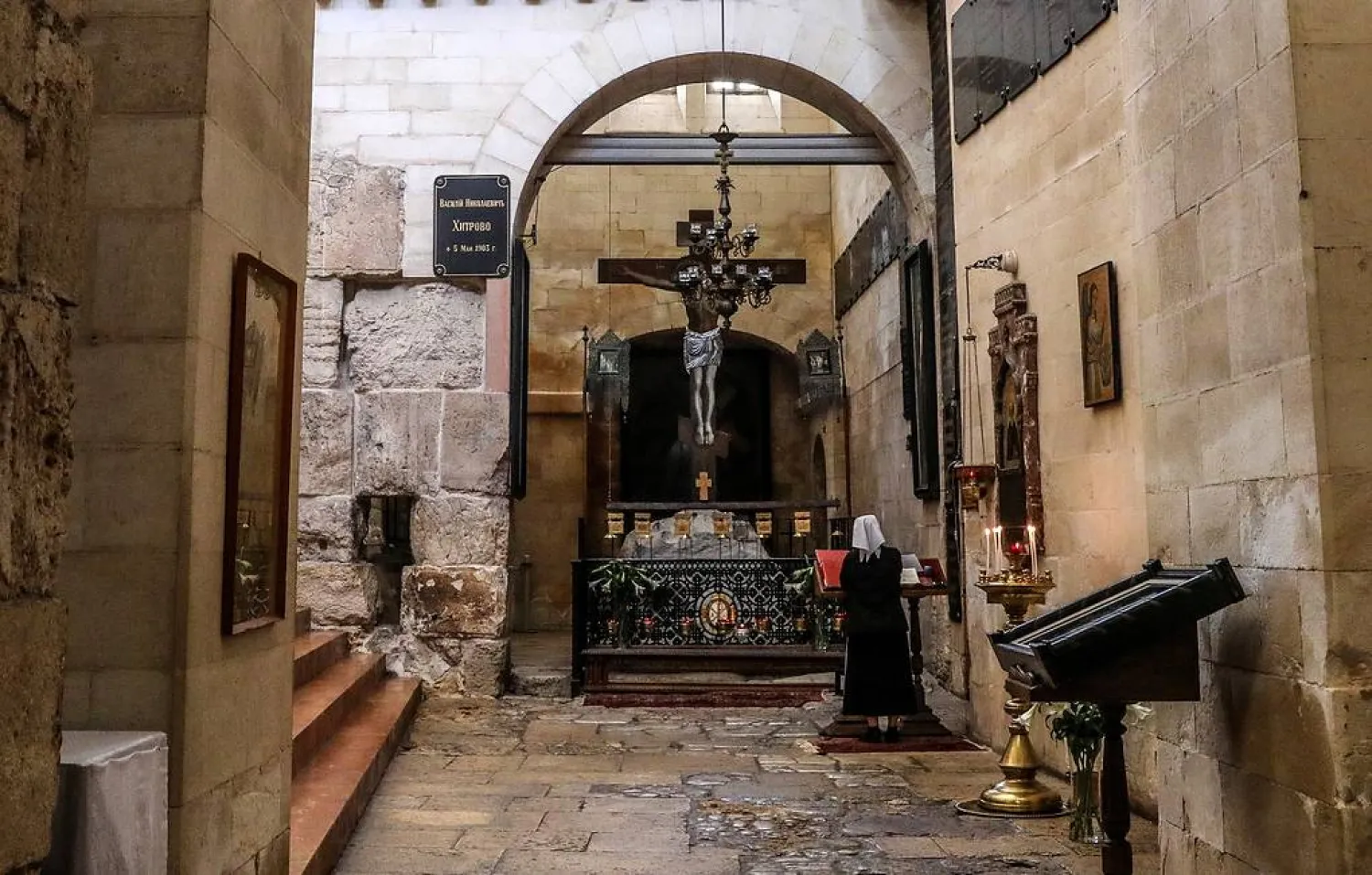

Israeli Court's Decision to Cancel Russia's Church Ownership Could Lead to Tensions

Alexander Metochion in the Old City of Jerusalem (TASS)
TT

Israeli Court's Decision to Cancel Russia's Church Ownership Could Lead to Tensions

Alexander Metochion in the Old City of Jerusalem (TASS)

The Jerusalem District Court halted the registration of ownership of the Russian Orthodox "Alexander Nevsky" church in the name of the Russian government on Thursday.

Diplomatic sources warned that the court’s decision could create a diplomatic crisis with Moscow, mainly that it comes amid Russia's war in Ukraine.

They called on Prime Minister Naftali Bennett to take advantage of his powers and officially transfer the church's ownership to the Russian government.

The Alexander Nevsky church, built at the end of the 19th century and is considered the most important Russian holding in and around the Old City, is adjacent to the Church of the Holy Sepulchre. During Ottoman times, the property was registered in the name of the Russian government.

It was managed by a group of Russian immigrants to Palestine, who established an Orthodox company, Imperial Orthodox Palestine Society, through which they handled dozens of Russian sites in the Holy Land.

After the revolution in Russia, the government claimed ownership of these lands. But the British Mandate government, and later the Israeli government, rejected the request.

In 2017, the Russian government filed a registration request for ownership rights with Israel's inspector in charge of the land registry.

The then-Prime Minister Benjamin Netanyahu promised to comply with the request but never fulfilled it.

In 2019-2020, Netanyahu approved giving Alexander's Courtyard to Russia after Moscow agreed to release Naama Issachar, an Israeli woman arrested in transit in Moscow for smuggling hashish and sentenced to seven and a half years in prison. The details of the deal remained unknown.

However, it turned out that one of those conditions was to approve the Russian government's request to register the Courtyard and the Church in the name of the Russian government.

The Imperial Orthodox Palestine Society filed objections to the transfer of ownership, which the court rejected.

The Society then filed an appeal, prompting Netanyahu to sign an order declaring that the church was a holy site, as defined by British Mandatory law, meaning that the government and not the courts are authorized to make any decisions regarding ownership disputes.

The Land Registry Commissioner dismissed appeals against the registration and ruled that the Russian Federation was recognized by international bodies and by the authorized bodies in the State of Israel as "the successor state" of the Russian imperial government.

Therefore, as part of the registration renewal order, the land should be registered in the name of the Russian Federation and not in the name of organizations representing the Russian imperial government, which no longer exists.

The Society then filed a lawsuit against the Israeli government, asserting that its registration as a holy place aims to dispossess the company in preparation for transferring ownership of the land and the church to the Russian government.

The court accepted the case. However, the presiding judge, Mordechay Caduri, referred to immense diplomatic sensitivity and opened a loophole for the government to resolve the matter by an official decision.

Caduri said in his ruling that since the property is a holy site by definition, then the competent body to determine the ownership is not an administrative body or the court but the Israeli government.

He admitted that the government would have to decide the issue considering various religious, political, and diplomatic considerations.

In practical terms, the court passed the issue to Bennett, who must decide the matter amid the war between Russia and Ukraine and the massive sanctions imposed by the West on Moscow.

Bennett set up a ministerial committee to examine the matter in July 2021. He will have to ask the committee to decide, knowing that it has never met since its formation.

According to the Israeli Foreign Ministry experts, a decisive decision in favor of the Russian government is inevitable.



Diplomatic, Military Push for Lebanon in Paris

Group photo of participants in a meeting to support the Lebanese Armed Forces in Paris on Thursday (French president’s account)
TT

Diplomatic, Military Push for Lebanon in Paris

Group photo of participants in a meeting to support the Lebanese Armed Forces in Paris on Thursday (French president’s account)

Senior officials and military officers gathered in Paris on Thursday to discuss support for the Lebanese Armed Forces and security services.

French President Emmanuel Macron first met Lebanese President Joseph Aoun at the Elysee Palace before the two joined Jordan’s King Abdullah II for a trilateral summit at Les Invalides.

The three leaders later opened a technical-military meeting attended by military commanders, chiefs of staff and senior officers from 17 countries and organizations.

“Paris is today the place where our partners are coming together to strengthen Lebanon’s sovereignty and enable it to fully ensure its own security,” Macron wrote on X.

“A Lebanon at peace offers renewed hope for the entire Middle East. A sovereign and stable Lebanon is a decisive step toward peace and stability across the region.”

“Together with the Lebanese president and the king of Jordan, and in close coordination with the United States, Saudi Arabia and our international partners, we support the Lebanese Armed Forces, which are indispensable to asserting the authority of the Lebanese state throughout its territory,” he added.

Turning to wider regional tensions, Macron argued that “diplomacy and dialogue alone” could end an escalation with no prospect of resolution.

He reiterated France’s solidarity with Jordan and condemnation of Iranian attacks, while stressing the importance of freedom of navigation through the Strait of Hormuz, the Red Sea and the Bab al-Mandab Strait.

Regional Dimension

Aoun revealed measures taken by the state and urged support for its armed forces as an investment in regional security and stability.

King Abdullah’s participation, within the framework of the Aqaba Process, gave the meeting a broader regional dimension.

According to Lebanon’s National News Agency (NNA), citing presidential sources, the three leaders discussed the “dangerous regional situation” and stressed the need to intensify international efforts toward comprehensive and sustainable de-escalation. They also discussed developments in Gaza, the West Bank and Jerusalem.

Aoun stressed the interconnected nature of regional security and called for a common regional security strategy based on joint energy projects and economic, security and political cooperation.

The Lebanese president also sought to put behind him a period of strained relations with France, thanking Macron for France’s support for Lebanon and its efforts to strengthen state authority, sovereignty and official institutions.

He praised Macron’s efforts, in cooperation with the Italian prime minister, to find an alternative to UNIFIL to prevent a security vacuum in South Lebanon, and called for broader economic and energy cooperation, including the resumption of oil and gas exploration in Lebanese blocks.

‘A Moment for Decision’

Aoun painted a bleak picture of conditions in South Lebanon because of Israeli attacks and practices, but said the country now had an opportunity based on “a clear determination to rebuild the state and its institutions and move forward with the reforms the country needs.”

He said the goal was to establish “a strong state and effective institutions,” with the army and security services playing a central role.

While emphasizing the importance of the state’s monopoly on weapons, Aoun insisted that this was “first and foremost a Lebanese choice and a Lebanese interest.”

He also defended negotiations with Israel, warning that agreements succeed not merely by being signed but by being respected and implemented by all parties.

He called on Lebanon’s “friends and partners” to help ensure the full implementation of what had been agreed and to treat Lebanon’s sovereignty and territorial integrity as a principle “not subject to selectivity.”

Aoun detailed the army’s responsibilities, including extending state authority, maintaining security and stability, preventing border violations and combating smuggling. He also highlighted the role it would be expected to assume after UNIFIL’s mission ends to prevent a security vacuum.

“There can be no strengthening of state authority without strong, effective military and security institutions present throughout Lebanese territory,” he underlined.

The Lebanese president called for concrete results from the preparatory meeting, including a roadmap and clear timetable for an international conference to support the army and Internal Security Forces, as well as a long-term approach to assisting Lebanon’s security institutions.

He pledged “full transparency and accountability” and said the Lebanese state would assume a growing share of financing its security institutions.

“Invest in the success of the Lebanese state and in the stability of the region,” Aoun concluded. “This is a moment for decision, not a moment for waiting.”


Sisi Warns of Attempts to ‘Bring Down Egypt,’ Denies ‘Militarization of the State’

Sisi during a previous visit to the Egyptian Military Academy in the New Administrative Capital (Egyptian Presidency) 
TT

Sisi Warns of Attempts to ‘Bring Down Egypt,’ Denies ‘Militarization of the State’

Sisi during a previous visit to the Egyptian Military Academy in the New Administrative Capital (Egyptian Presidency) 

Egyptian President Abdel Fattah al-Sisi warned Thursday of continuing attempts to bring down Egypt, saying that what happened between 2011 and 2013 “is not over,” that the plan behind it “has not stopped” and that “the persistence in seeking to bring down the state still exists.”

He made the remarks at a graduation ceremony for judges who completed a training course at the Egyptian Military Academy.

The president referred to the Jan. 25, 2011 uprising that ousted late President Hosni Mubarak, the violence that followed and the rise to power of the now-banned Muslim Brotherhood before its removal in 2013.

He urged Egyptians and families to remain vigilant, stressing that responsibility rested with everyone, “not only officials, intellectuals and media professionals.”

The Egyptian leader also defended mandatory training courses provided by the military academy to state officials and employees across various fields, which have drawn reservations from some quarters.

He described the academy as “a gateway to employment in the Egyptian state,” acknowledging that the approach had initially appeared unusual and unclear but saying its expected impact would be felt years from now.

The aim of making the academy a gateway for institutions including the judiciary, Foreign Ministry and Administrative Control Authority was to apply the same standards to everyone, he explained.

Detailed criteria had been established for selecting young men and women for each ministry according to its requirements, with the aim of creating an institution that applies “honest standards without favoritism or preferential treatment.”

In January, Sisi announced that judges would join academy programs following controversy in judicial circles over reports that appointments to the Public Prosecution could be entrusted to the Egyptian Military Academy.

Some judges had also expressed reservations over a 2023 cabinet decision requiring new appointees across state bodies and agencies, including judges, to complete a six-month qualifying course at the academy.

Responding to those concerns Thursday, the president said genuine reform of state institutions required “a serious path” and time, particularly in countries with populations in the millions.

He denied the “militarization of the state,” reiterating that what happened between 2011 and 2013 “is not over” and that efforts to bring down the state persist.

The academy courses were also intended to give state institutions an opportunity to interact with one another and expose trainees to different career paths, he added, saying the training would bring benefits, greater cohesion and a deeper understanding of the ties binding the state together.

Reflecting on 2011, the president said Egypt had witnessed “extremely dangerous practices” and faced major problems, but that “God Almighty willed that Egypt, unlike others, survive.”

“What happened to other countries was arranged and planned, but Egypt survived by God’s grace,” he said, adding that the country’s resources did not allow it to confront prolonged challenges.

According to the president, psychologists and sociologists helped design the academy’s programs. One objective, he explained, was to shield young people from “the idea of destroying Egypt, as was being planned for the country in 2011 and 2012.”


French Lawyers Object to Handling of ISIS Detainees in Iraq

A suspected ISIS member arrives for questioning at Karkh Prison in Baghdad (AP) 
TT

French Lawyers Object to Handling of ISIS Detainees in Iraq

A suspected ISIS member arrives for questioning at Karkh Prison in Baghdad (AP) 

An Iraqi official said the cases of ISIS detainees transferred from Syria to Iraq earlier this year were being handled exclusively by the Counter-Terrorism Service and the Supreme Judicial Council because of the sensitivity of the issue.

The official told Asharq Al-Awsat that the cases remained “an Iraqi national security matter,” adding that they went beyond “formal defense requirements.”

“Their files are still being reviewed by senior authorities, and it may take some time before they are referred to trial,” the official added.

The comments came after a team of French lawyers accused Iraqi authorities of refusing them permits to follow the cases of French clients accused of belonging to ISIS after their transfer from northeastern Syria to Iraq.

The lawyers warned that their clients could face death sentences after trials they described as “lacking the minimum standards of justice.”

In a statement Thursday, the defense team said several French nationals they represented had been “unlawfully transferred from northeastern Syria to Iraq” and were due to appear before courts in Baghdad in the coming days.

The lawyers reported meeting some of the detainees in Iraq and witnessing what they described as inhumane and degrading treatment and violence.

They also informed French authorities of torture suffered by the detainees in Iraq and the arbitrary nature of the proceedings.

The lawyers said they had been denied access to their clients’ case files and could not speak to them without Iraqi authorities present.

They also alleged that court-appointed lawyers assigned to defend the detainees — some of whom had been able to meet them for only 10 minutes — insulted them in front of their guards.

‘They Were Children’

The lawyers noted that some of the detainees were young men who had been children when their parents forcibly took them to Syria and were now adults. They applied over the summer for new permits to travel to Iraq, but Iraqi authorities “rejected our requests at the last minute,” they added.

The lawyers recently renewed their request to meet their clients, “but we learned that their trials would be held without us.”

According to the defense team, French authorities merely confirmed the information, explaining that Iraq did not recognize the French lawyers’ right to represent the detainees in the country or intervene in local judicial proceedings concerning them.

“France knows very precisely the fate awaiting these French nationals,” the lawyers warned, noting that 11 French citizens transferred to Iraq in 2018 “under the same circumstances” were sentenced to death by Baghdad’s Central Criminal Court.

They argued that those trials “did not meet the minimum standards of a fair trial guaranteed by Article 6 of the European Convention on Human Rights.”

The defense team urged French authorities to “urgently return them to France” to prevent them from facing the death penalty and becoming victims of a “flagrant denial of justice,” noting that the request had been submitted “many months ago.”

Al-Hol and Prisons

Deputy Minister of Migration and Displacement Karim al-Nouri, meanwhile, told Asharq Al-Awsat that “a distinction must be made between two matters.”

The first concerns al-Hol camp in northeastern Syria’s Hasakah region, which he said held “more than 60,000 people from countries around the world, including more than 25,000 Iraqis, most of them children and women.”

Al-Nouri distinguished them from detainees in prisons held by the SDF.

“The camps were under the SDF (Syrian Democratic Forces) and then came under the control of official Syrian forces,” he explained.

Iraqis who returned from prisons were also different from those repatriated from Hasakah and al-Hol after security screening, he added.

“A distinction must be made between those who returned to Iraq, most of whom returned to their homes and have had no security violations recorded against them, and those who are currently in prisons,” al-Nouri said, adding that those in prison had different cases that fell outside the remit of the Migration and Displacement Ministry, with responsibility resting with the judiciary.

Iraqi Judicial Jurisdiction

Legal expert Ali al-Tamimi told Asharq Al-Awsat that Iraq’s refusal to allow French lawyers to represent their clients rested on “two aspects: the Iraqi Law of Lawyers and the law governing criminal jurisdiction,” both of which he said gave Iraq the right to refuse.

Under Iraq’s Law of Lawyers No. 173 of 1965, lawyers registered to practice must hold Iraqi citizenship, al-Tamimi explained, noting an exception for Palestinians residing in Iraq as refugees.

A foreign lawyer who is not a member of a bar association in an Arab country may only appear alongside an Iraqi lawyer, he added. This requires approval from both the head of the Iraqi Bar Association and the president of the Supreme Judicial Council for a specific case, after confirming that the foreign lawyer continues to practice law.

On jurisdiction, al-Tamimi said Iraq considered the detainees to have “committed crimes on its territory.”

He cited an Iraqi judicial source as saying they had “all held senior positions in ISIS,” with some involved in planning attacks in the Iraq-Syria region.

Al-Tamimi noted that Article 6 of Iraq’s Penal Code applies Iraqi law to crimes committed in the country, while Anti-Terrorism Law No. 13 of 2005 gives Iraqi courts jurisdiction over terrorism cases.

He continued that proceedings are governed “exclusively by Iraqi Code of Criminal Procedure No. 23 of 1971, which guarantees the right to a defense, but through an Iraqi-licensed lawyer.”

“If the defendant has no lawyer, the court appoints one.”

Asked whether international law required Iraq to allow foreign lawyers to represent the defendants, al-Tamimi said the Vienna Convention on Consular Relations gave France the right to consular visits and access, “not the right to impose its lawyers to plead cases.”

“National security considerations and the integrity of the proceedings prevent this,” he underlined.