

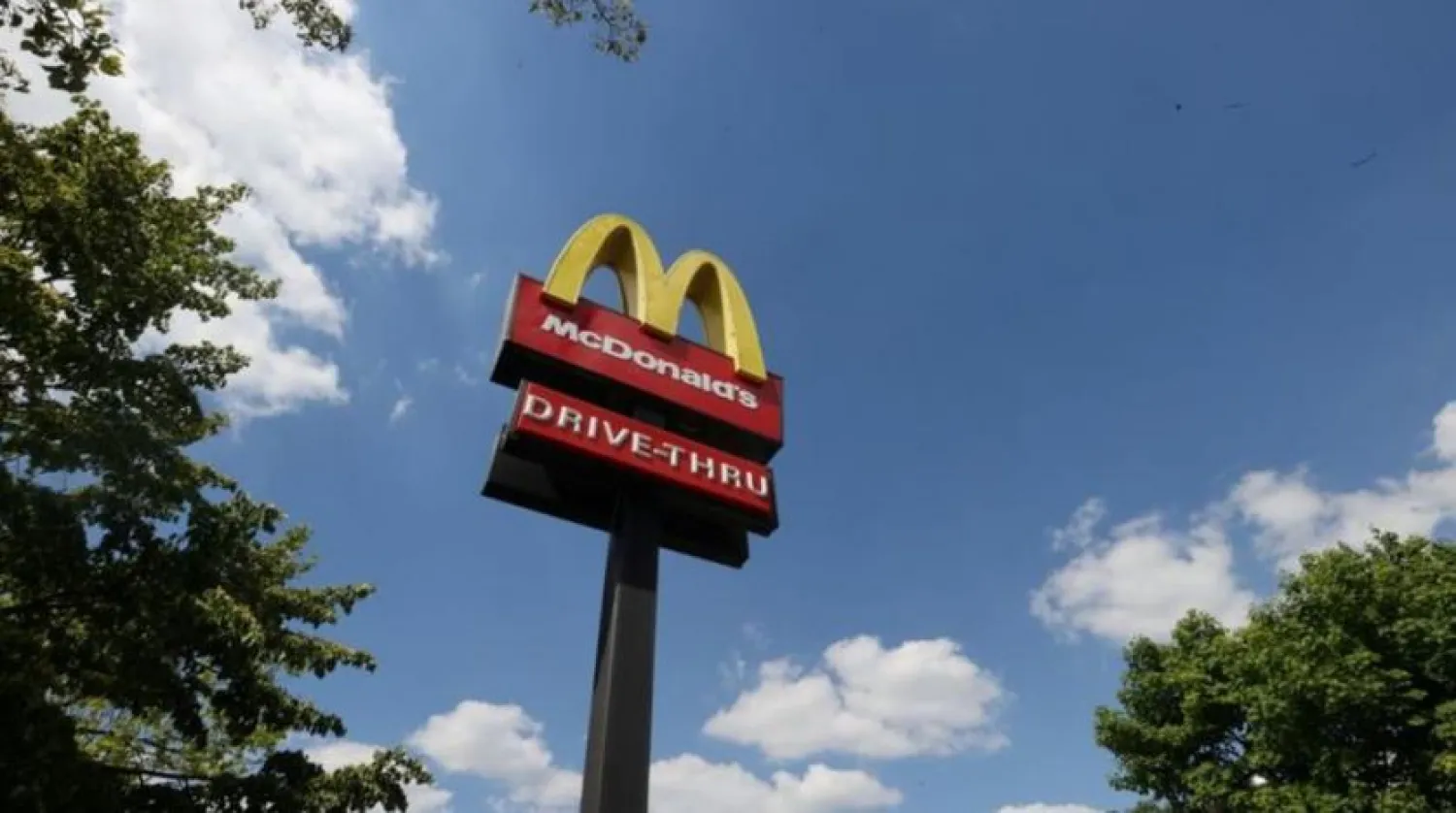

McDonald's, Coca-Cola Join US Firms Halting Russia Operations

General view of a McDonald's sign, Stoke-on-Trent, Britain, June 1, 2020. (Reuters)
TT

McDonald's, Coca-Cola Join US Firms Halting Russia Operations

General view of a McDonald's sign, Stoke-on-Trent, Britain, June 1, 2020. (Reuters)

McDonald's, Coca-Cola and Starbucks on Tuesday bowed to public pressure and suspended their operations in Russia, joining the international corporate chorus of outrage over Moscow's invasion of Ukraine.

Several of these companies, symbols of American cultural influence in the world, have been the subject of boycott calls on social media as investors have also begun to ask questions about their presence, AFP said.

"We cannot ignore the needless human suffering unfolding in Ukraine," the fast-food giant said, announcing the temporary closure all 850 restaurants in Russia, where it employs 62,000 people.

Starbucks, Coca-Cola and PepsiCo announced their own decisions to halt or restrict business in quick succession, noting the growing human cost of the invasion.

PepsiCo said that despite halting sales in Russia of its flagship beverage, as well as 7Up and Mirinda, it would continue to offer products like milk and baby food.

"By continuing to operate, we will also continue to support the livelihoods of our 20,000 Russian associates and the 40,000 Russian agricultural workers in our supply chain," PepsiCo CEO Ramon Laguarta said in a statement.

Starbucks, which has 130 Kuwaiti conglomerate-run coffee shops in Russia, said all operations, including product shipments, will be suspended.

A team from Yale University that keeps a list of companies with a significant presence in Russia said about 290 have announced withdrawal from the country since it invaded neighboring Ukraine, reminiscent of "the large-scale corporate boycott of Apartheid South Africa in the 1980s."

About 30 multinationals still remain on the list of companies with significant exposure to Russia.

- Legitimate reasons? -
Some companies, however, have noted the limits of their influence is halting business.

Yum! Brands, whose 1,000 or so KFC restaurants and 50 Pizza Hut locations in Russia are almost all independently owned, announced Tuesday that it was halting operations at company-owned KFC locations.

It said it was "finalizing an agreement" to do the same with its Pizza Hut restaurants, adding that all profits from operations in Russia will be redirected to "humanitarian efforts."

Some businesses may have legitimate reasons to stay, several experts in ethics and communications strategy told AFP.

Companies may be hesitant to leave because they think they can mediate or because they make essential products such as pharmaceutical ingredients, said Tim Fort, a professor of business ethics at Indiana University.

But he said they have to pick a side "and it doesn't strike me as this being very difficult to pick" given Russia's human rights and conflict law violations.

"Any one company leaving the country isn't going to tip the balance... but there's a cumulative effect," Fort noted.

- 'What's going on?' -
He said a company as well-known as McDonald's can have influence in Russia at a time when the general population has almost no access to sources of information other than the official messaging on the invasion.

Russians can "survive without the Big Mac," but they may ask "why is McDonald's closed? What's going on? It's a more powerful signal in that sense," Fort said.

Richard Painter, a professor at the University of Minnesota, said the companies "should think about the message that needs to be emphasized: that Russia cannot do this to Ukraine... while at the same time participating in the international economy."

The economic sanctions imposed on Russia with broad consensus among Western governments along with the voluntary withdrawal of multinationals "is really the best way to deal with Russia," said Painter, a former White House ethics lawyer.

Brian Berkey, who specializes in corporate ethics at the University of Pennsylvania, said some companies may be betting the criticism will ultimately subside.

Other crisis situations, such as the Israeli-Palestinian conflict, led to calls for boycotts against certain companies but without much effect.

Support for such initiatives is not always unanimous even though most people "in the United States and in Europe are unified in thinking that what Russia is doing is clearly unacceptable," he said.

Mark Hass, a communications specialist at Arizona State University, said the economic interest of companies that have chosen to stay in Russia "outweighs the reputational one."

But "if social media starts identifying you as a company that's willing to do business with an autocratic aggressor, who's slaughtering thousands of people in the Ukraine, you're in big trouble," Hass said.

"And it will hurt business more broadly than just in Russia."


European Development Bank Unveils 5 Bn Euros for War-hit Economies

A Lebanese man walks past destruction at the site of an Israeli airstrike the day before that targeted a building in Beirut on April 9, 2026. (Photo by Ibrahim AMRO / AFP)
TT

European Development Bank Unveils 5 Bn Euros for War-hit Economies

A Lebanese man walks past destruction at the site of an Israeli airstrike the day before that targeted a building in Beirut on April 9, 2026. (Photo by Ibrahim AMRO / AFP)

The European development bank said Thursday it was unlocking five billion euros ($5.9 bn) to help shore up economies hit by the Middle East war.

The European Bank for Reconstruction and Development (EBRD) said it will "deploy EUR5 billion in 2026 in economies impacted by Middle East conflict".

The funds would be focused on Iraq, Jordan, Lebanon, the West Bank and Gaza "and affected neighboring economies" including Egypt, Türkiye, Armenia and Azerbaijan, the bank said in a statement.

"The economic and social impact of the conflict is already being felt across many of the bank's economies in the form of disrupted trade routes, energy and commodity shocks, weakened investor confidence and broader costs to the population," it added.

Established in 1991 to help former Soviet bloc nations embrace free-market economies, the bank later extended its reach to the Middle East and Africa.

"In a time of rising uncertainty, we are stepping up where others may pull back," said EBRD president Odile Renaud Basso.

"We are here to support economies, clients and people in our countries of operation in tough times," she added.

The bank said "the volume of conflict response investment will be demand driven due to the fast-changing nature of the situation".

The funds will provide immediate relief "by supporting economic activity" and "fostering financial sector stabilization".

EBRD will aim to strengthen energy security and aid state-owned enterprises to "ensure the uninterrupted provision of essential goods and services".

On Thursday it had approved "a project to support Lebanon's retail chain," it said, adding it also aimed to safeguard access to jobs, finance and essential services.

Since starting operations in the southern and eastern Mediterranean in 2012, the EBRD has invested more than EUR26.5 billion in 489 projects in the region.

In Türkiye alone, the lender has committed more than 23 billion euros since 2009.


Saudia to Partially Resume Flights To, From Dubai, Abu Dhabi, and Amman on Saturday

One of Saudia’s aircraft (company website)
TT

Saudia to Partially Resume Flights To, From Dubai, Abu Dhabi, and Amman on Saturday

One of Saudia’s aircraft (company website)

Saudia announced on Thursday the partial resumption of its operations to and from Dubai, Abu Dhabi, and Amman starting Saturday, April 11.

In a post on its official account on the social media platform X, the airline said the resumption will be carried out through the operation of exceptional daily flights to and from those destinations.

Saudia advised passengers to check the status of their flights before heading to the airport, noting that further updates will be published through its official channels.


IMF Expects to Provide Vulnerable Economies Hit by Iran War Up to $50 bn

FILED - 24 October 2024, US, Washington: The logo of the International Monetary Fund (IMF) is pictured on the facade of the conference building on Pennsylvania Street. Photo: Soeren Stache/dpa
TT

IMF Expects to Provide Vulnerable Economies Hit by Iran War Up to $50 bn

FILED - 24 October 2024, US, Washington: The logo of the International Monetary Fund (IMF) is pictured on the facade of the conference building on Pennsylvania Street. Photo: Soeren Stache/dpa

The International Monetary Fund expects to have to provide up to $50 billion in immediate financial assistance to countries affected by the Middle East war, its managing director said on Thursday, with the crisis likely to have lasting economic effects.

"Given the spillovers of the Middle East war, we expect near-term demand for IMF balance-of-payments support to rise to somewhere between $20 billion and $50 billion, with the lower bound prevailing if the ceasefire holds," Kristalina Georgieva said, according to prepared remarks shared with AFP.

She added that food insecurity due to transport and supply chain disruptions caused by the war was expected to affect at least 45 million people.

"Even in a best case, there will be no neat and clean return to the status quo ante," she said, as a fragile ceasefire appeared to hold on Thursday.

The IMF will pare its global growth forecast for 2026 based on the impact of the crisis, with spiraling energy costs hitting some vulnerable economies harder than others.

Georgieva said that even in the Fund's "most hopeful scenario," infrastructure damage, supply disruptions and a loss of market confidence among other "scarring effects" meant growth would be less than expected.

She highlighted the "asymmetric" effects of the crisis, hitting low-income energy importers with limited fiscal space much harder than others.

"Spare a thought for the Pacific Island nations at the end of a long supply chain, wondering if fuel will still reach them in the wake of such a severe disruption," she said.
