


Congress Warns Biden Against Concluding Nuclear Deal with Iran

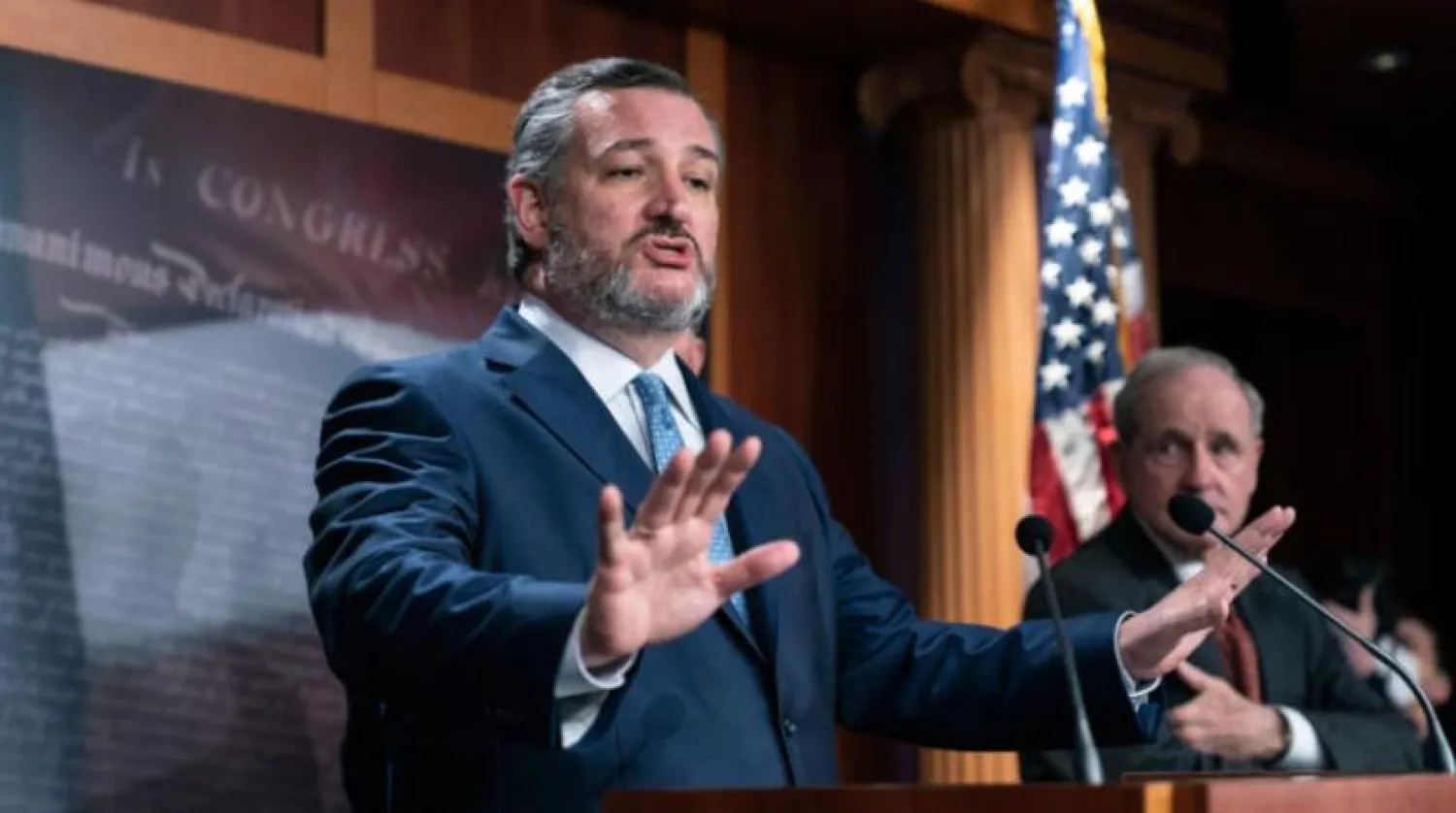
Republican Senator Ted Cruz, one of the fiercest critics of Biden's Iran policy. (AP)
TT

Congress Warns Biden Against Concluding Nuclear Deal with Iran

Republican Senator Ted Cruz, one of the fiercest critics of Biden's Iran policy. (AP)

Several Congressmen warned US President Joe Biden against concluding a nuclear deal with Tehran.

Republican Senator Ted Cruz accused US President Joe Biden of becoming the world's top funder of terrorism.

"Biden is committed to a new deal with Iran that will pour hundreds of billions of dollars into the terrorist regime. Let's be clear about what that means. Biden is about to become, literally, the number 1 funder of terrorism in the world," Cruz tweeted.

Cruz's statement reflects the anger among the Republicans and some Democrats, over the possibility of reaching an agreement with Iran, despite their repeated warnings.

The opposition against a deal with Iran escalated dramatically with the Russian invasion of Ukraine, in light of the US administration's reliance on Russia in the Vienna negotiations and the possibility of Moscow obtaining exemptions from sanctions as a result of reaching an agreement with Tehran.

Cruz and other Republican lawmakers had previously described this step as a "complete surrender to Putin," considering that the Russian president is the winner of returning to the nuclear agreement with Iran.

Also, the Biden administration is considering removing the Iranian Revolutionary Guards Corps (IRGC) from the list of terrorism in return for Iran's return to the nuclear agreement. The move sparked a wave of criticism from bipartisan representatives.

Jim Risch, the ranking member of the Senate Foreign Relations Committee, said he strongly opposes delisting the IRGC.

"The IRGC is responsible for numerous attacks on US forces and interests and openly sponsors dangerous terrorist proxies that threaten the region. Any argument to the contrary is false," he said.

Democrats in the House of Representatives sent a letter to the White House warning against delisting the Corps, saying Iran's nuclear program and activities are not limited to the Middle East through Hezbollah, Hamas, and Islamic Jihad, but extend to the rest of the world.

A recent statement by the commander of Central Command, Gen. Kenneth McKenzie, supported those requests. He told the Senate Armed Services Committee members on Tuesday that the IRGC is a terrorist organization.

The Republicans put forward several draft bills in Congress, the latest of which prevents the US administration from lifting any sanctions imposed on countries and entities that cooperate with Iran in its nuclear program.

Cruz said the "Biden administration is dismantling sanctions and is aching to secure a new agreement with the Iranian regime that is even weaker than the original catastrophic Obama-Iran nuclear deal."

The Biden administration notified the Congress that it was giving Iran and its international partners, including Russia, a waiver for seven civil nuclear activities, which Tehran uses to build its nuclear program.

Cruz fought to rescind those waivers, and the Trump administration did so in 2019 and 2020.

"The Biden administration is so committed to their deal that they are willing to make Iran a nuclear client for Putin, including work that amounts to a $10 billion subsidy for his war machine."

"That's why I've introduced legislation to stop the Biden administration from issuing civil-nuclear waivers allowing Russia to build up Iran's nuclear program," said the Senator.

He warned that the Iranian regime uses these civil nuclear waivers to build up the nuclear program with the "express intention of eventually developing nuclear weapons to inflict destruction on America and our allies."

Furthermore, 49 of the 50 Republicans at the Senate told Biden, democrats, and the international community that an Iran agreement without broad congressional support would not survive.

"Republicans have made it clear: We would be willing and eager to support an Iran policy that completely blocks Iran's path to a nuclear weapons capability, constrains Iran's ballistic missile program, and confronts Iran's support for terrorism."

They warned that if the administration agrees to a deal that fails to achieve these objectives or makes achieving them more complex, Republicans will do everything to reverse it.

"Unless Iran ceases its support for terrorism, we will oppose removing and seek to reimpose any terrorism-related sanctions. And we will force the Senate to vote on any Administration effort to do so."



China Warns Middle East at ‘Critical Juncture’ After Trump Extends Ceasefire

 13 April 2026, China, Beijing: Guo Jiakun, spokesman for the Chinese Foreign Ministry, speaks to journalists. (dpa)
13 April 2026, China, Beijing: Guo Jiakun, spokesman for the Chinese Foreign Ministry, speaks to journalists. (dpa)
TT

China Warns Middle East at ‘Critical Juncture’ After Trump Extends Ceasefire

 13 April 2026, China, Beijing: Guo Jiakun, spokesman for the Chinese Foreign Ministry, speaks to journalists. (dpa)
13 April 2026, China, Beijing: Guo Jiakun, spokesman for the Chinese Foreign Ministry, speaks to journalists. (dpa)

China warned on Wednesday that the situation in the Middle East was at a "critical juncture" after US President Donald Trump extended a ceasefire to allow Iran more time to negotiate.

Trump indefinitely pushed back the end of the two-week truce on Tuesday with Tehran yet to respond but he said a US blockade of Iran's ports would continue.

"The current regional situation stands at a critical juncture transitioning between war and peace; the paramount priority remains to make every effort to prevent a resumption of hostilities," Chinese foreign ministry spokesman Guo Jiakun told a news briefing.

Guo did not comment directly on the ceasefire when asked about it, adding only that Beijing would continue to play a "constructive" role.


Extreme Heat Threatens Global Food Systems, UN Agencies Warn

Emmanuel, a worker at the Fasoranti farm, harvests cocoa pods in Akure, Ondo State, Nigeria, 20 April 2026. (EPA)
TT

Extreme Heat Threatens Global Food Systems, UN Agencies Warn

Emmanuel, a worker at the Fasoranti farm, harvests cocoa pods in Akure, Ondo State, Nigeria, 20 April 2026. (EPA)

Extreme heat is pushing global agrifood systems to the brink, threatening the livelihoods and health of more than a billion people, according to a new report by the UN's food and weather agencies.

The United Nations Food and Agriculture Organization (FAO) and the World Meteorological Organization (WMO) said heatwaves are becoming more frequent, intense and prolonged, damaging crops, livestock, fisheries and forests.

"Extreme heat is rewriting the script on what farmers, fishers and foresters can grow and when they can grow. In some cases it is even dictating if they can still work," said Kaveh Zahedi, ‌head of ‌FAO's climate change office.

"At its core, this report ‌is ⁠telling us that ⁠we face a very uncertain future," he told Reuters.

Recent climate datasets show global warming is accelerating, with 2025 ranking among the three hottest years on record, triggering more frequent and severe weather extremes.

Acting as a risk multiplier, extreme heat intensifies droughts, wildfires and pest outbreaks and sharply cuts crop yields once critical temperature thresholds are breached.

RISKS ESCALATE RAPIDLY AS TEMPERATURES PUSH HIGHER

The report said higher temperatures ⁠are shrinking the safety margin that plants, animals and ‌humans rely on to function, with yields for ‌most major crops falling once temperatures exceed about 30 degrees Celsius (86 degrees Fahrenheit).

Zahedi cited ‌Morocco, where six years of drought were followed by record heatwaves. "This led ‌to a fall in cereal yields by over 40%. It decimated the olive and citrus harvest. Basically, those harvests failed," he said.

Marine heatwaves are also becoming more frequent, depleting oxygen levels in water and threatening fish stocks. In 2024, 91% of the world's ‌oceans experienced at least one marine heatwave, the report said.

Risks rise sharply as warming accelerates. The intensity of extreme ⁠heat events is ⁠expected to roughly double at 2 degrees Celsius of warming and quadruple at 3 degrees, compared with 1.5 degrees, the report said.

Zahedi said every one-degree rise in average global temperatures cuts yields of the world's four major crops - maize, rice, soya, and wheat - by about 6%.

The FAO and WMO said piecemeal responses were inadequate and called for better risk governance and early-warning weather systems to help farmers and fishers take preventive action.

"If you can get the data into the farmers' hands, they can adjust when they plant, they can adjust what they plant, they can adjust when they harvest," Zahedi said.

But the report said adaptation alone is not enough, arguing the only lasting solution to the growing threat of extreme heat is ambitious, coordinated action to curb climate change.


Russian Drones Strike Ukraine’s Odesa Port, Kill Railway Worker in South, Deputy PM Says

Rescuers work at the site of a Russian drone strike as port infrastructure was hit, amid Russia's attack on Ukraine, in Odesa region, Ukraine April 22, 2026. (Press service of the State Emergency Service of Ukraine in Odesa region/Handout via Reuters)
TT

Russian Drones Strike Ukraine’s Odesa Port, Kill Railway Worker in South, Deputy PM Says

Rescuers work at the site of a Russian drone strike as port infrastructure was hit, amid Russia's attack on Ukraine, in Odesa region, Ukraine April 22, 2026. (Press service of the State Emergency Service of Ukraine in Odesa region/Handout via Reuters)

Russian drones attacked infrastructure in Ukraine's Black Sea Odesa port overnight, Deputy Prime Minister Oleksiy Kuleba said on Wednesday.

Berths, warehouses, railway infrastructure and port operators' facilities were damaged in the assault, Kuleba ‌wrote on Telegram.

The ‌hold of a ‌cargo ⁠ship was also ⁠hit, causing a fire Ukraine's seaports authority said.

According to preliminary information no one was hurt in the attack, and the port was still ⁠operating, the authority said ‌on Telegram.

Russia has ‌repeatedly targeted maritime export routes ‌more than four years after its ‌invasion of Ukraine, striking ports vital to foreign trade and the wartime economy.

Kuleba said a Russian ‌drone attack at a sorting yard at the Zaporizhzhia-Live ⁠station ⁠in the southern Zaporizhzhia region killed an assistant train driver. The train driver was hospitalized, he added.

The Ukrainian air force said Russia had launched 215 drones at the country since 6 p.m. (1500 GMT) on Tuesday, and 189 had been downed or neutralized.