


North Korea Says Kim Ordered Test of 'New Type' of ICBM

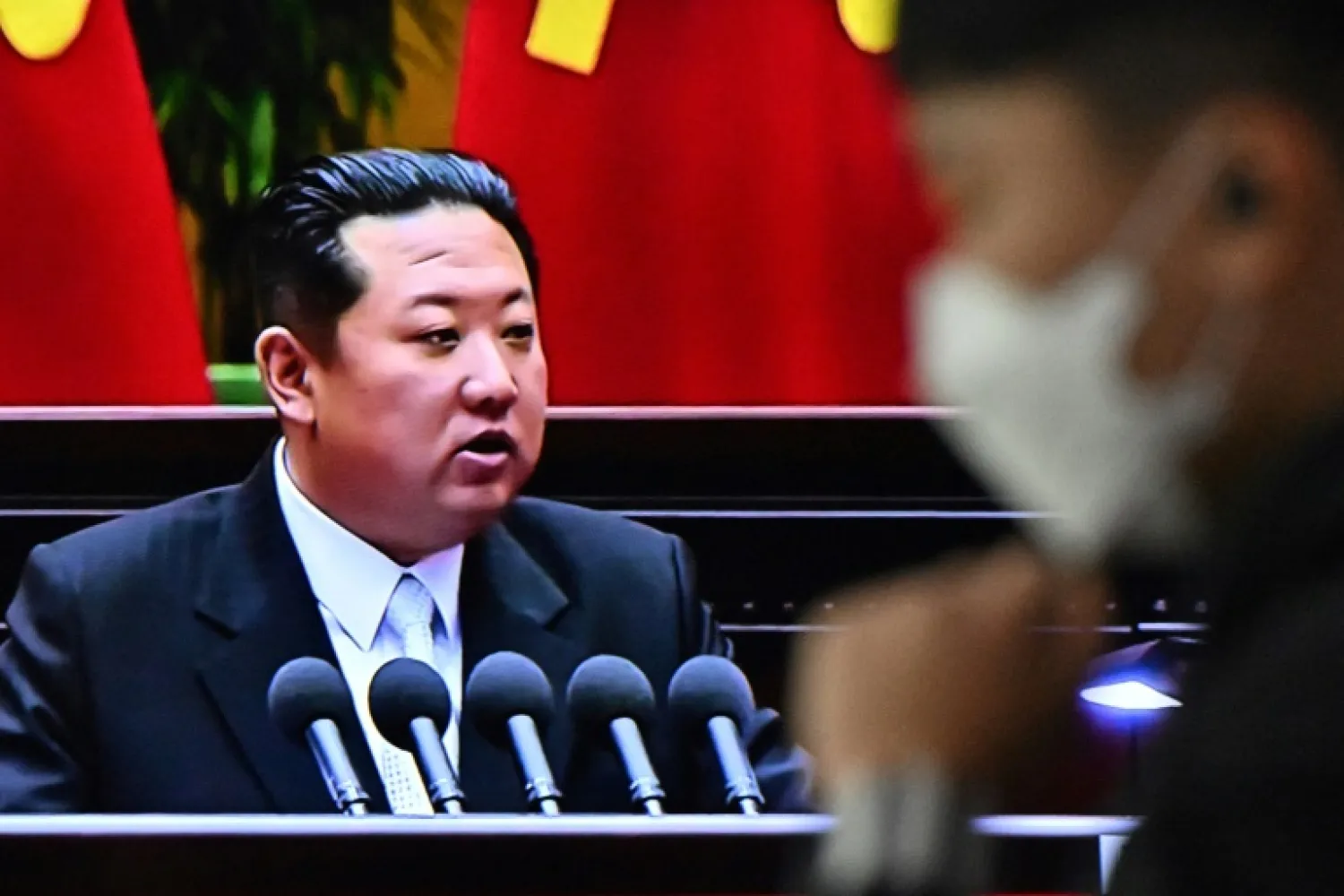
A man walks past a television report showing a news broadcast with file footage of North Korean leader Kim Jong Un after an intercontinental ballistic missile (ICBM) was launched earlier in the day, at a railway station in Seoul on March 24, 2022 Anthony WALLACE AFP/File
TT

North Korea Says Kim Ordered Test of 'New Type' of ICBM

A man walks past a television report showing a news broadcast with file footage of North Korean leader Kim Jong Un after an intercontinental ballistic missile (ICBM) was launched earlier in the day, at a railway station in Seoul on March 24, 2022 Anthony WALLACE AFP/File

Kim Jong Un personally oversaw the test-firing of North Korea's largest-ever intercontinental ballistic missile, ensuring his country is ready for "long-standing confrontation" with the United States, state media reported Friday.

The Thursday launch was the first time Pyongyang has fired Kim's most powerful missiles at full range since 2017.

It appears to have travelled higher and further than any previous ICBM tested by the nuclear-armed country -- including one designed to strike anywhere on the US mainland, AFP said.

The test-launch of the "new type inter-continental ballistic missile" was conducted under the "direct guidance" of leader Kim, KCNA reported.

State media photographs showed Kim, wearing his customary black leather jacket and dark sunglasses, striding across the tarmac in front of a huge missile, with other images of him cheering and celebrating the test-launch with uniformed military top brass.

The new ICBM "would make the whole world clearly aware of the power of our strategic armed forces once again," Kim said, according to KCNA, adding the country was now "fully ready for long-standing confrontation with the US imperialists".

- 'Monster missile' -
Known as the Hwasong-17, the giant ICBM was first unveiled in October 2020 and dubbed a "monster missile" by analysts.

It had never previously been successfully test fired, and the launch prompted immediate outrage from Pyongyang's neighbors and the United States.

"The missile, launched at Pyongyang International Airport, travelled up to a maximum altitude of 6,248.5 km and flew a distance of 1,090 km for 4,052s before accurately hitting the pre-set area in open waters" in the Sea of Japan, KCNA said.

South Korea's military had estimated the range of the Thursday launch as 6,200 kilometers (3,800 miles) -- far longer than the last ICBM, the Hwasong-15, which North Korea tested in November 2017.

The missile landed in Japan's exclusive economic zone, prompting anger from Tokyo, but KCNA said the test had been carried out "in a vertical launch mode" to ease neighbors' security concerns.

North Korea is already under biting international sanctions for its weapons programs, and the UN Security Council will hold an emergency meeting over the launch on Friday.

- 'Important progress' -
The test is a clear sign North Korea has made "important qualitative progress" on its banned weapons programs, said US-based analyst Ankit Panda.

"What's important about this ICBM is not how far it can go, but what it can potentially carry, which is multiple warheads," something North Korea has long coveted, he told AFP.

"The North Koreans are on the cusp of significantly increasing the threat to the United States beyond the ICBM capability demonstrated in 2017."

Multiple warheads would help a North Korean missile to evade US missile defense systems.

The North had carried out three ICBM tests prior to Thursday, the last being the Hwasong-15 in 2017.

Long-range and nuclear tests were paused when Kim and then US president Donald Trump engaged in a bout of diplomacy which collapsed in 2019. Talks have stalled since.

Thursday's launch, one of nearly a dozen North Korean weapons tests this year, marked a dramatic return to long-range testing.

It came just days after one last week, likely also of the Hwasong-17, ended in failure, exploding after launch.

- Compensation -
"This test also appears to 'compensate' for last week’s failed projectile launch – handsomely so," Soo Kim, RAND Corporation Policy Analyst and former CIA analyst, told AFP.

"The regime appears quite pleased with the outcome of the test," she added.

KCNA said that the launch proved the weapon worked and that its operation could now be guaranteed even "under wartime environment".

The country's new ICBM launch comes at a delicate time for the region, with South Korea going through a presidential transition until May, and the US distracted by Russia's invasion of Ukraine.

Analysts say the drive to successfully test-fire the Hwasong-17 is part of Pyongyang's preparations to mark the 110th anniversary of the birth of founder Kim Il Sung on April 15.

The official Rodong Sinmun newspaper carried a photograph of a haggard-looking Kim signing papers at his desk, with an image of a handwritten "I approve the test launch" scrawled over a report.

"Kim Jong Un wants to ultimately establish himself as a leader who has successfully developed both nuclear weapons and ICBMs," Ahn Chan-il, a North Korean studies scholar, told AFP.

"He is almost desperate as without such military achievements, he really hasn't done much," he added, pointing to the isolated country's Covid and sanctions-battered economy.



Top Trump Iran Negotiator Says Visits US Aircraft Carrier in Middle East

US Special Envoy Steve Witkoff delivers a press conference upon the signing of the declaration on deploying post-ceasefire force in Ukraine, during the so-called "Coalition of the Willing" summit, at the Elysee Palace in Paris, France, January 6, 2026. (Reuters)
TT

Top Trump Iran Negotiator Says Visits US Aircraft Carrier in Middle East

US Special Envoy Steve Witkoff delivers a press conference upon the signing of the declaration on deploying post-ceasefire force in Ukraine, during the so-called "Coalition of the Willing" summit, at the Elysee Palace in Paris, France, January 6, 2026. (Reuters)

US President Donald Trump's lead Iran negotiator Steve Witkoff on Saturday said he visited the USS Abraham Lincoln aircraft carrier currently in the Arabian Sea, with Washington and Tehran due to hold further talks soon.

"Today, Adm. Brad Cooper, Commander of US Naval Forces Central Command, Jared Kushner, and I met with the brave sailors and Marines aboard the USS Abraham Lincoln, her strike group, and Carrier Air Wing 9 who are keeping us safe and upholding President Trump's message of peace through strength," said Witkoff in a social media post.

Iranian Foreign Minister Abbas Araghchi said on Saturday he hoped talks with the United States would resume soon, while reiterating Tehran's red lines and warning against any American attack.


Israel’s Netanyahu Expected to Meet Trump in US on Wednesday and Discuss Iran

Israeli Prime Minister Benjamin Netanyahu delivers a speech during a special session to mark the 77th anniversary of the Knesset's establishment and the 60th anniversary of the dedication of the current building at the Knesset, the Israeli parliament, in Jerusalem, 02 February 2026. (EPA)
TT

Israel’s Netanyahu Expected to Meet Trump in US on Wednesday and Discuss Iran

Israeli Prime Minister Benjamin Netanyahu delivers a speech during a special session to mark the 77th anniversary of the Knesset's establishment and the 60th anniversary of the dedication of the current building at the Knesset, the Israeli parliament, in Jerusalem, 02 February 2026. (EPA)

Israeli Prime Minister Benjamin Netanyahu is expected to meet US President Donald Trump on Wednesday in Washington, where they will discuss negotiations with Iran, Netanyahu's office said on Saturday.

Iranian and US officials held indirect nuclear ‌talks in the ‌Omani capital ‌Muscat ⁠on Friday. ‌Both sides said more talks were expected to be held again soon.

A regional diplomat briefed by Tehran on the talks told Reuters Iran insisted ⁠on its "right to enrich uranium" ‌during the negotiations with ‍the US, ‍and that Tehran's missile capabilities ‍were not raised in the discussions.

Iranian officials have ruled out putting Iran's missiles - one of the largest such arsenals in the region - up ⁠for discussion, and have said Tehran wants recognition of its right to enrich uranium.

"The Prime Minister believes that any negotiations must include limiting ballistic missiles and halting support for the Iranian axis," Netanyahu's office said in a ‌statement.


Italy FM Rules Out Joining Trump’s ‘Board of Peace’

Italy's Minister for Foreign Affairs Antonio Tajani speaks to the press during the EPP Leaders’ meeting, in Zagreb, Croatia, 30 January 2026. (EPA)
TT

Italy FM Rules Out Joining Trump’s ‘Board of Peace’

Italy's Minister for Foreign Affairs Antonio Tajani speaks to the press during the EPP Leaders’ meeting, in Zagreb, Croatia, 30 January 2026. (EPA)

Italy will not take part in US President Donald Trump's "Board of Peace", Italian Foreign Minister Antonio Tajani said Saturday, citing "insurmountable" constitutional issues.

Trump launched his "Board of Peace" at the World Economic Forum in Davos in January and some 19 countries have signed its founding charter.

But Italy's constitution bars the country from joining an organization led by a single foreign leader.

Prime Minister Giorgia Meloni, a Trump ally, last month noted "constitutional problems" with joining, but suggested Trump could perhaps reopen the framework "to meet the needs not only of Italy, but also of other European countries".

Tajani appeared Saturday to rule that out.

"We cannot participate in the Board of Peace because there is a constitutional limit," he told the ANSA news agency.

"This is insurmountable from a legal standpoint," he said, the day after meeting US Secretary of State Marco Rubio and US Vice President JD Vance at the Olympics in Milan.

Although originally meant to oversee Gaza's rebuilding, the board's charter does not limit its role to the Palestinian territory and appears to want to rival the United Nations.