


Ukraine Oil Price Surge Casts Shadow over Ramadan Meals

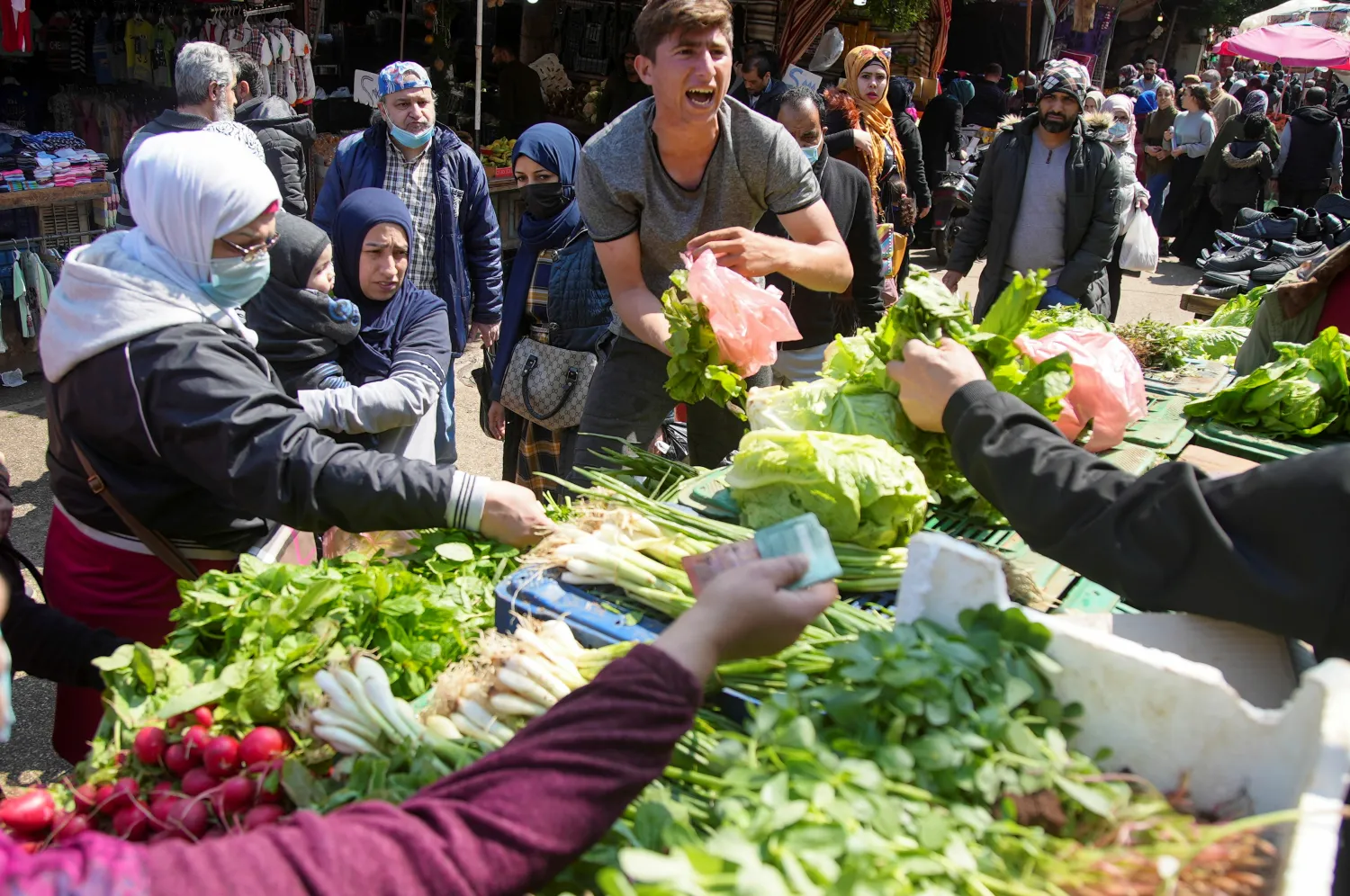
People buy vegetables at a market. Reuters file photo
TT

Ukraine Oil Price Surge Casts Shadow over Ramadan Meals

People buy vegetables at a market. Reuters file photo

Cheap and tasty, fried potatoes have become a staple in Lebanese mother Mona Amsha's kitchen in recent years. But with sunflower oil prices soaring due to Russia's invasion of Ukraine, she fears even fries will be out of reach this Ramadan.

"In 2021, when the prices were already up, I was using the same oil to cook several dishes," said Amsha, who has three children and lives in a run-down suburb of the capital, Beirut. "Now, I can't even do that."

In Lebanon, where a deep economic crisis has caused food prices to rise 11 times since 2019, according to the World Food Program(WFP), the impact of spiraling wheat, cooking oil and fuel costs will be sorely felt during the Muslim holy month, Reuters reported.

Each day of Ramadan, which starts on April 2, Muslims break their daily fast with evening meals known as "iftars", typically featuring large platters of rice, meat and deep-fried savory pastries.

Many of the dishes require copious amounts of oil – now too expensive for many people in Lebanon and other Muslim-majority countries in the Middle East and North Africa that are heavily dependent on imported food.

Ukraine and Russia account for more than 80% of global exports of sunflower seed oil, and prices for the culinary staple jumped 64% in a single week in late March.

Last month, when Russia unleashed its invasion, the Food and Agriculture Organization (FAO) said its vegetable oil index jumped 8.5% to a record high.

In Lebanon, a one-liter bottle of sunflower oil is nearly 10 times more expensive than it was three years ago, and scarce imports mean supermarkets are rationing purchases to one bottle per customer.

"I can't even have a plate full of French fries for my children," Amsha told the Thomson Reuters Foundation by phone.

The spike is hitting refugees and other vulnerable groups in the region particularly hard.

Nearly 90% of the 1.5 million Syrian refugees living in Lebanon already live in extreme poverty and rely on food assistance, according to the WFP.

For Kalima Deeb, a Syrian refugee living in an informal settlement in Lebanon with her husband and two children, a full Ramadan spread seems a distant dream.

"How could I imagine having a table full of food like I did in the past, when it's already impossible to afford to have a single full plate?" Deeb said.

Syrian refugees in Egypt, who number about 130,000 among a population of 100 million, are also worried.

The country, which is often the world's largest wheat importer, has already been hit by a sharp rise in global wheat prices due to the war in Ukraine.

Now, sunflower oil prices have increased by 25%, taking the cost of a one-liter bottle to 214 Egyptian pounds ($11.71), nearly 10% of the monthly minimum wage.



iRead Marathon Records over 6.5 Million Pages Read

Participants agreed that the number of pages read was not merely a numerical milestone - SPA
TT

iRead Marathon Records over 6.5 Million Pages Read

Participants agreed that the number of pages read was not merely a numerical milestone - SPA

The fifth edition of the iRead Marathon achieved a remarkable milestone, surpassing 6.5 million pages read over three consecutive days, in a cultural setting that reaffirmed reading as a collective practice with impact beyond the moment.

Hosted at the Library of the King Abdulaziz Center for World Culture (Ithra) and held in parallel with 52 libraries across 13 Arab countries, including digital libraries participating for the first time, the marathon reflected the transformation of libraries into open, inclusive spaces that transcend physical boundaries and accommodate diverse readers and formats.

Participants agreed that the number of pages read was not merely a numerical milestone, but a reflection of growing engagement and a deepening belief in reading as a daily, shared activity accessible to all, free from elitism or narrow specialization.

Pages were read in multiple languages and formats, united by a common conviction that reading remains a powerful way to build genuine connections and foster knowledge-based bonds across geographically distant yet intellectually aligned communities, SPA reported.

The marathon also underscored its humanitarian and environmental dimension, as every 100 pages read is linked to the planting of one tree, translating this edition’s outcome into a pledge of more than 65,000 trees. This simple equation connects knowledge with sustainability, turning reading into a tangible, real-world contribution.

The involvement of digital libraries marked a notable development, expanding access, strengthening engagement, and reinforcing the library’s ability to adapt to technological change without compromising its cultural role. Integrating print and digital reading added a contemporary dimension to the marathon while preserving its core spirit of gathering around the book.

With the conclusion of the iRead Marathon, the experience proved to be more than a temporary event, becoming a cultural moment that raised fundamental questions about reading’s role in shaping awareness and the capacity of cultural initiatives to create lasting impact. Three days confirmed that reading, when practiced collectively, can serve as a meeting point and the start of a longer cultural journey.


Imam Turki bin Abdullah Royal Reserve Launches Fifth Beekeeping Season

Jazan’s Annual Honey Festival - File Photo/SPA
TT

Imam Turki bin Abdullah Royal Reserve Launches Fifth Beekeeping Season

Jazan’s Annual Honey Festival - File Photo/SPA

The Imam Turki bin Abdullah Royal Nature Reserve Development Authority launched the fifth annual beekeeping season for 2026 as part of its programs to empower the local community and regulate beekeeping activities within the reserve.

The launch aligns with the authority's objectives of biodiversity conservation, the promotion of sustainable environmental practices, and the generation of economic returns for beekeepers, SPA reported.

The authority explained that this year’s beekeeping season comprises three main periods associated with spring flowers, acacia, and Sidr, with the start date of each period serving as the official deadline for submitting participation applications.

The authority encouraged all interested beekeepers to review the season details and attend the scheduled virtual meetings to ensure organized participation in accordance with the approved regulations and the specified dates for each season.


Hail Municipality Named Arab Green City For 2024-2025

The achievement establishes Hail as a leading Arab model for sustainable urban development - SPA
TT

Hail Municipality Named Arab Green City For 2024-2025

The achievement establishes Hail as a leading Arab model for sustainable urban development - SPA

The Hail Region Municipality has secured first place in the Arab Green City award for 2024-2025 at the 15th session of the Arab Towns Organization.

This recognition honors the municipality’s commitment to environmental sustainability, the expansion of green spaces, and the implementation of urban practices that elevate the quality of life, SPA reported.

The award follows a series of strategic environmental initiatives, including large-scale afforestation, the modernization of public parks, and the adoption of eco-friendly solutions to enhance the urban landscape and resource efficiency.

By aligning its projects with the sustainability goals of Saudi Vision 2030, the municipality continues to foster a healthy and safe environment for residents and visitors.

This achievement establishes Hail as a leading Arab model for sustainable urban development.