


North Korea Warns of Nuclear Response if South Provokes It

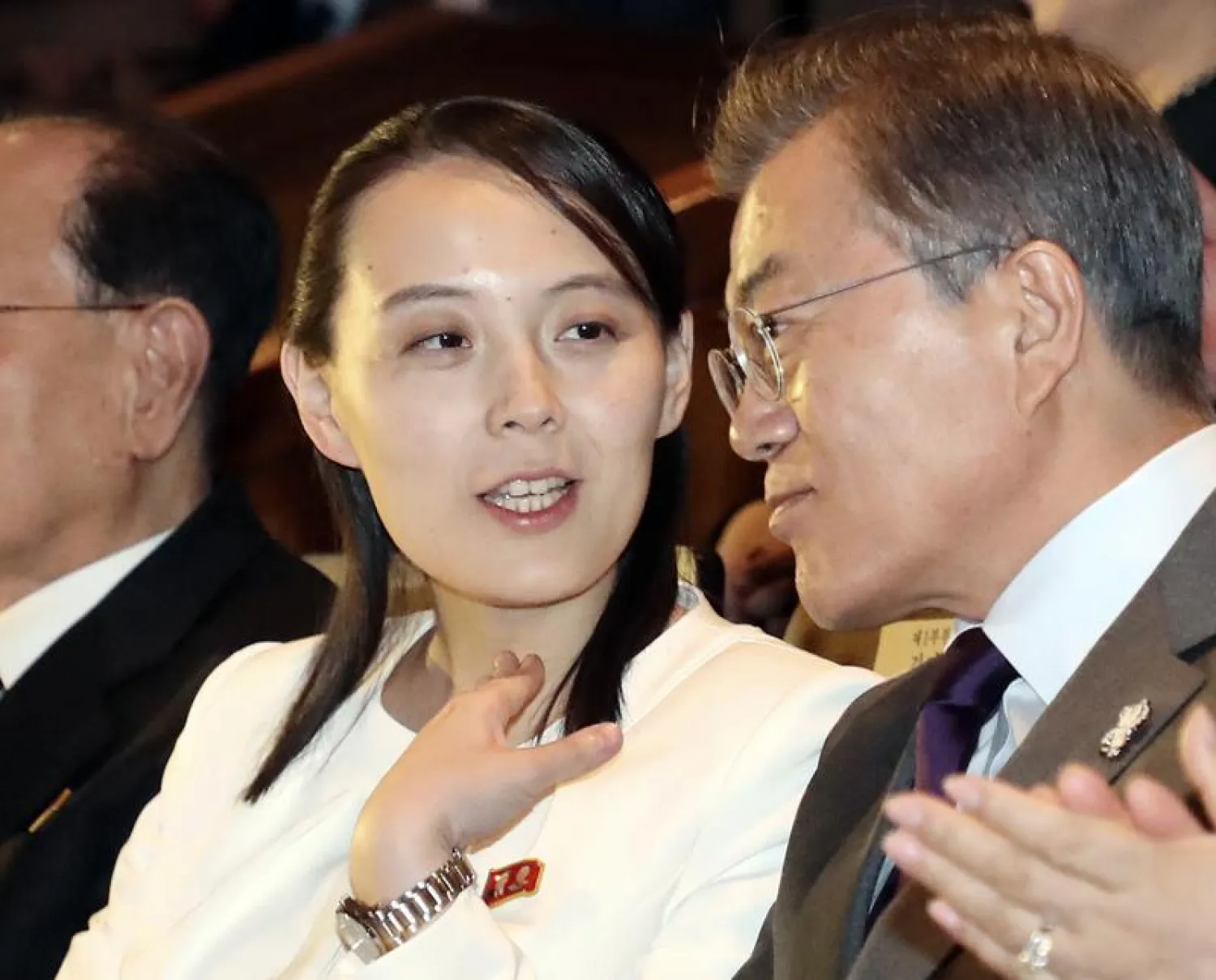
FILE - Kim Yo Jong, center, North Korean leader Kim Jong Un's sister, talks with South Koran President Moon Jae-in, right, as they watch a performance of North Korea's Samjiyon Orchestra at National Theater in Seoul, South Korea, on Feb. 11, 2018. (Bee Jae-man/Yonhap via AP, File)
TT

North Korea Warns of Nuclear Response if South Provokes It

FILE - Kim Yo Jong, center, North Korean leader Kim Jong Un's sister, talks with South Koran President Moon Jae-in, right, as they watch a performance of North Korea's Samjiyon Orchestra at National Theater in Seoul, South Korea, on Feb. 11, 2018. (Bee Jae-man/Yonhap via AP, File)

For the second time this week, the powerful sister of North Korean leader Kim Jong Un berated South Korea for touting its supposed preemptive strike capabilities against the North, saying her country’s nuclear forces would annihilate the South’s conventional forces if provoked.

In a statement carried Tuesday by North Korea’s state media, Kim Yo Jong called South Korea Defense Minister Suh Wook’s recent comments about preemptive strikes a “fantastic daydream” and the “hysteria of a lunatic.”

She stressed that North Korea doesn’t want another war on the Korean Peninsula but warned it would retaliate with its nuclear forces if the South opts for preemptive strikes or other attacks, which would leave the South’s military “little short of total destruction and ruin.”

North Korea has repeatedly stated it would preemptively use its nuclear weapons when threatened by rivals as it accelerated its development of nuclear bombs and missiles, which Kim Jong Un sees as his strongest guarantee of survival, The Associated Press reported.

In another statement directed toward Suh on Sunday, Kim Yo Jong called him a “scum-like guy” and warning that the South may face a “serious threat” because of his comments.

Her statements come amid tensions over North Korea’s accelerating weapons tests this year, including its first test of an intercontinental ballistic missile since 2017 on March 24, as her brother revives nuclear brinkmanship aimed at pressuring Washington to accept the North as a nuclear power and remove crippling sanctions.

Some experts say the North may up the ante in the coming months, possibly test-flying missiles over Japan or resuming nuclear explosive tests, as it tries to get a response from the Biden administration, which is distracted by Russia’s invasion of Ukraine and an intensifying rivalry with China.

The renewed tensions have been a major setback for outgoing South Korean President Moon Jae-in, a dovish liberal who had staked his presidential term on his ambitions for inter-Korean rapprochement.

During a visit to the country’s strategic missile command last week, Suh said South Korea has the ability and readiness to launch precision strikes on North Korea if it detects the North intends to fire missiles at South Korea.

Seoul has long maintained such a preemptive attack strategy to cope with North Korea’s missile and nuclear threats, but it was highly unusual for a Moon administration official to publicly discuss it.

“In case (South Korea) opts for military confrontation with us, our nuclear combat force will have to inevitably carry out its duty … a dreadful attack will be launched and the (South Korean) army will have to face a miserable fate little short of total destruction and ruin,” Kim said in her latest statement.

South Korea’s government didn’t immediately respond to her comments. Seoul had issued a low-key response following Kim’s earlier comments on Sunday, urging Pyongyang to refrain from further raising tensions and return to dialogue.

Moon met Kim Jong Un three times in 2018 and lobbied hard to help set up his Kim’s first summit with then-President Donald Trump in June that year.

But the diplomacy derailed after the second Kim-Trump meeting in 2019 where the Americans rejected North Korea’s demands for major sanctions relief in exchange for a limited surrender of its nuclear capabilities.

Kim has since vowed to bolster his nuclear forces and sped up weapons development despite limited resources and pandemic-related difficulties. North Korea has also severed all inter-Korean cooperation while expressing anger over US-South Korea military exercises and Seoul’s inability to wrest concessions from Washington on its behalf.

Before its resumption of long-range testing last month, the North had spent the much of the past three years expanding its arsenal of nuclear-capable short-range missiles threatening South Korea.

Experts say those missiles, which could potentially be armed with “tactical” battlefield nuclear weapons, communicate the North’s threat to use smaller nuclear arms even during conventional warfare to overcome the stronger conventional forces of South Korea and the US. The US stations about 28,500 soldiers in the South to deter North Korean aggression.

Moon’s term ends in May, when he will be replaced by conservative Yoon Suk Yeol, who could possibly take a harder line on Pyongyang.

US State Department spokesperson Ned Price said Biden’s special envoy for North Korea, Sung Kim, plans to meet his Chinese counterpart in Washington to discuss the North’s growing threat. China, Pyongyang’s major ally and economic lifeline, has repeatedly called for the easing of UN Security Council sanctions against the North, citing the economic toll on civilians. ___ AP writers Hyung-jin Kim in Seoul and Matthew Lee in Washington contributed to this report.



Le Pen Says France Will No Longer Aid Ukraine ‘Financially’ if Elected

Marine Le Pen (C), the far-right National Rally (RN) party's candidate for the 2027 French presidential election, visits the "Made in France" fair at the Porte de Versailles exhibition center in Paris, France, 13 November 2026. (EPA)
TT

Le Pen Says France Will No Longer Aid Ukraine ‘Financially’ if Elected

Marine Le Pen (C), the far-right National Rally (RN) party's candidate for the 2027 French presidential election, visits the "Made in France" fair at the Porte de Versailles exhibition center in Paris, France, 13 November 2026. (EPA)

Marine Le Pen on Monday said that France would provide no further financial aid to Ukraine if she is elected president next year, after a meeting with Kyiv's ambassador in Paris.

"The state of France's public finances would no longer allow the country to provide financial assistance to Ukraine in the coming months," Le Pen said in a statement, while insisting France would honor existing commitments, including toward a 90-billion-euro ($100-billion) European Union loan.

Le Pen is currently ahead in polls in the race to succeed President Emmanuel Macron next year, as the war sparked by Russia's 2022 full-scale invasion of Ukraine grinds towards its fifth anniversary.

She has faced criticism over past links to Russia, which included a 2017 meeting in the Kremlin with President Vladimir Putin and her party taking a loan from a Russian bank that it paid off in full in 2023.

But she has opposed the invasion and, at her talks in Paris with Ukrainian ambassador Vadym Omelchenko, Le Pen made clear her "unwavering support for Ukraine since the beginning of the conflict".

The statement said the talks -- the first such between Le Pen and the Ukrainian ambassador -- were "cordial".

While financial aid would be cut, Le Pen told the ambassador that "France would continue to support Ukraine through donations of equipment, humanitarian aid and much more active diplomacy".

The statement said there was a "frank discussion" on the future of the conflict, with Le Pen stressing that "the pursuit of peace -- though a difficult goal to achieve -- must remain a priority for all".

She also asked the ambassador to tell President Volodymyr Zelensky she is ready to meet in "either Paris or Brussels". However, there was no mention of the candidate making the journey to Kyiv after Zelensky invited her to visit the Ukrainian capital.

Le Pen's opponents have expressed alarm that by emphasizing the importance of ending the war swiftly, she could force Ukraine to capitulate on unfavorable terms.

"If Russia imposes its will on a European nation through brutality, all of Europe is weakened," Macron wrote on Facebook at the weekend.

Taking aim at Le Pen, he said: "Let us be clear: those who seek to limit the resources available to Ukraine are, in effect, pushing for an unjust peace -- one that would leave Ukraine permanently vulnerable, and, by extension, leave Europe vulnerable as well."


Trump Says He Might Meet with North Korea’s Kim Jong Un in China

US President Donald Trump and North Korean leader Kim Jong Un shake hands before their one-on-one chat during the second US-North Korea summit at the Metropole Hotel in Hanoi, Vietnam February 27, 2019. (Reuters)
TT

Trump Says He Might Meet with North Korea’s Kim Jong Un in China

US President Donald Trump and North Korean leader Kim Jong Un shake hands before their one-on-one chat during the second US-North Korea summit at the Metropole Hotel in Hanoi, Vietnam February 27, 2019. (Reuters)

US President Donald Trump said on Monday he might meet with North Korean leader Kim Jong Un in China this week, an announcement that could dramatically reshape his upcoming trip through East Asia if it occurs.

The president, who met the North Korean leader several times during his 2017-2021 term, including once in the Korean Demilitarized Zone, has previously expressed ‌interest in ‌another meeting during his current term. Senior ‌US ⁠officials, however, have previously ⁠said he has no immediate plans to do so.

Moreover, Trump has repeatedly previewed meetings with Kim that never took place, including during a trip to Asia last year. North Korea, whose mission to the United Nations did not immediately respond to a ⁠request for comment, has publicly indicated it ‌has no intention of ‌meeting with the US president at this time.

Trump told reporters ‌while departing the White House en route to ‌the Philippines and China that any meeting would occur in China, and that the North Korean leader's presence was ultimately up to Chinese President Xi Jinping.

"(Xi) was here a ‌month ago, and we're also going to meet with (Russian) President Putin, and we ⁠may ⁠meet with Kim Jong Un also," Trump said.

"So that'll be good. We have a chance to accomplish a lot."

Trump has indicated he will meet with Putin and Xi during his trip, but US officials and analysts have played down the possibility of a meaningful agreement emerging from any trilateral sit-down.

Among the possible topics of conversation, Trump and others have said, are Russia's invasion of Ukraine, counterproliferation and the war in Iran.


Third US Aircraft Carrier Arrives in Middle East

This US Navy handout photograph released by US Naval Forces Central Command on November 4, 2026, shows the Nimitz-class aircraft carrier USS Theodore Roosevelt (CVN 71) sails alongside Royal Australian Navy Supply-class replenishment oiler HMAS Stalwart (A304). (AFP / NAVCENT Public Affairs / US Navy)
TT

Third US Aircraft Carrier Arrives in Middle East

This US Navy handout photograph released by US Naval Forces Central Command on November 4, 2026, shows the Nimitz-class aircraft carrier USS Theodore Roosevelt (CVN 71) sails alongside Royal Australian Navy Supply-class replenishment oiler HMAS Stalwart (A304). (AFP / NAVCENT Public Affairs / US Navy)

The USS Theodore Roosevelt aircraft carrier arrived in the Middle East on Sunday, media reports said, bringing the number of American carrier strike groups in the region to three.

The deployment, which was reported by the National News and Axios journalist Barak Ravid, comes as fighting reignites in the region, with Iran claiming a drone attack on Bahrain on Sunday, ending a lull in strikes in the war.

Iran also fired drones at Bahrain on Friday -- the first strikes since September against countries in the energy-rich Gulf, which has been targeted several times in the conflict that erupted in February.

US President Donald Trump plans to discuss the war at a trilateral meeting with his Chinese and Russian counterparts Xi Jinping and Vladimir Putin this week, an official said Friday.

Months of diplomacy have failed to resolve the war, which began with US-Israeli strikes that killed Iran's supreme leader Ali Khamenei.