

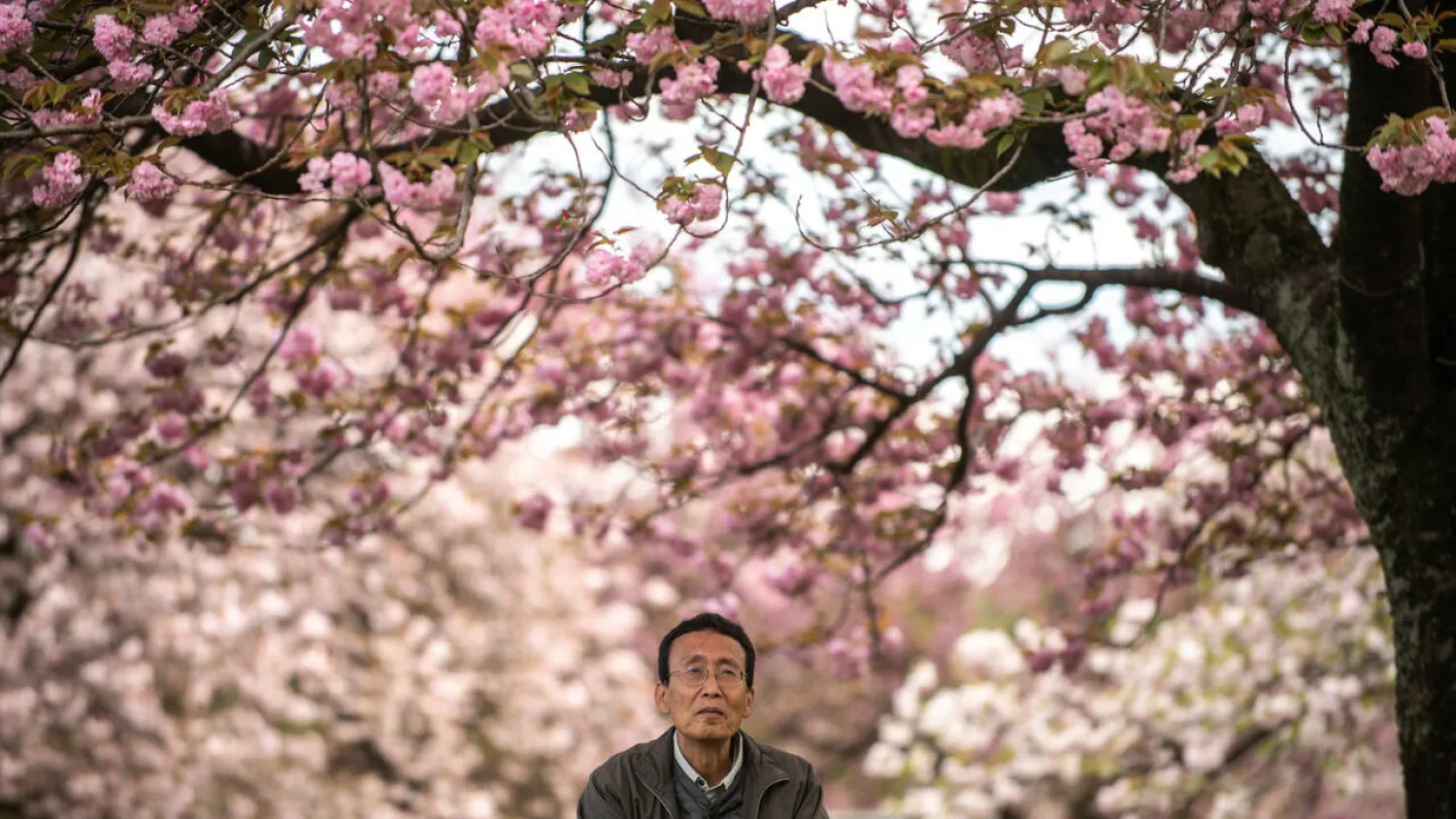

Prettier in Pink: The Push to Remake Japan's Cherry Blossom Season

Hideaki Tanaka is trying to popularize other strains of cherry blossom. Philip FONG AFP
TT

Prettier in Pink: The Push to Remake Japan's Cherry Blossom Season

Hideaki Tanaka is trying to popularize other strains of cherry blossom. Philip FONG AFP

Japan's famed cherry blossom season blankets the country in the delicate white flowers of the prized and popular "somei-yoshino" tree, delighting residents and visitors alike. But some want change.

The season produces a nationwide frenzy, as forecasters compete to declare when full bloom will arrive, and Japanese unfurl picnic blankets for sometimes raucous flower-viewing parties -- at least in pre-pandemic times, AFP said.

The blooms of the ubiquitous somei-yoshino strain, which accounts for more than 90 percent of the cherry trees planted in Japan, last only around a week and tend to emerge simultaneously in a given region because the trees are clones of a single specimen.

And while the tree has become synonymous with blossom season, it is a growing headache for city planners because the strain is prone to disease and tends to grow too large to be well managed in urban settings.

"It's all about planting the right flora in the right place," says Hideaki Tanaka, an expert on sakura -- Japanese for cherry blossoms -- who is trying to popularize other strains.

"There are all kinds of sakura, not just somei-yoshino. I want to help recreate the old times when people enjoyed a wide variety," added Tanaka, 63.

He runs a farm in Yuki, in eastern Japan's Ibaraki prefecture, with around 1,000 sample trees of 400 cherry varieties.

His goal is to convince local officials across Japan to consider alternatives with petals in all shades of pink, or even rare green.

As Tanaka sits on the grass among his trees, nail-sized petals of pale pink flutter down in the gentle breeze, while elsewhere other flowers are still coming into bloom.

It's a scene more like the cherry blossom seasons Japanese enjoyed several centuries ago, with a range of blooms arriving at different times.

- Promoting diversity -
His farm is operated by the Flower Association of Japan, which gives cherry saplings to communities that want to create scenic spots to draw tourists and please residents.

The farm has distributed about three million saplings, including somei-yoshino, but it is now promoting the "jindai-akebono" variety which is more resistant to infection and grows smaller, making it easier to prune.

Its flowers bloom around four days earlier than somei-yoshino's and are a stronger pink colour.

But convincing Japan to turn its back on the somei-yoshino strain may not be easy.

As urban development swept the country from the 1950s to 1980s, cities competed to plant countless millions of fast-growing somei-yoshino trees.

Decades on, many of those trees have not been properly pruned, leaving them vulnerable to an infection called "witch's broom" that deforms twigs, discourages flowering and can kill the trees.

Somei-yoshino also grows large -- as high as five-storey buildings in some cases -- with sprawling branches stretching from enormous trunks that can develop hollows, and bulky roots that can crack pavements.

Older trees are at risk during the country's typhoon season, giving city planners plenty of reasons to consider replacing them.

But residents are less convinced.

- 'Green shoots of feeling' -
In western Tokyo's Kunitachi, it has taken officials three decades to remove around 80 of the approximately 210 trees that have been designated as needing to be felled or replaced.

The trees formed an elegant floral tunnel every spring and residents wanted to keep them, said Ryusuke Endo, an official at the city's roads and traffic division.

"Some people moved here to enjoy them and bought apartments along the street," he said, describing locals as emotionally attached to the trees.

Elsewhere, efforts in Yokohama to axe around 300 cherry trees along a busy street caused public outcry and made television news.

In Kunitachi, officials have started planting the jindai-akebono variety promoted by Tanaka's farm, and residents are starting to embrace the new arrivals.

"I believe green shoots of feeling are emerging among residents who are starting to see that they too are very beautiful," Endo said.

But Tanaka said even diversity evangelists like him are convinced the somei-yoshino will never be dethroned as Japan's sakura king.

Instead, he hopes to encourage people to "learn about the profound diversity of cherry trees".

"The somei-yoshino will always be the main draw for cherry viewing. I want to help communities create other places where people can enjoy all kinds of cherry varieties."



China's LandSpace Hopes to Complete Rocket Recovery in Mid-2026

Zhuque-3 rocket by China’s private rocket firm LandSpace, takes off from the Jiuquan Satellite Launch Center, China, December 3, 2025, in this screengrab taken from handout drone footage provided by LandSpace. LandSpace/Handout via REUTERS
TT

China's LandSpace Hopes to Complete Rocket Recovery in Mid-2026

Zhuque-3 rocket by China’s private rocket firm LandSpace, takes off from the Jiuquan Satellite Launch Center, China, December 3, 2025, in this screengrab taken from handout drone footage provided by LandSpace. LandSpace/Handout via REUTERS

Chinese rocket developer LandSpace plans to successfully recover a reusable booster in mid-2026, a company executive said in an interview, underscoring the Beijing-based firm's ambition to become China's answer to SpaceX.

The ability to return, recover, and reuse a rocket's engine-packed first stage, or booster, after launch is crucial to reducing costs and making it easier for countries to send satellites into orbit, and to turn space exploration into a commercially viable business similar to civil aviation, Reuters reported.

Earlier this month, privately-owned LandSpace ‌became the first ‌Chinese entity to conduct a full reusable rocket ‌test, when ⁠Zhuque-3 ​blasted off ‌from a remote area in northwest China for its maiden flight, drawing comparisons to US aerospace giant SpaceX.

SECOND ATTEMPT PLANNED

While LandSpace failed to complete the crucial final step of landing and recovering the rocket's engine-packed booster, it hopes to clear this challenge in mid-2026 with a second test flight, Zhuque-3 deputy chief designer Dong Kai told Chinese podcast Tech Early Know in an interview published on Tuesday.

"If the second flight's recovery (stage) succeeds, we ⁠plan that on the fourth flight we will use a reused first stage to launch," Dong said.

So far, ‌the only company that has mastered reusable rocket technology is ‍SpaceX, founded by the world's richest ‍person Elon Musk. SpaceX's Falcon 9 launches around 150 times a year, or roughly ‍three times per week, with its booster reused dozens of times if necessary.

Musk said in October that LandSpace's Zhuque-3 design could allow it to beat the Falcon 9, but went on to state that the Chinese challenger's launch cadence would take more than five years to ​reach that of SpaceX's workhorse model, at which point the US firm would have transitioned to its heavier, new-generation model Starship and "doing over ⁠100 times the annual payload to orbit of Falcon".

INITIAL PUBLIC OFFERING

LandSpace's Dong said that, while the company was already building an engine for a future Starship-like model, he was not optimistic that in five years Falcon 9's work rate could be surpassed, noting that all rocket models in China combined this year totalled only around 100 launches.

"It's very difficult for a single company to reach that kind of frequency. It requires the support of an entire ecosystem," Dong said, adding that LandSpace had 10 launches planned next year for all its models.

Other executives have previously said that the financial cost of a high-frequency testing and launch regimen was crucial to SpaceX's success, and that LandSpace's only ‌hope of amassing enough funds to sustain a similar programme would be by tapping China's capital markets, pointing to plans for an initial public offering next year.


Russia Plans a Nuclear Power Plant on the Moon within a Decade

November's full moon, also known as Beaver Moon, rises over Fort-de-France in the French overseas island of Martinique, on November 5, 2025. (AFP)
TT

Russia Plans a Nuclear Power Plant on the Moon within a Decade

November's full moon, also known as Beaver Moon, rises over Fort-de-France in the French overseas island of Martinique, on November 5, 2025. (AFP)

Russia plans to put ​a nuclear power plant on the moon in the next decade to supply its lunar space program and a joint Russian-Chinese research station as major powers rush to explore the earth's only natural satellite.

Ever since Soviet cosmonaut Yuri Gagarin became the first human to go into space in 1961, Russia has prided itself as ‌a leading power in ‌space exploration, but in recent ‌decades ⁠it ​has fallen ‌behind the United States and increasingly China.

Russia's ambitions suffered a massive blow in August 2023 when its unmanned Luna-25 mission smashed into the surface of the moon while attempting to land, and Elon Musk has revolutionized the launch of space vehicles - once a Russian specialty.

Russia's state space corporation, Roscosmos, ⁠said in a statement that it planned to build a lunar power ‌plant by 2036 and signed a contract ‍with the Lavochkin Association ‍aerospace company to do it.

Roscosmos said the purpose of ‍the plant was to power Russia's lunar program, including rovers, an observatory and the infrastructure of the joint Russian-Chinese International Lunar Research Station.

"The project is an important step towards the creation of ​a permanently functioning scientific lunar station and the transition from one-time missions to a long-term lunar exploration program," ⁠Roscosmos said.

Roscosmos did not say explicitly that the plant would be nuclear but it said the participants included Russian state nuclear corporation Rosatom and the Kurchatov Institute, Russia's leading nuclear research institute.

The head of Roscosmos, Dmitry Bakanov, said in June that one of the corporation's aims was to put a nuclear power plant on the moon and to explore Venus, known as earth's "sister" planet.

The moon, which is 384,400 km (238,855 miles) from our planet, moderates the earth's wobble ‌on its axis, which ensures a more stable climate. It also causes tides in the world's oceans.


Seasonal Rains Transform Saudi Arabia’s Rawdat Muhanna into Natural Lake

People visit Rawdat Muhanna after recent rainfall. (SPA)
TT

Seasonal Rains Transform Saudi Arabia’s Rawdat Muhanna into Natural Lake

People visit Rawdat Muhanna after recent rainfall. (SPA)

Rawdat Muhanna, or Muhanna's Garden, located near the town of Al-Nabqiyah in the eastern part of Saudi Arabia’s Qassim region, has witnessed a notable influx of visitors and picnickers in recent days following rainfall that filled the Rawdat with water, transforming it into a vast natural lake.

The rare and striking scene has drawn residents and visitors from within and outside the region, reported the Saudi Press Agency on Tuesday.

Stretching over more than 10 kilometers, Rawdat Muhanna has become a breathtaking natural landscape amid the sands of Al-Thuwairat. The contrast between the blue waters and the red desert sand has created a picturesque panorama, making the site a favored destination for nature enthusiasts and photographers.

Rawdat Muhanna is one of the region’s prominent seasonal parks, as several valleys flow into it, most notably Wadi Al-Mustawi. These valleys contribute to the accumulation of large volumes of water, which in some seasons can remain for nearly a year, boosting the site’s ecological value and making it one of the most beautiful natural areas in the Qassim desert.

Visitors said Rawdat Muhanna has become an ideal destination for outdoor recreation and relaxation.