


EU Defies Gas ‘Blackmail’ as Russia Pushes Deeper into Ukraine

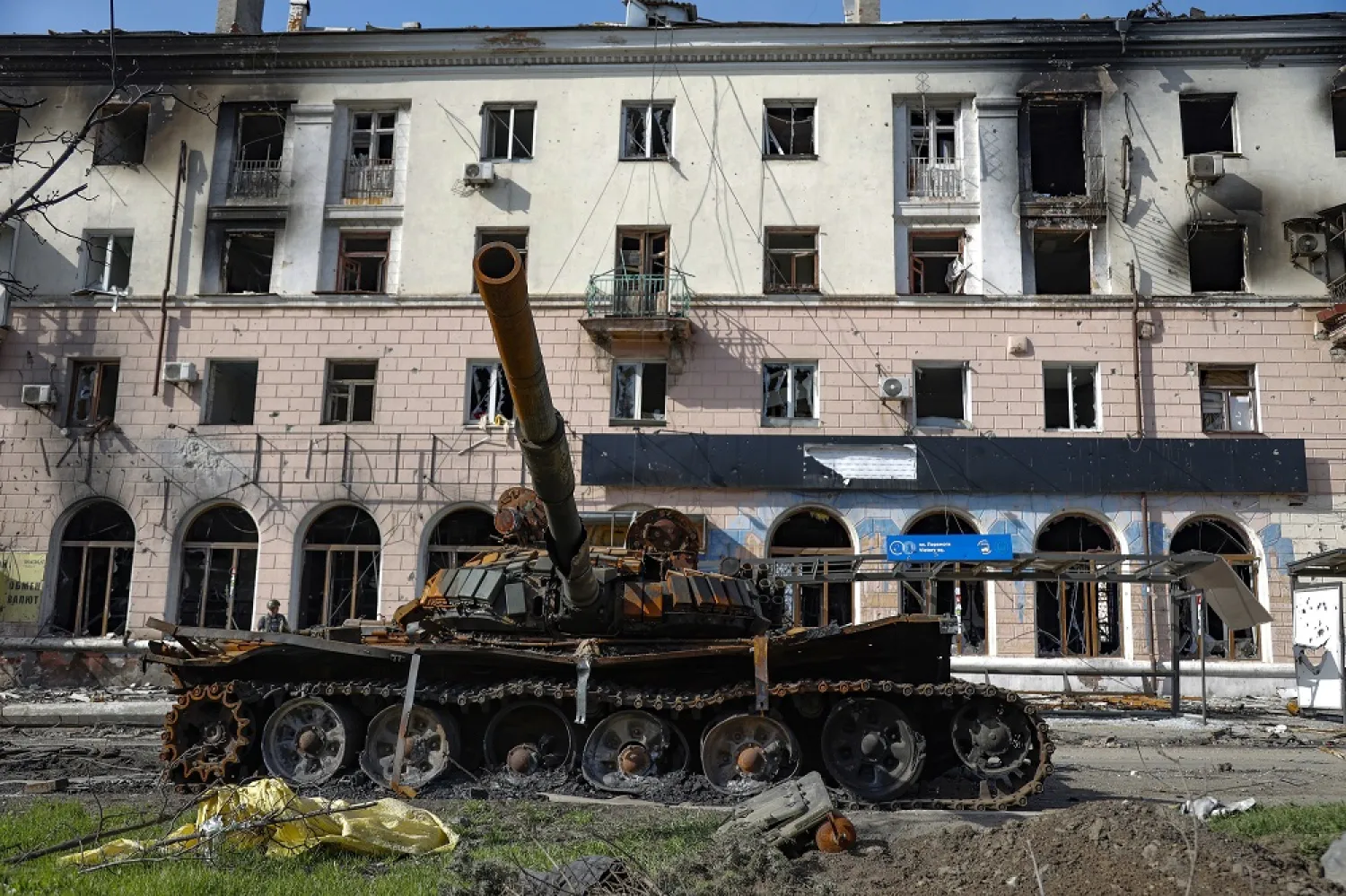
A destroyed tank and a damaged apartment building from heavy fighting are seen in an area controlled by Russian-backed separatist forces in Mariupol, Ukraine, Tuesday, April 26, 2022. (AP)
TT

EU Defies Gas ‘Blackmail’ as Russia Pushes Deeper into Ukraine

A destroyed tank and a damaged apartment building from heavy fighting are seen in an area controlled by Russian-backed separatist forces in Mariupol, Ukraine, Tuesday, April 26, 2022. (AP)

The European Union warned Russia on Wednesday it would not bend to "blackmail" over its support for Kyiv, after the Kremlin cut off gas supplies to Bulgaria and Poland.

Russia's President Vladimir Putin, meanwhile, warned that if Western forces intervene in Ukraine, they will face a "lightning-fast" military response.

"We have all the tools for this, that no one else can boast of having," he told lawmakers, implicitly referring to Moscow's ballistic missiles and nuclear arsenal.

"We won't boast about it: we'll use them, if needed. And I want everyone to know that," he said. "We have already taken all the decisions on this."

The dire threats came as Moscow claimed to have carried out a missile strike in southern Ukraine to destroy a "large batch" of Western-supplied weapons.

As the war, which has already claimed thousands of lives, entered its third month, Kyiv conceded that Russian forces had made gains in the east.

Russia's military offensive saw it capture a string of villages in the Donbas region, now the immediate target of its invasion force.

And in its economic standoff with the West, Moscow cut off gas supplies to Bulgaria and Poland, two EU and NATO members backing Ukraine in the conflict.

In Brussels, Ursula von der Leyen, the president of the European Commission, insisted that EU member states were ready for the move.

'Blackmail'
She described the announcement by Russia's state energy giant Gazprom as "another provocation from the Kremlin" that would be countered.

"It comes as no surprise that the Kremlin uses fossil fuels to try to blackmail us... Our response will be immediate, united and coordinated.

"Both Poland and Bulgaria are now receiving gas from their EU neighbors," she said. "The era of Russian fossil fuels in Europe will come to an end."

European powers have imposed massive sanctions on Russia since Putin's decision to invade his neighbor, while shipping weapons to Ukraine's defenders.

But they have moved slowly on hitting Moscow's vast gas exports, with many EU members -- notably industrial giant Germany -- reliant on Russian energy to keep their lights on.

Putin has attempted to turn up the pressure by insisting that Russia will only accept payments for gas in rubles -- hoping to force his foes to prop up his currency.

Gazprom announced the halt of gas to both Poland and highly dependent Bulgaria, saying it had not received payment in rubles from the two EU members.

But von der Leyen said that "about 97 percent" of all EU contracts explicitly stipulate payments in euros or dollars -- and warned importing firms off paying in rubles.

"This would be a breach of the sanctions," she told reporters.

'Heaven and earth'
Moscow defended its demand that western customers buy rubles, saying that sanctions against its central bank had forced it to rebuild its foreign reserves.

"They blocked from us -- or, to put it plainly, stole -- a fairly significant amount of our reserves," Kremlin spokesman Dmitry Peskov said. "So there is no question of blackmail here."

The first phase of Russia's invasion failed to reach Kyiv and to overthrow President Volodymyr Zelensky's government after encountering stiff Ukrainian resistance reinforced with Western weapons.

The campaign has refocused on seizing the east and south of the country, while increased use of long-range missile strikes against west and central Ukraine to counter the Western response.

On Wednesday, Russia's defense ministry said its forces had destroyed a "large batch" of weapons and ammunition supplied by the United States and European countries.

Russia hit hangars at an aluminum plant near the Ukrainian city of Zaporizhzhia with "high-precision long-range sea-based Kalibr missiles", the ministry said.

On Tuesday, at a summit in Germany of 40 Western allies to discuss arming Ukraine, Washington pledged to move "heaven and earth" to enable Kyiv to emerge victorious from the war.

Tensions are also rising in a breakaway region of Moldova bordering southwestern Ukraine.

In the region, Transnistria, pro-Russian separatists claimed shots were fired across the border towards a village housing a Russian arms depot, after drones flew over from Ukraine.

'Ramp up'
The unrecognized region has reported a series of explosions in recent days that it called "terrorist attacks", leading Kyiv to accuse Moscow of seeking to expand the war further into Europe.

The targeting of Western-supplied arms came as the United States and Europe have started to heed Zelensky's call for heavier firepower.

Western allies remain wary of being drawn into war with Russia but have stepped up military support as Ukraine has maintained its fierce resistance.

Germany announced Tuesday it would send anti-aircraft tanks, in a sharp U-turn on its much-criticized cautious stance.

Britain will on Wednesday urge Kyiv's allies to "ramp up" military production including tanks and planes to help Ukraine, with Foreign Secretary Liz Truss set to call for a "new approach" to confront Putin.

Fighting continues to rage across Ukraine's east, Kyiv's defense ministry said, as it confirmed Russian forces had seized several villages in their renewed bid to "liberate" the Donbas region.

The ministry said a pair of villages in the north-eastern Kharkiv region and two in the Donetsk region had fallen.

Meanwhile, three people died and 15 others were injured in bombings around the eastern city of Kharkiv, Ukraine's second city, regional governor Oleg Synegubov said.

Moscow aims to create a land bridge between territory held by pro-Russian separatists in parts of the Donbas and the Russian-annexed Black Sea peninsula of Crimea.

Separately, Moscow also said it was expelling eight Japanese diplomats in a tit-for-tat response to expulsions by Tokyo over the conflict in Ukraine.


Seven Killed in Gold Mine Accident in Eastern China, State Media CCTV Reports

Gold mine in China (archive-Reuters)
TT

Seven Killed in Gold Mine Accident in Eastern China, State Media CCTV Reports

Gold mine in China (archive-Reuters)

Seven people were killed in a gold mine accident in China's eastern Shandong province, and authorities were investigating, state-run CCTV reported, sending shares of the mine owner, Zhaojin Mining Industry, down 6% on Tuesday, Reuters said.

The accident occurred on Saturday when a cage fell ‌down a mine ‌shaft, CCTV reported ‌late ⁠on Monday ‌night.

The emergency management and public security departments were investigating the cause of the accident, and whether there had been an attempt to cover it up, the ⁠report added.

The mine is owned by ‌leading gold producer Zhaojin ‍Mining Industry, according ‍to the Qichacha company registry. Shares ‍of the company were down 6.01%, as of 0525 GMT. A person who answered Zhaojin's main phone line told Reuters that the matter was under investigation and ⁠declined to answer further questions.

China's emergency management ministry on Monday held a meeting on preventing accidents during the upcoming Lunar New Year holiday. It announced inspections of mines, chemical companies, and other hazardous operations. Also on Saturday, an explosion at a biotech company ‌in northern China killed eight people.


Still a Long Way to Go in Talks on Ukraine, Russia's Lavrov Says

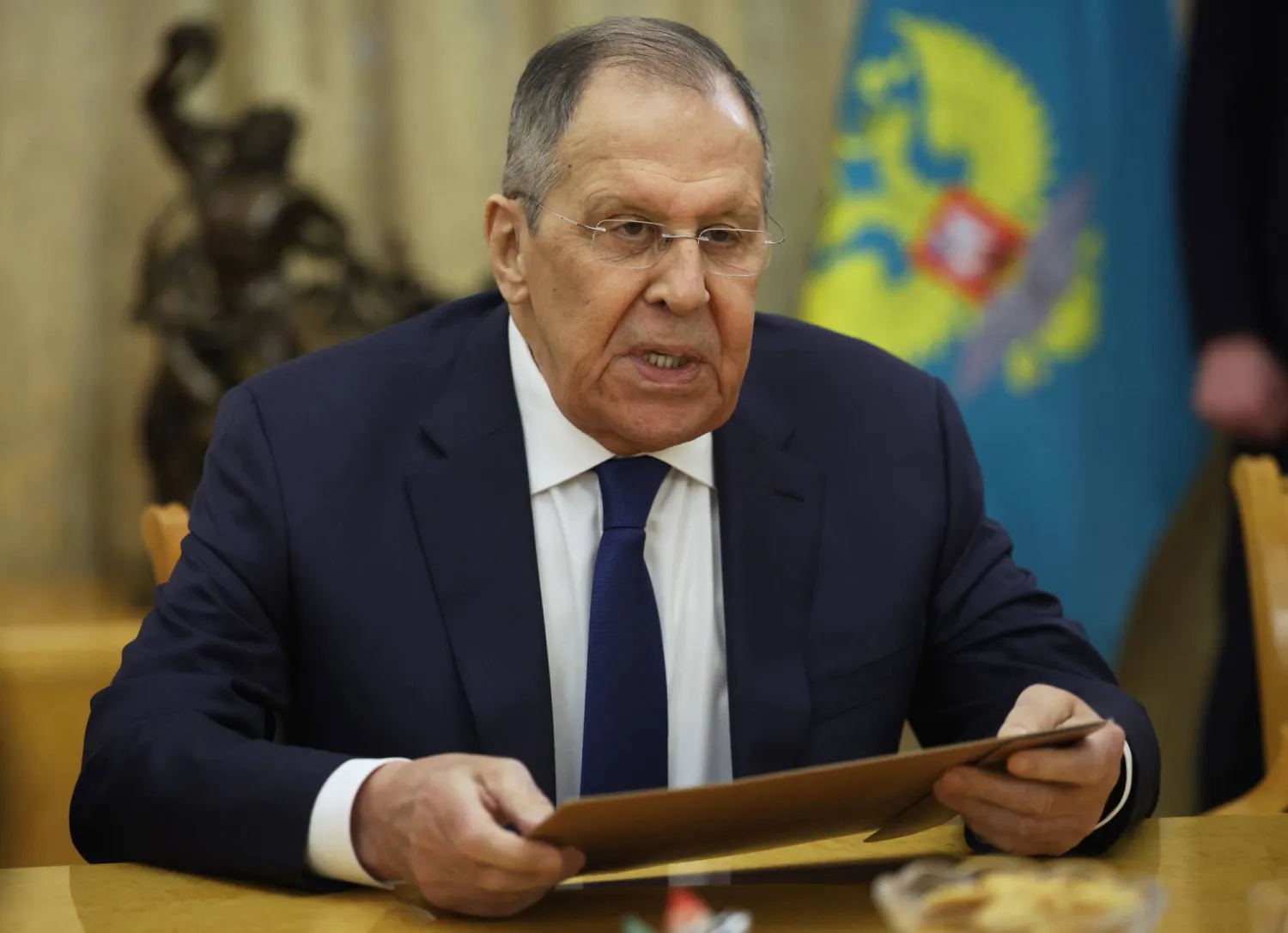
Russian Foreign Minister Sergei Lavrov attends a meeting with Tanzanian Minister of Foreign Affairs and East African Cooperation Mahmoud Thabit Kombo (not pictured), in Moscow, Russia, 09 February 2026.  EPA/RAMIL SITDIKOV / POOL
Russian Foreign Minister Sergei Lavrov attends a meeting with Tanzanian Minister of Foreign Affairs and East African Cooperation Mahmoud Thabit Kombo (not pictured), in Moscow, Russia, 09 February 2026. EPA/RAMIL SITDIKOV / POOL
TT

Still a Long Way to Go in Talks on Ukraine, Russia's Lavrov Says

Russian Foreign Minister Sergei Lavrov attends a meeting with Tanzanian Minister of Foreign Affairs and East African Cooperation Mahmoud Thabit Kombo (not pictured), in Moscow, Russia, 09 February 2026.  EPA/RAMIL SITDIKOV / POOL
Russian Foreign Minister Sergei Lavrov attends a meeting with Tanzanian Minister of Foreign Affairs and East African Cooperation Mahmoud Thabit Kombo (not pictured), in Moscow, Russia, 09 February 2026. EPA/RAMIL SITDIKOV / POOL

Russian Foreign Minister Sergei Lavrov said that there was no reason to be enthusiastic about US President Donald Trump's pressure on Europe and Ukraine as there was still a long way to go in talks on peace in Ukraine, RIA reported on Tuesday.

Here are ‌some details:

The ‌United States has ‌brokered ⁠talks between Russia and Ukraine ‌on various different drafts of a plan for ending the war in Ukraine, but no deal has yet been reached despite Trump's repeated promises to clinch one.

* "There is still a long way to go," Lavrov ⁠was quoted as saying by Russian news agencies.

* Lavrov said that ‌Trump had put Ukraine ‍and Europe in their places ‍but that such a move was ‍no reason to embrace an "enthusiastic perception" of the situation.

* Russian Deputy Foreign Minister Alexander Grushko said that any deal would have to exclude NATO membership for Ukraine and rule out the deployment of foreign troops in Ukraine, Izvestia ⁠reported.

* At stake is how to end the deadliest war in Europe since World War Two, the future of Ukraine, the extent to which European powers are sidelined and whether or not a peace deal brokered by the United States will endure.

* Russia invaded Ukraine in February 2022 after eight years of fighting in eastern Ukraine, triggering the biggest confrontation between ‌Moscow and the West since the depths of the Cold War.


Iran Warns of 'Destructive' Influence on Diplomacy ahead of Netanyahu's US Trip

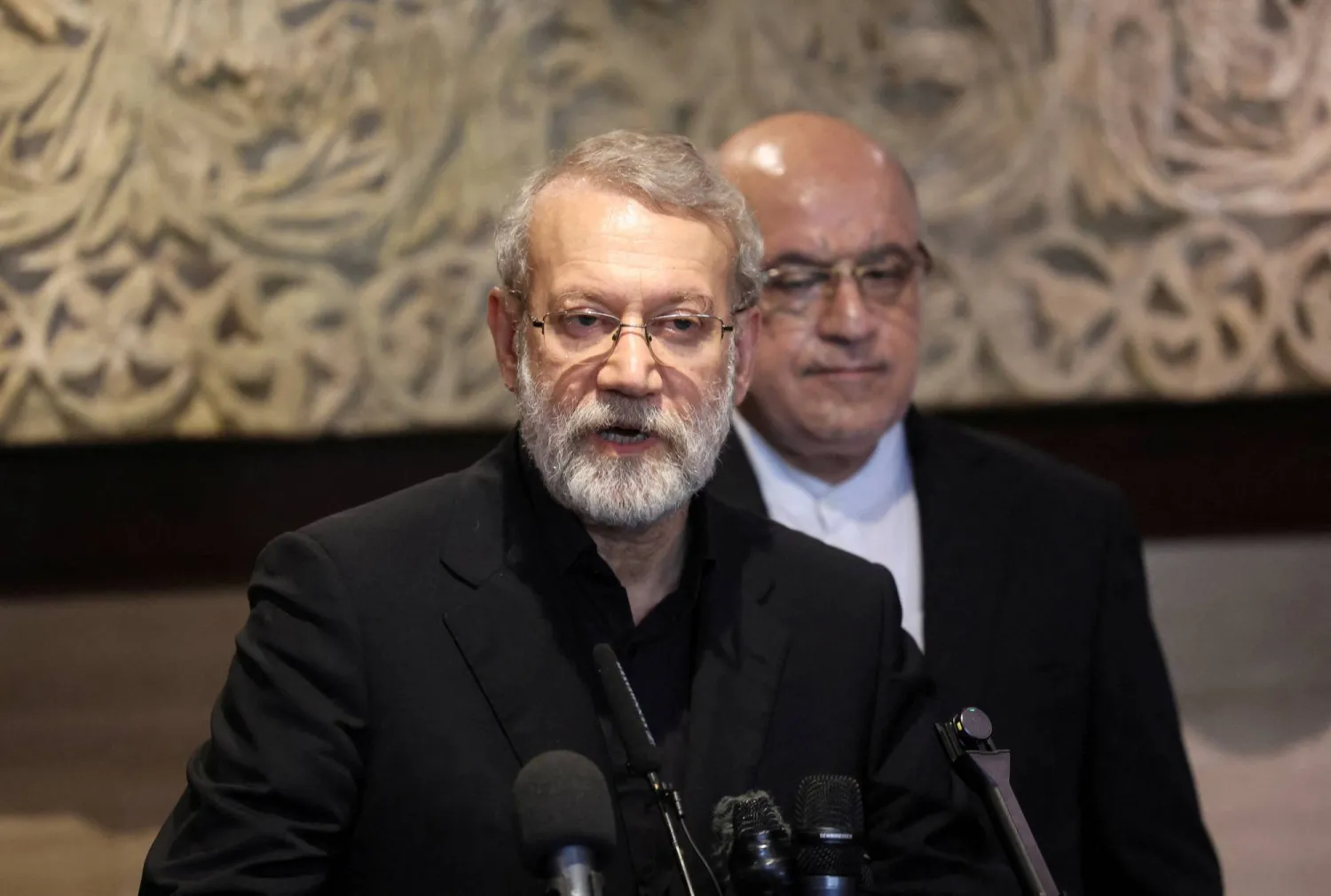
FILE PHOTO: Iran's Supreme National Security Council Secretary Ali Larijani speaks after meeting with Lebanese Parliament Speaker Nabih Berri, in Beirut, Lebanon August 13, 2025. REUTERS/Aziz Taher/File Photo
TT

Iran Warns of 'Destructive' Influence on Diplomacy ahead of Netanyahu's US Trip

FILE PHOTO: Iran's Supreme National Security Council Secretary Ali Larijani speaks after meeting with Lebanese Parliament Speaker Nabih Berri, in Beirut, Lebanon August 13, 2025. REUTERS/Aziz Taher/File Photo

The secretary of Iran's top security body arrived in Oman on Tuesday, amid Iranian warning of  "destructive" influence on diplomacy ahead of Israeli Prime Minister Benjamin Netanyahu's visit to Washington for talks expected to focus on US negotiations with Tehran. 

"Our negotiating party is America. It is up to America to decide to act independently of the pressures and destructive influences that are detrimental to the region," said Iranian foreign ministry spokesman Esmail Baqaei in a weekly press briefing. 

"The Zionist regime has repeatedly, as a saboteur, shown that it opposes any diplomatic process in our region that leads to peace." 

Ali Larijani, who heads the Supreme National Security Council, is expected to hold talks with Haitham bin Tariq, the Sultan of Oman, and Foreign Minister Badr bin Hamad al-Busaidi, Iran's state news agency IRNA reported.  

They will discuss the latest regional and international developments as well as economic cooperation between Iran and Oman, the news agency said. 

Tehran and Washington resumed talks in Muscat on Friday, months after earlier negotiations collapsed following Israel's unprecedented bombing campaign against Iran last June, which triggered a 12-day war. 

During the conflict, Israel targeted senior Iranian military officials, nuclear scientists and nuclear sites, as well as residential areas. 

The United States later joined the campaign, launching its own strikes on key Iranian nuclear facilities. 

Iran responded with drone and missile attacks on Israel and by targeting the largest US military base in the Middle East, located in Qatar. 

"The June experience was a very bad experience. Therefore, taking these experiences into account, we are determined to secure Iran's national interests through diplomacy," Baqaei said. 

He insisted that Iran's focus would remain strictly on the nuclear file in return for sanctions relief. 

Tehran has repeatedly said it rejects any negotiations that extend beyond that issue. 

On Saturday, Netanyahu's office said in a statement that the Israeli premier "believes any negotiations must include limitations on ballistic missiles and a halting of the support for the Iranian axis" -- referring to Iran's allied armed groups in the region. 

The talks followed threats from Washington and the deployment of a US aircraft carrier group to the region after Iran's deadly crackdown on anti-government protests last month. 

Iranian authorities said the protests, which erupted in late December over the rising cost of living, began as peaceful demonstrations before turning into "riots" involving killings and vandalism, which they said were inflamed by the United States and Israel.