

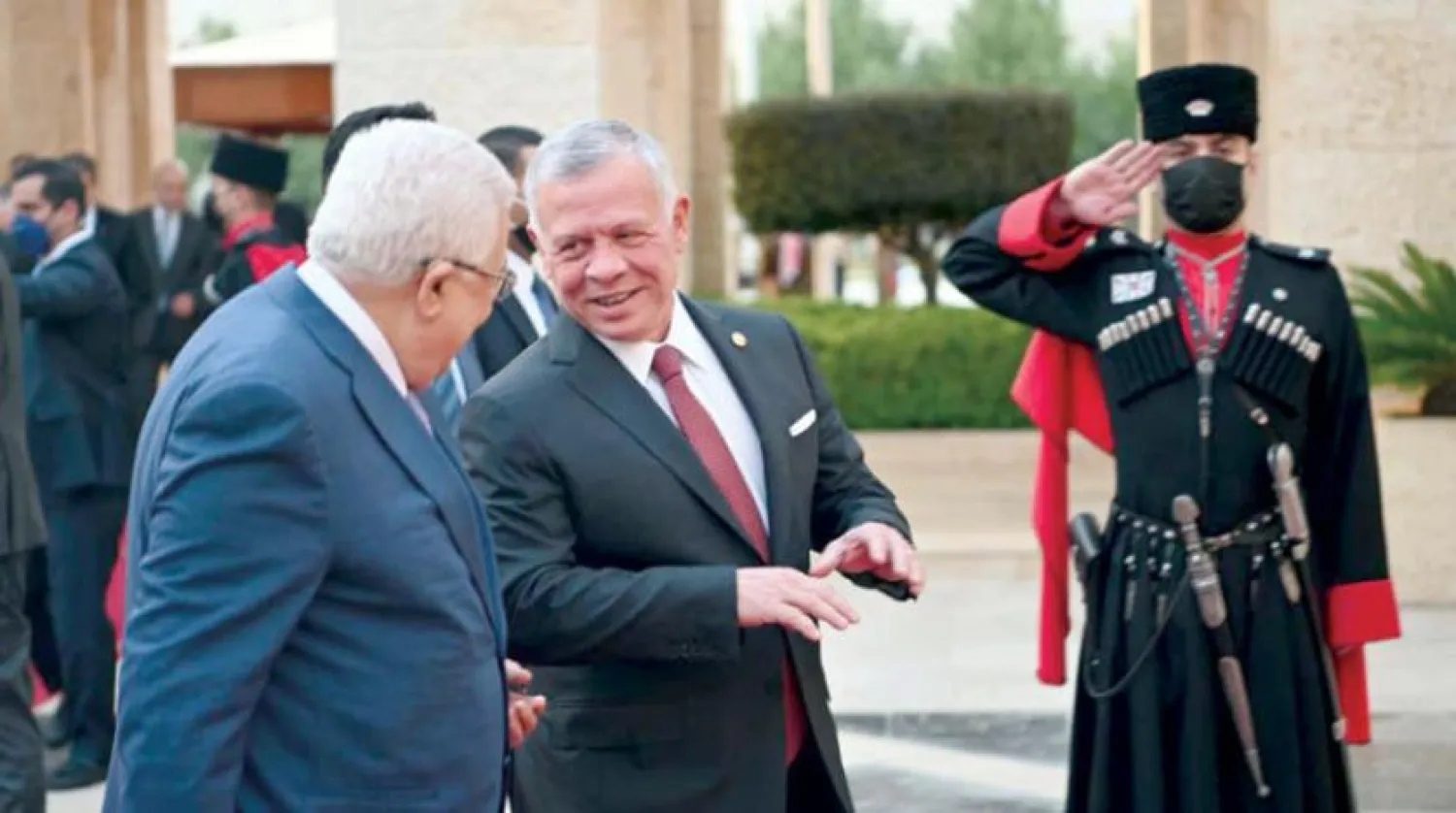

Palestinian President Pressures for a Political Process, Not Just Calm

Palestinian President Mahmoud Abbas and Jordan's King Abdullah II in Amman (Wafa)
TT

Palestinian President Pressures for a Political Process, Not Just Calm

Palestinian President Mahmoud Abbas and Jordan's King Abdullah II in Amman (Wafa)

Palestinian President Mahmoud Abbas is pressing to reduce tension in the Palestinian territories, including Jerusalem.

According to informed sources, Abbas wants to launch a political process to achieve lasting and comprehensive peace as the only solution that will guarantee calm.

The sources told Asharq Al-Awsat that Abbas agreed with Jordan's King Abdullah II to resume efforts to advance the political process in the region.

Abbas informed King Abdullah that establishing a Palestinian state is the only guarantor for achieving security and stability in the region, including for Israel.

Abbas met the Jordanian monarch in Amman, and the two leaders discussed the recent Israeli escalation in Jerusalem and the peace process.

The President also relayed the same message to the head of the Israeli Shin Bet, Ronen Bar, whom he met in Ramallah last week, and all the officials who contacted him during the current escalation period, including US Secretary of State Anthony Blinken.

The President said it was necessary to return to the political process that ends the occupation of Palestine, with East Jerusalem as its capital.

During the meeting, King Abdullah stressed the need to step up efforts toward reaching just and comprehensive peace based on the two-state solution, guaranteeing the establishment of an independent Palestinian state on the June 4, 1967 lines, with East Jerusalem as its capital, according to a Royal Court statement.

The monarch reaffirmed his rejection of any attempts to alter the historical and legal status quo in al-Haram al-Sharif, stressing that Jordan continues its efforts to safeguard Islamic and Christian holy sites in Jerusalem under the Hashemite Custodianship.

Jordan is the custodian of Muslim and Christian sites in the Old City, supervision recognized by Israel, which signed a peace treaty with Jordan in 1994.

Ahead of his meeting with Abbas, the Jordanian monarch attended the tripartite summit in Cairo with Egyptian President Abdel Fattah El-Sisi and Abu Dhabi Crown Prince Mohammed bin Zayed.

The sources said that Abbas took advantage of the escalation to tell the Israelis and the US administration that without a political solution, violence would prevail.

Contrary to expectations, Washington did not launch prospects for a political process and was satisfied with supporting economic initiatives to break the deadlock and build confidence.

Palestinians refused this situation to become an alternative to the political process and called for direct US support to launch a new political process in the region that would lead to direct negotiations between the Palestinians and the Israelis.

The Palestinian Authority (PA) offered to launch a political track under international supervision.

The Authority expects King Abdullah to help persuade the current US administration to intervene more strongly in the conflict.

Last week, Abbas met with Bar in Ramallah amid efforts to restore calm following heightened tensions between Palestinians and Israeli forces atop the Temple Mount in Jerusalem.

Israeli media said that the meeting discussed reducing tensions with the end of the month of Ramadan and enhancing coordination between Ramallah and Tel Aviv and achieving peace.

After the government led by Naftali Bennett was sworn in about a year ago, Abbas held a series of meetings with senior Israeli officials, including Bar, shortly after taking over as head of the security in November 2021.

Abbas also met Defense Minister Benny Gantz twice.


Iraqi Guards Threatened by ISIS Prisoners

US military vehicles move along a road in a convoy transporting ISIS detainees being transferred to Iraq from Syria, on the outskirts of Qahtaniyah in Syria's northeastern Hasakah province on February 7, 2026. (Photo by Delil SOULEIMAN / AFP)
TT

Iraqi Guards Threatened by ISIS Prisoners

US military vehicles move along a road in a convoy transporting ISIS detainees being transferred to Iraq from Syria, on the outskirts of Qahtaniyah in Syria's northeastern Hasakah province on February 7, 2026. (Photo by Delil SOULEIMAN / AFP)

Iraq is continuing to transfer prisoners believed to be mostly ISIS members to its own detention facilities under a previous arrangement with Washington and the US-led coalition fighting the group, Iraqi security sources said.

The move is aimed at preventing jailbreaks following unrest last month in parts of northeastern Syria, which host camps and prisons holding thousands of ISIS fighters and their families.

Iraqi security officials said some detainees threatened Iraqi soldiers and guards during the transfer process, telling them, “We will kill you when we escape from prison,” an indication that the group’s violent ideology persists even while its members are in custody.

Iraq formally agreed last month to receive thousands of ISIS detainees held in northeastern Syria under the control of the Syrian Democratic Forces, a step the government described as preemptive to protect national security and prevent escapes, particularly given the fragile security situation in the area.

At the end of January, Iraq’s National Security Ministerial Council approved the formation of a high-level security committee to fully oversee the transfer process and the handling of detainees, including security, judicial, and logistical aspects.

Prosecutions

The Security Media Cell said on Saturday that Iraq had received 2,250 militants from the Syrian side and had begun judicial classification procedures “in accordance with Iraqi laws in force related to counterterrorism.”

The head of the Security Media Cell, Lt. Gen. Saad Maan, told the state news agency that Iraq had received the 2,250 militants by land and air in coordination with the international coalition, following extensive efforts by the security forces, and that they were being held in tightly secured official facilities.

Maan said the government and security forces were fully prepared to deal with the numbers “to avert danger not only from Iraq, but globally,” adding that specialized teams had started initial investigations and classifying the detainees according to their level of risk, as well as recording their confessions under direct judicial supervision.

He said all those involved in crimes against Iraq and affiliated with ISIS would be tried before competent Iraqi courts, noting that the foreign ministry was in continuous contact with several countries regarding detainees of other nationalities.

He added that the process of handing over militants to their home countries would begin once legal requirements were completed. At the same time, security agencies continued their field and investigative duties in the case.

In the same context, the Supreme Judicial Council announced last week the opening of investigation procedures into 1,387 ISIS members who were recently received from Syrian territory.

Former judge Rahim al-Uqaili previously told Asharq Al-Awsat that detainees transferred from Syria could be tried before Iraqi criminal courts if they were charged with committing crimes outside Iraq that affected internal or external state security, among other offenses.

He expressed doubt, however, about the possibility of obtaining conclusive evidence in some cases.

Tight transfer measures

Security sources told Asharq Al-Awsat that most detainees transferred from Syria were being held in prisons and detention centers in Baghdad and Hilla, both of which host highly fortified facilities.

They said the Counter Terrorism Service was supervising the transport and distribution process, adding that detainees’ hands and feet were bound and their faces covered. Some hurled insults and direct death threats at guards if they managed to escape, while others remained silent.

The sources said security personnel had strict orders not to speak with or interact with detainees, and that most guards were unaware of the detainees' nationalities, as part of measures aimed at reducing risks and preventing communication or security breaches.


Head of Arab World Institute in Paris Resigns over Epstein-linked tax Fraud Probe

(FILES) France's former culture minister and president of Paris's famed Arab World Institute (AWI), Jack Lang, poses on January 28, 2013 in Paris. (Photo by Martin BUREAU / AFP)
TT

Head of Arab World Institute in Paris Resigns over Epstein-linked tax Fraud Probe

(FILES) France's former culture minister and president of Paris's famed Arab World Institute (AWI), Jack Lang, poses on January 28, 2013 in Paris. (Photo by Martin BUREAU / AFP)

France’s former Culture Minister Jack Lang has resigned as head of a Paris cultural center over alleged past financial links to convicted sex offender Jeffrey Epstein that prompted a tax investigation.

Lang was summoned to appear at the French Foreign Ministry, which oversees the Arab World Institute, on Sunday, but he submitted his resignation.

He is the highest-profile figure in France impacted by the release of Epstein files on Jan. 30 by the US Department of Justice, known for his role as a culture minister under Socialist President François Mitterrand in the 1980s and 1990s.

The Foreign Ministry confirmed his resignation Saturday evening.

The financial prosecutors' office said it had opened an investigation into Lang and his daughter, Caroline, over alleged “aggravated tax fraud laundering.”

French investigative news website Mediapart reported last week on alleged financial and business ties between the Lang family and Jeffrey Epstein through an offshore company based in the US Virgin Islands in the Caribbean Sea.

Jack Lang's name was mentioned more than 600 times in the Epstein files, showing intermittent correspondence between 2012 and 2019. His daughter was also in the released files.

Foreign Minister Jean-Noël Barrot has “taken note” of Lang's resignation and began the process to look for his successor, the foreign ministry said.
Lang headed the Arab World Institute since 2013.


Lebanon PM Pledges Reconstruction on Visit to Ruined Border Towns

This handout picture released by the Lebanese Government Press Office shows Lebanon's Prime Minister Nawaf Salam being showered with confetti as he is received by locals during a tour in the heavily-damaged southern village of Dhayra near the border with Israel on February 7, 2026. (Lebanese Government Press Office / AFP)
TT

Lebanon PM Pledges Reconstruction on Visit to Ruined Border Towns

This handout picture released by the Lebanese Government Press Office shows Lebanon's Prime Minister Nawaf Salam being showered with confetti as he is received by locals during a tour in the heavily-damaged southern village of Dhayra near the border with Israel on February 7, 2026. (Lebanese Government Press Office / AFP)

Lebanese Prime Minister Nawaf Salam visited heavily damaged towns near the Israeli border on Saturday, pledging reconstruction.

It was his first trip to the southern border area since the army said it finished disarming Hezbollah there, in January.

Swathes of south Lebanon's border areas remain in ruins and largely deserted more than a year after a US-brokered November 2024 ceasefire sought to end hostilities between Israel and the Iran-backed group.

Lebanon's government has committed to disarming Hezbollah, and the army last month said it had completed the first phase of its plan to do so, covering the area between the Litani River and the Israeli border about 30 kilometers (20 miles) further south.

Visiting Tayr Harfa, around three kilometers from the border, and nearby Yarine, Salam said frontier towns and villages had suffered "a true catastrophe".

He vowed authorities would begin key projects including restoring roads, communications networks and water in the two towns.

Locals gathered on the rubble of buildings to greet Salam and the delegation of accompanying officials in nearby Dhayra, some waving Lebanese flags.

In a meeting in Bint Jbeil, further east, with officials including lawmakers from Hezbollah and its ally the Amal movement, Salam said authorities would "rehabilitate 32 kilometers of roads, reconnect the severed communications network, repair water infrastructure" and power lines in the district.

Last year, the World Bank announced it had approved $250 million to support Lebanon's post-war reconstruction, after estimating that it would cost around $11 billion in total.

Salam said funds including from the World Bank would be used for the reconstruction and rehabilitation projects.

The second phase of the government's disarmament plan for Hezbollah concerns the area between the Litani and the Awali rivers, around 40 kilometers south of Beirut.

Israel, which accuses Hezbollah of rearming, has criticized the army's progress as insufficient, while Hezbollah has rejected calls to surrender its weapons.

Despite the truce, Israel has kept up regular strikes on what it usually says are Hezbollah targets and maintains troops in five south Lebanon areas.

Lebanese officials have accused Israel of seeking to prevent reconstruction in the heavily damaged south with repeated strikes on bulldozers, excavators and prefabricated houses.

Visiting French Foreign Minister Jean-Noel Barrot on Friday said the reform of Lebanon's banking system needed to precede international funding for reconstruction efforts.

The French diplomat met Lebanon's army chief Rodolphe Haykal on Saturday, the military said.
