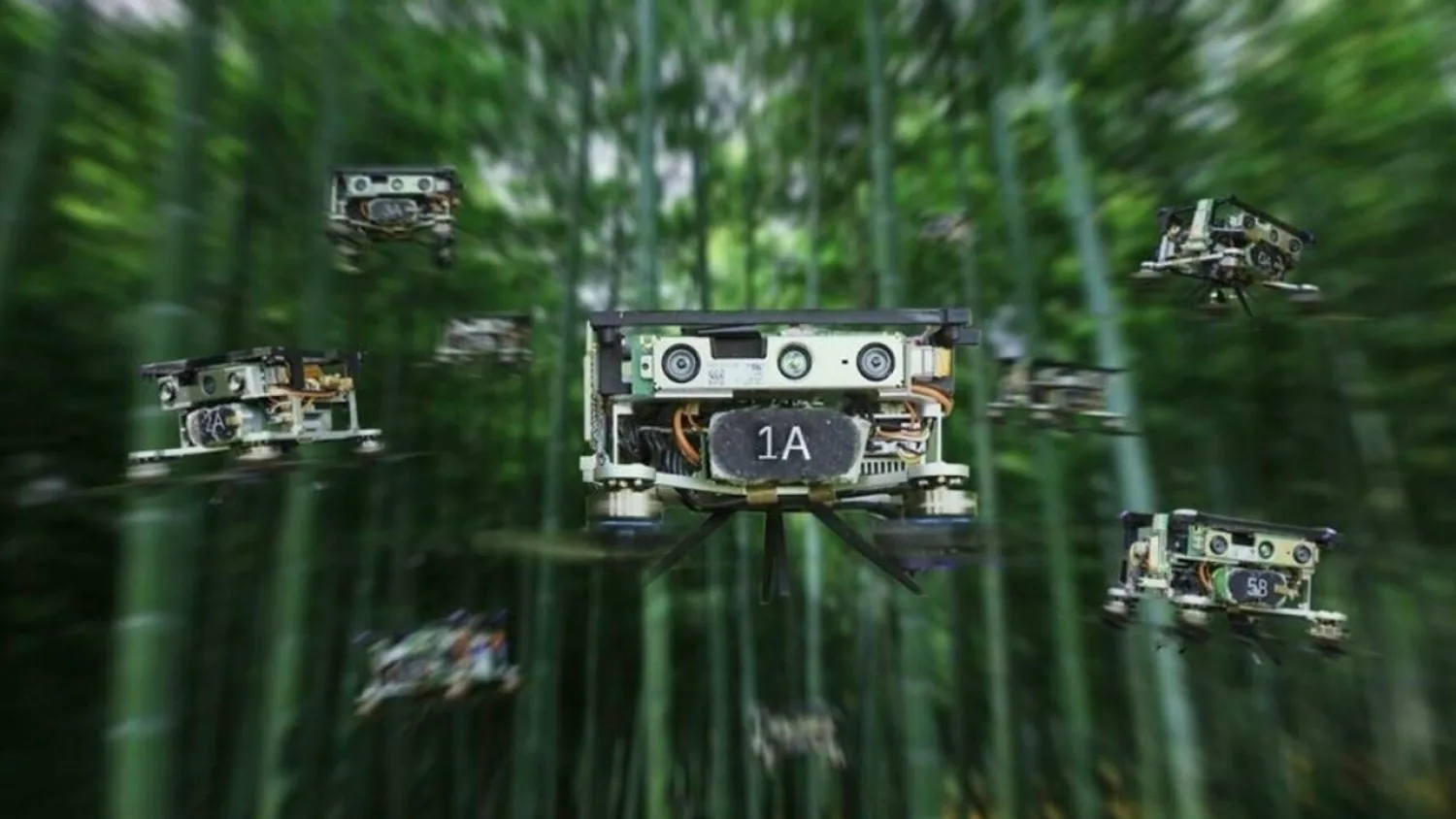
Drone Swarms Can Now Fly Autonomously through Thick Forest

This Handout photo provided by Yuman Gao and Rui Jin on May 4, 2022 shows a new flight path planning system that enables drone swarms to fly through crowded forests without collisions Handout Yuman Gao and Rui Jin/AFP
TT

Drone Swarms Can Now Fly Autonomously through Thick Forest

This Handout photo provided by Yuman Gao and Rui Jin on May 4, 2022 shows a new flight path planning system that enables drone swarms to fly through crowded forests without collisions Handout Yuman Gao and Rui Jin/AFP

A swarm of 10 bright blue drones lifts off in a bamboo forest in China, then swerves its way between cluttered branches, bushes and over uneven ground as it autonomously navigates the best flight path through the woods.

The experiment, led by scientists at Zhejiang University, evokes scenes from science fiction -- and the authors in fact cite films such as "Star Wars," "Prometheus" and "Blade Runner 2049" in the opening of their paper published Wednesday in the journal Science Robotics, AFP said.

"Here, we take a step forward (to) such a future," wrote the team, led by Xin Zhou.

In theory, there are myriad real world applications, including aerial mapping for conservation and disaster relief work. But the technology has needed to mature so that flying robots can adapt to new environments without crashing into one another or objects, thus endangering public safety.

Drone swarms have been tested in the past, but either in open environments without obstacles, or with the location of those obstacles programmed in, Enrica Soria, a roboticist at the Swiss Federal Institute of Technology Lausanne, who was not involved in the research, told AFP.

"This is the first time there's a swarm of drones successfully flying outside in an unstructured environment, in the wild," she said, adding the experiment was "impressive."

The palm-sized robots were purpose-built, with depth cameras, altitude sensors and an on-board computer. The biggest advance was a clever algorithm that incorporates collision avoidance, flight efficiency and coordination within the swarm.

Since these drones do not rely on any outside infrastructure, such as GPS, swarms could be used during natural disasters.

For example, they could be sent into earthquake-hit areas to survey damage and identify where to send help, or into buildings where it's unsafe to send people.

It's certainly possible to use single drones in such scenarios, but a swarm approach would be far more efficient, especially given limited flight times.

Another possible use is having the swarm collectively lift and deliver heavy objects.

There's also a darker side: swarms could be weaponized by militaries, just as remote-piloted single drones are today. The Pentagon has repeatedly expressed interest and is carrying out its own tests.

"Military research is not shared with the rest of the world just openly, and so it's difficult to imagine at what stage they are with their development," said Soria.

But advances shared in scientific journals could certainly be put to military use.

Coming soon?
The Chinese team tested their drones in different scenarios -- swarming through the bamboo forest, avoiding other drones in a high-traffic experiment, and having the robots follow a person's lead.

"Our work was inspired by birds that fly smoothly in a free swarm through even very dense woods," wrote Zhou in a blog post.

The challenge, he said, was balancing competing demands: the need for small, lightweight machines, but with high-computational power, and plotting safe trajectories without greatly prolonging flight time.

For Soria, it's only a matter of a few years before we see such drones deployed in real-life work. First, though, they will need to be tested in ultra-dynamic environments like cities, where they'll constantly come up against people and vehicles.

Regulations will also need to catch up, which takes additional time.


Chinese Robot Makers Ready for Lunar New Year Entertainment Spotlight

A folk performer breathes fire during a performance ahead of Lunar New Year celebrations in a village in Huai'an, in China's eastern Jiangsu Province on February 7, 2026. (AFP)
TT

Chinese Robot Makers Ready for Lunar New Year Entertainment Spotlight

A folk performer breathes fire during a performance ahead of Lunar New Year celebrations in a village in Huai'an, in China's eastern Jiangsu Province on February 7, 2026. (AFP)

In China, humanoid robots are serving as Lunar New Year entertainment, with their manufacturers pitching their song-and-dance skills to the general public as well as potential customers, investors and government officials.

On Sunday, Shanghai-based robotics start-up Agibot live-streamed an almost hour-long variety show featuring its robots dancing, performing acrobatics and magic, lip-syncing ballads and performing in comedy sketches. Other Agibot humanoid robots waved from an audience section.

An estimated 1.4 million people watched on the Chinese streaming platform Douyin. Agibot, which called the promotional stunt "the world's first robot-powered gala," did not have an immediate estimate for total viewership.

The ‌show ran a ‌week ahead of China's annual Spring Festival gala ‌to ⁠be aired ‌by state television, an event that has become an important - if unlikely - venue for Chinese robot makers to show off their success.

A squad of 16 full-size humanoids from Unitree joined human dancers in performing at China Central Television's 2025 gala, drawing stunned accolades from millions of viewers.

Less than three weeks later, Unitree's founder was invited to a high-profile symposium chaired by Chinese President Xi Jinping. The Hangzhou-based robotics ⁠firm has since been preparing for a potential initial public offering.

This year's CCTV gala will include ‌participation by four humanoid robot startups, Unitree, Galbot, Noetix ‍and MagicLab, the companies and broadcaster ‍have said.

Agibot's gala employed over 200 robots. It was streamed on social ‍media platforms RedNote, Sina Weibo, TikTok and its Chinese version Douyin. Chinese-language television networks HTTV and iCiTi TV also broadcast the performance.

"When robots begin to understand Lunar New Year and begin to have a sense of humor, the human-computer interaction may come faster than we think," Ma Hongyun, a photographer and writer with 4.8 million followers on Weibo, said in a post.

Agibot, which says ⁠its humanoid robots are designed for a range of applications, including in education, entertainment and factories, plans to launch an initial public offering in Hong Kong, Reuters has reported.

State-run Securities Times said Agibot had opted out of the CCTV gala in order to focus spending on research and development. The company did not respond to a request for comment.

The company demonstrated two of its robots to Xi during a visit in April last year.

US billionaire Elon Musk, who has pivoted automaker Tesla toward a focus on artificial intelligence and the Optimus humanoid robot, has said the only competitive threat he faces in robotics is from Chinese firms.


AI to Track Icebergs Adrift at Sea in Boon for Science

© Jonathan NACKSTRAND / AFP
TT

AI to Track Icebergs Adrift at Sea in Boon for Science

© Jonathan NACKSTRAND / AFP

British scientists said Thursday that a world-first AI tool to catalogue and track icebergs as they break apart into smaller chunks could fill a "major blind spot" in predicting climate change.

Icebergs release enormous volumes of freshwater when they melt on the open water, affecting global climate patterns and altering ocean currents and ecosystems, reported AFP.

But scientists have long struggled to keep track of these floating behemoths once they break into thousands of smaller chunks, their fate and impact on the climate largely lost to the seas.

To fill in the gap, the British Antarctic Survey has developed an AI system that automatically identifies and names individual icebergs at birth and tracks their sometimes decades-long journey to a watery grave.

Using satellite images, the tool captures the distinct shape of icebergs as they break off -- or calve -- from glaciers and ice sheets on land.

As they disintegrate over time, the machine performs a giant puzzle problem, linking the smaller "child" fragments back to the "parent" and creating detailed family trees never before possible at this scale.

It represents a huge improvement on existing methods, where scientists pore over satellite images to visually identify and track only the largest icebergs one by one.

The AI system, which was tested using satellite observations over Greenland, provides "vital new information" for scientists and improves predictions about the future climate, said the British Antarctic Survey.

Knowing where these giant slabs of freshwater were melting into the ocean was especially crucial with ice loss expected to increase in a warming world, it added.

"What's exciting is that this finally gives us the observations we've been missing," Ben Evans, a machine learning expert at the British Antarctic Survey, said in a statement.

"We've gone from tracking a few famous icebergs to building full family trees. For the first time, we can see where each fragment came from, where it goes and why that matters for the climate."

This use of AI could also be adapted to aid safe passage for navigators through treacherous polar regions littered by icebergs.

Iceberg calving is a natural process. But scientists say the rate at which they were being lost from Antarctica is increasing, probably because of human-induced climate change.


AMD Predicts Weaker First-Quarter Sales, Shares Plunge on Nvidia Comparisons

An AMD logo and a computer motherboard appear in this illustration created on August 25, 2025. (Reuters)
TT

AMD Predicts Weaker First-Quarter Sales, Shares Plunge on Nvidia Comparisons

An AMD logo and a computer motherboard appear in this illustration created on August 25, 2025. (Reuters)

Advanced Micro Devices on Tuesday forecast a slight decline in quarterly revenue, raising concerns about whether it ​can effectively challenge Nvidia in the booming AI market and sending its shares tumbling 8% in after-hours trade.

The lackluster prediction comes despite an unexpected boost from sales of certain artificial intelligence chips to China, which began in the last quarter after the Trump administration approved a license for orders that AMD received in early 2025.

And without those sales to China which generated $390 million, AMD's data-center segment would have missed estimates for the fourth quarter.

AMD said it expects revenue of about $9.8 billion this quarter, plus or minus $300 million. That's down from $10.27 billion in the fourth-quarter which was up 34% year-on-year and ahead of LSEG ‌estimates for $9.67 billion.

PALES ‌NEXT TO NVIDIA

Though AMD is seen as one of the ‌few ⁠contenders ​that can seriously ‌challenge Nvidia, investors noted the stark contrast between the two companies' performances. AMD expects an adjusted gross margin of 55% this quarter. Nvidia has said it expects adjusted gross margin in the mid-70% range during its fiscal 2027.

"The expectations for large blowout quarters for AI-related hardware companies have skewed what the market is looking for," said Bob O'Donnell, president of TECHnalysis Research.

The forecast for the current first quarter includes $100 million from sales to China, where the situation remains "dynamic," AMD CEO Lisa Su said on a conference call with investors.

The US government ⁠has placed restrictions on the exports of advanced chips to China, but AMD received licenses to sell modified versions of its MI300 series ‌of AI chips there. Its MI308 chip competes with Nvidia's H20 ‍chip in China.

OPENAI SALES

AMD has accelerated its ‍product launches and is moving into selling full AI systems to better compete against Nvidia, which now ‍provides "rack-scale" systems that combine GPUs, CPUs and networking gear.

Last year, it entered into a multi-year deal to supply AI chips to ChatGPT-owner OpenAI, which would bring in tens of billions of dollars in annual revenue and give the startup the option to buy up to roughly 10% of the chipmaker.

Su reiterated on Tuesday that the company ​expects sales of a new flagship AI server to OpenAI and others to rise rapidly in the second half of this year, saying a global memory-chip crunch will not ⁠slow its plans.

"I do not believe that we will be supply-limited in terms of the ramp that we put in place," Su said.

BEYOND OPENAI

As Big Tech and governments across the globe double down on investing in AI hardware, shares in Santa Clara, California-based AMD have doubled since the start of 2025, outperforming a 60% bump in the broader chip index.

But analysts remain concerned that AMD's success remains tied to a handful of customers that rivals such as Nvidia could try to poach. Reuters reported this week that Nvidia made a $20 billion move to hire most of chip startup Groq's founders after OpenAI held chip supply discussions with the startup.

"Growth appears concentrated in large deployments and specific regions, and China shipments are significant enough to influence a quarter," said eMarketer analyst Gadjo Sevilla.

Revenue in AMD's key data-center segment grew 39% to $5.38 billion in the ‌fourth quarter. But excluding sales of the MI308, which is a data-center chip, that revenue would have been $4.99 billion, below estimates of $5.07 billion.