


Marrakesh Meeting Renews Commitment to Eliminate ISIS

Saudi Foreign Minister Faisal bin Farhan with Moroccan Foreign Minister Nasser Bourita (AFP)
TT

Marrakesh Meeting Renews Commitment to Eliminate ISIS

Saudi Foreign Minister Faisal bin Farhan with Moroccan Foreign Minister Nasser Bourita (AFP)

Morocco hosted the first meeting of the Global Coalition against ISIS in Africa, which was called upon by the Moroccan Foreign Minister Nasser Bourita and his US counterpart Anthony Blinken, who did not attend the meeting after he tested positive for the coronavirus.

The meeting included 84 regional and international entities and 42 foreign ministers and focused on the challenges posed by terrorism in all its forms and the repositioning of ISIS in Africa.

In his opening speech at the ministerial meeting, Bourita said: "Separatism and terrorism are often two sides of the same coin," adding that a "worrying trend has been on the rise without garnering the necessary attention: the terrorism-separatism nexus."

"The collusion against the sovereignty and stability of states, and the convergence of financial, tactical and operational means, create an objective alliance between terrorist and separatist groups."

Bourita warned that "those who finance, shelter, support, and weaponize separatism, are actually contributing to spread terrorism and further compromise regional peace and security."

Morocco has been calling for a multilateral response that enhances solidarity and integration, Bourita explained.

Bourita indicated that the opening of the Rabat-based Program Office for Counter-Terrorism and Training in Africa of the UN Office of Counter-Terrorism enhances the coalition's capabilities.

He explained that the UN office constitutes a new organization containing terrorism in Africa and proposes programs to boost several fields.

The FM said that Morocco had developed an effective, multi-dimensional, comprehensive strategy to combat terrorism and extremism.

The good policies developed by the Moroccan security services and the unique approach adopted by the Kingdom reflects a deep conviction in Africa's capabilities, as emphasized by King Mohammed VI.

US Under Secretary for Political Affairs Victoria Nuland affirmed that the members of the international coalition against ISIS are committed to ensuring the complete elimination of ISIS in Iraq, Syria, Africa, and the whole world.

Nuland explained that the coalition's work includes liberating ISIS-controlled territories in Iraq and Syria and identifying global areas that may shape a fertile ground for the spread of terrorist groups.

She indicated that the participants would focus on evaluating the coalition's work and its members during the past year in Iraq, Syria, the African continent, and Afghanistan.

The official warned that ISIS continues to pose a threat, waiting to rebuild itself.

She urged vigilance in the face of the threat ISIS constantly poses globally, especially in Africa.

Terrorist attacks increased by 43 percent during the period 2018-2021 in the Sahel region, said Nuland, adding that about 500 terrorist ISIS attacks were recorded in 2021, killing more than 2,900 people on the African continent.

She warned that ISIS and other terrorist groups enhanced their influence and capabilities in the Sahel region while al-Qaeda affiliated Nusrat al-Islam threatened the Sahel region.

"The United States is committed to working with our partners in West Africa to confront the challenges that have allowed these groups to flourish, among them lack state legitimacy, persistent rights violations, and food insecurity," she said.

"In response to this and other security threats, the United States will spend over $119 million in new assistance in sub-Saharan Africa to improve the capabilities of civilian law enforcement and the judiciary to disrupt, apprehend, prosecute and convict terrorists across the continent."

In a joint press conference with Nuland, Bourita confirmed that 27 terrorist entities are registered on the UN Security Council sanctions list.

"This is a clear indicator of their connections to major global terrorist groups."

The Ministers welcomed the first meeting and reaffirmed their shared determination to continue the fight against ISIS through military and civilian-led efforts contributing to the enduring defeat of the terrorist group.

The Ministers stressed the importance of addressing underlying causes of insecurity in Africa while reiterating that any lasting solution to halting the spread of ISIS on the continent will rely primarily on national authorities, as well as sub-regional and regional efforts and initiatives that acknowledge and address the political and economic drivers of conflict.

The Ministers also reiterated their global commitment to the survivors and families of victims of ISIS crimes, including by holding the ISIS leaders and perpetrators accountable.

Earlier, the US Secretary of State spoke with the Moroccan Foreign Minister over the phone, expressing his regret that he could not attend the meeting and conveyed that Nuland would represent the US.

Blinken thanked Bourita for Morocco's hosting of the meeting, its commitment to counterterrorism, and its role in promoting regional security and stability.



UNHCR Official Expects One Million Syrian Refugees to Return in 2026

People walk along a street in Damascus, Syria, December 18, 2025. REUTERS/Khalil Ashawi

People walk along a street in Damascus, Syria, December 18, 2025. REUTERS/Khalil Ashawi

TT

UNHCR Official Expects One Million Syrian Refugees to Return in 2026

People walk along a street in Damascus, Syria, December 18, 2025. REUTERS/Khalil Ashawi

People walk along a street in Damascus, Syria, December 18, 2025. REUTERS/Khalil Ashawi


The United Nations High Commissioner for Refugees (UNHCR) has projected that around one million Syrian refugees are expected to return to their country during 2026, amid what it described as a “gradual recovery” in Syria following the fall of Bashar al-Assad’s regime on December 8, 2024.

Speaking in an interview with Türkiye’s Anadolu Agency, UNHCR’s Representative in Syria, Gonzalo Vargas Llosa, said that approximately 1.3 million Syrian refugees and nearly two million internally displaced persons have returned to their areas of origin since December 2024.

“This means more than three million Syrians have returned to their homes within a relatively short period of time, in a country exhausted by years of war at the economic, infrastructural, and service levels,” he said.

Vargas Llosa recalled that on December 9, 2024, he and his team traveled to the Lebanese border, where they witnessed thousands of Syrians spontaneously returning home after more than 14 years of forced displacement.

Need for International Support
Concerning future prospects, Llosa said since Assad’s fall, most returnees came to Syria from Türkiye, Lebanon, and Jordan, with smaller numbers returning from Egypt and Iraq.

“UNHCR estimates suggest that more that more than four million Syrians may return within the next two years,” he added.

“This large-scale return is taking place under extremely difficult conditions,” Losa said, stressing that international financial support is an urgent and critical necessity to ensure stability and prevent a further deterioration of the humanitarian situation.

Active Turkish Role
The UN official praised Türkiye’s role, noting that Ankara’s long-term hosting of refugees and its support for the new Syrian government after December 8, 2024, have helped create a positive climate for recovery.

“Representatives from the Turkish private sector have started visiting Syria to explore investment opportunities,” describing the trend as a sign of a new phase of reconstruction.

End of Isolation
Assessing the current situation, Llosa said Syria is witnessing a complex transition that will require time, given the vast destruction left by 14 years of war.

He noted that Syria’s recovery after a long war will not be immediate.
However, he praised the Syrian government and people for successfully reconnecting the country with the world in a relatively short time.

“This is a positive sign,” he said, stressing that coordinated international support is needed to improve economic conditions.

Key for Recovery
The UNHCR representative noted that lifting sanctions and encouraging private investment will be key to accelerating the reconstruction process.

Llosa noted that the UN agency and its partners are providing direct support to returnees, particularly in re-issuing official documents.

He said one quarter of returnees lack basic documents, including IDs and property papers.

On Thursday, US President Donald Trump signed the National Defense Authorization Act for Fiscal Year 2026, which included the lifting of sanctions imposed on Syria under the Caesar Act.


32% of Yemenis in Houthi-controlled Areas Live in Moderate to Severe Hunger

The sun sets over a residential neighborhood of Sanaa, Yemen, 20 December 2025. EPA/YAHYA ARHAB
TT

32% of Yemenis in Houthi-controlled Areas Live in Moderate to Severe Hunger

The sun sets over a residential neighborhood of Sanaa, Yemen, 20 December 2025. EPA/YAHYA ARHAB

Recent UN data has revealed a rising hunger crisis in areas under the control of the Houthi militias, who have increased their repressive measures in targeting hundreds of local employees working for the United Nations and humanitarian organizations.

Local sources announced that the UN has suspended its activities in Houthi-controlled areas following the arrest of 69 of its staff members. This step reflects the scale of violations affecting humanitarian work and casts a heavy shadow over millions of aid beneficiaries in a country suffering from one of the world’s worst humanitarian crises.

The World Food Program’s Yemen Food Security Update said that 32 percent of households in Houthi-controlled areas reported moderate to severe hunger (Phase 3+) in November 2025 compared to 25 percent in areas controlled by the internationally recognized government.

The use of crisis or emergency livelihood coping strategies was more widespread in Houthi-controlled areas (66 percent) than in government areas (58 percent), it said.

A greater proportion of households in Houthi areas (49 percent) reported restricting adults’ food consumption in favor of children, compared to 44 percent in government areas.

These patterns highlight deeper vulnerability in areas run by the Houthis, amid “prolonged assistance suspension and limited livelihood options,” the Food Security Update added.

As the food crisis worsens, sources working in the relief sector told Asharq Al-Awsat that the Houthis have prevented hundreds of Yemeni employees working for the UN and international and local relief organizations - as well as those who had previously worked with foreign diplomatic missions - from leaving areas under their control.

According to the sources, these individuals are subjected to house-arrest conditions and have become vulnerable to arrest at any time.

The sources also reported that the group used employee data that had previously been submitted through organizations and passed it to its intelligence arm.

Lists including the names of all staff working for organizations, in addition to those who had worked with diplomatic missions, were circulated to security checkpoints spread from the outskirts of Sanaa to the front lines with government-controlled areas.

This week, the total number of UN staffers detained by the Houthis rose to 69.


Building Collapses Pose Another Threat to People in Gaza

Palestinians walk along a street surrounded by buildings destroyed during Israeli air and ground operations in Gaza City, Wednesday, Dec. 17, 2025. (AP)
TT

Building Collapses Pose Another Threat to People in Gaza

Palestinians walk along a street surrounded by buildings destroyed during Israeli air and ground operations in Gaza City, Wednesday, Dec. 17, 2025. (AP)

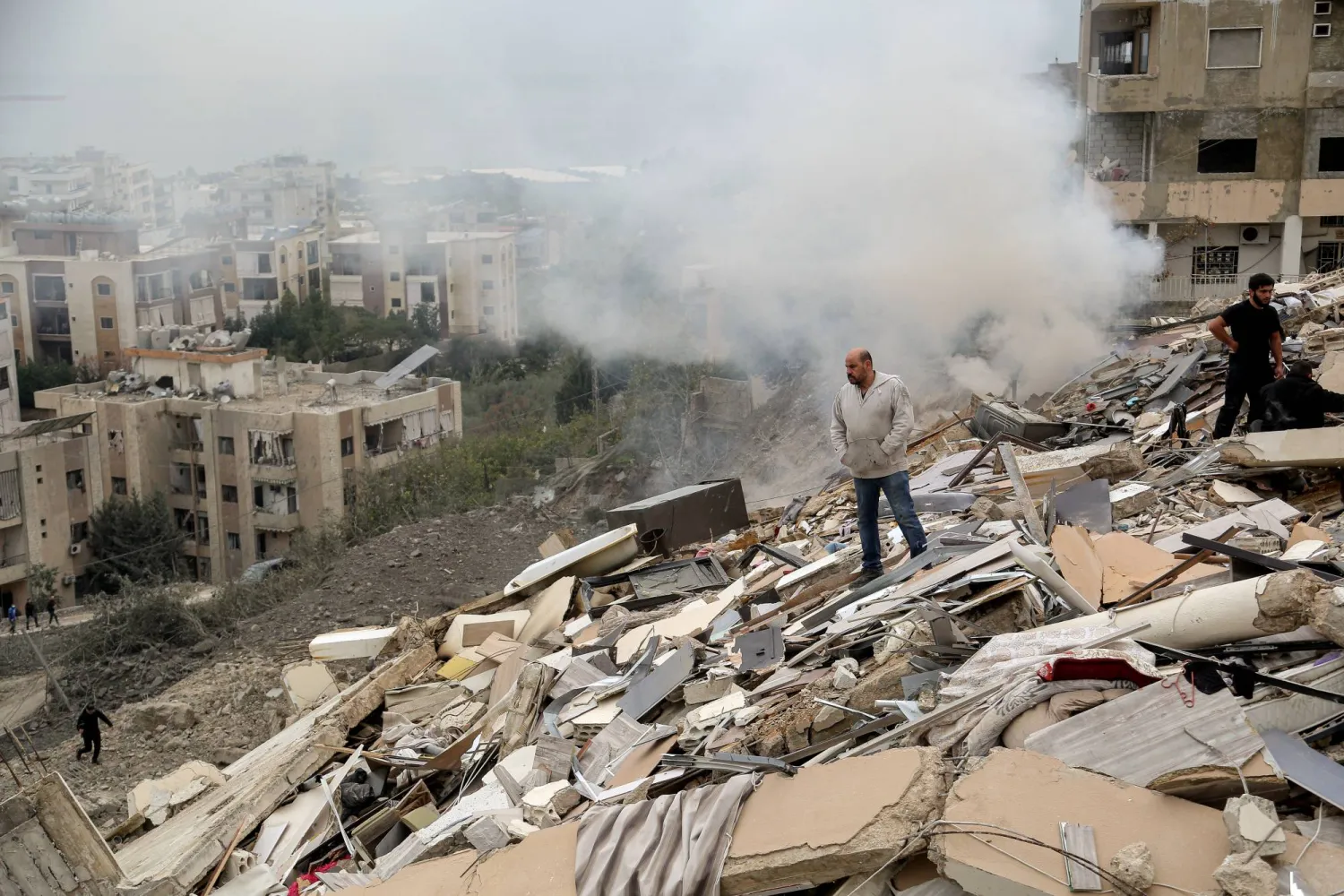
Residents of Gaza are taking the risk of living in damaged buildings despite their possibility of collapse, opting to live with a roof over their heads than stay in tents that do little to shelter them from the cold, rain and wind.

The enclave had been under a cold front that brought with it heavy rain and strong winds that led to the collapse of 20 damaged houses and buildings in less than ten days, claiming the lives of over 15 Palestinians.

Speaking to Asharq Al-Awsat, a Civil Defense spokesman warned against delaying in tackling the issue of damaged buildings.

A building collapsed in the Sheikh Radwan neighborhood in northern Gaza in the early morning on Sunday, killing a man, his wife, two children and granddaughter, who had lost her father and son during the war.

Civil Defense teams managed to rescue three members of the family from under the rubble of the multi-storey building that had been partially damaged during the conflict.

In just the past ten days, no less than six buildings collapsed in Sheikh Radwan.

Experts believed that the Israeli forces’ demolition operations have raised the risk of collapse of damaged buildings.

The forces are deploying booby-trapped vehicles and remotely detonating them. The strength of the detonations can be felt several kilometers away, even in Israel itself.

Israel is carrying out these operations along the so-called yellow line that is serving as a new military boundary in Gaza.

Civil Defense spokesman in Gaza Mahmoud Basal said over 90 residential buildings are at the risk of collapse because they are partially damaged. Thousands of people live in those houses and have no other shelter.

He told Asharq Al-Awsat that specialized teams have carried out field tours and inspections of the buildings, urging residents to evacuate them given the risk.

He added that the Civil Defense is facing a shortage in tools to rescue people from a building in case of a collapse, saying teams are relying on primitive means to rescue people from under the rubble.

Meanwhile, people sheltering in tents can do little to shield themselves from the cold, Basal added. The tents are prone to taking in rainwater and have already been damaged by the elements.

He underlined the need to come to the aid of the people of Gaza and to rebuild the enclave because delays are only putting lives in danger.