
Tony Moments: A Night for Broadway to Reclaim its Groove

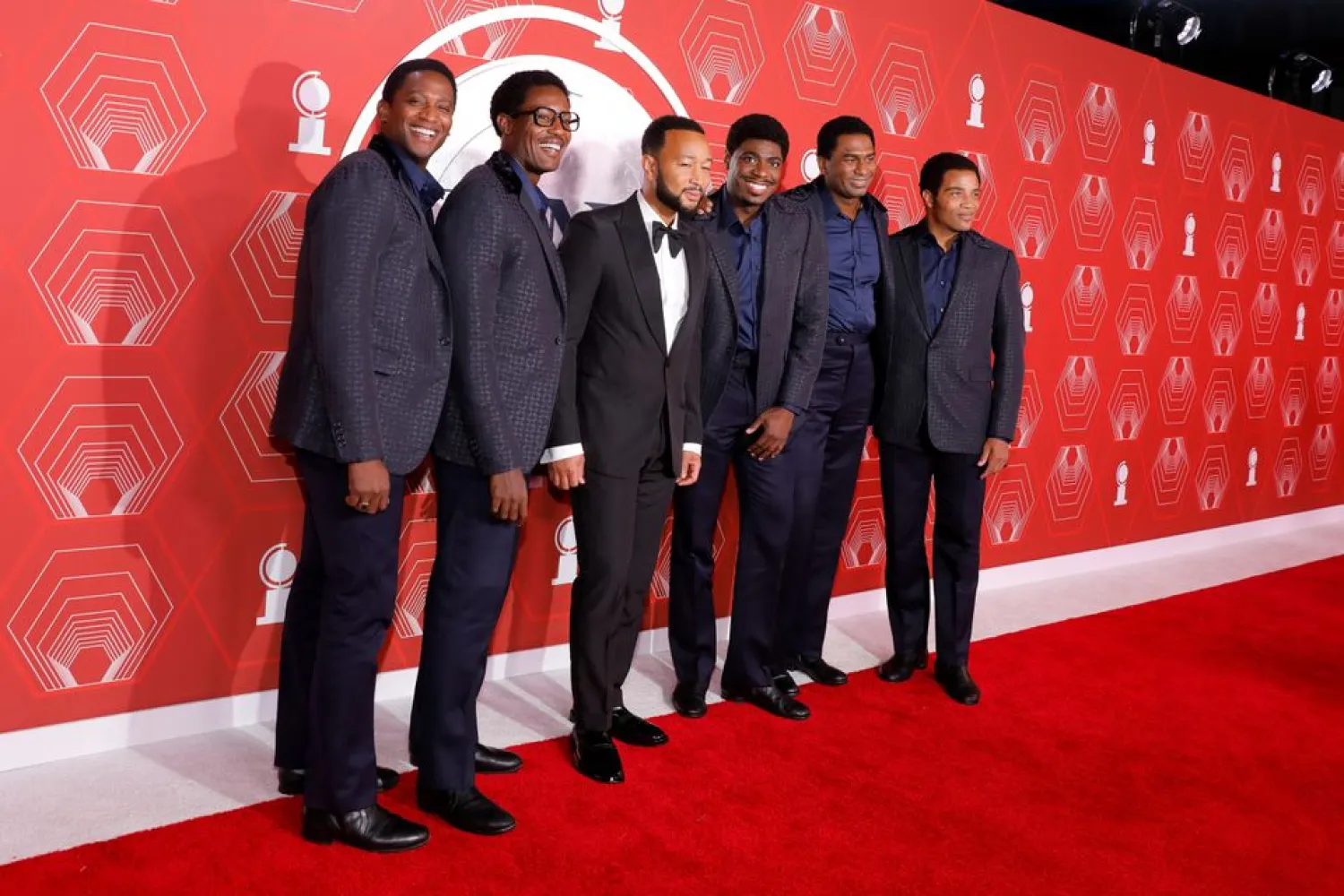
John Legend and the cast of Ain't Too Proud pose on the red carpet at the 74th Annual Tony Awards in New York, US, September 26, 2021. REUTERS/Andrew Kelly
TT

Tony Moments: A Night for Broadway to Reclaim its Groove

John Legend and the cast of Ain't Too Proud pose on the red carpet at the 74th Annual Tony Awards in New York, US, September 26, 2021. REUTERS/Andrew Kelly

Surely many in the audience were thinking it, but “Company” director Marianne Elliott said it most directly at Sunday's Tony awards: In the devastating two years since the pandemic hit, it “felt at times that live theater was endangered.”

As in, the industry might never recover.

The exuberant ceremony Sunday night was designed to answer that unthinkable possibility with an emphatic “No” — to make clear that whatever the ongoing difficulties, Broadway is back, with verve and creativity, and it's here to stay. It just needs even more people filling the seats.

But if the ceremony was meant to recapture the razzle-dazzle of Broadway seasons past, marking the 75th anniversary of the Tonys with a dollop of nostalgia, it was also a celebration of groundbreaking work by a hugely diverse group of artists. The marquee award, best new musical, went to the highly innovative “A Strange Loop,” Michael R. Jackson’s 2020 Pulitzer Prize winner about a Black gay man writing a show about a Black gay man. “A Strange Loop” beat out crowd-pleasing fare like “Six: The Musical,” a pop reimagining of the six wives of Henry VIII, and “MJ,” about the king of pop, Michael Jackson.

The night was hosted by a supremely confident and versatile (and recent Oscar winner) Ariana DeBose, who declared at the beginning that Broadway had gotten its groove back. But a quick glance around the room at Radio City Music Hall showed that challenges remain. While nominees and guests in the orchestra were maskless (having submitted COVID-19 tests), those in the balconies were all masked — including a group of COVID-19 safety managers being honored — as Broadway theater audiences are still required to be. The somewhat jarring juxtaposition showed this is still by far not a “normal” Broadway season.

Some key moments:

UNDERSTUDIES GET SOME LOVE
With Broadway casts sometimes decimated by virus cases, hardworking understudies and swings have been recognized all season as saviors, and heralded by stars like Hugh Jackman, who has praised them as “superheroes.” Host DeBose noted that she herself was an understudy early in her career, and some winners also made sure to pay respect: "I bow to you,” said “MJ” director and choreographer Christopher Wheeldon. Later in the show after a number from “Six,” DeBose made sure to mention that Mallory Maedke, the show’s dance captain and alternate, “was put into this number 12 hours ago,” drawing cheers from the crowd.

THE ‘GREAT WHITE WAY?' — JUST A NICKNAME
Broaching the subject of diversity and representation, DeBose hailed the fact that Broadway was becoming “more reflective of the community that adores it.” She noted the season was full of Black creative voices both on and offstage, and that two Broadway theaters were being renamed for the great Black performers James Earl Jones and Lena Horne. And she quipped that she saw the phrase “The Great White Way,” as Broadway has long been called, as a nickname — “as opposed to a how-to guide.”

JACKSON’S LIFE RAFT
Jackson, cutting a striking figure with his hot pink coat over a tuxedo, explained how he took 18 years to complete “A Strange Loop,” which he wrote as he was feeling “unseen, unheard, misunderstood.” He added: “I just wanted to create a little bit of a life raft for myself as a Black gay man to get through the day.” And he noted that while representation is crucial, also crucial was doing one's best possible work. "I’m all about representation but let’s make sure we are staying on our grind,” he said. “Never settle for anything less than the best you can do.” His cast seemed as overjoyed as he was; when they finished their Tony number, they jumped up and down wildly with joy.

NO TONYS, BUT THEY GOT TROMBONES
“The Music Man” revival is one of the biggest current hits on Broadway, regularly pulling in more than $3 million a week, in no small part due to its beloved and charismatic leads, Hugh Jackman and Sutton Foster. Despite six nominations, it failed to win any Tonys on Sunday. But the crowd seemed to love it when Jackman started crooning the famous “Seventy-Six Trombones” number with smiling young cast members marching through the audience and then Foster arriving to tap up a storm with her costar — two of the best triple threats in any Broadway season.

AWARD FOR MOST THANKED? DUH, MOM AND DAD
Everyone thanks Mom and their Dad at awards shows — well, almost everyone — but some are more specific than others. Jesse Tyler Ferguson, winning featured actor in a play for “Take Me Out,” made sure to thank the ’rents for letting him find his dreams in the Big Apple. “Mom, Dad, thank you for letting me move to New York when I was 17 years old. I told you it would be OK!” said the “Modern Family” star. As for Gareth Owen, who won in sound design for “MJ,” he thanked his parents “for not pushing me too hard to get a proper job.”
... AND SISTER

Joaquina Kalukango, too, thanked “the best parents in the world” when she won the Tony for best actress in a musical for her towering performance in “Paradise Square,” a show about Irish immigrants and Black Americans in Civil War-era New York. But she also thanked her sister, for designing her glistening dress with a lime green train. Kalukango won the rare double standing ovation — first for her scorching performance of the musical’s “Let It Burn,” and then for her speech.

AND MOM AGAIN!
It was a huge moment for Myles Frost, winning best actor in a musical for his Broadway debut role as Michael Jackson in “MJ.” He chose to spotlight his mother for her teaching-by-showing approach. “Without you there would be no me,” said Frost, 22, whose dancing is a standout in the show. “You showed me what a strong Black woman is and what it means to raise a strong Black man.” Frost became the youngest solo winner in the category, beating out Jaquel Spivey, 23, of “A Strange Loop,” not to mention Billy Crystal, Hugh Jackman and Rob McClure.

LOTS OF ‘COMPANY’ INDEED
It was a night to mourn revered composer Stephen Sondheim, who died in November at 91, and his influence was nowhere more apparent than in the five wins for the gender-bending revival of his “Company.” Elliot, who as director changed the commitment-phobe male role to a female, made Tony history by becoming the only woman to win three Tonys for directing, She dedicated her award to everyone fighting to keep theaters open. The beloved Patti LuPone won best featured actress, thanking COVID-19 safety officers among many others in her acceptance speech, and Matt Doyle won for best featured actor.

THEY LISTENED
A moving tribute to Sondheim was introduced by an emotional Lin-Manuel Miranda, who described the generosity of the late composer in writing letters to countless admirers, especially young writers hoping to learn from him, as Miranda once was. The floor then went to Bernadette Peters, one of the most renowned interpreters of Sondheim’s songs, who performed the moving “Children Will Listen” from “Into the Woods,” his mashup of fairytales. “Careful the things you say,” the song goes. “Children will listen.”

At Radio City and beyond, they were listening, and not just the children.


Perry Bamonte, Keyboardist and Guitarist for The Cure, Dies at 65

Perry Bamonte of The Cure performs at North Island Credit Union Amphitheater on May 20, 2023 in Chula Vista, California. (Getty Images/AFP)
TT

Perry Bamonte, Keyboardist and Guitarist for The Cure, Dies at 65

Perry Bamonte of The Cure performs at North Island Credit Union Amphitheater on May 20, 2023 in Chula Vista, California. (Getty Images/AFP)

Perry Bamonte, keyboardist and guitarist in The Cure, has died at 65, the English indie rock band confirmed through their official website on Friday.

In a statement, the band wrote that Bamonte died "after a short illness at home" on Christmas Day.

"It is with enormous sadness that ‌we confirm ‌the death of our ‌great ⁠friend and ‌bandmate Perry Bamonte who passed away after a short illness at home over Christmas," the statement said, adding he was a "vital part of The Cure story."

The statement said Bamonte was ⁠a full-time member of The Cure since 1990, ‌playing guitar, six-string bass, ‍and keyboards, and ‍performed in more than 400 shows.

Bamonte, ‍born in London, England, in 1960, joined the band's road crew in 1984, working alongside his younger brother Daryl, who worked as tour manager for The Cure.

Bamonte first worked as ⁠an assistant to co-founder and lead vocalist, Robert Smith, before becoming a full member after keyboardist Roger O'Donnell left the band in 1990.

Bamonte's first album with The Cure was "Wish" in 1992. He continued to work with them on the next three albums.

He also had various acting ‌roles in movies: "Judge Dredd,About Time" and "The Crow."


First Bond Game in a Decade Hit by Two-month Delay

'007 First Light' depicts a younger Bond earning his license to kill. Ina FASSBENDER / AFP
TT

First Bond Game in a Decade Hit by Two-month Delay

'007 First Light' depicts a younger Bond earning his license to kill. Ina FASSBENDER / AFP

A Danish video game studio said it was delaying the release of the first James Bond video game in over a decade by two months to "refine the experience".

Fans will now have to wait until May 27 to play "007 First Light" featuring Ian Fleming's world-famous spy, after IO Interactive said on Tuesday it was postponing the launch to add some final touches.

"007 First Light is our most ambitious project to date, and the team has been fully focused on delivering an unforgettable James Bond experience," the Danish studio wrote on X.

Describing the game as "fully playable", IO Interactive said the two additional months would allow their team "to further polish and refine the experience", giving players "the strongest possible version at launch".

The game, which depicts a younger Bond earning his license to kill, is set to feature "globe-trotting, spycraft, gadgets, car chases, and more", IO Interactive added.

It has been more than a decade since a video game inspired by Bond was released. The initial release date was scheduled for March 27.


Movie Review: An Electric Timothee Chalamet Is the Consummate Striver in Propulsive ‘Marty Supreme’

 Timothee Chalamet attends the premiere of "Marty Supreme" at Regal Times Square on Tuesday, Dec. 16, 2025, in New York. (AP)
Timothee Chalamet attends the premiere of "Marty Supreme" at Regal Times Square on Tuesday, Dec. 16, 2025, in New York. (AP)
TT

Movie Review: An Electric Timothee Chalamet Is the Consummate Striver in Propulsive ‘Marty Supreme’

 Timothee Chalamet attends the premiere of "Marty Supreme" at Regal Times Square on Tuesday, Dec. 16, 2025, in New York. (AP)
Timothee Chalamet attends the premiere of "Marty Supreme" at Regal Times Square on Tuesday, Dec. 16, 2025, in New York. (AP)

“Everybody wants to rule the world,” goes the Tears for Fears song we hear at a key point in “Marty Supreme,” Josh Safdie’s nerve-busting adrenaline jolt of a movie starring a never-better Timothee Chalamet.

But here’s the thing: everybody may want to rule the world, but not everybody truly believes they CAN. This, one could argue, is what separates the true strivers from the rest of us.

And Marty — played by Chalamet in a delicious synergy of actor, role and whatever fairy dust makes a performance feel both preordained and magically fresh — is a striver. With every fiber of his restless, wiry body. They should add him to the dictionary definition.

Needless to say, Marty is a New Yorker.

Also needless to say, Chalamet is a New Yorker.

And so is Safdie, a writer-director Chalamet has called “the street poet of New York.” So, where else could this story be set?

It’s 1952, on Manhattan’s Lower East Side. Marty Mauser is a salesman in his uncle’s shoe store, escaping to the storeroom for a hot tryst with his (married) girlfriend. This witty opening sequence won’t be the only thing recalling “Uncut Gems,” co-directed by Safdie with his brother Benny before the two split for solo projects. That film, which feels much like the precursor to “Marty Supreme,” began as a trip through the shiny innards of a rare opal, only to wind up inside Adam Sandler’s colon, mid-colonoscopy.

Sandler’s Howard Ratner was a New York striver, too, but sadder, and more troubled. Marty is young, determined, brash — with an eye always to the future. He’s a great salesman: “I could sell shoes to an amputee,” he boasts, crassly. But what he’s plotting to unveil to the world has nothing to do with shoes. It’s about table tennis.

How likely is it that this Jewish kid from the Lower East Side can become the very face of a sport in America, soon to be “staring at you from the cover of a Wheaties box?”

To Marty, perfectly likely. Still, he knows nobody in the US cares about table tennis. He’s so determined to prove everyone wrong, starting at the British Open in London, that when there’s a snag obtaining cash for his trip, he brandishes a gun at a colleague to get it.

Shaking off that sorta-armed robbery thing, Marty arrives in London, where he fast-talks his way into a suite at the Ritz. Here, he spies fellow guest Kay Stone (Gwyneth Paltrow, in a wise, stylish return to the screen), a former movie star married to an insufferable tycoon (“Shark Tank” personality Kevin O’Leary, one of many nonactors here.)

Kay’s skeptical, but Marty finds a way to woo her. Really, all he has to say is: “Come watch me.” Once she sees him play, she’s sneaking into his room in a lace corselet.

This would be a good time to stop and consider Chalamet’s subtly transformed appearance. He is stick-thin — duh, he never stops moving. His mustache is skimpy. His skin is acne-scarred — just enough to erase any movie-star sheen. Most strikingly, his eyes, behind the round spectacles, are beady — and smaller. Definitely not those movie-star eyes.

But then, nearly all the faces in “Marty Supreme” are extraordinary. In a movie with more than 100 characters, we have known actors (Fran Drescher, Abel Ferrara); nonacting personalities (O’Leary, and an excellent Tyler Okonma (Tyler, The Creator) as Marty’s friend Wally); and exciting newcomers like Odessa A’Zion as Marty’s feisty girlfriend Rachel.

There are also a slew of nonactors in small parts, plus cameos from the likes of David Mamet and even high wire artist Philippe Petit. The dizzying array makes one curious how it all came together — is casting director Jennifer Venditti taking interns? Production notes tell us that for one hustling scene at a bowling alley, young men were recruited from a sports trading-card convention.

Elsewhere on the creative team, composer Daniel Lopatin succeeds in channeling both Marty’s beating heart and the ricochet of pingpong balls in his propulsive score. The script by Safdie and cowriter Ronald Bronstein, loosely based on real-life table tennis hustler Marty Reisman, beats with its own, never-stopping pulse. The same breakneck aesthetic applies to camera work by Darius Khondji.

Back now to London, where Marty makes the finals against Japanese player Koto Endo (Koto Kawaguchi, like his character a deaf table tennis champion). “I’ll be dropping a third atom bomb on them,” he brags — not his only questionable World War II quip. But Endo, with his unorthodox paddle and grip, prevails.

After a stint as a side act with the Harlem Globetrotters, including pingpong games with a seal — you’ll have to take our word for this, folks, we’re running low on space — Marty returns home, determined to make the imminent world championships in Tokyo.

But he's in trouble — remember he took cash at gunpoint? Worse, he has no money.

So Marty’s on the run. And he’ll do anything, however messy or dangerous, to get to Japan. Even if he has to totally debase himself (mark our words), or endanger friends — or abandon loyal and brave Rachel.

Is there something else for Marty, besides his obsessive goal? If so, he doesn’t know it yet. But the lyrics of another song used in the film are instructive here: “Everybody’s got to learn sometime.”

So can a single-minded striver ultimately learn something new about his own life?

We'll have to see. As Marty might say: “Come watch me.”