

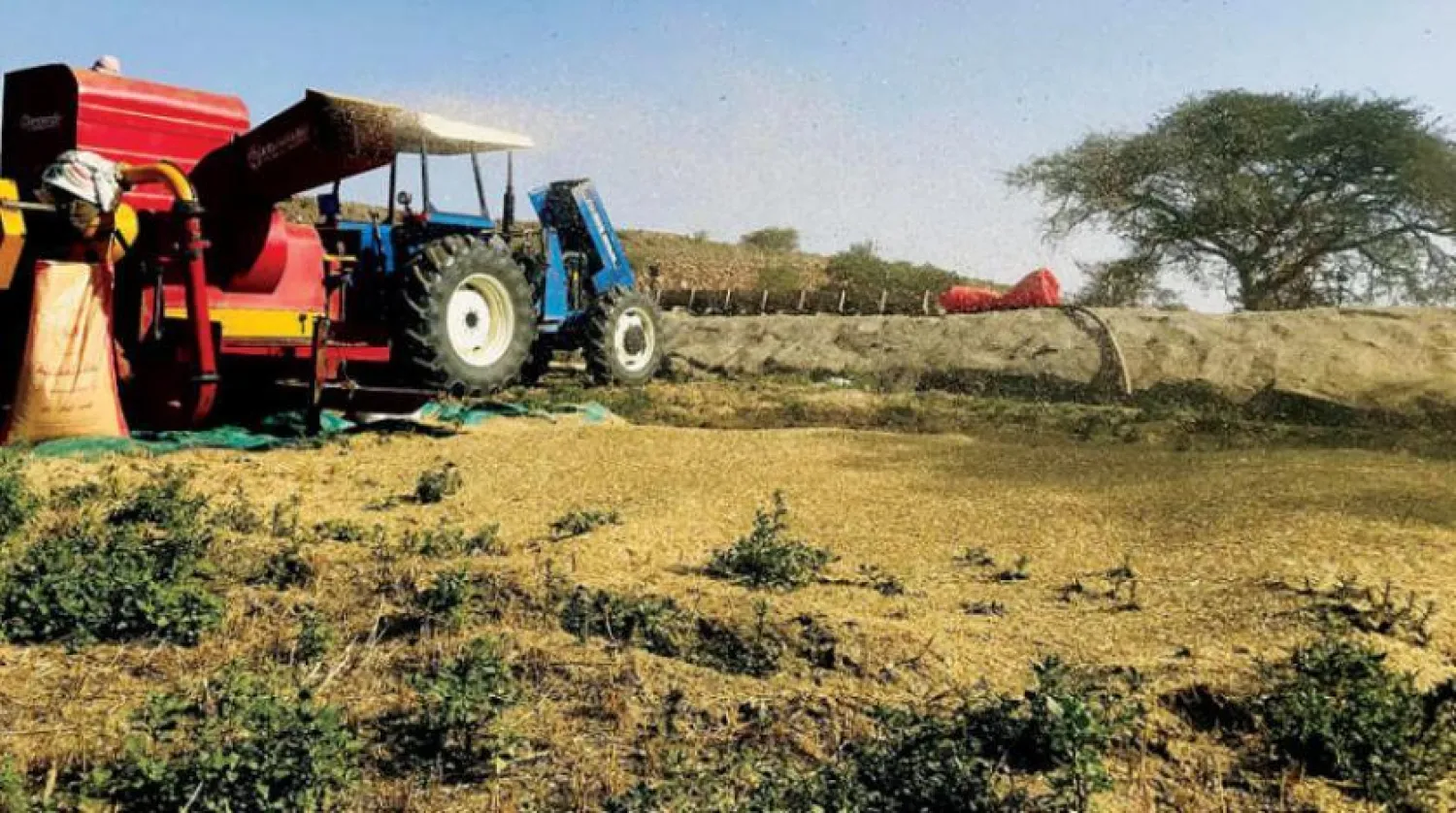

How Did Russia-Ukraine War Trigger a Food Crisis?

Arab countries could face a food shortage crisis if they do not address the existing challenges. (Asharq Al-Awsat)
TT

How Did Russia-Ukraine War Trigger a Food Crisis?

Arab countries could face a food shortage crisis if they do not address the existing challenges. (Asharq Al-Awsat)

Russian hostilities in Ukraine are preventing grain from leaving the “breadbasket of the world" and making food more expensive across the globe, threatening to worsen shortages, hunger and political instability in developing countries.

Together, Russia and Ukraine export nearly a third of the world’s wheat and barley, more than 70% of its sunflower oil, and are big suppliers of corn. Russia is the top global fertilizer producer, The Associated Press said.

World food prices were already climbing, and the war made things worse, preventing some 20 million tons of Ukrainian grain from getting to the Middle East, North Africa and parts of Asia.

Weeks of negotiations on safe corridors to get grain out of Ukraine's Black Sea ports have made little progress, with urgency rising as the summer harvest season arrives.

“This needs to happen in the next couple of months (or) it’s going to be horrific,’’ said Anna Nagurney, who studies crisis management at the University of Massachusetts Amherst and is on the board of the Kyiv School of Economics.

She says 400 million people worldwide rely on Ukrainian food supplies. The UN Food and Agriculture Organization projects that up to 181 million people in 41 countries could face food crisis or worse levels of hunger this year.

Here’s a look at the global food crisis:
WHAT'S THE SITUATION?
Typically, 90% of wheat and other grain from Ukraine's fields are shipped to world markets by sea but have been held up by Russian blockades of the Black Sea coast.

Some grain is being rerouted through Europe by rail, road and river, but the amount is a drop in the bucket compared with sea routes. The shipments also are backed up because Ukraine’s rail gauges don't match those of its neighbors to the west.

Ukraine’s deputy agriculture minister, Markian Dmytrasevych, asked European Union lawmakers for help exporting more grain, including expanding the use of a Romanian port on the Black Sea, building more cargo terminals on the Danube River and cutting red tape for freight crossing at the Polish border.

But that means food is even farther from those that need it.

“Now you have to go all the way around Europe to come back into the Mediterranean. It really has added an incredible amount of cost to Ukrainian grain,’’ said Joseph Glauber, senior research fellow at the International Food Policy Research Institute in Washington.

Ukraine has only been able to export 1.5 million to 2 million tons of grain a month since the war, down from more than 6 million tons, said Glauber, a former chief economist at the US Department of Agriculture.

Russian grain isn't getting out, either. Moscow argues that Western sanctions on its banking and shipping industries make it impossible for Russia to export food and fertilizer and are scaring off foreign shipping companies from carrying it.

Russian officials insist sanctions be lifted to get grain to global markets.

European Commission President Ursula von der Leyen and other Western leaders say, however, that sanctions don't touch food.

WHAT ARE THE SIDES SAYING?
Ukraine has accused Russia of shelling agricultural infrastructure, burning fields, stealing grain and trying to sell it to Syria after Lebanon and Egypt refused to buy it. Satellite images taken in late May by Maxar Technologies show Russian-flagged ships in a port in Crimea being loaded with grain and then days later docked in Syria with their hatches open.

Ukrainian President Volodymyr Zelensky says Russia has provoked a global food crisis. The West agrees, with officials like European Council President Charles Michel and US Secretary of State Antony Blinken saying Russia is weaponizing food.

Russia says exports can resume once Ukraine removes mines in the Black Sea and arriving ships can be checked for weapons.

Russian Foreign Minister Sergey Lavrov promised that Moscow would not “abuse” its naval advantage and would “take all necessary steps to ensure that the ships can leave there freely.”

Ukrainian and Western officials doubt the pledge. Turkish Foreign Minister Mevlut Cavusoglu said this week that it may be possible to create secure corridors without the need to clear sea mines because the location of the explosive devices are known.

But other questions would still remain, such as whether insurers would provide coverage for ships.

Dmytrasevych told the EU agriculture ministers this week that the only solution is defeating Russia and unblocking ports: “No other temporary measures, such as humanitarian corridors, will address the issue.”

HOW DID WE GET HERE?
Food prices were rising before the invasion, stemming from factors including bad weather and poor harvests cutting supplies, while global demand rebounded strongly from the COVID-19 pandemic.

Glauber cited poor wheat harvests last year in the United States and Canada and a drought that hurt soybean yields in Brazil. Also exacerbated by climate change, the Horn of Africa is facing one of its worst droughts in four decades, while a record-shattering heat wave in India in March reduced wheat yields.

That, along with soaring costs for fuel and fertilizer, has prevented other big grain-producing countries from filling in the gaps.

WHO’S HARDEST HIT?
Ukraine and Russia mainly export staples to developing countries that are most vulnerable to cost hikes and shortages.

Countries like Somalia, Libya, Lebanon, Egypt and Sudan are heavily reliant on wheat, corn and sunflower oil from the two warring nations.

“The burden is being shouldered by the very poor," Glauber said. “That’s a humanitarian crisis, no question.’’

Beside the threat of hunger, spiraling food prices risk political instability in such countries. They were one of the causes of the Arab Spring, and there are worries of a repeat.

The governments of developing countries must either let food prices rise or subsidize costs, Glauber said. A moderately prosperous country like Egypt, the world's top wheat importer, can afford to absorb higher food costs, he said.

“For poor countries like Yemen or countries in the Horn of Africa — they’re really going to need humanitarian aid," he said.

Starvation and famine are stalking that part of Africa. Prices for staples like wheat and cooking oil in some cases are more than doubling, while millions of livestock that families use for milk and meat have died. In Sudan and Yemen, the Russia-Ukraine conflict came on top of years of domestic crises.

UNICEF warned about an “explosion of child deaths” if the world focuses only on the war in Ukraine and doesn’t act. UN agencies estimated that more than 200,000 people in Somalia face “catastrophic hunger and starvation,” roughly 18 million Sudanese could experience acute hunger by September and 19 million Yemenis face food insecurity this year.

Wheat prices have risen in some of those countries by as much as 750%.

“Generally, everything has become expensive. Be it water, be it food, it’s almost becoming quite impossible,” Justus Liku, a food security adviser with the aid group CARE, said after visiting Somalia recently.

Liku said a vendor selling cooked food had “no vegetables or animal products. No milk, no meat. The shopkeeper was telling us she’s just there for the sake of being there."

In Lebanon, bakeries that used to have many types of flat bread now only sell basic white pita bread to conserve flour.

WHAT'S BEING DONE?
For weeks, UN Secretary-General Antonio Guterres has been trying to secure an agreement to unblock Russian exports of grain and fertilizer and allow Ukraine to ship commodities from the key port of Odesa. But progress has been slow.

A vast amount of grain is stuck in Ukrainian silos or on farms in the meantime.
And there's more coming — Ukraine’s harvest of winter wheat is getting underway soon, putting more stress on storage facilities even as some fields are likely to go unharvested and because of the fighting.

Serhiy Hrebtsov can’t sell the mountain of grain at his farm in the Donbas region because transport links have been cut off. Scarce buyers mean prices are so low that farming is unsustainable.

“There are some options to sell, but it is like just throwing it away,” he said.

US President Joe Biden says he’s working with European partners on a plan to build temporary silos on Ukraine's borders, including with Poland, a solution that would also address the different rail gauges between Ukraine and Europe.

The idea is that grain can be transferred into the silos, and then “into cars in Europe and get it out to the ocean and get it across the world. But it’s taking time," he said in a speech Tuesday.

Dmytrasevych said Ukraine’s grain storage capacity has been reduced by 15 million to 60 million tons after Russian troops destroyed silos or occupied sites in the south and east.

WHAT’S COSTING MORE?
World production of wheat, rice and other grains is expected to reach 2.78 billion tons in 2022, down 16 million tons from the previous year — the first decline in four years, the UN Food and Agriculture Organization said.

Wheat prices are up 45% in the first three months of the year compared with the previous year, according to the FAO's wheat price index. Vegetable oil has jumped 41%, while sugar, meat, milk and fish prices also have risen by double digits.

The increases are fueling faster inflation worldwide, making groceries more expensive and raising costs for restaurant owners, who have been forced to increase prices.

Some countries are reacting by trying to protect domestic supplies. India has restricted sugar and wheat exports, while Malaysia halted exports of live chickens, alarming Singapore, which gets a third of its poultry from its neighbor.

The International Food Policy Research Institute says if food shortages grow more acute as the war drags on, that could lead to more export restrictions that further push up prices.

Another threat is scarce and costly fertilizer, meaning fields could be less productive as farmers skimp, said Steve Mathews of Gro Intelligence, an agriculture data and analytics company.

There are especially big shortfalls of two of the main chemicals in fertilizer, of which Russia is a big supplier.

“If we continue to have the shortage of potassium and phosphate that we have right now, we will see falling yields," Mathews said. “No question about it in the coming years."


What to Know as Iran and US Meet for New Nuclear Talks as Americans Deploy Forces in Mideast

A woman walks past the flag and map of Iran painted on a wall in Tehran on February 25, 2026. (Photo by ATTA KENARE / AFP)
TT

What to Know as Iran and US Meet for New Nuclear Talks as Americans Deploy Forces in Mideast

A woman walks past the flag and map of Iran painted on a wall in Tehran on February 25, 2026. (Photo by ATTA KENARE / AFP)

Iran and the United States will meet Thursday in Geneva as talks over Tehran's nuclear program hang in the balance following Israel's 12-day war on the country in June and Iran carrying out a bloody crackdown on nationwide protests.

US President Donald Trump has kept up pressure on Iran, moving an aircraft carrier and other military assets to the Arabian Gulf and suggesting the US could attack Iran over the killing of peaceful demonstrators or if Tehran launches mass executions over the protests. A second aircraft carrier now is in the Mediterranean Sea.

Trump has pushed Iran's nuclear program back into the frame as well after the June war disrupted five rounds of talks held in Rome and Muscat, Oman, last year. Two rounds of talks so far have yet to reach a deal, though.

Mideast nations fear a collapse in diplomacy could spark a new regional war. US concerns also have gone beyond Iran's nuclear program to its ballistic missiles, support for proxy networks across the region and other issues.

Iran has said it wants talks to focus solely on the nuclear program. Iranian President Masoud Pezeshkian has insisted that his nation was “not seeking nuclear weapons. ... and are ready for any kind of verification.” However, the United Nations’ nuclear watchdog — the International Atomic Energy Agency — has been unable for months to inspect and verify Iran’s nuclear stockpile.

Trump began the diplomacy initially by writing a letter last year to Iran’s 86-year-old Supreme Leader Ali Khamenei to jump start these talks. Khamenei has warned Iran would respond to any attack with an attack of its own, particularly as the theocracy he commands reels following the protests.

Here’s what to know about Iran’s nuclear program and the tensions that have stalked relations between Tehran and Washington since the 1979 Iranian Revolution.

Trump writes letter to Khamenei

Trump dispatched the letter to Khamenei on March 5, 2025, then gave a television interview the next day in which he acknowledged sending it. He said: “I’ve written them a letter saying, ‘I hope you’re going to negotiate because if we have to go in militarily, it’s going to be a terrible thing.’”

Since returning to the White House, the president has been pushing for talks while ratcheting up sanctions and suggesting a military strike by Israel or the US could target Iranian nuclear sites.

A previous letter from Trump during his first term drew an angry retort from the supreme leader.

But Trump’s letters to North Korean leader Kim Jong Un in his first term led to face-to-face meetings, though no deals to limit Pyongyang’s atomic bombs and a missile program capable of reaching the continental US.

Oman mediated previous talks

Oman, a sultanate on the eastern edge of the Arabian Peninsula, has mediated talks between Araghchi and US Mideast envoy Steve Witkoff. The two men have met face to face after indirect talks, a rare occurrence due to the decades of tensions between the countries.

It hasn't been all smooth, however. Witkoff at one point made a television appearance in which he suggested 3.67% enrichment for Iran could be something the countries could agree on. But that’s exactly the terms set by the 2015 nuclear deal struck under former US President Barack Obama, from which Trump unilaterally withdrew America. Witkoff, Trump and other American officials in the time since have maintained Iran can have no enrichment under any deal, something to which Tehran insists it won't agree.

The first attempt at negotiations ended, however, with Israel launching the war in June on Iran. A new effort has seen two new rounds of talks in Oman and Geneva so far.

The 12-day war and nationwide protests Israel launched what became a 12-day war on Iran in June that included the US bombing Iranian nuclear sites. Iran later acknowledged in November that the attacks saw it halt all uranium enrichment in the country, though inspectors from the IAEA, the UN nuclear watchdog, have been unable to visit the bombed sites.

Half a year later, Iran saw protests that began in late December over the collapse of the country's rial currency. Those demonstrations soon became nationwide, sparking Tehran to launch a bloody crackdown that killed thousands and saw tens of thousands detained by authorities.

Iran’s nuclear program worries the West

Iran has insisted for decades that its nuclear program is peaceful. However, its officials increasingly threaten to pursue a nuclear weapon. Iran now enriches uranium to near weapons-grade levels of 60%, the only country in the world without a nuclear weapons program to do so.

Under the original 2015 nuclear deal, Iran was allowed to enrich uranium up to 3.67% purity and to maintain a uranium stockpile of 300 kilograms (661 pounds). The last report by the IAEA on Iran’s program put its stockpile at some 9,870 kilograms (21,760 pounds), with a fraction of it enriched to 60%. The agency for months has been unable to assess Iran's program, raising nonproliferation concerns.

US intelligence agencies assess that Iran has yet to begin a weapons program, but has “undertaken activities that better position it to produce a nuclear device, if it chooses to do so.” Iranian officials have threatened to pursue the bomb.

Israel, a close American ally, believes Iran is pursuing a weapon. It wants to see the nuclear program scrapped, as well as a halt in its ballistic missile program and support for anti-Israel militant groups such as Hezbollah in Lebanon and Hamas.

Decades of tense relations between Iran and the US

Iran was once one of the US’s top allies in the Mideast under Shah Mohammad Reza Pahlavi, who purchased American military weapons and allowed CIA technicians to run secret listening posts monitoring the neighboring Soviet Union. The CIA had fomented a 1953 coup that cemented the shah’s rule.

But in January 1979, the shah, fatally ill with cancer, fled Iran as mass demonstrations swelled against his rule. The Iranian Revolution followed, led by Grand Khomeini, and created Iran’s theocratic government.

Later that year, university students overran the US Embassy in Tehran, seeking the shah’s extradition and sparking the 444-day hostage crisis that saw diplomatic relations between Iran and the US severed. The Iran-Iraq war of the 1980s saw the US back Saddam Hussein. The “Tanker War” during that conflict saw the US launch a one-day assault that crippled Iran at sea, while the US later shot down an Iranian commercial airliner that the US military said it mistook for a warplane.

Iran and the US have seesawed between enmity and grudging diplomacy in the years since, with relations peaking when Tehran made the 2015 nuclear deal with world powers. But Trump unilaterally withdrew the US from the accord in 2018, sparking tensions in the Mideast that persist today.


Surviving Strike, Shamkhani Resumes Central Role in Iran’s War Room

Image from a video released by Iranian television shows Shamkhani talking about his assassination attempt on June 13, 2025.
TT

Surviving Strike, Shamkhani Resumes Central Role in Iran’s War Room

Image from a video released by Iranian television shows Shamkhani talking about his assassination attempt on June 13, 2025.

Ali Shamkhani, who taunted Israel after being pulled alive from the rubble of his Tehran home following a strike in June 2025, has survived at the center of Iranian policy-making during its most testing military confrontations and diplomatic endeavors.

The 70-year-old former Revolutionary Guard commander is a trusted adviser to Supreme Leader Ali Khamenei in a high-stakes standoff with the US that could determine whether the Islamic Republic, born from revolution in 1979, survives to half a century.

“Bastards, I am alive,” Shamkhani told Iranian filmmaker Javad Mogouei in an interview published in October, referring to his narrow escape from the Israeli strike that destroyed his home and evoking the 1973 Hollywood prison escape film Papillon.

This year, Khamenei confirmed Shamkhani as secretary of Iran’s newly established Defense Council, created after last year's 12-day war in which Israel and the US launched military strikes on Iran's nuclear facilities and military sites.

His appointment returns him to the core of Iran’s decision-making apparatus. The Council is tasked with coordinating Iran's wartime actions at a time when the US is threatening new air strikes from nearby warships if negotiations do not produce a new deal curtailing Tehran's nuclear program.

US President Donald Trump briefly laid out his case for a possible attack on Iran in his State of the Union speech to Congress on ‌Tuesday, saying he ‌would not allow the world's biggest sponsor of terrorism to have a nuclear weapon.

Iran denies being a sponsor ‌of ⁠terrorism and has ⁠long said it has no intention of building nuclear weapons, although Western nations and Israel believe that is the goal of what Tehran calls its peaceful nuclear program.

"A 'limited strike' is an illusion. Any military action by US - from any origin and any level - will be considered the start of war, and its response will be immediate, all out, and unprecedented, targeting heart of Tel Aviv and all those supporting the aggressor," Shamkhani said on X in January 2026.

A veteran of the 1980-1988 Iran-Iraq war when the newly created republic battled for survival, Shamkhani has served as a political adviser to Khamenei since his 2023 departure from the Supreme National Security Council (SNSC).

He led that council for a decade, including during Iran's 2015 nuclear deal with world powers and Washington's 2018 US withdrawal from the agreement, an episode that reinforced his skepticism of the ⁠accord.

The SNSC is the overarching body setting security and defense policies, and Shamkhani acted as Khamenei’s representative there during his ‌tenure.

As tensions with Washington rise and speculation grows about Iran’s fate in the event of war, ‌Shamkhani looks poised to wield influence among a politically astute cohort of former elite Revolutionary Guard Corps (IRGC) commanders.

FORGED IN WAR

Born in 1955 to an ethnic Arab family in ‌oil-rich Khuzestan province, Shamkhani rose through IRGC ranks in the Iran-Iraq war, first commanding its forces in his home province which was the main battlefront against ‌Saddam Hussein's forces.

By 1982, he was deputy to IRGC commander-in-chief Mohsen Rezaei, another Khuzestan native with whom he had participated in anti-shah activism in the 1970s. By the war’s end he had commanded the Guards’ ground forces while holding a cabinet post.

In 1989, the newly appointed Supreme Leader Ali Khamenei transferred him to the regular navy, which had been heavily damaged in clashes with US forces. Within a year, he was given simultaneous command of both the regular and IRGC navies, overseeing a shift toward asymmetric maritime tactics designed to counter ‌conventionally superior adversaries.

SECURITY OPERATOR AND DIPLOMATIC CHANNEL

Shamkhani has also been deployed in diplomatic roles. His appointments have often coincided with moments when Tehran sought to engage adversaries without appearing to concede ground.

That balancing act was visible during last decade’s nuclear negotiations. While serving under President Hassan Rouhani, Shamkhani was involved in implementing the 2015 nuclear agreement and navigating its aftermath after the US withdrew.

Rouhani later came to regret his appointment, believing Shamkhani had supported parliamentary measures that hardened Iran’s negotiating position by mandating higher uranium enrichment.

In the October 2025 interview, Shamkhani went further, saying that in hindsight Iran should have considered building nuclear weapons in the 1990s, remarks that underscored his emphasis on deterrence after Iran sustained major air strikes from both Israel and the US during the 12-day war.

SANCTIONS ECONOMY AND SCRUTINY

Shamkhani has over the years faced allegations and sanctions over his family’s own dealings. In 2020, he was sanctioned by the US Treasury, which also targeted his son Mohammad Hossein in 2025 for operating a network of vessels transporting sanctioned oil from Iran and Russia to international buyers.

According to the treasury, the Shamkhani family’s “shipping empire” allowed it to accrue massive wealth and become a key actor facilitating Iran’s circumvention of US sanctions.

Shamkhani has not publicly commented on allegations of corruption.

His daughter Fatemeh faced a backlash in 2025 over a widely shared video of her in a revealing gown at her opulent wedding, fueling accusations of elite privilege and highlighting tensions between the ruling establishment’s conservative ethos and the lifestyles of those close to power.


Countries Issuing Middle East Travel Advisories as Iran Tensions Rise

Vehicles pass a billboard depicting a US aircraft carrier with damaged fighter jets on its deck and a sign in Farsi and English reading, "If you sow the wind, you'll reap the whirlwind," at Enqelab-e-Eslami Square in Tehran, Iran, Sunday, Feb. 22, 2026. (AP)
TT

Countries Issuing Middle East Travel Advisories as Iran Tensions Rise

Vehicles pass a billboard depicting a US aircraft carrier with damaged fighter jets on its deck and a sign in Farsi and English reading, "If you sow the wind, you'll reap the whirlwind," at Enqelab-e-Eslami Square in Tehran, Iran, Sunday, Feb. 22, 2026. (AP)

Several countries have begun withdrawing dependents of diplomatic personnel and non-essential staff from some locations in the Middle East, or advising citizens to defer travel to Iran, amid rising tensions between Washington and Tehran.

Here are some of the moves:

AUSTRALIA: The government has told dependents of Australian diplomats in Israel and Lebanon to leave the two countries, citing a deteriorating security situation in the region. It also offered voluntary departures to Australian diplomats' dependents in the United Arab Emirates, Jordan ‌and Qatar. It ‌continues to advise citizens in Israel and ‌Lebanon ⁠to consider leaving ⁠while commercial options remain available. (Foreign Ministry X account)

SERBIA: Serbia has told its nationals in Iran to leave as soon as possible due to increased tensions and the risk of a deterioration of the security situation. (Foreign Ministry)

POLAND: Polish citizens should leave Iran immediately. (Prime Minister Donald Tusk)

UNITED STATES: The US is pulling ⁠non-essential staff and eligible family members from its ‌embassy in Lebanon amid ‌Iran tensions. (Senior State Department official)

SWEDEN: The Foreign Ministry advised its citizens to ‌avoid all travel to Iran and leave the country ‌immediately on January 12. The foreign minister said in February that people who decided to stay should not expect help from the government to be evacuated. (Foreign Ministry website)

INDIA: The Indian embassy in ‌Iran advised citizens currently in Iran to leave by available means of transport, including commercial flights. (Post ⁠on X ⁠by Indian embassy in Iran, on February 23)

CYPRUS: Cyprus advised its citizens to avoid all travel to Iran and leave the country immediately on January 13. (Foreign Ministry)

SINGAPORE: Singapore advised citizens to continue to defer all travel to Iran. (Singapore Foreign Ministry)

GERMANY: Germany has urged its citizens to leave Iran, noting commercial flights out are still operating and departure by land is also possible (Foreign Ministry, January 20)

BRAZIL: Brazil recommended last week that its citizens leave Iran, following a similar alert to citizens in Lebanon in January. The government last year recommended that Brazilians not travel to the two countries.