


Modi Breaks Netanyahu’s Isolation with 16 Cooperation Agreements

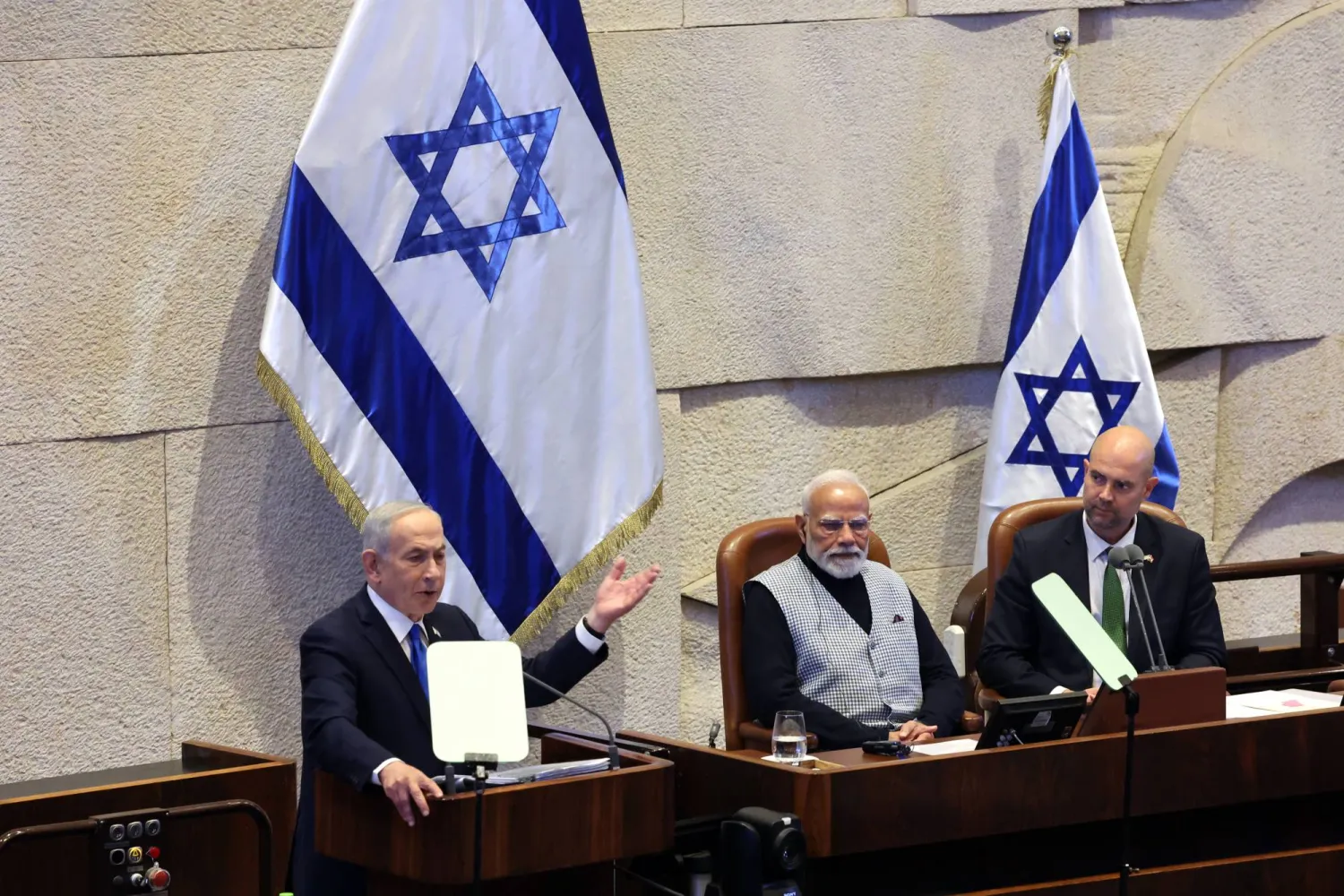
The Indian Prime Minister listens to the Israeli Prime Minister during an exceptional session of the Knesset on Wednesday (EPA)
TT

Modi Breaks Netanyahu’s Isolation with 16 Cooperation Agreements

The Indian Prime Minister listens to the Israeli Prime Minister during an exceptional session of the Knesset on Wednesday (EPA)

In a move seen as breaking Israel’s relative international isolation amid its ongoing war in Gaza, Indian Prime Minister Narendra Modi signed 16 agreements with Israel during a two-day visit to the country.

Modi arrived in Israel on Wednesday for talks aimed at strengthening ties in trade and defense. The visit was marked by an unusually warm reception. Israeli Prime Minister Benjamin Netanyahu personally welcomed Modi at the airport and later accompanied him to address the Knesset, Israel’s parliament, where lawmakers applauded and cheered.

Netanyahu hailed Modi as “a great global leader and a great friend; more than that, a great brother.”

He added: “They say India has achieved tremendous accomplishments. That is not accurate. It should be said that thanks to your leadership, your wisdom, and your determination, India has achieved its successes.”

The Israeli premier also thanked Modi for India’s assistance during the recent Gaza war, noting that New Delhi had supplied Israel with ammunition and drones.

Sixteen Agreements and a Historic Honor

The Israeli government announced the signing of 16 bilateral agreements during the visit. In a symbolic gesture, Knesset Speaker Amir Ohana awarded Modi the “Knesset Medal,” marking the first time the honor has been bestowed on a visiting leader.

This is Modi’s second visit to Israel since taking office, nearly nine years after his first trip in 2017.

Beyond political symbolism, the relationship carries significant economic weight. India is Israel’s second-largest trading partner in Asia. According to India’s Ministry of Commerce and Industry, total bilateral trade reached $3.62 billion in fiscal year 2025.

Renewed Indian Condemnation of October 7

For his part, Modi declared that “India stands with Israel at this moment and beyond.” Addressing the Knesset plenary, he offered condolences for those killed in the Oct. 7, 2023 attack launched by Hamas, describing it as a “terrorist and brutal attack.”

Modi also praised a plan proposed by US President Donald Trump that he said would safeguard Palestinian national rights.

Expanding Strategic Ties, Secrecy

Observers view the visit not merely as a reflection of improved relations, but as a major step in advancing strategic cooperation. The agreements include memoranda of understanding designed to deepen coordination across several sectors, particularly in security, with officials describing the partnership as a “distinguished strategic relationship.”

Security sources revealed that the two sides reached an arrangement establishing a “confidentiality framework,” allowing India access to previously restricted Israeli systems. These reportedly include advanced air defense systems and integration into Israel’s laser-based air defense network. India is also expected to receive licenses to manufacture certain Israeli weapons systems domestically.

The Israeli daily Yedioth Ahronoth quoted a senior political official as saying the agreement would provide greater flexibility to security agencies and enable both countries to rely on one another when necessary, calling it “a major revolution.”

Writing in the right-leaning newspaper Israel Hayom, columnist and former lawmaker Zvi Hauser, a political ally of Netanyahu, said one of the key issues Modi and Netanyahu would discuss is Iran’s future and the prospects for the fall of its regime. Hauser suggested that Israel, India, and a post-Revolution Iran could form a powerful strategic alliance in the region.



Russia Pounds Ukraine with Missiles and Drones, Injuring at Least 26

Municipal workers remove debris next to damaged cars outside an apartment building hit by a Russian drone strike on Thursday, amid Russia's attack on Ukraine, in Kharkiv, Ukraine February 26, 2026. REUTERS/Vyacheslav Madiyevskyy
TT

Russia Pounds Ukraine with Missiles and Drones, Injuring at Least 26

Municipal workers remove debris next to damaged cars outside an apartment building hit by a Russian drone strike on Thursday, amid Russia's attack on Ukraine, in Kharkiv, Ukraine February 26, 2026. REUTERS/Vyacheslav Madiyevskyy

Russia fired a barrage of drones and missiles at Ukraine's energy sector and railway infrastructure overnight on Thursday, injuring dozens of people, damaging residential buildings and triggering fires, officials said.

They were the latest of Russia's missile and drone strikes on Ukraine's energy sector in recent months, focused on destroying power plants and substations and plunging entire regions into prolonged blackouts, Reuters said.

President Volodymyr Zelenskiy said Russia launched 420 drones and 39 missiles, including 11 ballistic ones, ‌to target Ukraine's energy ‌sector and other critical infrastructure.

"Last night, ‌Russia ⁠once again waged ⁠war on critical infrastructure and ordinary residential buildings," he said on the Telegram messaging app.

"The cold has not yet fully receded, and air defense missiles are needed every single day, while Russia continues its attempts to destroy our energy system."

Ukrainian air defense units shot down 374 drones and 32 missiles, the air ⁠force said, but five Russian ballistic missiles and ‌46 drones hit 32 sites.

Children ‌were among the dozens injured nationwide, with damage reported in eight ‌regions, Zelenskiy said.

The Russian attacks targeted gas facilities in ‌the Poltava region and electricity substations in the Kyiv and Dnipro regions, he said.

Russia also attacked railway infrastructure in the frontline regions of Donetsk, Kharkiv and Zaporizhzhia, a deputy prime minister said.

At least 14 people ‌were injured in the Kharkiv region, including a seven-year old, Kharkiv Governor Oleh Syniehubov, said on ⁠Telegram, adding ⁠that the city itself had been attacked by two missiles and 17 drones.

Zaporizhzhia Governor Ivan Fedorov said at least 10 people were injured in the overnight attack on the city, when Russian drones damaged 19 apartment buildings.

Fedorov published photographs of smashed shops, houses with holes in the walls, and private homes that had been destroyed.

Two people were injured in the city of Kryvyi Rih, where 10 residential houses, a kindergarten and administrative buildings were damaged, officials said.

Authorities in Kyiv, the capital, said falling debris from downed missiles and drones damaged several buildings in three districts.


Iran University Suspends 3 Students for Burning Flag

An Iranian man walks near a huge anti-US billboard in a street in Tehran, Iran, 26 February 2026. EPA/ABEDIN TAHERKENAREH
TT

Iran University Suspends 3 Students for Burning Flag

An Iranian man walks near a huge anti-US billboard in a street in Tehran, Iran, 26 February 2026. EPA/ABEDIN TAHERKENAREH

A major Iranian university has suspended three students for burning the national flag during recent anti-government protests, local media reported Thursday.

Student demonstrations erupted on Saturday at several major universities in the capital Tehran, with campuses in other cities joining in the days that followed.

Pro- and anti-government groups faced off during rallies on the university campuses. The anti-government protests revived slogans from earlier nationwide demonstrations that peaked in January and saw thousands of people killed.

"Three students who disrespected a national symbol of Iranians have been identified and, by order of the university president, have been temporarily suspended from their studies pending a disciplinary council hearing," the Fars news agency reported, quoting a statement from the University of Tehran.

On Wednesday, judiciary chief Gholamhossein Mohseni Ejei deemed the behavior of some students during the protests as "inappropriate,” including "burning the national flag or shouting slogans with offensive language."

"Anyone who commits a disciplinary violation within a university will be dealt with through legal channels, and if a crime has occurred, the judiciary will intervene," he said, according to Mehr news agency.

Government spokeswoman Fatemeh Mohajerani on Tuesday acknowledged the students' "right to protest" but added "that we all have a duty to understand the red lines" including the "sanctities and the flag."

Science minister Hossein Simaei said universities would continue holding classes on campuses.

However, public university Kharazmi and several branches of the private Azad University announced they would hold classes virtually, citing the holy fasting month of Ramadan.

Protests triggered by worsening economic hardship erupted in Tehran in late December before spreading nationwide, peaking on January 8 and 9.

Iranian officials acknowledge more than 3,000 deaths, including members of the security forces and innocent bystanders, but say the violence was caused by "terrorist acts" fueled by the United States and Israel.

The US-based Human Rights Activists News Agency (HRANA) has recorded more than 7,000 deaths, mostly protesters, while warning the full toll is likely far higher.


At Least 25 Killed in Extremist Attacks in Northeast Nigeria

FILE PHOTO: People gather at a site where burnt grass is seen in Jabo village, after US forces had launched a strike against ISIS militants in northwest Nigeria at the request of Nigeria's government, as US President Donald Trump announced on Truth Social on December 25, in Sokoto state, Nigeria, December 26, 2025. REUTERS/Stringer/File Photo
TT

At Least 25 Killed in Extremist Attacks in Northeast Nigeria

FILE PHOTO: People gather at a site where burnt grass is seen in Jabo village, after US forces had launched a strike against ISIS militants in northwest Nigeria at the request of Nigeria's government, as US President Donald Trump announced on Truth Social on December 25, in Sokoto state, Nigeria, December 26, 2025. REUTERS/Stringer/File Photo

At least 25 people were killed in two separate extremist attacks in northeastern Nigeria's Adamawa state, local sources told AFP on Thursday. 

The attacks in the towns of Madagali and Hong in the border region with Cameroon, were attributed to Boko Haram extremists, whose fighters have been active in the area since the group began its violent insurgency in 2009. 

"Gunmen we believed to be Boko Haram on many motorcycles... attacked the market. They opened fire on people and killed 21," a Madagali local government official told AFP about the Tuesday evening attack, on the condition of anonymity. 

"We are still searching for more bodies as some might have died in the bush from gunshot wounds while trying to find safety." 

The attackers also looted a market and stole food items and motorcycles, the source said. 

Four others, including three troops, were killed in neighboring Hong, resident Ezekiel Musa told AFP. 

"Boko Haram attacked us after they left the town. We saw the corpses of three soldiers and one woman was killed," Musa said. 

"Now the town has security personnel but some of us have already started leaving the town because of fear of what happened." 

State governor Adamu Umaru Fintiri condemned the attack without providing an official toll in a statement. 

"We will not let terrorists undermine our efforts to restore peace and stability," the statement said. "I warn perpetrators: desist from these senseless attacks or face the full weight of our collective resolve." 

Since 2009, the extremist insurgency in Nigeria, led primarily by Boko Haram and its rival faction, the ISIS West Africa Province (ISWAP), has left more than 40,000 dead and two million displaced in the northeast of the country, according to the UN. 

The conflict has spread to neighboring Niger, Chad, and Cameroon, prompting the formation of a regional military coalition to fight these groups.