


The Battle to Build a Child-friendly Metaverse

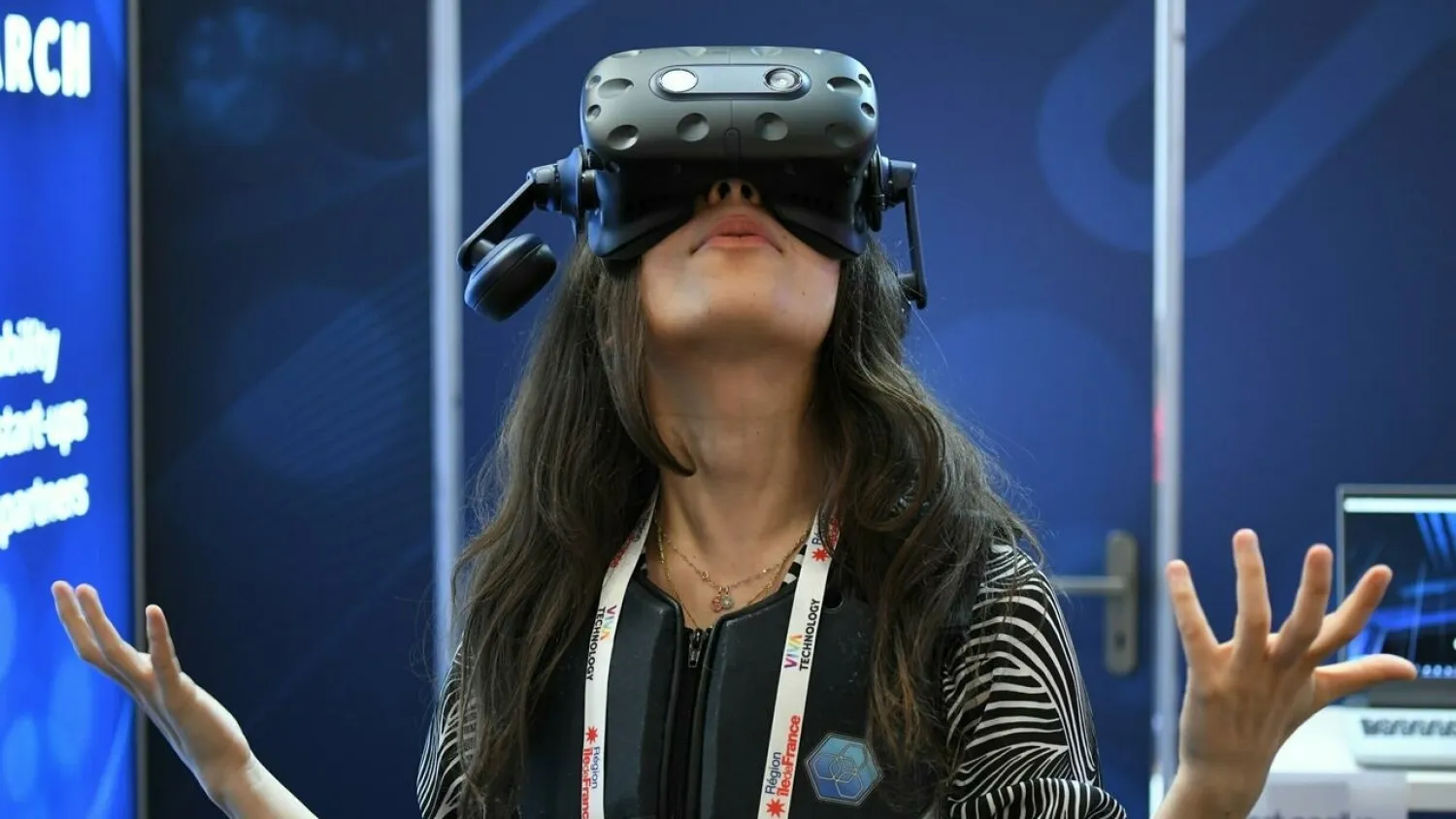
Campaigners and experts warn that the wider ecosystem of the metaverse needs to start acting to ensure child safety Eric PIERMONT AFP
TT

The Battle to Build a Child-friendly Metaverse

Campaigners and experts warn that the wider ecosystem of the metaverse needs to start acting to ensure child safety Eric PIERMONT AFP

As a young woman straps on her vest and headset and becomes immersed in a virtual world, Mainak Chaudhuri talks excitedly about the potential of the technology.

"This is the first step towards the metaverse," Chaudhuri of French start-up Actronika told AFP at this week's VivaTech trade show in Paris.

The vest can give users the sensation of being buffeted by the wind or even feel a monster's breath on their back, and it can be used to enhance movie watching, education or gaming, said AFP.

It is a family-friendly vision of the 3D immersive internet, now widely known as the metaverse, and sits well with some interactive experiences already widely available for children -- like virtual trips to museums.

But campaigners and experts are increasingly warning that the wider ecosystem needs to start acting on child safety to ensure the benign vision is realized.

"The biggest challenge is kids are getting exposed to content that is not intended for them," said Kavya Pearlman, whose NGO XR Safety Initiative campaigns to ensure immersive technology will be safe for everyone.

The problems she envisages range from children being exposed to sexual and violent material, to worries over young people being used as content creators or having inappropriate contact with adults.

Even though the metaverse has not yet been widely adopted and the technology is still in development, early users have already brought to light serious issues.

One woman's allegation that her avatar was sexually assaulted in the metaverse sparked global outrage.

Worries about the future of the technology have only grown as the economic opportunities have become clearer.

'Colossal' money
Metaverse-linked investments topped $50 billion last year, according to research firm McKinsey, which predicts the figure could more than double this year.

"We're talking about absolutely colossal amounts of money, that's three times more than the investment in artificial intelligence in 2017," McKinsey partner Eric Hazan told AFP.

Chief among the investors is tech giant Meta, which owns the likes of Instagram, Facebook and WhatsApp.

The firm has already rolled out measures to give parents more control over the content their children interact with while using VR headsets.

Meta and many of its competitors market immersive products with a lower age limit of 13 -- though it is widely accepted that younger children will use the tech.

Pearlman raises a broader concern that very little is known about the possible effects on young people's development.

"Organizations have not yet validated these experiences from a scientific perspective," she said.

"Yet they are allowing kids to be exposed to these new technologies, practically experimenting on children's developing brains."

The metaverse has shifted the paradigm, according to Valentino Megale, a neuropharmacologist who researches the issue.

While the public has so far merely consumed what others have created, in the metaverse "we are going to be part of the digital content", he said.

"This makes everything that we experience in that world more compelling," he told the RightsCon digital rights conference last week, adding that it was particularly true for children.

Experts worry that the industry needs scrutiny before the rot sets in.

'Ethical basis'
The solution, they argue, is to make sure the builders of these new virtual worlds instil child protection measures into the ethos of their work.

In other words, each piece of software and hardware should be constructed on the understanding that children might use it and will need safeguarding.

"We are potentially going to have a huge impact on their behavior, their identity, their emotions, their psychology in the exact moment when they are forming their personality," said Megale.

"You need to provide an ethical basis and safety by design from the beginning."

One of the most controversial areas of product design is the kind of suit that will allow users to feel all sorts of sensations -- even pain.

Such suits are already being manufactured, simulating pain through electric shocks.

The products are intended for military or other professional training.

Chaudhuri said the products developed by his firm Actronika use vibrations rather than electric shocks and were perfectly safe for anyone to use.

"We're about engaging the audience and not necessarily doing a real-time firefighting scenario or a battlefield scenario," he said.

"We don't cause pain."


UK Looks to Restart Cooperation after US Suspends Tech Deal

Pedestrians walk across Westminster Bridge as early morning fog covers the streets of London on December 17, 2025. (Photo by JUSTIN TALLIS / AFP)
TT

UK Looks to Restart Cooperation after US Suspends Tech Deal

Pedestrians walk across Westminster Bridge as early morning fog covers the streets of London on December 17, 2025. (Photo by JUSTIN TALLIS / AFP)

The UK government on Wednesday said it was focused on resuming talks promptly after the United States suspended implementation of a tech cooperation deal with Britain.

The deal was signed during US President Donald Trump's pomp-filled state visit to the UK in September.

But on Tuesday Michael Kratsios, head of the White House Office of Science and Technology Policy, said on X that the UK must make "substantial progress" on trade talks for the deal to resume.

The US and UK have been trying to implement the "Economic Prosperity Deal," agreed in May and one of the first international agreements signed after Trump threatened the world with punishing tariffs on goods entering the United States.

The US-UK Technology Prosperity Deal agreed in September 2025 was a non-binding agreement to sit alongside the broader Economic Prosperity Deal.

It was designed to align the two countries on tech innovation while spurring mostly private-sector investment, Agence France Presse reported.

Following the White House announcement, a UK government spokesperson said: "We look forward to resuming work on this partnership as quickly as possible... and working together to help shape the emerging technologies of the future."

Business and Trade Secretary Peter Kyle held trade talks with US counterparts in Washington DC last week to progress the Economic Prosperity Deal, the spokesperson said.

"They celebrated the success of the recent pharma deal and both sides agreed to continue further negotiations next year."

According to the Financial Times, US officials have become increasingly frustrated with Britain's lack of willingness to address non-tariff barriers, including rules and regulations governing food and industrial goods.


With Freebies, OpenAI, Google Vie for Indian Users and Training Data

FILE PHOTO: A message reading "AI artificial intelligence", a keyboard, and robot hands are seen in this illustration taken January 27, 2025. REUTERS/Dado Ruvic/Illustration/File Photo
TT

With Freebies, OpenAI, Google Vie for Indian Users and Training Data

FILE PHOTO: A message reading "AI artificial intelligence", a keyboard, and robot hands are seen in this illustration taken January 27, 2025. REUTERS/Dado Ruvic/Illustration/File Photo

OpenAI, Google and Perplexity have begun an unprecedented fight for artificial intelligence users in India, rolling out freebies in a strategy seen as a way to harvest troves of multilingual training data in the world's most populous nation.

India is the second-biggest smartphone market with 730 million devices. On average, Indians consume 21 gigabytes of data each month, paying 9.2 cents per gigabyte, one of the world's lowest mobile data rates. To lure price-conscious users, Google in November started giving its $400 Gemini AI Pro subscription for free for 18 months to 500 million customers of Reliance Jio, India's biggest telecom player.

Last week, it added India to dozens of countries where it is offering its heavily discounted "AI Plus" package. OpenAI has also made its ChatGPT Go plan, which offers extended but not unlimited usage compared with existing plans, free for a year.

The plan incurs charges in more than 100 countries and was $54 in India before being made free to everyone in the country in November, Reuters reported.

Just like Google's AI Pro, the free package is only available in India.

Early download data suggests a jump in usage due to the free plans, with daily active users of ChatGPT in India surging 607% year-on-year to 73 million as of last week - more than double the number in the US, according to data from market intelligence firm Sensor Tower compiled for Reuters.

Gemini's daily users in India rose 15% from when it launched the Reliance Jio offer in November to touch 17 million last week, compared to 3 million in the US, the data showed.

Perplexity, meanwhile, has made its Pro tool - priced at $200 a year globally - free for a year for users of Indian telecom company Airtel. It says the plan gives unlimited access to its most advanced research tools.

India now accounts for more than a third of Perplexity's global daily active users, up from just 7% last year, Sensor Tower data showed. OpenAI, Perplexity and Google did not respond to Reuters requests for comment.

TRAINING FILLS DATA GAPS
OpenAI's India executive, Pragya Misra, has said on social media the company's decision to make ChatGPT Go free was part of its "continued India-first commitment" and to make tools more accessible to everyone.

Five AI analysts, however, said the freebies strategy would help companies gain from India's linguistic diversity to secure crucial data for AI training.

They view the training data generated by Indian users, characterized by a mix of languages and dialects, as a critical stress test that will help AI models master complex communication patterns that are largely absent from the existing data. Free plans "fill gaps in AI training data sets that currently lack information on user behavior patterns in the region," said Sagar Vishnoi, co-founder at AI think tank Future Shift Labs.

FREEBIES WORK IN INDIA, OFTEN
Indian billionaire Mukesh Ambani's Reliance, which has partnered with Gemini, has repeatedly used aggressive pricing to boost its customer base. Its telecom unit now has more than 500 million users, after luring customers at its 2016 launch with months of free data and voice services.

Reliance and Disney offered cricket streaming for free on their India platforms, before merging their India media operations.

ChatGPT is seeing high app usage -- with 46% of its monthly users opening the app daily in India in November, compared to 20% for Perplexity and 14% for Gemini, Sensor Tower's data showed.

Anees Hassan, a PhD student in Hyderabad, is using the free ChatGPT and Gemini plans for three hours a day to find citations, refine his writing and generate images for presentations.

"The free plan was not good enough as I used to hit chat limit caps faster," said Hassan, 33.

Still, he is also aware that freebies sometimes come with costs.

"I am concerned about data harvesting, so I have used the opt-out feature to stop sharing my data for AI training," he added.


Alswaha: Saudi Arabia Leads International Indicators, Efforts to Bridge AI Gaps

Saudi Minister of Communications and Information Technology Abdullah Alswaha speaks at the event in New York. (SPA)
TT

Alswaha: Saudi Arabia Leads International Indicators, Efforts to Bridge AI Gaps

Saudi Minister of Communications and Information Technology Abdullah Alswaha speaks at the event in New York. (SPA)

Saudi Minister of Communications and Information Technology Abdullah Alswaha stressed on Tuesday that the Kingdom’s achievements represent the greatest digital success story of the 21st century.

This was possible by the support of Custodian of the Two Holy Mosques King Salman bin Abdulaziz Al Saud and the direct enablement by Prince Mohammed bin Salman bin Abdulaziz Al Saud, Crown Prince and Prime Minister, reflecting their ambitious vision for building a comprehensive technological future.

The minister made his remarks from New York during his participation in the high-level meeting of the United Nations General Assembly (UNGA) on the overall review of the implementation of the outcomes of the World Summit on the Information Society (WSIS).

Alswaha said that progress in the information society is reflected worldwide, with the number of internet users rising from around 800 million to nearly 6 billion.

The Kingdom ranked first globally on the ICT Development Index (IDI) issued by the UN International Telecommunication Union (ITU) and made remarkable progress in empowering women in the digital world, with female participation reaching approximately 36%, he revealed.

He highlighted that the foremost challenge today lies in bridging the gaps in artificial intelligence (AI), namely the computing gap, the data gap, and the algorithm gap.

Alswaha stated that the Kingdom leveraged its capabilities to boost advanced computing power and launch national language models that help close the data gap in the Arab world, including the AI model “ALLaM.”

Moreover, he noted global scientific achievements, such as Saudi scientist Omar Yaghi winning the 2025 Nobel Prize in Chemistry, reflecting Saudi Arabia’s scientific presence on the international stage.

He stressed that the achievements reflect the profound impact of the support from King Salman and Crown Prince Mohammed in consolidating the Kingdom’s global standing, enhancing its pivotal role in leading a more inclusive technological future, harnessing technologies for human benefit, supporting sustainable development, and aligning with the world’s aspirations for a more advanced and integrated era.
