


Israel to Dissolve Parliament, Call 5th Election in 3 Years

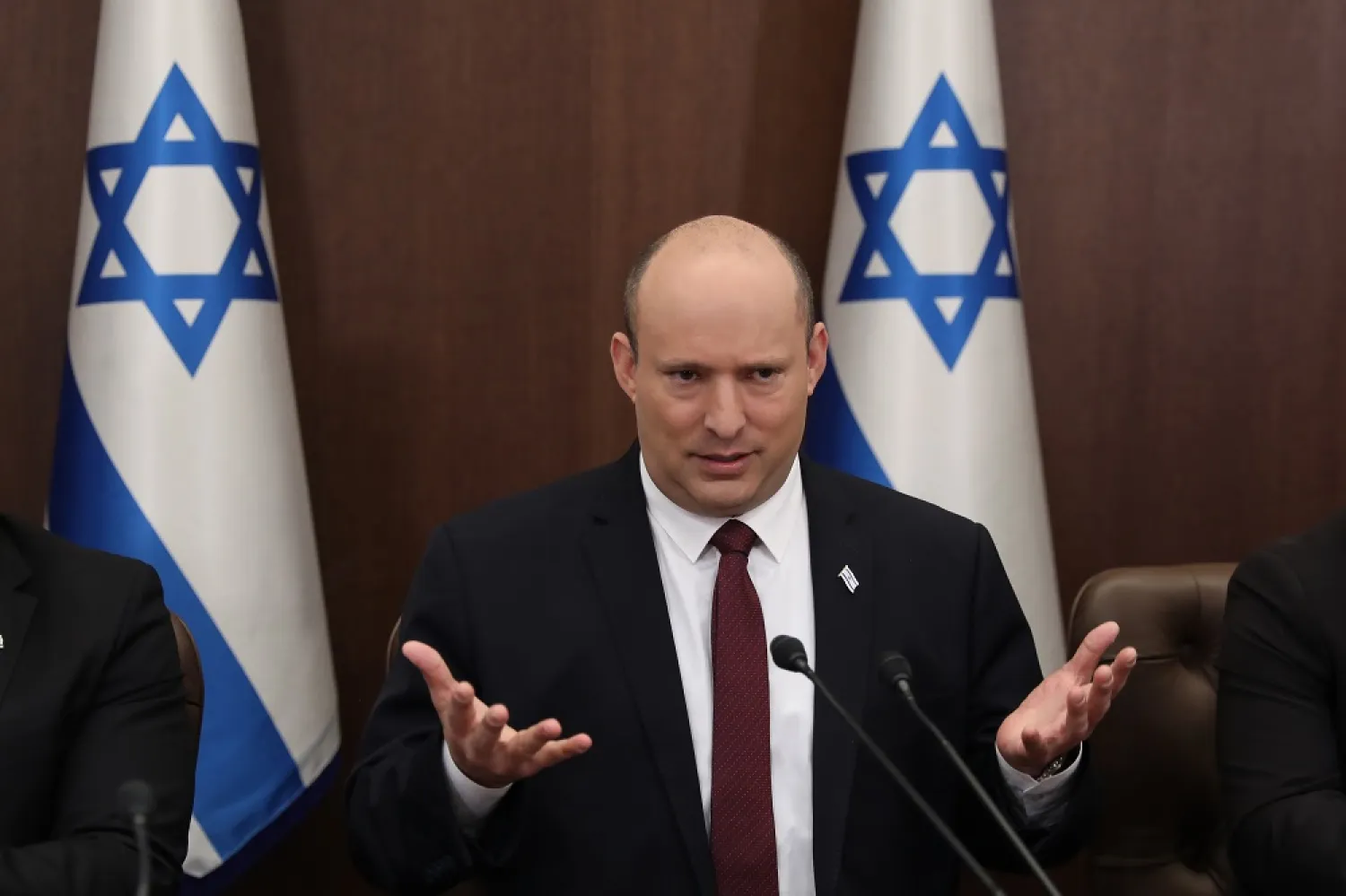
Israeli Prime Minister Naftali Bennett attends a cabinet meeting at the Prime Minister's office in Jerusalem, Sunday, June 19, 2022. (AP)
TT

Israel to Dissolve Parliament, Call 5th Election in 3 Years

Israeli Prime Minister Naftali Bennett attends a cabinet meeting at the Prime Minister's office in Jerusalem, Sunday, June 19, 2022. (AP)

Israel’s weakened coalition government announced Monday that it would dissolve parliament and call new elections, setting the stage for the possible return to power of former Prime Minister Benjamin Netanyahu or another period of prolonged political gridlock.

The election will be Israel's fifth in three years, and it will put the polarizing Netanyahu, who has been the opposition leader for the past year, back at the center of the political universe.

"I think the winds have changed. I feel it," Netanyahu declared.

The previous four elections, focused on Netanyahu’s fitness to rule while facing a corruption investigation, ended in deadlock. While opinion polls project Netanyahu, who is now on trial, as the front-runner, it is far from certain that his Likud party can secure the required parliamentary majority to form a new government.

Prime Minister Naftali Bennett, a former ally and aide of Netanyahu, formed his government a year ago with the aim of halting the never-ending cycle of elections. But the fragile coalition government, which includes parties from across the political spectrum, lost its majority earlier this year and has faced rebellions from different lawmakers in recent weeks.

Announcing his plan to disband the government during a nationally televised news conference, Bennett said he had made "the right decision" in difficult circumstances.

"Together, we got Israel out of the pit. We accomplished many things in this year. First and foremost, we brought to center stage the values of fairness and trust," Bennett said, standing alongside his main partner, Foreign Minister Yair Lapid. "We shifted to a culture of ‘we,’ ‘together.’"

Under their coalition deal, Lapid, who heads the large centrist party Yesh Atid, now becomes the interim prime minister until the election, in which he is expected to be the main rival to Netanyahu.

Standing together with Bennett, he thanked his partner for his hard work and for putting the country ahead of his personal interests.

"Even if we’re going to elections in a few months, our challenges as a state cannot wait," Lapid said. "What we need to do today is go back to the concept of Israeli unity. Not to let dark forces tear us apart from within."

Bennett’s coalition included a diverse array of parties, from dovish factions that support an end to Israel’s occupation of lands captured in 1967 and claimed by the Palestinians, to hard-line parties that oppose Palestinian statehood.

Many of the parties had little in common beyond a shared animosity to Netanyahu. Often described as a political "experiment," the coalition made history by becoming the first to include an Arab party.

Bennett listed his government’s accomplishments, including passing a national budget for the first time in three years and leading the country through two waves of the coronavirus without imposing a lockdown. Under his watch, Israel’s tense border with the Gaza Strip remained largely quiet, though tensions with the Palestinians escalated in east Jerusalem and the occupied West Bank. His Arab partner, the Islamic Ra'am party, secured unprecedented budgets to fight poverty, neglect and discrimination in Israel's Arab sector.

On the international stage, Bennett repaired Israel's bipartisan standing in Washington, which suffered after Netanyahu's close ties with former President Donald Trump. He deepened fledgling ties with Gulf Arab countries, repaired frayed relations with Egypt and Jordan, and claimed to have prevented the United States from reviving an international nuclear deal with Iran. Bennett even briefly emerged as a mediator in the Russia-Ukraine war.

Despite its successes, the coalition eventually unraveled, in large part because several members of Bennett’s own hard-line party objected to what they felt were his pragmatism and moderation.

Netanyahu, meanwhile, whipped up the opposition by accusing Bennett of cooperating with "terror supporters" - a reference to his Arab partners in the coalition. A Netanyahu supporter was arrested last month on suspicion she sent death threats and bullets to Bennett's family in the mail.

Palestinian citizens of Israel make up about 20% of the country’s population but are often seen as a fifth column and have never before been part of a coalition. Although Netanyahu himself had also courted the same Islamist party last year, the criticism appeared to make some of the hard-line members of Bennett’s coalition uncomfortable.

The final blow to the government was the looming expiration of a law that grant Israel’s West Bank settlers special legal status.

The law underpins separate legal systems for Jews and Palestinians in the West Bank, a situation that three prominent human rights groups say amounts to apartheid. Israel rejects that allegation as an attack on its legitimacy.

Parliament had been set to extend the law earlier this month, as it has done for the past 55 years. But the hard-line opposition, comprised heavily of settler supporters, paradoxically voted against the bill in order to embarrass Bennett. Dovish members of the coalition who normally oppose the settlements voted in favor in hopes of keeping the government afloat.

But a handful of coalition members, including Arab lawmakers as well as hard-line nationalists, either abstained or voted with the opposition to defeat the bill and cause the coalition to rip apart.

Bennett, a former settler leader, said there would have been "grave security perils and constitutional chaos" if he had allowed the law to expire at the end of the month. "I couldn’t let that happen," he said.

Bennett and Lapid will now present a bill to dissolve parliament in the coming days. Once that passes, the country will head to an election, most likely in October.

The settler law remains in effect and will not expire if the government collapses.

Netanyahu described the imminent dissolution of parliament as "great tidings" for millions of Israelis, and he said he would form "a broad nationalist government headed by Likud" after the next election.

But he also vowed to try to form an alternative government before the parliamentary vote by trying to persuade some of his opponents to support him. The odds of that appeared slim, given their past never to serve under Netanyahu while he is on trial.

"There’s a need to rehabilitate the state of Israel, and we have the ability to do it," Netanyahu said.

The dissolution threatened to overshadow a visit by President Joe Biden scheduled for next month. A statement issued by Biden’s National Security Council said he "looks forward to the visit."

Israel held four inconclusive elections between 2019 and 2021 that were largely referendums about Netanyahu’s ability to rule while on trial for corruption. Netanyahu denies wrongdoing.

Opinion polls have forecast that Netanyahu’s hard-line Likud will once again emerge as the largest single party. But it remains unclear whether he would be able to muster the required support of a majority of lawmakers to form a new government.

Yohanan Plesner, president of the Israel Democracy Institute, said Monday’s developments were "a clear indication that Israel’s worst political crisis did not end when this government was sworn into office."



Modi Breaks Netanyahu’s Isolation with 16 Cooperation Agreements

The Indian Prime Minister listens to the Israeli Prime Minister during an exceptional session of the Knesset on Wednesday (EPA)
TT

Modi Breaks Netanyahu’s Isolation with 16 Cooperation Agreements

The Indian Prime Minister listens to the Israeli Prime Minister during an exceptional session of the Knesset on Wednesday (EPA)

In a move seen as breaking Israel’s relative international isolation amid its ongoing war in Gaza, Indian Prime Minister Narendra Modi signed 16 agreements with Israel during a two-day visit to the country.

Modi arrived in Israel on Wednesday for talks aimed at strengthening ties in trade and defense. The visit was marked by an unusually warm reception. Israeli Prime Minister Benjamin Netanyahu personally welcomed Modi at the airport and later accompanied him to address the Knesset, Israel’s parliament, where lawmakers applauded and cheered.

Netanyahu hailed Modi as “a great global leader and a great friend; more than that, a great brother.”

He added: “They say India has achieved tremendous accomplishments. That is not accurate. It should be said that thanks to your leadership, your wisdom, and your determination, India has achieved its successes.”

The Israeli premier also thanked Modi for India’s assistance during the recent Gaza war, noting that New Delhi had supplied Israel with ammunition and drones.

Sixteen Agreements and a Historic Honor

The Israeli government announced the signing of 16 bilateral agreements during the visit. In a symbolic gesture, Knesset Speaker Amir Ohana awarded Modi the “Knesset Medal,” marking the first time the honor has been bestowed on a visiting leader.

This is Modi’s second visit to Israel since taking office, nearly nine years after his first trip in 2017.

Beyond political symbolism, the relationship carries significant economic weight. India is Israel’s second-largest trading partner in Asia. According to India’s Ministry of Commerce and Industry, total bilateral trade reached $3.62 billion in fiscal year 2025.

Renewed Indian Condemnation of October 7

For his part, Modi declared that “India stands with Israel at this moment and beyond.” Addressing the Knesset plenary, he offered condolences for those killed in the Oct. 7, 2023 attack launched by Hamas, describing it as a “terrorist and brutal attack.”

Modi also praised a plan proposed by US President Donald Trump that he said would safeguard Palestinian national rights.

Expanding Strategic Ties, Secrecy

Observers view the visit not merely as a reflection of improved relations, but as a major step in advancing strategic cooperation. The agreements include memoranda of understanding designed to deepen coordination across several sectors, particularly in security, with officials describing the partnership as a “distinguished strategic relationship.”

Security sources revealed that the two sides reached an arrangement establishing a “confidentiality framework,” allowing India access to previously restricted Israeli systems. These reportedly include advanced air defense systems and integration into Israel’s laser-based air defense network. India is also expected to receive licenses to manufacture certain Israeli weapons systems domestically.

The Israeli daily Yedioth Ahronoth quoted a senior political official as saying the agreement would provide greater flexibility to security agencies and enable both countries to rely on one another when necessary, calling it “a major revolution.”

Writing in the right-leaning newspaper Israel Hayom, columnist and former lawmaker Zvi Hauser, a political ally of Netanyahu, said one of the key issues Modi and Netanyahu would discuss is Iran’s future and the prospects for the fall of its regime. Hauser suggested that Israel, India, and a post-Revolution Iran could form a powerful strategic alliance in the region.


Cuba Says It Killed Four Gunmen on Speedboat Trying to Infiltrate from US

Cuban coast guard ships docked at the port of Havana. (AFP) 
TT

Cuba Says It Killed Four Gunmen on Speedboat Trying to Infiltrate from US

Cuban coast guard ships docked at the port of Havana. (AFP) 

Cuba said it thwarted the attempt of gunmen trying to infiltrate from the United States as its coastguard opened fire on Wednesday at a Florida-registered speedboat near its shores, killing four people and wounding six.

Havana's Interior Ministry said the speedboat's passengers opened fire on a coast guard vessel that approached them near an island off the country's northern coast.

The ministry claimed the passengers were armed and intended to “carry out an infiltration for terrorist purposes.”

Handguns, assault rifles and improvised explosive devices were recovered on the speedboat, according to the statement, along with other tactical gear.

The ministry said the 10 passengers are all Cuban citizens living in the US.

US Secretary of State Marco Rubio said Washington was seeking its own facts about the shooting and would “respond accordingly.”

“We're not going to base our conclusions on what they've (Cuba) told us, and I'm very, very confident that we will know the full story of what happened here,” Rubio told reporters while on a trip to the Caribbean nation of St Kitts and Nevis. “As we gather more information, then we'll be prepared to respond accordingly.”

James Uthmeier, Florida's attorney general, said he would direct local law enforcement to investigate the incident.

“The Cuban government cannot be trusted, and we will do everything in our power to hold these communists accountable,” he said.

In an earlier statement posted on X, the Cuban interior ministry said the Florida-registered vessel was detected near Cayo Falcones, in the country's central Villa Clara province on Wednesday morning.

When a Cuban boat carrying five members of the ministry's border guard approached the vessel for identification, “the crew of the violating speedboat opened fire” and wounded the Cuban commander, the statement said.

It added that “As a consequence of the confrontation, as of the time of this report, four aggressors on the foreign vessel were killed and six injured.”

Those injured were evacuated and given medical assistance, the statement said.

In Washington, US Vice President JD Vance said the White House was “monitoring” the incident but added that he hoped it was not a serious one.

“Certainly, you know, a situation that we're monitoring, hopefully it's not as bad as we fear it could be. But can't say more, because I just don't know more,” Vance told reporters.

The confrontation comes amid heightened tensions between the United States and Cuba, which lies just 160 km across the Florida Straits. It also comes as the US softened a virtual oil siege of the island imposed by President Donald Trump in January after the US ouster of top Cuba ally, Nicolas Maduro of Venezuela.

Before Maduro's capture by US forces on 3 January, Cuba had relied on Venezuela for about half its fuel needs.

Faced with an outcry from Caribbean leaders, worried that starving Cuba of oil would cause the economy to quickly collapse, the US said it would allow shipments of Venezuelan oil for “commercial and humanitarian use.”


US Arrests Ex-Air Force Pilot for Training Chinese Military

Former Air Force pilot Gerald Brown (photo circulated on social media)
TT

US Arrests Ex-Air Force Pilot for Training Chinese Military

Former Air Force pilot Gerald Brown (photo circulated on social media)

The US Justice Department announced the arrest on Wednesday of a former Air Force fighter pilot who allegedly trained Chinese military personnel without authorization.

Gerald Brown, 65, was arrested in Indiana after having recently returned to the United States from China, where he had been since December 2023, a Justice Department statement said.

He is accused of having "conspired with foreign nationals to provide combat aircraft training to pilots in the Chinese Air Force" without a required license from the US State Department, AFP quoted the statement as saying.

FBI director Kash Patel posted on X: "Major story... the FBI and our partners have arrested a former US Air Force Pilot who was allegedly training pilots in the Chinese military."

Brown had a 24-year career in the US Air Force during which he "commanded sensitive units with responsibility for nuclear weapons delivery systems, led combat missions, and served as a fighter pilot instructor and simulator instructor on a variety of fighter and attack aircraft."

He had retired from the military in 1996 and worked as a cargo pilot, the statement said, but he later began a role as a US defense contractor training pilots to fly the A-10 and state-of-the-art F-35 fighter jets.

He allegedly began negotiating a contract in August 2023 with Stephen Su Bin -- a Chinese national who was imprisoned in the United States for four years beginning in 2016 over another espionage scheme -- and traveled in December 2023 to China to begin his training job.

"The Chinese government continues to exploit the expertise of current and former members of the US armed forces to modernize China's military capabilities," said Roman Rozhavsky, an official with the FBI's Counterintelligence and Espionage Division.

"This arrest serves as a warning that the FBI and our partners will stop at nothing to hold accountable anyone who collaborates with our adversaries to harm our service members and jeopardize our national security," he added.