

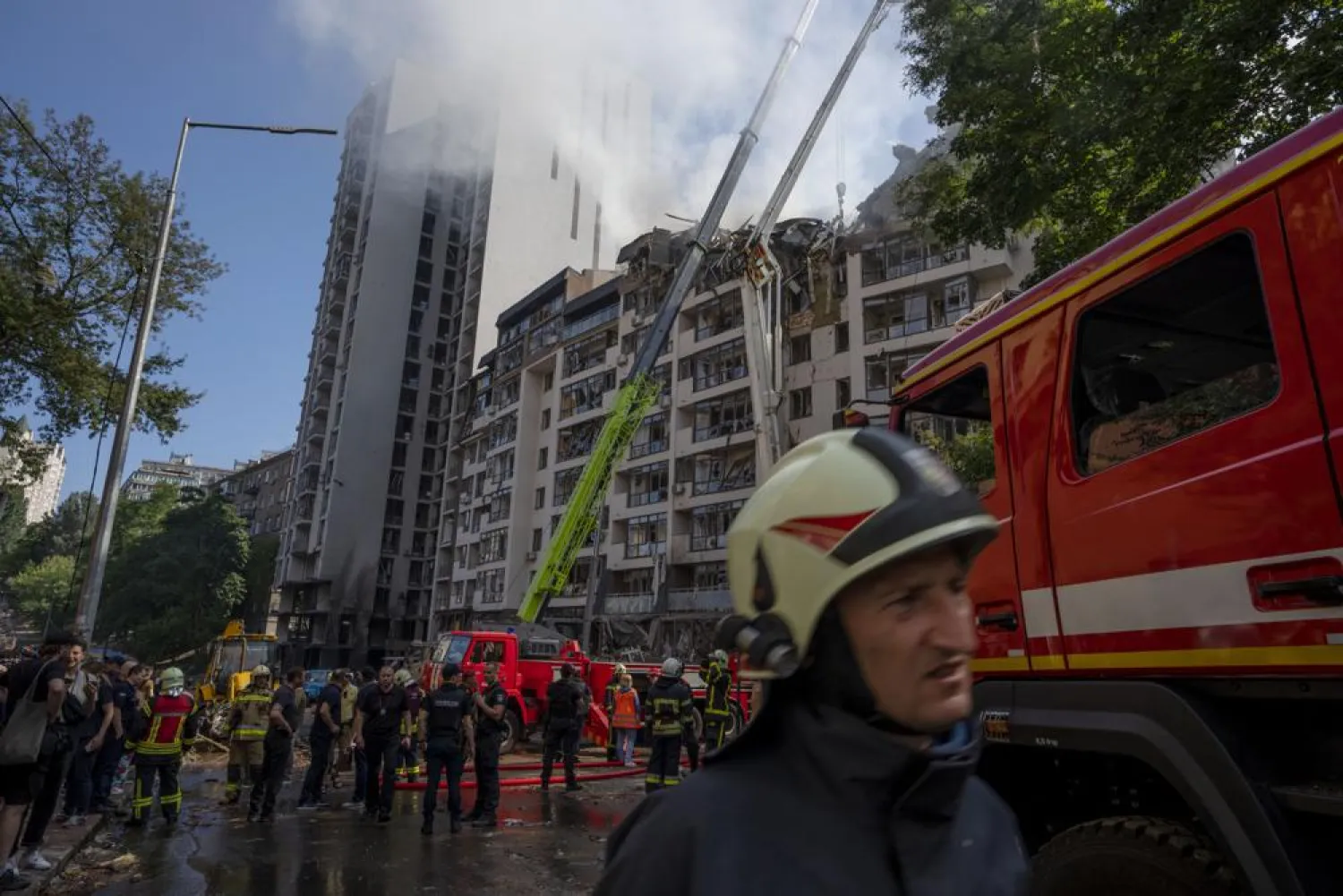

Russia’s Messages with Missiles Tell West to Back Off

Firefighters work at the scene of a residential building following explosions, in Kyiv, Ukraine, June 26, 2022. (AP)
TT

Russia’s Messages with Missiles Tell West to Back Off

Firefighters work at the scene of a residential building following explosions, in Kyiv, Ukraine, June 26, 2022. (AP)

The latest in a litany of horrors in Ukraine came this week as Russian firepower rained down on civilians in a busy shopping mall far from the front lines of a war in its fifth month.

The timing was not likely a coincidence.

While much of the attritional war in Ukraine’s east is hidden from sight, the brutality of Russian missile strikes on a mall in the central city of Kremenchuk and on residential buildings in the capital, Kyiv, unfolded in full view of the world and especially of Western leaders gathered for a trio of summits in Europe.

Were the attacks a message from Russian President Vladimir Putin as the West sought to arm Ukraine with more effective weapons to bolster its resistance, and to set Ukraine on the path to joining the European Union?

Kyiv Mayor Vitali Klitschko suggested as much when missiles struck the capital on June 26, three days after EU leaders unanimously agreed to make Ukraine a candidate for membership.

It was "maybe a symbolic attack" as the Group of Seven leading economic powers and then NATO leaders prepared to meet and apply further pressure on Moscow, he said. At least six people were killed in the Kyiv strike, which pummeled an apartment building.

The former commanding general of US Army forces in Europe, retired Lt. Gen. Ben Hodges, went further in connecting the attack and the meetings. "The Russians are humiliating the leaders of the West," he said.

A day after the Kyiv attack, as G7 leaders met in Germany to discuss further support for Ukraine during their annual summit, Russia fired missiles at a crowded shopping mall in the central Ukrainian city of Kremenchuk, killing at least 19 people.

The timing of both attacks appeared to be juxtaposed with the European meetings of US President Joe Biden, British Prime Minister Boris Johnson, German Chancellor Olaf Scholz and French President Emmanuel Macron, all supporters of Ukraine.

Defying the evidence, Putin and his officials deny that Russia hit residential areas. Putin has denied that Russian forces targeted the Kremenchuk mall, saying it was directed at a nearby weapons depot. But Ukrainian officials and witnesses said a missile directly hit the mall.

It was hardly the first time that bursts of violence were widely seen as signals of Moscow’s displeasure. In late April, Russian missiles struck Kyiv barely an hour after Ukrainian President Volodymyr Zelenskyy held a news conference with visiting UN Secretary-General Antonio Guterres.

"This says a lot about Russia’s true attitude toward global institutions," Zelenskyy said at the time. Kyiv's mayor called the attack Putin’s way of giving the "middle finger."

The Russian president recently warned that Moscow would strike targets it had so far spared if the West supplied Ukraine with weapons that could reach Russia. If Kyiv gets long-range rockets, Russia will "draw appropriate conclusions and use our means of destruction, which we have plenty of," Putin said.

On Friday, a day after Russian forces made a high-profile retreat from Snake Island near the Black Sea port city of Odesa following what Ukraine called a barrage of artillery and missile strikes, Russia bombarded residential areas in a coastal town near Odesa and killed at least 21 people, including two children.

While Russia’s messaging can be blunt and devastating, Ukraine’s signals under Zelenskyy have focused daily on seeking to amplify Moscow’s cruelty to a world that day by day risks becoming weary of the war.

If interest fades, the concerted support seen at global summits could fade, too. and with it the urgency to deliver the heavier weapons that Ukraine craves.

Zelenskyy tends to pair pleas for more help with reminders that all of Europe ultimately is at stake.

He described the mall attack as "one of the most daring terrorist attacks in European history."

For all of Ukraine’s indisputable suffering, it was a bold statement of some hyperbole in the context of extremist attacks with mass deaths in Paris, Nice, Brussels, Madrid and London in this century alone.

For Zelenskyy and Ukraine, the underlying demand cannot be reiterated enough: provide more heavy weapons, and faster, before Russia perhaps makes irreversible gains in the eastern industrial region of the Donbas, where street-by-street fighting grinds on.

In his nightly public addresses, Zelenskyy also makes sure to capture the traumatic toll on everyday life in Ukraine, appealing well beyond global leaders to the wider world.

This week, he accused Russia of sabotaging "people’s attempts to live a normal life."

Images of the shopping mall’s smoking debris said the rest.



Why Hantavirus Is Not the New Covid, According to Experts

 The hantavirus-stricken cruise ship MV Hondius is seen at anchor at the port of Granadilla in Tenerife, Canary Islands, Spain, Monday, May 11, 2026. (AP)
The hantavirus-stricken cruise ship MV Hondius is seen at anchor at the port of Granadilla in Tenerife, Canary Islands, Spain, Monday, May 11, 2026. (AP)
TT

Why Hantavirus Is Not the New Covid, According to Experts

 The hantavirus-stricken cruise ship MV Hondius is seen at anchor at the port of Granadilla in Tenerife, Canary Islands, Spain, Monday, May 11, 2026. (AP)
The hantavirus-stricken cruise ship MV Hondius is seen at anchor at the port of Granadilla in Tenerife, Canary Islands, Spain, Monday, May 11, 2026. (AP)

A deadly hantavirus outbreak on a cruise ship has revived bitter memories of when Covid-19 first emerged, but health experts have emphasized the two viruses are very different -- and have sought to assuage fears of another pandemic.

Here is what you need to know.

- New or old? -

After the first cases of Covid in late 2019, it was referred to as the "novel coronavirus" because it was a brand new pathogen.

The virus rapidly engulfed the world, sending countries into punishing lockdowns and crippling the global economy.

The exact number of people killed by Covid is difficult to determine, but the World Health Organization estimates it was at least 20 million.

Unlike Covid, hantavirus is not a new pathogen.

It was first described among soldiers fighting in the Korean War in the early 1950s.

Cases of hantavirus are regularly recorded across the world, particularly in Asia and Europe. It has long been monitored in areas where the virus is endemic.

- Transmission and symptoms -

Humans almost always catch hantavirus by being exposed to the saliva, urine or droppings of wild rodents. The most common way is to inhale dust from droppings.

The Andes hantavirus strain, which caused the recent outbreak on the MV Hondius cruise ship, is the only one out of more than 30 species known to be able to transmit between humans.

But even this is rare, with only a handful of previously documented cases.

After being infected with Andes, it takes between one and six weeks for symptoms to appear. This is vastly shorter than for Covid, which has an incubation period of seven to 10 days.

Human-to-human transmission of Andes "requires very specific conditions of close proximity, overcrowding, or an underlying health condition -- far beyond what is known for other respiratory viruses," including Covid, Virginie Sauvage, the head of France's National Reference Center for Hantaviruses, told AFP.

The last major outbreak in 2018 killed at least 11 people in Argentina, where the Andes species is endemic. Two of the three people who died in the latest outbreak travelled to Argentina before boarding the cruise ship.

Research into the 2018 outbreak found that the majority of transmission occurred on the first day the infected person showed symptoms.

Hantaviruses in the Americas such as Andes can cause severe respiratory and cardiac distress, as well as hemorrhagic fever.

In comparison, Covid is solely a respiratory illness, and can cause fever, shortness of breath, body aches, fatigue and loss of smell.

- Too lethal for a pandemic? -

The Andes hantavirus may be too rapidly fatal to spark a pandemic, explained biologist Raul Gonzalez Ittig of Argentina's scientific research agency Conicet.

"For a pandemic to occur, the virus cannot be so lethal that it kills 50 percent of the population, because it quickly kills everyone and runs out of opportunities to spread," Ittig told AFP.

The Andes hantavirus is thought to have a mortality rate of around 40 percent.

"So deaths start appearing quickly, isolation measures are put in place quickly, and the chain of transmission is rapidly stopped," Ittig said.

Covid, on the other hand, "infects thousands of people and only later do deaths start to accumulate," he said.

"Everything happens much faster: One person transmits it, 10 people become infected, and they die if they do not receive proper treatment," he said.

"That is why there is not as much chance of a hantavirus pandemic."

- Treatment and vaccines? -

There are currently no treatments or vaccines specifically targeting hantavirus, so doctors treat the symptoms it causes, such as breathing problems.

"The faster people receive treatment, the better their prognosis," Sauvage said.

Patients with severe lung damage may need a machine to help them breathe. Kidney failure may lead them to require dialysis.

There have been trials for vaccines targeting some hantavirus strains, "but their effectiveness has not yet been proven against all hantaviruses," French infectious disease specialist Vincent Ronin told AFP.

During the pandemic, new Covid treatments and vaccines were developed in record time.

With billions of vaccines administered worldwide, the effectiveness of these jabs has been thoroughly demonstrated -- though vaccination rates have fallen steeply in recent years.


Gaza Wedding Cheers Drown Out Sound of Israeli Airstrikes

Palestinians gather at a wedding in the Al-Nasser neighborhood, west of Gaza City, in April. (Asharq Al-Awsat)
TT

Gaza Wedding Cheers Drown Out Sound of Israeli Airstrikes

Palestinians gather at a wedding in the Al-Nasser neighborhood, west of Gaza City, in April. (Asharq Al-Awsat)

Since the announcement of a ceasefire agreement in Gaza last October, Israeli violations have continued and the toll of dead and wounded has climbed. Yet, that has not stopped residents of the Palestinian enclave — almost entirely devastated by war — from breaking into celebratory wedding cheers that, if only briefly, cut through the buzz of drones and the thunder of airstrikes.

In recent weeks, residents in Khan Younis, Al-Shati refugee camp, Shujaiya and other areas have held public wedding celebrations attended by relatives and neighbors, reviving scenes absent from Gaza throughout more than two years of war.

Alaa Moussa, 33, from the Sheikh Nasser area of Khan Younis in southern Gaza, lost her husband in an Israeli strike in mid-2024. She said she married in late April a man four years older than her who had also lost his wife and two children in a strike that hit displaced persons’ tents in the Al-Mawasi area of the same city.

“I accepted only a symbolic dowry of no more than 1,500 Jordanian dinars ($2,100), because it has become insignificant under these difficult circumstances,” Moussa told Asharq Al-Awsat.

She held what she described as a “modest wedding” among the tents of displaced families in Al-Mawasi, where one of the tents has become the couple’s new home.

“The war has not stopped, yet like many others we are searching for moments of joy despite all the pain we have endured and continue to endure in Gaza amid unrelenting attacks,” she remarked.

Moussa, who had no children with her late husband, said she saw no issue in marrying a man with three children “despite some criticism” from relatives and those around her.

“I will raise them as though they were my own,” she added.

Palestinians gather at a wedding in the Al-Nasser neighborhood, west of Gaza City, in April. (Asharq Al-Awsat)

‘Social criticism’

Israel has imposed restrictions and a tight blockade on Gaza since the early 1990s, tightening them further after Hamas seized control of the enclave nearly 19 years ago. Unemployment rose from 29.7 percent in 2007 to 45 percent in 2023, the year the war erupted at its close.

Abdullah Farhat, 29, from Al-Shati refugee camp west of Gaza City, was among those whose hopes of marriage and starting a family were delayed for years by Gaza’s harsh economic conditions.

Farhat told Asharq Al-Awsat he recently married a woman two years older than him who had lost her husband at the start of the current war.

He said he paid little attention to what he described as “social criticism” over “marrying a widow or the age difference.”

“My convictions did not change, especially after we found mutual acceptance,” he stated.

Return of wedding halls

Months after the ceasefire, wedding gatherings gradually returned in some areas. Youth parties have also resurfaced, and some wedding halls have reopened to customers.

Ayman Muhaysin, 26, from the Shujaiya neighborhood east of Gaza City, who is displaced in a school turned shelter in the Rimal district, held his wedding last month in a wedding hall in his neighborhood.

He said he paid 4,000 shekels (about $1,300) for the venue and a similar amount for a separate gathering for male relatives and friends, in keeping with Gaza traditions in which the groom’s celebration is held one day with male relatives and friends, followed the next day by a reception attended by women inside the hall, while close male relatives from both families gather outside.

Ayman Muhaysin celebrates his wedding in the Rimal neighborhood of Gaza City in April. (Photo provided by Muhaysin)

Muhaysin works in a shop earning 1,500 shekels a month. After the wedding, he moved into a classroom where he had been living with his four brothers, who relocated to a neighboring classroom to stay with their parents and three sisters.

Muhaysin said he had to borrow heavily to finance the wedding but did not regret it.

“I lost my brother during the war, along with many relatives, but this is life. We are searching for whatever brings joy to our hearts despite the hardships we face,” he told Asharq Al-Awsat.

Exorbitant prices

Dozens of wedding halls built along Gaza’s Mediterranean coast were destroyed by Israeli forces during the war. Some restaurants and investors have since opened new venues west of Gaza City, though many residents consider their prices exorbitant.

Mohammed Ghanem, an owner of a wedding hall in Gaza City, explained that prices are high because of the cost of constructing these halls.

“The lack of electricity, operating private generators and securing fuel for them all add to expenses, in addition to the salaries of male and female employees providing wedding services,” he underlined.

Ghanem said prices were “close to what wedding halls charged before the war,” but noted that the new venues “do not have the same level of amenities and equipment that halls once had.”

Recently, Arab and Islamic charitable organizations have begun sponsoring mass wedding ceremonies in Gaza and providing financial support to newlyweds as part of efforts “to ease the burden on young people, tens of thousands of whom rushed to register for such an opportunity.”


Caspian Sea Provides Lifeline for Iran amid Sanctions, Blockade

An Iranian man walks past the map of Iran, with its citizens holding hands, painted on a wall in the capital Tehran on May 9, 2026. (AFP)
TT

Caspian Sea Provides Lifeline for Iran amid Sanctions, Blockade

An Iranian man walks past the map of Iran, with its citizens holding hands, painted on a wall in the capital Tehran on May 9, 2026. (AFP)

Amid the regional tensions and western sanctions, a complex network of supply routes is beginning to emerge, underscoring the alliances between Russia, Iran and China in confronting mounting US pressure on Iran’s military program and its ability to maintain its production.

In March, Israel carried out a “one of the most significant” strikes on Iran targeting its naval command center at the port of Bandar Anzali, located on the Caspian Sea.

The Caspian Sea, a huge body of water hundreds of miles north of the Gulf. Routinely overlooked, the Caspian has taken on new significance as a trade route linking Russia and Iran, reported The New York Times on Saturday.

For two allies that have been embroiled in wars and facing more Western sanctions than any other country, the waterway provides a passageway for both overt and covert trade — shipments that have helped Iran persist as an adversary to the United States despite overwhelming American military superiority.

Russia is shipping drone components to Iran via the Caspian Sea, US officials say, helping Iran rebuild its offensive abilities after losing roughly 60 percent of its drone arsenal during recent fighting. The officials spoke anonymously to divulge private military assessments.

Russia also provides goods that would typically pass through the Strait of Hormuz, now blockaded by the US Navy, as part of global trade.

Bigger than Japan, the Caspian is considered the largest lake in the world. Much of the trade passing through it is opaque. It has proved difficult to monitor from afar, not least because ships plying the route between Russian and Iranian ports habitually turn off the transponders that allow for satellite tracking, according to maritime tracking groups.

“If you’re thinking about the ideal place for sanction evasion and military transfers, it’s the Caspian,” said Nicole Grajewski, a professor specializing in Iran and Russia at Sciences Po in Paris, according to NYT.

While both Russia and Iran are public about trade in commodities like wheat, trade in weapons systems is a different issue.

Drone shipments show the close defense partnership between Moscow and Tehran. While it is unlikely the Russian parts play a decisive role in Iran’s war with the United States and Israel, they help bolster Tehran’s drone arsenal. If the shipments continue, they will help Iran to quickly rebuild that arsenal, the US officials said.

The trade flowed in both directions in years past, the officials said, with Iran shipping drones to Russia for use in Ukraine even as Russia sent parts to Iran. The need for supplies from Iran diminished after July 2023 however, when Russia, under license from Iran, began producing its own model of the Shahed drone at a factory in Tatarstan.

Asian networks

The US Treasury on Friday announced sanctions against 10 individuals and companies, including several in China and Hong Kong, over accusations they aided Iran's efforts to secure weapons and the raw materials needed to build its Shahed drones and ballistic missiles.

The Treasury move, first reported by Reuters, comes days before US President Donald Trump plans to travel to China for a meeting with President Xi Jinping and as efforts to end the war with Iran have stalled.

In a statement, Treasury said it remained ready to take economic action against Iran's military industrial base ‌to prevent Tehran ‌from reconstituting its production capacity.

The Treasury said it was ‌also ⁠prepared to act ⁠against any foreign company supporting illicit Iranian commerce, including airlines, and could impose secondary sanctions on foreign financial institutions that aid Iran's efforts, including those connected to China's independent "teapot" oil refineries.

Brett Erickson, managing principal at Obsidian Risk Advisors, said Treasury's actions were aimed at cracking down on Iran's ability to threaten ships operating in the Strait of Hormuz and regional allies.

Iran shut the ⁠Strait of Hormuz, a narrow chokepoint between Iran and ‌Oman through which a fifth of ‌the world's crude oil and liquefied natural gas passes, after the US and Israel attacked ‌a large number of targets in Iran on February 28. Shipping ‌through the crucial waterway has ground to a near halt since the war began, sending energy prices sharply higher.

Iran is a major drone manufacturer and has the industrial capacity to produce around 10,000 a month, according to the British government-fund ‌Centre for Information Resilience.

Erickson said the sanctions were still narrowly focused, giving Iran more time to adapt ⁠and reroute ⁠procurement to other suppliers. The Treasury was also not yet going after Chinese banks that were keeping Iran's economy going, he added.

The companies facing sanctions include the China-based Yushita Shanghai International Trade Co Ltd for facilitating acquisition efforts for Iran to purchase weapons from China; Elite Energy FZCO for transferring millions of dollars to a Hong Kong company to aid the procurement effort; and Hong Kong-based HK Hesin Industry Co Ltd and Belarus-based Armory Alliance LLC for working as intermediaries in the procurements.

The sanctions also targeted Hong Kong-based Mustad Ltd for facilitating weapon procurement by Iran's Revolutionary Guard Corps; Iran-based Pishgam Electronic Safeh Co for procuring motors used in drones; and China-based Hitex Insulation Ningbo Co Ltd for supplying materials used in ballistic missiles.