


Star Trek’s ‘Strange New Worlds’: In Defense of Episodic TV

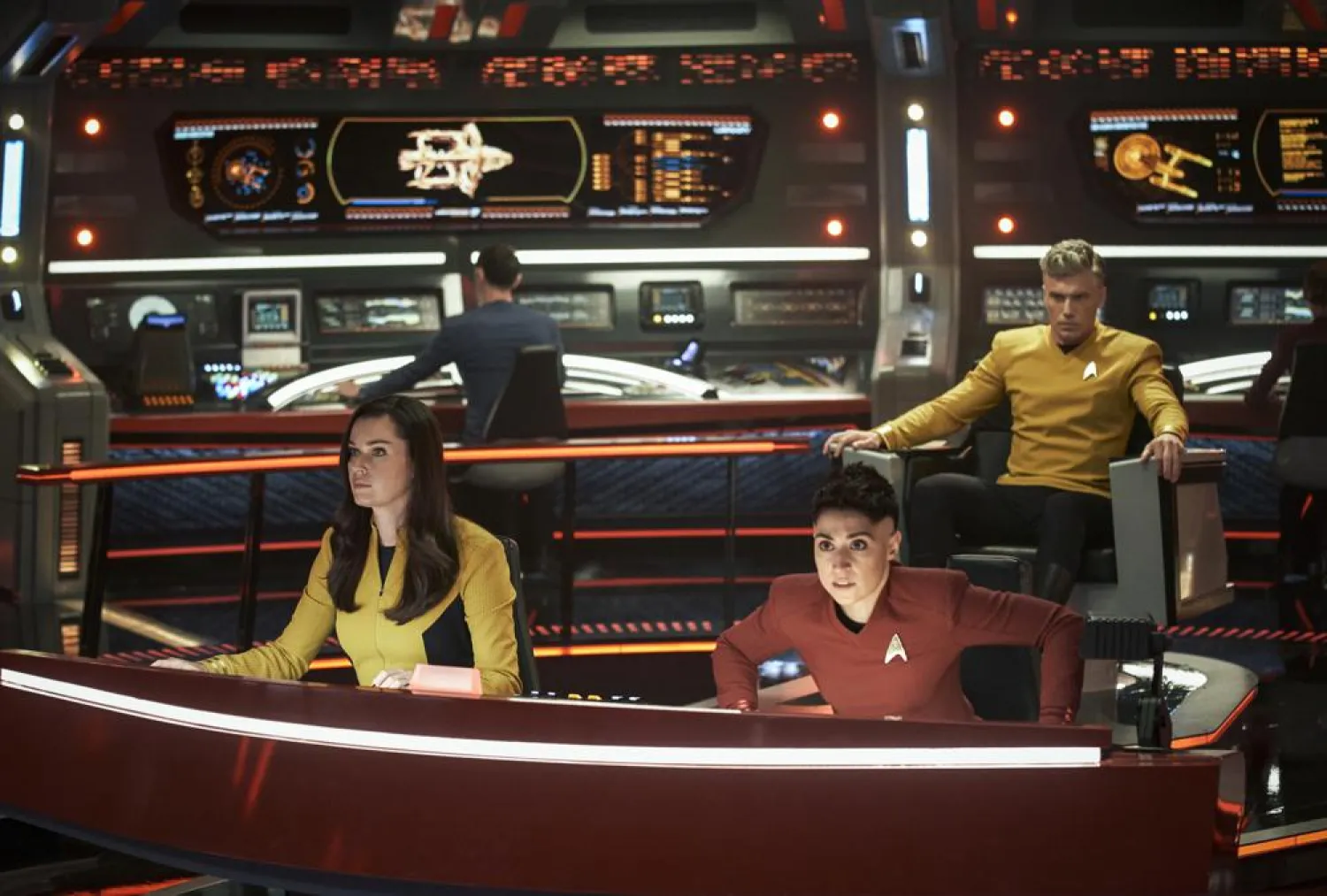
This image released by Paramount+ shows, from left, Rebecca Romijn as Una, Ethan Peck as Spock, background, Melissa Navia as Ortegas and Anson Mount as Pike in a scene from the series "Star Trek: Strange New Worlds." (Paramount+ via AP)
TT

Star Trek’s ‘Strange New Worlds’: In Defense of Episodic TV

This image released by Paramount+ shows, from left, Rebecca Romijn as Una, Ethan Peck as Spock, background, Melissa Navia as Ortegas and Anson Mount as Pike in a scene from the series "Star Trek: Strange New Worlds." (Paramount+ via AP)

Two generations after its 1966 debut, the universe of “Star Trek” has become a vast and sprawling mural in these heady days of streaming TV.

There’s the dark and bingeworthy “Star Trek: Picard,” a deep character study of an aging and beloved captain confronting his demons — and saving life as we know it twice in two seasons. There’s “Star Trek: Prodigy,” a rich, 3D-animated story aimed at kids and full of wonder. There’s the more traditionally animated “Star Trek: Lower Decks,” a wacky variation on the theme that unfolds on an also-ran starship and is brimming with fan-service moments.

And smack in the center of the mural sits “Star Trek Discovery,” the epic journey of a Federation starship and its crew across an entire millennium as it saves the galaxy not once (rogue AI!) , not twice (“The Burn!”), but three times (“The Dark Matter Anomaly!”) in four seasons and counting.

Intricate story arcs. Deep serialization. A requirement for sequential viewing and a serious attention span. That’s a lot of commitment, even for a binger. So what’s a planet-of-the-week fan of the original series and its episodic aesthetic to do?

The answer, of course, is “Star Trek: Strange New Worlds,” which is chronicling the voyages of the USS Enterprise before Kirk became its captain. Led by Capt. Christopher Pike (Anson Mount), the show is essentially a workplace drama in deep space — the intergalactic equivalent of looking in on a really interesting office and getting various tastes of what exactly it is that everyone does.

“Strange New Worlds,” whose first-season finale “airs” Thursday on Paramount+ in the United States, has been a true errand of mercy for those “Trek” fans who love old-fashioned, self-contained episodes, and want the opportunity to experience a Whitman’s Sampler of sci-fi from week to week.

So far, the show’s peregrinations — one-and-done plots, even as character development reaches across episodes — have been varied and wandering in the most satisfying of ways.

Season One has featured, among other genre journeys, forays into comedy, horror, submarine thriller, contagious-disease drama and full-on medieval fantasy. Each has been suffused with humanism, optimism and the complex moral questions and allegories that made “Star Trek” so relevant in that other period of unrelenting upheaval, the 1960s.

Viewers — not merely longtime fans — are eating it up. The show has a preposterously high rating of 99% on Rotten Tomatoes and seems to appeal to both traditionalists and newer acolytes. But why does this iteration of the “Trek” universe hit so rightly at this exact moment? As Spock might say, a number of possibilities present themselves.

First, consider the baseball card and the postage stamp — both fodder for collectors for a century and a half. People love them for many reasons, but they share a key trait: Each, when collected, is an assemblage of variants of an appealing form. And though the form is familiar and generally consistent, inside its borders anything goes.

What’s more, not every specimen has to be earth-shattering (or galaxy-shattering). For every rare 1909 Honus Wagner card or 1918 “Inverted Jenny” stamp, there are countless others that are simply small glimpses of the day-to-day — the journeyman infielder, the forever stamp with the flower on it. They’re not world-changers on their own, but each is a sterling example of the breed, and together — when collected — they form a larger tapestry.

When it comes to “Strange New Worlds,” though, the appeal runs even deeper than that. Oddly enough, it’s also about normalcy.

The creator of “Star Trek,” Gene Roddenberry, pitched it originally as “Wagon Train to the Stars,” pushing out onto the (final) frontier. But boiled down, the original series — and “Strange New Worlds,” on a 21st-century level — is a meditation on the workplace.

The coronavirus pandemic has taught us a lot about the workplace — both being in it and not being in it — and about the desire for the normal rhythms of existence. Lots of people are craving routine, day-to-day problems again, while navigating the blurring of barriers between work and home. “Strange New Worlds” is the Trek-verse iteration of all that.

The Enterprise is to “Strange New Worlds” what Grey-Sloan Memorial is to “Grey’s Anatomy” and Dunder Mifflin is to “The Office.” It’s a canvas. And behind all the fantastic allegories that the best of “Trek” has offered are more prosaic ones — ones that evoke our own workplaces and getting along with other departments and meeting cool new colleagues (talkin’ to you, Erica Ortegas) and, sometimes, dealing with a public that may occasionally seem downright alien.

Members of the Enterprise crew on “Strange New Worlds” are living their lives. They’re doing their jobs, even when their jobs really suck — like when they lose one of their own or are under attack. Like us, they find themselves in different moods from episode to episode, from scene to scene. They’re silly one moment, crisp and efficient the next, emotional the next and then, maybe, silly all over again. It all feels more like the cadence of actual life than one of these deep dives into a single, relentless story arc.

And while nothing is reset at the end of each week — characters evolve, pain endures, progress is made — to begin each episode with a new story feels strangely like an act of optimism. With humanity navigating such huge issues — climate change, guns, racism, abortion, war — why wouldn’t the chance for a narrative fresh start each week be immensely appealing?

Saving life as we know it? Sure, when it’s needed. That’s part of what sci-fi is all about. But DEALING with life as we know it? That’s the sweet and timely spot here, too. Aboard this version of the USS Enterprise, each is equally in play. And in these jumbled times, at the intersection of both, “Star Trek: Strange New Worlds” is thriving.


It’s-a-Hit: ‘The Super Mario Galaxy Movie’ Box Office Blasts off with $372.5 Million Globally

 This image released by Universal Pictures shows, from left, Luigi, voiced by Charlie Day, Mario, voiced by Chris Pratt, Yoshi, voiced by Donald Glover, and Princess Peach, voiced by Anya Taylor-Joy, in a scene from "The Super Mario Galaxy Movie." (Nintendo and Illumination/Universal Pictures via AP)
This image released by Universal Pictures shows, from left, Luigi, voiced by Charlie Day, Mario, voiced by Chris Pratt, Yoshi, voiced by Donald Glover, and Princess Peach, voiced by Anya Taylor-Joy, in a scene from "The Super Mario Galaxy Movie." (Nintendo and Illumination/Universal Pictures via AP)
TT

It’s-a-Hit: ‘The Super Mario Galaxy Movie’ Box Office Blasts off with $372.5 Million Globally

 This image released by Universal Pictures shows, from left, Luigi, voiced by Charlie Day, Mario, voiced by Chris Pratt, Yoshi, voiced by Donald Glover, and Princess Peach, voiced by Anya Taylor-Joy, in a scene from "The Super Mario Galaxy Movie." (Nintendo and Illumination/Universal Pictures via AP)
This image released by Universal Pictures shows, from left, Luigi, voiced by Charlie Day, Mario, voiced by Chris Pratt, Yoshi, voiced by Donald Glover, and Princess Peach, voiced by Anya Taylor-Joy, in a scene from "The Super Mario Galaxy Movie." (Nintendo and Illumination/Universal Pictures via AP)

Mixed reviews didn’t dissuade mass audiences from buying tickets to the “The Super Mario Galaxy Movie,” which scored the biggest opening of the year for a Hollywood movie. The Illumination and Nintendo co-production earned $130.9 million over the weekend and a massive $190.1 million in its first five days in North American theaters, according to studio estimates Sunday.

Universal Pictures released the sequel globally on Wednesday, capitalizing on kids’ spring break vacations in the week leading up to the Easter holiday. With an estimated $182.4 million from 80 overseas markets, the film is looking at an astronomical $372.5 million debut — the latest hit for the PG rating. Mexico is leading the international bunch with $29.1 million from 5,136 screens, followed by the UK and Ireland with $19.7 million.

The animated sequel is the industry’s biggest debut since “Avatar: Fire and Ash” launched over Christmas. The Chinese movie “Pegasus 3,” which was not a Motion Picture Association release, has the slight edge for the 2026 global record, however.

It’s also a dip from the first film, which opened to $204 million domestically during the same five-day time frame in 2023 ($147 of that was from Friday, Saturday and Sunday). “The Super Mario Bros. Movie” went on to be the second biggest movie of 2023, with over $1.3 billion in box office receipts.

“The Super Mario Galaxy Movie,” which features returning voice actors Chris Pratt, Jack Black, Anya Taylor-Joy and Charlie Day, had a massive footprint in the US and Canada, where it played in 4,252 theaters, including 421 IMAX and 1,345 premium large format screens. It also cost around $110 million to make, not including marketing and promotion expenses. But it arrived on a wave of less-than-stellar reviews. Its Rotten Tomatoes score is currently sitting at a lousy 40%. Ticket buyers were more enthusiastic, however.

The family audience gave the movie five out of five stars according to PostTrak exit polls, while general audiences gave it four stars and an A- on CinemsScore. Audiences skewed male (61%) overall, although when it came to families attending there were slightly more moms (52%) than dads.

Last year, the first weekend in April hosted the launch of another video game blockbuster, “A Minecraft Movie,” which had a bigger three-day debut ($162.8 million) but didn’t have a “Project Hail Mary” in a strong second place, meaning the weekend overall is still up around 5%.

As expected, “The Super Mario Galaxy Movie” ended the two-week reign of the Ryan Gosling-led sci-fi hit “Project Hail Mary,” which landed in second its third weekend in theaters where it added $29.8 million, bringing its domestic total to $216.3 million.

Third place went to A24’s provocative new movie “The Drama,” starring Zendaya and Robert Pattinson, which made an estimated $14.4 million from 3,087 theaters. The film’s stars have been on a massive and charming press blitz to promote their R-rated movie about an engaged couple grappling with an unnerving revelation, which cost a reported $28 million to produce. The reveal has drummed up a fair amount of cultural discourse. While reviews have been more positive than not (82% on Rotten Tomatoes), it got a less promising B CinemaScore.

“Hoppers” and “Reminders of Him” rounded out the top five.


Surprise! Zendaya Wears Something Blue, After the Old, New and Borrowed

 Zendaya attends a special screening of "The Drama" at Regal Union Square on Thursday, April 2, 2026, in New York. (AP)
Zendaya attends a special screening of "The Drama" at Regal Union Square on Thursday, April 2, 2026, in New York. (AP)
TT

Surprise! Zendaya Wears Something Blue, After the Old, New and Borrowed

 Zendaya attends a special screening of "The Drama" at Regal Union Square on Thursday, April 2, 2026, in New York. (AP)
Zendaya attends a special screening of "The Drama" at Regal Union Square on Thursday, April 2, 2026, in New York. (AP)

Yup, she wore something blue.

Zendaya, surprising precisely nobody on the planet, showed up in dazzling blue at Thursday’s New York premiere of “The Drama,” after teasing the bridal theme for weeks by wearing something old, then something new, then something borrowed.

Her strapless Schiaparelli Haute Couture ball gown, accompanied by sapphire earrings, completed the sartorial series just in time for the opening of her movie — a film that has attracted considerable controversy and mixed reviews. Zendaya and Robert Pattinson play a couple whose wedding plans go seriously awry following a dark revelation.

The high-fashion appearances have also echoed the bridal theme of Zendaya’s own life, with unconfirmed speculation flying — fed in part by rings she’s been wearing — that she’s already married to partner Tom Holland.

The actor and her stylist, Law Roach, saved the most spectacular outfit for last. Schiaparelli posted on its own Instagram that the gown, which took some 8,000 hours of work, was made of blue and black raw silk “feathers” in satin stitch embroidery, and contained 27 shades of blue.

“Something old” came in Los Angeles on March 17, where Zendaya wore the same white, off-the-shoulder Vivienne Westwood Bridal gown that she’d worn to the 2015 Oscars.

She transitioned to “something new” at the March 24 Paris premiere — a white custom Louis Vuitton gown with a huge black bow and train.

“Something borrowed” came two days later in Rome, a black Armani Privé dress previously worn by Cate Blanchett, with a plunging neckline framed with stones.

Finally on Thursday, Zendaya completed the circle. “SomethingBlue,” posted Roach.

In case nobody had noticed.


Travolta Returns to Cannes with Aviation-Inspired Directorial Debut

John Travolta. (AFP)
TT

Travolta Returns to Cannes with Aviation-Inspired Directorial Debut

John Travolta. (AFP)

US movie legend John Travolta will present his directorial debut "Propeller One-Way Night Coach", about a young boy's journey in the "golden age of aviation", at the Cannes Film Festival in May, organizers said Thursday.

The film, to make its world premiere, is adapted from the 72-year-old star's own 1997 book, inspired by his lifelong passion for aviation, the festival said.

Among the three Travolta films showcased at the Festival de Cannes in the past was "Pulp Fiction" (1994), famed for the actor's two-fingered swipe in its cult dance scene.

"The unforgettable Vince Vega of Pulp Fiction returns to the Croisette for an event as unexpected as it is exciting: his very first film as a director," the festival said.

Travolta wrote the book for his son Jett, who suffered from epileptic seizures and died in 2009 at the age of 16.

The film follows a young airplane enthusiast Jeff and his mother embarking on a one-way journey to Hollywood.

"The story unfolds as a nostalgic journey set in the golden age of aviation," the festival said.

"The journey unfolds in moments both magical and unexpected, charting the course for the boy's future," the statement said, adding that one of the flight attendants is played by the star's only daughter, Ella Bleu, 25.

The actor, who grew up not far from LaGuardia Airport near New York, is a professional pilot and began flying when he was 15.

"Travolta is certified to fly Boeing 707s, 737s, and 747s, Bombardier's Global Express and was the first private pilot to fly an Airbus A380," the festival said.

Travolta has become a pop culture icon, celebrated for his roles in films such as Saturday Night Fever (1977), Grease (1978), and Hairspray (2007).

"Propeller One-Way Night Coach" will make its global debut on Apple TV in May.