

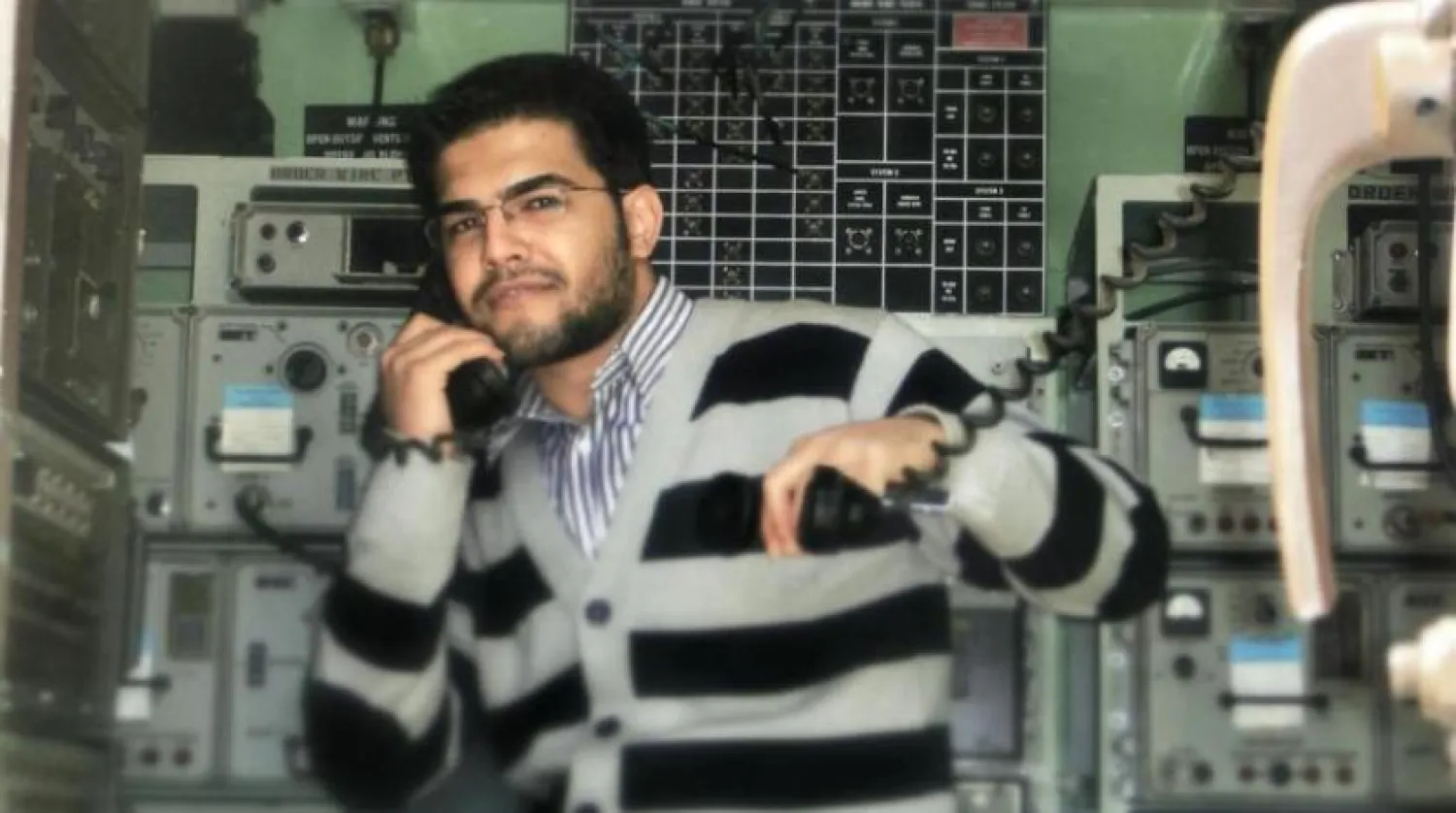

Turkey Convicts 14 Accused of Killing Iranian Dissident

Masoud Molavi-Vardanjani
TT

Turkey Convicts 14 Accused of Killing Iranian Dissident

Masoud Molavi-Vardanjani

A Turkish court handed down jail sentences to 14 accused of assassinating Iranian dissident Masoud Molavi-Vardanjani in Istanbul.

Abdul Wahab Kocak, the main suspect, was sentenced to life in prison for the murder of Molavi -Vardanjani, who was shot dead in November 2019 in Sisli in Istanbul.

Molavi-Vardanjani had a telegram channel called "Black Box," which criticized the Iranian regime and the Revolutionary Guards. He repeatedly accused the judiciary and security forces of financial corruption and assassination of opposition figures by publishing documents.

Kocak was among 14 defendants who were sentenced in the case. Three others were sentenced to 15 years, 12 years, and six months, respectively.

Two of the three convicts, still in detention, were accused of providing and transporting weapons for the assassination, while the third was convicted of providing a hideout for the killer. He was released on condition of judicial supervision.

A fifth defendant was given a 30-month suspended prison sentence, while the rest of the defendants were acquitted.

Before he was killed, Molavi-Vardanjani wrote: "God willing, I will root out these corrupt mafia leaders...Pray that they don't kill me before I accomplish that."

Molavi-Vardanjani worked for a decade as a consultant and director of a data security company in Isfahan before starting his work as a military consultant specializing in artificial intelligence.

The Turkish authorities watched 320 hours of CCTV footage on the streets, and the security forces searched 49 locations and interrogated 185 people about the assassination.

Pictures published by the Turkish media after the assassination showed Molavi-Vardanjani walking with a friend towards Sisli at night on November 14, 2019, when a gunman opened fire on them.

Security sources confirmed that the person with Molavi-Vardanjani came with him to Turkey in June 2018. He made friends and leaked information about the victim to Iranian intelligence. The police report identified him as Ali Esfanjani.

The sources said that Esfanjani visited the Iranian consulate the day before the assassination and met the defendants to discuss the details of the operation.

The police report identified Esfanjani as the mastermind behind the plot to kill Molavi-Vardanjani. He was transported to the other side of the Turkish-Iranian border by an Iranian smuggler three days after the assassination.

Last February, the Turkish police arrested 16 members of a group linked to the Iranian security services, which is in charge of kidnapping Iranian dissidents and handing them over to the authorities in Tehran.

Turkish media also published, in mid-February last year, a video clip circulated by Iranian media showing the arrest of Mohammad Reza Naserzadeh on charges of involvement in the assassination of Molavi-Vardanjani.

Turkish sources said that the Turkish and Iranian suspects, who were arrested after the killing, admitted they acted on the orders of two intelligence officers at the Iranian consulate in Istanbul.

A Turkish official said the suspects' statements revealed they had received assassination orders from Iranians with diplomatic passports.

He indicated that the evidence and witness statements confirmed that these two people were intelligence officers who played a role in inciting and coordinating the assassination.



Iran Warns US Troops, Israel Will Be Targets if America Strikes

FILE PHOTO: Protesters gather as vehicles burn, amid evolving anti-government unrest, in Tehran, Iran, in this screen grab obtained from a social media video released on January 9, 2026. Social Media/via REUTERS/File Photo
TT

Iran Warns US Troops, Israel Will Be Targets if America Strikes

FILE PHOTO: Protesters gather as vehicles burn, amid evolving anti-government unrest, in Tehran, Iran, in this screen grab obtained from a social media video released on January 9, 2026. Social Media/via REUTERS/File Photo

Nationwide protests challenging Iran’s regime saw protesters flood the streets in the country’s capital and its second-largest city into Sunday, crossing the two-week mark as violence surrounding the demonstrations has killed at least 116 people, activists said.

With the internet down in Iran and phone lines cut off, gauging the demonstrations from abroad has grown more difficult. But the death toll in the protests has grown, while 2,600 others have been detained, according to the US-based Human Rights Activists News Agency.

Meanwhile, Iran's parliament speaker warned the US military and Israel would be “legitimate targets” if America strikes Iran, as threatened by President Donald Trump.

Trump offered support for the protesters, saying on social media that “Iran is looking at FREEDOM, perhaps like never before. The USA stands ready to help!!!”

The New York Times and Wall Street Journal, citing anonymous US officials, said on Saturday night that Trump had been given military options for a strike on Iran, but hadn’t made a final decision.

The State Department separately warned: “Do not play games with President Trump. When he says he’ll do something, he means it.”

Iranian state television broadcast the parliament session live. Qalibaf gave a speech applauding police and Iran's Revolutionary Guard, particularly its all-volunteer Basij, for having “stood firm” during the protests.

“The people of Iran should know that we will deal with them in the most severe way and punish those who are arrested,” Qalibaf said.

He went on to directly threaten Israel, “the occupied territory” as he referred to it, and the US military, possibly with a preemptive strike.

“In the event of an attack on Iran, both the occupied territory and all American military centers, bases and ships in the region will be our legitimate targets,” Qalibaf said. “We do not consider ourselves limited to reacting after the action and will act based on any objective signs of a threat.”


Sources: Israel on High Alert for Possibility of US Intervention in Iran

In this frame grab from video taken by an individual not employed by The Associated Press and obtained by the AP outside Iran shows people during a protest in Tehran, Iran, Friday, Jan. 9, 2026. (UGC via AP)
TT

Sources: Israel on High Alert for Possibility of US Intervention in Iran

In this frame grab from video taken by an individual not employed by The Associated Press and obtained by the AP outside Iran shows people during a protest in Tehran, Iran, Friday, Jan. 9, 2026. (UGC via AP)

Israel is on high alert for the possibility of any US intervention in Iran as authorities there confront the biggest anti-government protests in years, according to three Israeli sources with knowledge of the matter.

President Donald Trump has repeatedly threatened to intervene ⁠in recent days and warned Iran’s rulers against using force against demonstrators. On Saturday, Trump said the US stands “ready to help”.

The sources, who were present ⁠for Israeli security consultations over the weekend, did not elaborate on what Israel’s high-alert footing meant in practice, Reuters reported. Israel and Iran fought a 12-day war in June.

In a phone call on Saturday, Israeli Prime Minister Benjamin Netanyahu and US Secretary ⁠of State Marco Rubio discussed the possibility of US intervention in Iran, according to an Israeli source who was present for the conversation. A US official confirmed the two men spoke but did not say what topics they discussed.


NKorea Says Another SKorean Drone Entered its Airspace

These images taken on January 4, 2026 and released as a combo image by North Korea's official Korean Central News Agency (KCNA) via KNS on January 10, 2026 shows an aerial view of Kaesong city, which North Korea claims is footage taken retrieved from a drone from South Korea that violated North Korean airspace and brought down by specialized electronic warfare assets. (Photo by KCNA VIA KNS / AFP)
TT

NKorea Says Another SKorean Drone Entered its Airspace

These images taken on January 4, 2026 and released as a combo image by North Korea's official Korean Central News Agency (KCNA) via KNS on January 10, 2026 shows an aerial view of Kaesong city, which North Korea claims is footage taken retrieved from a drone from South Korea that violated North Korean airspace and brought down by specialized electronic warfare assets. (Photo by KCNA VIA KNS / AFP)

North Korea said on Saturday that South Korea flew another drone into its airspace on January 4, infringing on its sovereignty, according to state media KCNA.

The announcement, which comes before North Korea holds a key party congress that will lay out policies for the next five years, sets the stage for cementing leader Kim Jong Un's rhetoric that South Korea is a foreign and hostile nation, an analyst said.

The drone, which originated from an island in the South Korean city of Incheon, flew 8 km (5 miles) before it was shot down inside North Korean airspace, KCNA said, citing a spokesperson for the North Korean military.

The drone was equipped with surveillance cameras to record "major" North Korean facilities, ⁠Reuters quoted KCNA as saying. Photos on KCNA showed a drone salvaged in pieces, electronic parts and aerial photos of buildings that KCNA said the drone had taken.

KCNA said the incident follows a September incursion by another South Korean drone that was shot over Kaesong.

"Even after the change of a regime... (South Korea) has continued to commit such acts of provocation by drones near the border," KCNA said, calling South Korea its "enemy most hostile".

Since South Korean President Lee Jae Myung took office in June, North Korea has rebuffed conciliatory gestures from Lee's administration. Lee had ⁠pledged to re-engage with Pyongyang to defuse tensions on the Korean Peninsula.

South Korea's military said on Saturday it does not operate the drone model in question, it did not operate drones on the date North Korea is claiming, and it will conduct a thorough investigation of a civilian possibly having operated the drone.

"We have no intention of provoking North Korea, and we will continue to take practical measures and efforts to ease... tensions and build trust," South Korea's military said in a statement.

The drone and electronics parts shown by North Korean state media are low-cost consumer products, and the captured video it revealed is of areas that do not have particular information value or military targets, said North Korean expert Hong Min at the Korea Institute for National Unification.

"The South Korean military already has a ⁠number of high-value assets that can clearly monitor the area near the armistice line," Hong said, making it unlikely that it was the South Korean military.

The timing of North Korea's mention of the drones is notable, as it comes just before North Korea's 9th Party Congress expected to be held soon.

Kim Jong Un's rhetoric of deeming the relationship between the two Koreas as two hostile countries, first introduced in 2024, is expected to be cemented further at the congress and may be put into North Korea's constitution this year, Hong said.

North Korea previously accused South Korea of sending a drone over Pyongyang in October 2024.

South Korea's former President Yoon Suk Yeol was accused by Seoul's special prosecutor late last year of ordering the Pyongyang drone operation to use military tensions between Pyongyang and Seoul as a justification for declaring emergency martial law.

Yoon has denied the charge, with his legal counsel saying the performance of the president's duties cannot be framed as a crime after the fact.