

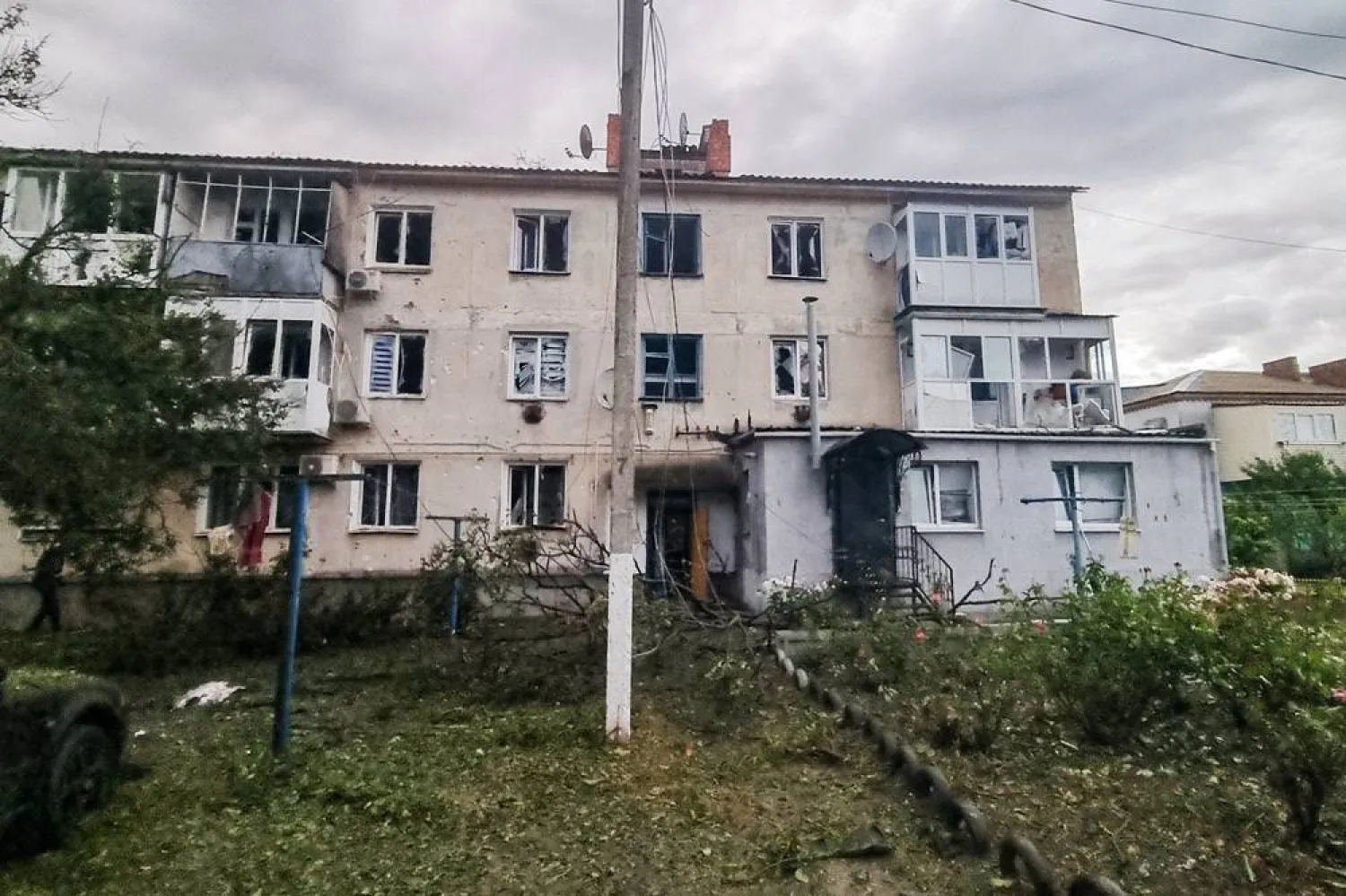

Russian Strikes Kill 7 in Ukraine

31 May 2026, Russia, Kherson: Blocks of flats in Bratyev Kovalenko Street in Genichesk are damaged in a drone attack. (dpa)
TT

Russian Strikes Kill 7 in Ukraine

31 May 2026, Russia, Kherson: Blocks of flats in Bratyev Kovalenko Street in Genichesk are damaged in a drone attack. (dpa)

Russia fired hundreds of drones at Ukraine between late Thursday and early Friday, killing seven people and destroying a factory that produces milk products for children, authorities said.

Images published by Ukraine's state emergency service showed the ruins of a building bearing the logo of Ukrainian dairy producer "Yagotynske for Kids", its facade partly destroyed and flames visible on one floor.

"The enemy attacked a peaceful civilian food industry enterprise," Kyiv region governor Mykola Kalashnyk said in a post on Telegram.

"Unfortunately, the number of people killed as a result of the hostile attack... has increased to four people," AFP quoted him as saying in a later post.

Separate strikes on Ukraine's central Dnipropetrovsk region killed two people, regional governor Oleksandr Ganzha said, while a drone strike in the southern Zaporizhzhia region killed one woman, according to the Ukrainian state emergency service.

Russia fired at least 216 drones at Ukraine between late Thursday and early Friday, as well as two missiles, according to the Ukrainian air force.

Moscow and Kyiv have intensified drone strikes on each other in recent months as US-led diplomatic efforts to end the war, now in its fifth year, remain stalled over the conflict in the Middle East.

Ukrainian President Volodymyr Zelensky proposed a meeting with Vladimir Putin in an open letter to the Russian leader late Thursday, saying it was only the leaders who could resolve "key issues".

The Kremlin said it was aware of the letter but that Putin was yet to review it.

The Russian leader has previously ruled out meeting Zelensky before a final deal is agreed and has questioned his legitimacy.

Russia is demanding Ukraine fully withdraw from the eastern Donbas region as a precondition of any deal.

Ukraine wants a full ceasefire along the current front lines, pending negotiations on a territorial settlement.



Nations Seek Reset at UN Talks as Nature Goals off Track

Armenia is hosting the UN COP17 biodiversity talks in its capital Yerevan. KAREN MINASYAN / AFP
TT

Nations Seek Reset at UN Talks as Nature Goals off Track

Armenia is hosting the UN COP17 biodiversity talks in its capital Yerevan. KAREN MINASYAN / AFP

Nearly 200 nations are gathering in Armenia on Monday for critical negotiations as governments come under pressure to salvage a landmark nature pact whose goals are slipping out of reach.

Most countries joined a historic call four years ago to halt and reverse the destruction of nature by 2030 but governments have been slow to act on these pledges, said AFP.

Many goals of the so-called "Paris Agreement for Nature" are falling behind, including a centerpiece commitment to protect 30 percent of Earth's land and oceans.

Some of the toughest objectives of the pact, such as cutting subsidies for fossil fuels and other powerful industries, have made little progress.

"We must honestly admit that collectively, we are not yet on track as needed," Armenia's Prime Minister Nikol Pashinyan said Friday ahead of the formal UN negotiations known as COP17.

The summit comes at a difficult time, with public finances under strain and political attention fixed on conflicts, geopolitical tensions and a global energy crisis.

Only a handful of world leaders, including UN chief Antonio Guterres but mostly heads of state from nearby Central Asian nations, turned up for a high-level session ahead of the formal negotiations.

But the stakes could not be higher, Guterres said at the event on Friday, describing an unrelenting "war on nature" that threatened the very livability of the planet for future generations.

"We need more action, more speed and more will," he said.

"Halfway to 2030, Yerevan is our moment of accountability. It is time to ask ourselves -- are we doing enough?"

- Falling short -

A United Nations scorecard issued ahead of COP17 reported that progress toward the 23 biodiversity targets was being made -- but unevenly, and not at pace to meet the 2030 deadline.

A major tension at the summit will be money, with the report finding that the effort to close a yawning gap in necessary finance "falls far short" of what is needed.

European and other wealthy nations obligated to provide biodiversity finance have been pushing for large emerging economies like China to also contribute.

But attention is likely to focus more on how private capital, not public finances, might help plug the shortfall.

A key priority will be encouraging corporations to donate a share of profits to a near-empty UN fund to support conservation in developing countries.

Guterres also fixed the spotlight on state incentives for extractive industries, scolding governments for "spending money on the wrong things" despite pledging to reform harmful subsidies.

"Subsidizing fossil fuels is subsidizing suicide," said Guterres of the coal, oil and gas that are "boiling our planet and are the scourge of biodiversity".

For the mountainous Caucasus nation of Armenia, the summit is one of the largest international events it has ever hosted, with thousands of visitors expected over the next two weeks.

The hosts have stressed that action -- not new pledges -- would define success at COP17.

"The world does not need a new vision. We have one. What it needs is delivery," Adil Najam, global president of WWF International, said Friday.


Russian FM to Visit Iran as Moscow Looks to Mediate in War

 Russia's Foreign Minister Sergei Lavrov speaks during a joint press conference with Bahrain's foreign minister and the Gulf Cooperation Council (GCC) secretary-general after the 9th Joint Ministerial Meeting of the Strategic Dialogue between GCC and the Russian Federation in Manama on October 18, 2026. (AFP)
Russia's Foreign Minister Sergei Lavrov speaks during a joint press conference with Bahrain's foreign minister and the Gulf Cooperation Council (GCC) secretary-general after the 9th Joint Ministerial Meeting of the Strategic Dialogue between GCC and the Russian Federation in Manama on October 18, 2026. (AFP)
TT

Russian FM to Visit Iran as Moscow Looks to Mediate in War

 Russia's Foreign Minister Sergei Lavrov speaks during a joint press conference with Bahrain's foreign minister and the Gulf Cooperation Council (GCC) secretary-general after the 9th Joint Ministerial Meeting of the Strategic Dialogue between GCC and the Russian Federation in Manama on October 18, 2026. (AFP)
Russia's Foreign Minister Sergei Lavrov speaks during a joint press conference with Bahrain's foreign minister and the Gulf Cooperation Council (GCC) secretary-general after the 9th Joint Ministerial Meeting of the Strategic Dialogue between GCC and the Russian Federation in Manama on October 18, 2026. (AFP)

Russian Foreign Minister Sergei Lavrov was due to arrive in Iran on Monday in his first visit since the outbreak of the Middle East war, as Russia seeks to play a mediating role.

Iranian foreign ministry spokesman Esmaeil Baqaei confirmed the trip on Sunday, saying in a statement that the two sides will discuss "regional and international developments".

Lavrov, who is scheduled to meet with Iranian Foreign Minister Abbas Araghchi, said Moscow's efforts are "aimed at preventing the return of a large-scale war", with talks stalled between Tehran and Washington.

The visit comes after Russian President Vladimir Putin told his Iranian counterpart Masoud Pezeshkian in early October that Moscow was prepared to contribute to mediation efforts.

Russia and Iran, two of the most heavily sanctioned nations in the world, maintain close ties. Their military and economic cooperation has only increased since the Russian invasion of Ukraine in 2022.

The Middle East war began in February with US-Israeli strikes on Iran.

Despite a ceasefire in April, followed by a US-Iran memorandum of understanding in June, hostilities in and around the Strait of Hormuz have not stopped.

Iran claims control over the strategic waterway -- through which one-fifth of the world's hydrocarbons pass in normal times -- and regularly targets vessels that cross without its authorization.

In response, Washington has been maintaining a naval counter-blockade on Iranian ports.

Russia's foreign ministry said discussions during Lavrov's visit were expected to focus on "ways to resolve the acute international crisis triggered by the unlawful aggression of the US and Israel against Iran".

The ministry said the war had been a blow to stability and security "not only in the near and Middle East, but also on a global scale".


Philippines Summons China’s Envoy Over Remarks Conveying ‘Threat’

This handout photo taken on October 19, 2026 and released by the Department of Foreign Affairs (DFA) shows Philippine Secretary of the Department of Foreign Affairs Maria Theresa Lazaro (L) and China's Ambassador to the Philippines Jing Quan posing for a photo during their meeting at the foreign ministry office in Manila. (Handout / Philippine Department of Foreign Affairs / AFP)
TT

Philippines Summons China’s Envoy Over Remarks Conveying ‘Threat’

This handout photo taken on October 19, 2026 and released by the Department of Foreign Affairs (DFA) shows Philippine Secretary of the Department of Foreign Affairs Maria Theresa Lazaro (L) and China's Ambassador to the Philippines Jing Quan posing for a photo during their meeting at the foreign ministry office in Manila. (Handout / Philippine Department of Foreign Affairs / AFP)

The Philippine foreign ministry on Monday summoned China's ambassador to express its "serious concern and strong objection" about remarks by the envoy that it said conveyed a threat of the use of force.

Philippine Foreign Secretary Ma. Theresa Lazaro summoned Ambassador Jing Quan and told him comments he made to media last week were "provocative and unacceptable", the Department of Foreign Affairs ‌said in ‌a statement.

Jing had told reporters ‌that ⁠China "may easily win" ⁠in a confrontation with the Philippines, but Beijing would not use force because "we love peace".

He was responding to a question about the Philippine defense secretary describing China as a regional troublemaker.

Diplomatic squabbles between China and US ally the ⁠Philippines have become more frequent ‌in recent years, typically ‌over standoffs and altercations between rival vessels in the ‌South China Sea, much of which ‌Beijing claims sovereignty over.

Manila has accused China's coast guard of aggressive conduct in the Philippines' exclusive economic zone, while Beijing insists it is enforcing the law ‌against vessels that are encroaching on its territory.

China's embassy in Manila did ⁠not ⁠immediately respond to a request for comment on the ambassador being summoned. It last week said Jing had been selectively quoted and his remarks over-interpreted.

Lazaro told Jing the comments aggravated an already sensitive atmosphere between the two countries and undermined mutual efforts to build understanding and cooperation, the foreign ministry said.

Sensitive issues should be addressed through established diplomatic channels and bilateral mechanisms that reserve space for dialogue and engagement, she said.