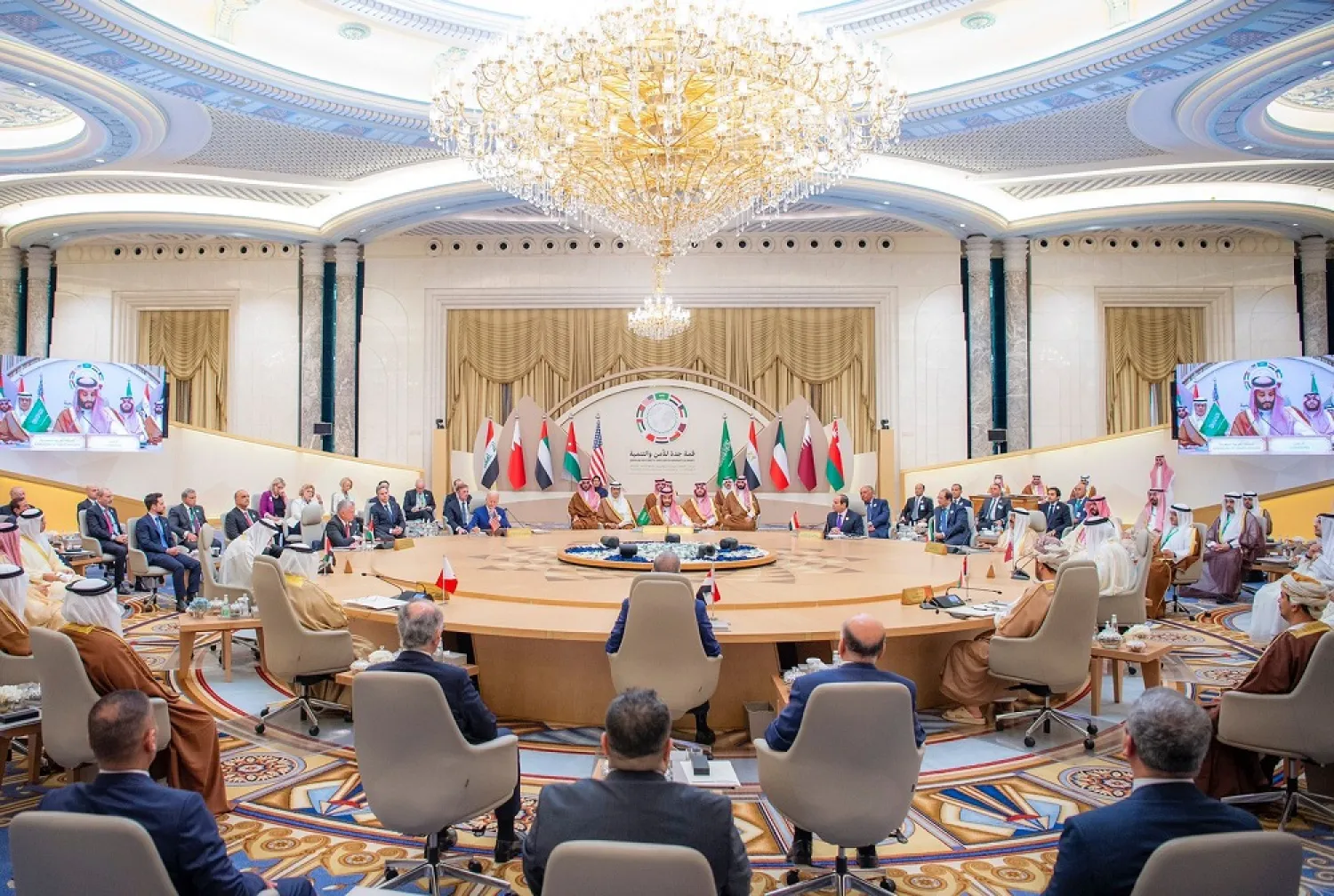

Crown Prince Mohammed bin Salman, Deputy Prime Minister and Minister of Defense, chaired on Saturday the Jeddah Security and Development Summit on behalf of Custodian of the Two Holy Mosques King Salman bin Abdulaziz.
The summit was attended by leaders of the Gulf Cooperation Council (GCC) countries, as well as US President Joe Biden, Egyptian President Abdul Fattah al-Sisi, Jordan’s King Abdullah II and Iraqi Prime Minister Mustafa al-Kadhimi.
In his address, Crown Prince Mohammed said the “future of the region that we want to build demands the adoption of a vision that prioritizes achieving security, stability and prosperity.”
It is based on mutual respect, he added, calling on Iran to cooperate with the countries of the region so that it can be a part of this vision.
For his part, Biden had declared that the US won’t leave the region and leave behind a void that would be filled by China, Russia or Iran.
Welcoming the guests, Crown Prince Mohammed said the summit was being held a time the region and world are facing “major fateful challenges”.
Confronting them demands boosting joint cooperation according to the United Nations Charter that is based on respecting the sovereignty, independence and values of countries, refraining from meddling in their internal affairs, he added.
“We hope our summit will pave the way for a new era of cooperation to deepen the strategic partnership between our nations and the US to serve our mutual interests and bolster security and development in this vital region,” he continued.
“The significant challenges that the world has recently faced due to the COVID-19 pandemic and the geopolitical situation call for more concerted international efforts to recover the global economy and achieve food and health security,” he stressed.
Moreover, he noted “the environmental challenges that the world is currently facing, especially climate change, and the international community's determination to maintain the Earth's temperature per the levels set by the Paris Agreement.”
Climate change requires “dealing with it realistically and responsibly to achieve sustainable development, by adopting a ‘balanced approach’ through a gradual and responsible transition towards more sustainable energy sources that take into account the circumstances and priorities of each country.”
“The adoption of unrealistic policies to reduce emissions by excluding major sources of energy without taking into account the resulting impact of these policies on the social and economic pillars of sustainable development and global supply chains will lead in the coming years to unprecedented inflation, rise in energy prices, increase unemployment and exacerbate serious social and security problems, including an increase in poverty and famine and crime rates, extremism and terrorism,” warned Crown Prince Mohammed.
“We reiterate that the growth of the global economy is closely linked to benefiting from all available energy sources in the world, including hydrocarbons while controlling their emissions through clean technologies, which enhances the possibility of the world reaching net-zero emissions by 2050 or before while maintaining the security of energy supplies.”
“Therefore, the Kingdom has adopted a balanced approach to achieving net-zero emissions by following the circular carbon economy approach in line with its development plans and enabling its economic diversification without affecting growth and supply chains, while developing technologies with global participation to address emissions through the ‘Saudi Green” and “Middle East Green’ initiatives to support these efforts locally and regionally.”
“We also stress the importance of continuing to inject and encourage investments in fossil energy and its clean technologies over the next two decades to meet the growing global demand, with the importance of assuring investors that the policies adopted do not pose a threat to their investments to avoid their reluctance to invest and to ensure that no shortage of energy supply would affect the international economy.”
“The Kingdom will do its part in this regard, as it announced an increase in its production capacity to 13 million barrels per day, after which the Kingdom will not have any additional capacity to increase production,” declared Crown Prince Mohammed.
“The future of the region we seek requires adopting a vision that prioritizes the achievement of security, stability, and prosperity, based on mutual respect among the countries of the region, strengthening common cultural and social bonds, and confronting security and political challenges, toward achieving comprehensive economic development,” he urged.
“We call on Iran, as a neighboring country, with which we share religious and cultural ties, to cooperate with the countries of the region to be part of this vision, by adhering to the principles of international legitimacy, non-interference in the internal affairs of other countries, cooperating with the International Atomic Energy Agency, and fulfilling its obligations in this regard,” he demanded.
“As an extension of the Kingdom's vision to achieve security and stability in the region, the Kingdom has supported all efforts to reach a Yemeni-Yemeni political solution, per the three references. The Kingdom has also made efforts to consolidate the current truce, and we will continue to provide humanitarian aid to the brotherly Yemeni people.”
“We stress that the prosperity of the region requires expediting finding a just and comprehensive solution to the Palestinian issue, per the initiatives and resolutions of international legitimacy and the Arab Peace Initiative.”
“We are pleased with the recent improvement in Iraq's security and stability, which will be reflected in its brotherly people's prosperity, and its positive interaction with its Arab and regional surroundings,” he remarked.
“We commend the signing of the two electricity interconnection agreements between the Kingdom and Iraq, as well as with the Gulf Cooperation Council countries, as this will contribute to providing Iraq's need for electricity. We also underline the ongoing electricity interconnection projects between the Kingdom, Egypt, and Jordan,” said Crown Prince Mohammed.
“Achieving security, stability, and prosperity in the region requires finding realistic political solutions to other crises, especially in Syria and Libya, to ensure an end to the suffering of their two brotherly peoples,” he stated.
“We are optimistic that this summit will lead to laying out a comprehensive framework for a new phase in which we give hope to the young men and women of the region for a bright future in which they will be able to realize their hopes and deliver to the rest of the world our noble message and values, of which we are proud and will never abandon. We hope the world respects them as we respect other values in a way that enhances our partnerships and serves our region and the world,” he said.
The Kingdom's official delegation at the summit included Prince Abdulaziz bin Salman bin Abdulaziz, Minister of Energy; Prince Turki bin Mohammed bin Fahd, Minister of State and Member of the Cabinet; Prince Abdulaziz bin Turki Al-Faisal, Minister of Sports; Prince Abdulaziz bin Saud bin Nayef, Minister of Interior; Prince Abdullah bin Bandar bin Abdulaziz, Minister of the National Guard; Princess Rima bint Bandar bin Sultan, the Kingdom’s Ambassador to the United States; Prince Faisal bin Farhan bin Abdullah, Minister of Foreign Affairs; and Minister of State, Cabinet Member and National Security Adviser, Dr. Musaed bin Mohammed Al-Aiban.
Biden: We won’t leave
Biden said his country will remain “an active, engaged partner in the Middle East.”
Reiterating remarks he made in Israel days earlier, he stressed: “We will not walk away and leave a vacuum to be filled by China, Russia, or Iran. And we’ll seek to build on this moment with active, principled American leadership.”
“The United States is clear-eyed about the challenges in the Middle East and about where we have the greatest capacity to help drive positive outcomes,” he added.
“Our objectives are focused, realistic, and achievable so that we can target our resources, rebuild trust, and deliver real results. We will operate in the context of the Middle East as it is today: a region more united than it has been in years.”
“The GCC is a prime example of that. Former rivals have reestablished diplomatic and economic ties. New memberships are being forged. And increasingly, the world is seeing the Middle East through the lens of opening and opportunity.”
“As the world grows more competitive and the challenges we face more complex, it is only becoming clearer to me that — how closely interwoven America’s interests are with the successes of the Middle East.”
Biden said the United States’ “new framework for the Middle East” has five key principles.
“First, the United States will support and strengthen partnerships with countries that subscribe to the rules-based international order. And we will make sure that these — those countries can defend themselves against foreign threats,” he stated.
“The United States and each of the countries around this table are an essential part of that order because we reject the use of brute force to change borders.”
“On food security, we are collectively committing billions of dollars to alleviate the crisis here in the region, with more than $1 billion coming from the United States.”
“On energy security, we agree on the need to ensure adequate supplies to meet global needs. Energy producers have already increased production, and I look forward to seeing what’s coming in the — in the coming months.”
“And on the climate crisis, we’re collectively investing hundreds of billions of dollars in clean energy initiatives, increasing our climate ambition, and working together to diversify supply chains and invest in critical infrastructure. And we’re looking forward to Egypt and the UAE hosting the next two major UN climate conferences.”
“Second, the United States will not allow — will not allow foreign or regional powers to jeopardize the freedom of navigation through the Middle East’s waterways, including the Strait of Hormuz and the Bab al-Mandab. Nor will we tolerate efforts by any country to dominate another in the region through military buildups, incursions, and/or threats,” Biden stressed.
“The free flow of commerce and resources through the Middle East is the lifeblood of a global economy. That’s as true today as it has been — as it has been for decades. And when nations adhere to international rules, it works. So, my administration has made it a priority to protect those vital waterways,” he continued.
“We’ve established a new naval task force to work in partnership with many of your navies to help secure the Red Sea. That includes the first naval task force to use multi-manned [un-manned] surface vessels and artificial intelligence technology to enhance marine — maritime awareness. We’re also integrating air defenses and early warning systems to ensure that we can defeat airborne threats,” added Biden.
“Third, the United States will not just aim to deter threats of regional — to regional stability; we will work to reduce tensions, de-escalate, and end conflicts wherever possible. This approach is already reaping dividends. As was mentioned: In Yemen, working closely with Saudi Arabia, Oman, the UAE, and the UN, we forged a truce that is now in its 15th week,” he noted.
“We’ve welcomed the leadership of Iraqi Prime Minister Kadhimi to bring countries from the region together for talks in Baghdad.”
“Thanks to the months of quiet, persistent diplomacy, we helped finalize an agreement to remove international peacekeepers from Tiran Island in the Red Sea, and transform an area that once sparked wars into a future hub of peaceful tourism and economic development,” he remarked.
“And as we continue to work closely with many of you to counter the threats posed by — posed to the region by Iran, we’re also pursuing diplomacy to return constraints on Iran’s nuclear program. But no matter what, the United States is committed to ensuring that Iran never gets a nuclear weapon,” vowed Biden.
“Fourth, the United States will build political, economic, and security connections between the United States — between the US partners wherever possible, while respecting each country’s sovereignty and independent choices. Integration, interconnection — these are the underlying themes of our meeting today," he said.
“Fifth, the United States will always promote human rights and the values enshrined in the UN Charter. Foundational freedoms are foundational to who we are as Americans. It’s in our DNA. But it’s also because we know that the future will be won by the countries that unleash the full potential of their populations, where women can exercise equal rights and contribute to building stronger economies, resilient societies, and more modern and capable militaries.”
“The United States is invested in building a positive future in the region, in partnership with all of you, and the United States is not going anywhere,” declared Biden.
Sisi: This is an extraordinary moment
Egypt’s Sisi said the Jeddah summit was being held during an “extraordinary moment in the history of the world and Arab region.”
It has clear political significance in underlining “our determination to develop the partnership between Arab countries and the US, whether on the bilateral or the broader regional levels,” he added.
He noted that the Arab world is facing major political, development and security challenges, as well as terrorism, that are undermining the stability of the people and the rights of future generations.
“It is no longer acceptable for people from our Arab nation to be a refugee or displaced from war and disasters or to be hopeless of a better future,” he added.
Sisi said: “It is time to bring together our efforts to put an end to all chronic conflicts and long civil wars that have exhausted the people of the region and wrongly used its resources and wealth and allowed some forces to meddle in the internal affairs of Arab countries,” he remarked.
Such meddling has squandered the capabilities and fate of generations and sparked pre-modern state conflicts, such as sectarian, tribal and ethnic hostilities, he lamented.
This in turn has led to the collapse of the foundations of the modern national state and allowed the emergence of terrorism and spread of extremism, he noted.
The adoption of peace “was Egypt’s strategic choice because it believes in the power of reason, not force,” he went on to say.
Sisi proposed an approach that would be based on a fair, comprehensive and permanent settlement to the Palestinian-Israeli conflict according to the two-state solution.
He added that societies must be built on democratic foundations, equality, respect for human rights and shunning of sectarian and extremist ideologies. He called for prioritizing national interests above all else.
He stressed the importance of Arab national security which he described as “indivisible”
Sisi reiterated his commitment to “combating terrorism and extremism in all their forms to defeat all of its organizations and armed militias, which are spread in many parts of the Arab world with the backing of foreign parties to serve their destructive agendas.”
There can be no room in the Arab world for militias, mercenaries and armed gangs, he added.
Moreover, he called for bolstering international cooperation to raise the capabilities of regional countries to help them confront major global crises.
King Abdullah: Good neighborliness
Jordan’s King Abdullah stressed that the Jeddah summit aims to “underscore the historic partnership between the GCC countries and deepen cooperation in various fields.”
It underscores the importance of developing the means of cooperation and integration between them to achieve sustainable development in the region and jointly confront climate change, he added.
He expressed support to reaching a permanent solution to the Palestinian-Israeli conflict based on the two-state solution, relevant international resolutions and Arab Peace Initiative.
He condemned the Iran-backed Houthi militias in Yemen for their attacks on civilians and vital energy facilities.
King Abdullah underlined the need to prevent the proliferation of weapons of mass destruction in the region and called on Iran to return to its nuclear commitments and respect good neighborliness.
Kadhimi: Political challenges
Iraqi PM Kadhimi said the Jeddah summit was taking place amid major regional and international and great hopes that cooperation and mending bridges would prioritize dialogue that would secure a dignified life for the peoples of the region.
He said Iraq, “with the cooperation of its brothers, neighbors and friends, played central role in fighting terrorism and defeating ISIS, but we have more ways to go to uproot terror.”
He stated that his country was keen on boosting dialogue in the Middle East, remarking that “economic cooperation and security coordination between regional countries directly serves the interests of our people.”
He spoke of “significant steps” taken to consolidate ties between Iraq and the GCC.
Kadhimi also called for reaching a just, comprehensive and permanent settlement to the Palestinian-Israeli conflict that meets the aspirations of the people.
Bahrain: Peaceful coexistence
Bahrain’s King Hamad bin Isa Al Khalifa said that intervening in the internal affairs of countries remains among the most serious challenges.
He said such interference “undermines principles and rights enshrined in international law.”
“The time has come to unify efforts to end such interference, out of respect for the sovereignty of states, their religious and cultural values, and their civilized approach to respecting others, promoting tolerance and peaceful coexistence, in addition to continuing joint efforts to make the Middle East a region free of weapons of mass destruction, and to combat terrorism and extremist ideology and its banned organizations.”
King Hamad called for cooperation, solidarity and effective joint action to maintain regional security and stability.
He also stressed “the importance of supporting efforts aimed at stabilizing global energy prices, including increasing investments to expand exploration and refining, and introducing new technologies that contribute to supporting global economic growth and addressing price inflation.”
UAE President: Expanding interests
United Arab Emirates President Sheikh Mohamed bin Zayed Al Nahyan stressed his country’s keenness on bolstering cooperation between the countries of the region and coordinating with partners to serve regional and international peace and stability and confront common challenges.
He added that ties between countries must be balanced and based on expanding interests to achieve national development, peace and stability in the world.
He noted that the world and region are confronted with immense challenges, which demand that “we unite international efforts to mee the aspirations of our people for progress and prosperity.”
“We, in the UAE, believe that peace, dialogue and coexistence are the ways to fortify the future of the coming generations,” stressed Sheikh Mohamed.
He remarked that history has shown that there can be no end to conflicts and tensions without wisdom, committing to international law and adopting diplomacy and political solutions that ensure the rights of all parties.
Emir of Qatar: Respecting countries
Emir of Qatar Sheikh Tamim bin Hamad Al Thani underlined his country’s firm stance in avoiding the Gulf and Middle East the threat of nuclear arms.
He said countries have the right to use nuclear technology for peaceful means in line with international regulations.
He stressed the need to resolve regional conflicts through dialogue based on respecting the sovereignty of nations and non-interference in their internal affairs, and boosting joint interests.
Moreover, Shiekh Tamim noted that the “dangers lurking around the Middle East, amid international tensions, demand that a just and permanent solution be reached to the Palestinian-Israeli conflict.”
The conflict will remain the main source of tensions and instability if Israel does not cease its violations of international law, he warned.
Shiekh Tamim said that adhering to international and the UN Charter will spare people and humanity as a whole more tragedies.