


Turkey Announces Killing of Prominent Kurdish Leader in N. Syria

Arhan Amran. (Anadolu Agency)
TT

Turkey Announces Killing of Prominent Kurdish Leader in N. Syria

Arhan Amran. (Anadolu Agency)

Turkish intelligence announced the killing of a prominent leader of the Kurdish People's Protection Units (YPG), the military backbone of the Syrian Democratic Forces (SDF), in Ain al-Arab, northern Syria.

On Monday, the Anadolu Agency reported that a special operation by Turkish intelligence neutralized Arhan Arman, a member of Ain al-Arab Executive Council of the Kurdistan Workers’ Party (PKK).

Arman joined the banned PKK in 2013 and participated in many operations inside the Turkish territories. He later moved to Ain al-Arab, where he assumed the task of organizing new recruits and participated in the smuggling of weapons and terrorists into Turkey.

Meanwhile, Turkish Defense Minister Hulusi Akar stressed that his country's goal in military operations outside its borders is to combat "terrorist organizations" and that it is not seeking to claim territory in neighboring countries.

He called on the US to end its support of the YPG, which Washington considers a close ally in the war against the terrorist ISIS organization in Syria.

During an interview with Anadolu on Monday, Akar said the Turkish armed forces have eliminated 2,226 terrorists since the beginning of the year.

He added that Ankara respects the sovereignty and territorial integrity of neighboring countries and that its operations against terrorist organizations in Syria and Iraq will benefit both countries as well.

Turkey aims to protect citizens’ security without harming anyone, said the minister, asserting that “Turks, Kurds, Arabs, Sunnis, and Alevis are brothers, and Turkey does not target any of them. It only seeks to eliminate terrorist organizations, and everyone should realize that.”

Turkey's new strategy in combating terrorism is to strike terrorists wherever they are, he continued.

He criticized the US support for the YPG, adding that Washington will realize one day that “you cannot live with terrorism and terrorists. They will eventually understand this” and abandon the YPG.

Moreover, minister condemned the condolences offered by the US Central Command over the death of a YPG commander. He described it as an “abdication of reason,” adding that there is no explanation for it.

“Our US allies will be upset when they remember this one day.”

The US has declared its rejection of a possible Turkish military operation against the SDF in northern Syria.

Ankara had said it was planning an incursion against the SDF in Manbij and Tal Rifaat to establish safe zones at 30 kilometers in Syrian territory to secure its southern borders.

Washington warned that the operation would endanger its forces taking part in anti-ISIS operations.

Meanwhile, clashes continued between the Turkish troops and the pro-Ankara Syrian National Army against SDF and regime forces in northern Syria.

On Monday, clashes with heavy and medium machine guns erupted between the regime forces, the SDF, and the National Army on the Harbel axis in Aleppo’s northern countryside.

The Syrian Observatory for Human Rights said Turkish forces stationed at the Thulthana base on the outskirts of Marea in the northern countryside of Aleppo shelled the vicinity of the villages of Umm al-Hosh and Ahris in the northern Aleppo countryside.


French Lawyers Object to Handling of ISIS Detainees in Iraq

A suspected ISIS member arrives for questioning at Karkh Prison in Baghdad (AP) 
TT

French Lawyers Object to Handling of ISIS Detainees in Iraq

A suspected ISIS member arrives for questioning at Karkh Prison in Baghdad (AP) 

An Iraqi official said the cases of ISIS detainees transferred from Syria to Iraq earlier this year were being handled exclusively by the Counter-Terrorism Service and the Supreme Judicial Council because of the sensitivity of the issue.

The official told Asharq Al-Awsat that the cases remained “an Iraqi national security matter,” adding that they went beyond “formal defense requirements.”

“Their files are still being reviewed by senior authorities, and it may take some time before they are referred to trial,” the official added.

The comments came after a team of French lawyers accused Iraqi authorities of refusing them permits to follow the cases of French clients accused of belonging to ISIS after their transfer from northeastern Syria to Iraq.

The lawyers warned that their clients could face death sentences after trials they described as “lacking the minimum standards of justice.”

In a statement Thursday, the defense team said several French nationals they represented had been “unlawfully transferred from northeastern Syria to Iraq” and were due to appear before courts in Baghdad in the coming days.

The lawyers reported meeting some of the detainees in Iraq and witnessing what they described as inhumane and degrading treatment and violence.

They also informed French authorities of torture suffered by the detainees in Iraq and the arbitrary nature of the proceedings.

The lawyers said they had been denied access to their clients’ case files and could not speak to them without Iraqi authorities present.

They also alleged that court-appointed lawyers assigned to defend the detainees — some of whom had been able to meet them for only 10 minutes — insulted them in front of their guards.

‘They Were Children’

The lawyers noted that some of the detainees were young men who had been children when their parents forcibly took them to Syria and were now adults. They applied over the summer for new permits to travel to Iraq, but Iraqi authorities “rejected our requests at the last minute,” they added.

The lawyers recently renewed their request to meet their clients, “but we learned that their trials would be held without us.”

According to the defense team, French authorities merely confirmed the information, explaining that Iraq did not recognize the French lawyers’ right to represent the detainees in the country or intervene in local judicial proceedings concerning them.

“France knows very precisely the fate awaiting these French nationals,” the lawyers warned, noting that 11 French citizens transferred to Iraq in 2018 “under the same circumstances” were sentenced to death by Baghdad’s Central Criminal Court.

They argued that those trials “did not meet the minimum standards of a fair trial guaranteed by Article 6 of the European Convention on Human Rights.”

The defense team urged French authorities to “urgently return them to France” to prevent them from facing the death penalty and becoming victims of a “flagrant denial of justice,” noting that the request had been submitted “many months ago.”

Al-Hol and Prisons

Deputy Minister of Migration and Displacement Karim al-Nouri, meanwhile, told Asharq Al-Awsat that “a distinction must be made between two matters.”

The first concerns al-Hol camp in northeastern Syria’s Hasakah region, which he said held “more than 60,000 people from countries around the world, including more than 25,000 Iraqis, most of them children and women.”

Al-Nouri distinguished them from detainees in prisons held by the SDF.

“The camps were under the SDF (Syrian Democratic Forces) and then came under the control of official Syrian forces,” he explained.

Iraqis who returned from prisons were also different from those repatriated from Hasakah and al-Hol after security screening, he added.

“A distinction must be made between those who returned to Iraq, most of whom returned to their homes and have had no security violations recorded against them, and those who are currently in prisons,” al-Nouri said, adding that those in prison had different cases that fell outside the remit of the Migration and Displacement Ministry, with responsibility resting with the judiciary.

Iraqi Judicial Jurisdiction

Legal expert Ali al-Tamimi told Asharq Al-Awsat that Iraq’s refusal to allow French lawyers to represent their clients rested on “two aspects: the Iraqi Law of Lawyers and the law governing criminal jurisdiction,” both of which he said gave Iraq the right to refuse.

Under Iraq’s Law of Lawyers No. 173 of 1965, lawyers registered to practice must hold Iraqi citizenship, al-Tamimi explained, noting an exception for Palestinians residing in Iraq as refugees.

A foreign lawyer who is not a member of a bar association in an Arab country may only appear alongside an Iraqi lawyer, he added. This requires approval from both the head of the Iraqi Bar Association and the president of the Supreme Judicial Council for a specific case, after confirming that the foreign lawyer continues to practice law.

On jurisdiction, al-Tamimi said Iraq considered the detainees to have “committed crimes on its territory.”

He cited an Iraqi judicial source as saying they had “all held senior positions in ISIS,” with some involved in planning attacks in the Iraq-Syria region.

Al-Tamimi noted that Article 6 of Iraq’s Penal Code applies Iraqi law to crimes committed in the country, while Anti-Terrorism Law No. 13 of 2005 gives Iraqi courts jurisdiction over terrorism cases.

He continued that proceedings are governed “exclusively by Iraqi Code of Criminal Procedure No. 23 of 1971, which guarantees the right to a defense, but through an Iraqi-licensed lawyer.”

“If the defendant has no lawyer, the court appoints one.”

Asked whether international law required Iraq to allow foreign lawyers to represent the defendants, al-Tamimi said the Vienna Convention on Consular Relations gave France the right to consular visits and access, “not the right to impose its lawyers to plead cases.”

“National security considerations and the integrity of the proceedings prevent this,” he underlined.


Israel and Morocco Deepen Diplomatic Ties

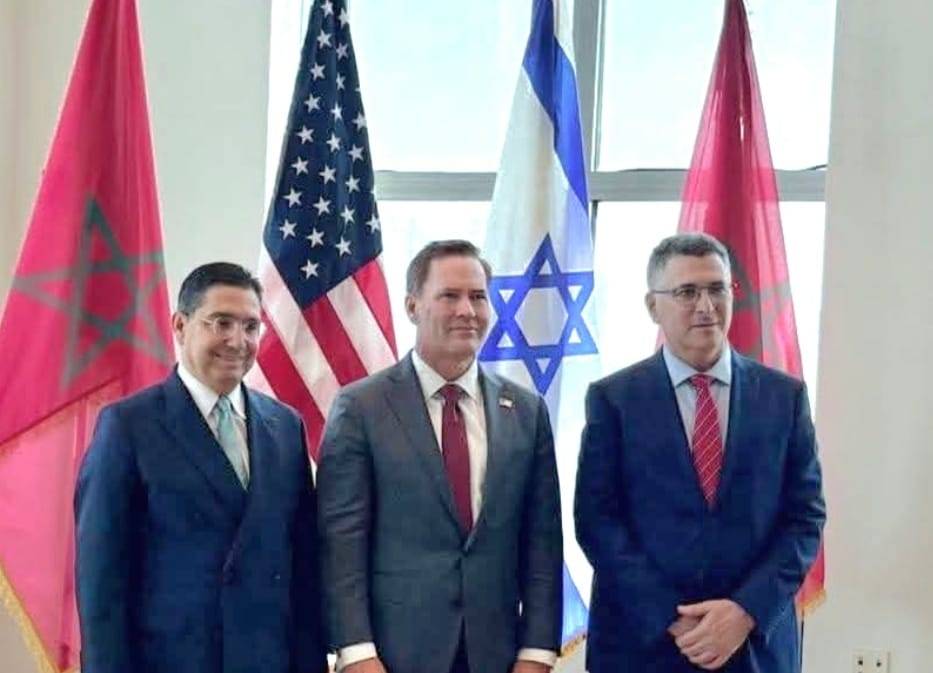
Meeting between the foreign ministers of Morocco and Israel held in New York under American sponsorship (Israeli Foreign Ministry)
TT

Israel and Morocco Deepen Diplomatic Ties

Meeting between the foreign ministers of Morocco and Israel held in New York under American sponsorship (Israeli Foreign Ministry)

Israel and Morocco have said they will open embassies and expand relations established under the US-brokered Abraham Accords.

Morocco was one of four Arab countries - along with the United Arab Emirates, Bahrain and Sudan - to move ⁠towards normalizing relations with Israel in 2020 under the accords.

Israel and Morocco announced the new move on Thursday in a joint statement with the United States, saying that integrating Israel into the broader Arab world “will lead to peace, stability and shared prosperity.”

Meeting between the foreign ministers of Morocco and Israel in New York (Israeli Foreign Ministry)

The Abraham Accords were a marquee foreign policy achievement of US President Donald Trump’s first term.

Thursday’s statement said a tripartite ⁠meeting was held in New York between Israeli Foreign Minister Gideon Saar, Moroccan counterpart Nasser Bourita and US ambassador to the United Nations Mike Waltz.

The officials affirmed commitment to ⁠a series of steps aimed at advancing ties between Israel and Morocco, including "elevating their respective diplomatic missions to the level of ⁠embassies, and appointing ambassadors," according to the statement.

They also agreed to expand flights between Israel and Morocco ⁠and work on finalizing agreements aimed at facilitating mutual investments and economic and trade ties.


US Sentences Ex-head of Syrian Prison to 60 Years on Torture Charges

File photo: Aleppo central prison. AAWSAT AR
TT

US Sentences Ex-head of Syrian Prison to 60 Years on Torture Charges

File photo: Aleppo central prison. AAWSAT AR

The former head of a notorious Syrian prison was sentenced by a US federal judge on Thursday to 60 years in prison for torture and immigration fraud, according to the Department of Justice (DOJ).
Samir Ousman Alsheikh, 74, who has been in the US since 2020, allegedly ran Damascus Central Prison -- known colloquially as Adra Prison -- from approximately 2005 to 2008, where detainees were subjected to horrific abuse in the "Punishment Wing”, AFP said.
A jury found Alsheikh guilty in March of "one count of conspiracy to commit torture, three counts of torture, one count of visa fraud, and one count of attempted naturalization fraud," according to the DOJ.
Three former prisoners testified during the trial about the abuse they suffered at the hands of Alsheikh, as well as the torture inflicted on other prisoners.
"The conviction in this case is a testament to the courage of his victims," Assistant US Attorney General A. Tysen Duva said in a statement.
In addition to the torture charges, Alsheikh was found guilty of immigration fraud after he lied about his past to gain entry to the United States in 2020.
"The message is clear: human rights violators who come to the United States will receive no safe harbor here," Duva added.
"We will find them, and they will be prosecuted and punished for their heinous crimes."
A coalition of the opposition toppled Bashar al-Assad's government in late 2024, and after the collapse, Syrians flocked to prisons searching for missing loved ones.
