


Banksy Painting Sprayed in West Bank Resurfaces in Tel Aviv

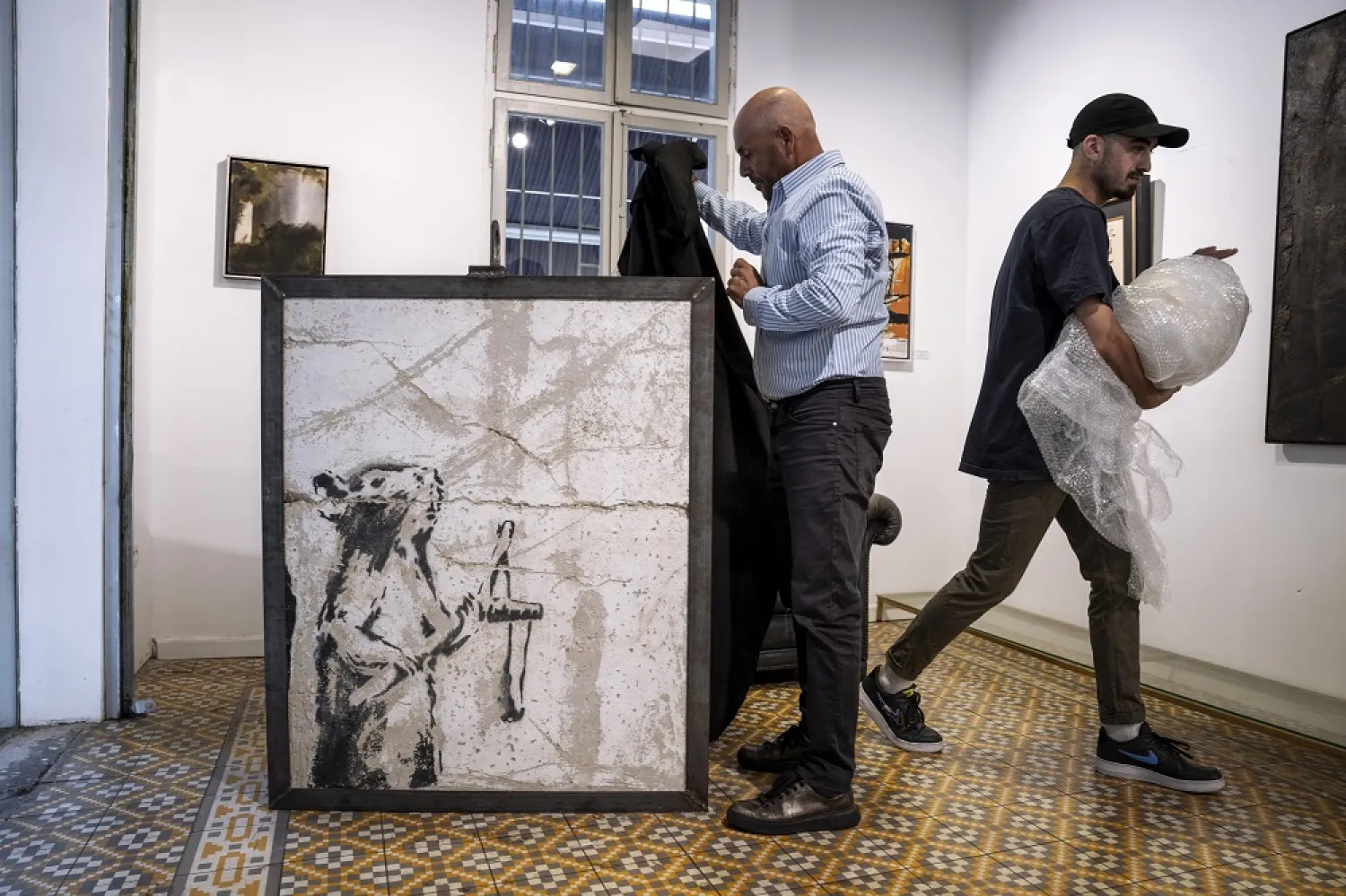
Koby Abergel, an Israeli art dealer, reveals a painting by the secretive British graffiti artist Banksy that was mysteriously transferred from the occupied West Bank to the Urban Gallery in Tel Aviv, Israel, Thursday, Aug. 4, 2022. (AP)
TT

Banksy Painting Sprayed in West Bank Resurfaces in Tel Aviv

Koby Abergel, an Israeli art dealer, reveals a painting by the secretive British graffiti artist Banksy that was mysteriously transferred from the occupied West Bank to the Urban Gallery in Tel Aviv, Israel, Thursday, Aug. 4, 2022. (AP)

A long-lost painting by the British graffiti artist Banksy has resurfaced in a swank art gallery in downtown Tel Aviv, an hour’s drive and a world away from the concrete wall in the occupied West Bank where it was initially sprayed.

The relocation of the painting — which depicts a slingshot-toting rat and was likely intended to protest the Israel occupation — raises ethical questions about the removal of artwork from occupied territory and the display of such politically-charged pieces in radically different settings from where they were created.

The painting initially appeared near Israel’s separation barrier in the occupied West Bank city of Bethlehem and was one of several works created in secret around 2007. They employed Banksy’s trademark absurdist and dystopian imagery to protest Israel’s decades-long occupation of territories the Palestinians want for a future state.

Now it resides at the Urban Gallery in the heart of Tel Aviv’s financial district, surrounded by glass and steel skyscrapers.

“This is the story of David and Goliath,” said Koby Abergel, an Israeli art dealer who purchased the painting, without elaborating on the analogy. He said the gallery was simply displaying the work, leaving its interpretation to others.

The Associated Press could not independently confirm the authenticity of the piece, but Abergel said the cracks and scrapes in the concrete serve as “a fingerprint” that proves it is the same piece that appears on the artist’s website.

The 70-kilometer (43-mile) journey it made from the West Bank to Tel Aviv is shrouded in secrecy. The 900-pound concrete slab would have had to pass through Israel’s serpentine barrier and at least one military checkpoint — daily features of Palestinian life and targets of Banksy’s biting satire.

Abergel, who is a partner with the Tel Aviv gallery, said he bought the concrete slab from a Palestinian associate in Bethlehem. He declined to disclose the sum he paid or identify the seller, but insisted on the deal's legality.

The graffiti artwork was spray-painted on a concrete block that was part of an abandoned Israeli army position in Bethlehem, next to a soaring concrete section of the separation barrier.

Some time later, the painting was itself subjected to graffiti by someone who obscured the painting and scrawled “RIP Bansky Rat” on the block. Palestinian residents cut out the painting and kept it in private residences until earlier this year, Abergel said.

He said the relocation involved delicate negotiations with his Palestinian associate and careful restoration to remove the acrylic paint sprayed over Banksy’s work. The massive block was then enclosed in a steel frame so it could be lifted onto a flatbed truck and rolled through a checkpoint, until it arrived in Tel Aviv in the middle of the night.

It was not possible to independently confirm his account of its journey.

The piece now stands on an ornately patterned tile floor, surrounded by other contemporary art. Baruch Kashkash, the gallery’s owner, said the roughly 2-square-meter (-yard) block was so heavy it had to be brought inside by a crane, and could barely be moved from the doorway.

Israel controls all access to the West Bank, and Palestinians require Israeli permits to travel in or out and to import and export goods. Even when traveling within the West Bank, they can be stopped and searched by Israeli soldiers at any time.

Israeli citizens, including Jewish settlers, can travel freely in and out of the 60% of the West Bank that is under full Israeli control. Israel prohibits its citizens from entering areas administered by the Palestinian Authority for security reasons, but there’s little enforcement of that ban.

The Palestinians have spent decades seeking an independent state in the West Bank, Gaza and east Jerusalem, territories captured by Israel in the 1967 Mideast war. The peace process ground to a halt more than 10 years ago.

Abergel said the artwork’s move was not coordinated with the Israeli military, and that his Palestinian associates, whom he declined to name, were responsible for moving it into Israel and crossing through military checkpoints. He said he has no plans to sell the piece.

According to the international treaty governing cultural property to which Israel is a signatory, occupying powers must prevent the removal of cultural property from occupied territories. It remains unclear exactly how the 1954 Hague Convention would apply in this instance.

“This is theft of the property of the Palestinian people,” said Jeries Qumsieh, a spokesperson for the Palestinian Tourism Ministry. “These were paintings by an international artist for Bethlehem, for Palestine, and for visitors to Bethlehem and Palestine. So transferring them, manipulating them and stealing them is definitely an illegal act.”

The Israeli military and COGAT, the Israeli Defense Ministry body responsible for coordinating civilian affairs with the Palestinians, said they had no knowledge of the artwork or its relocation.

Banksy has created numerous artworks in the West Bank and Gaza Strip in recent years, including one depicting a girl conducting a body search on an Israeli soldier, another showing a dove wearing a flak jacket, and a masked protester hurling a bouquet of flowers. He also designed the “Walled Off Hotel” guesthouse in Bethlehem, which is filled with his artwork.

A spokesperson for Banksy did not respond to requests for comment.

This is not the first time the street artist’s work has been lifted from the West Bank. In 2008, two other paintings — “Wet Dog” and “Stop and Search” — were removed from the walls of a bus shelter and butcher shop in Bethlehem. They were eventually bought by galleries in the United States and Britain where they were exhibited in 2011.

Abergel says it’s up to viewers to draw their own conclusions about the artwork and its implications.

“We brought it to the main street of Tel Aviv to be shown to the audience and to show his messages,” said Abergel. “He should be happy with it.”



Scientists May Have Unlocked Key Secret to Long Life

Prof Uri Alon said he hoped the study would inspire further investigation into the genes that affect lifespan (Shutterstock)
TT

Scientists May Have Unlocked Key Secret to Long Life

Prof Uri Alon said he hoped the study would inspire further investigation into the genes that affect lifespan (Shutterstock)

Scientists think they may have unlocked a key secret to long life – quite simply, genetics, according to The Guardian.

Writing in the journal Science, the researchers described how previous studies that had attempted to unpick the genetic component of human lifespan had not taken into account that some lives were cut short by accidents, murders, infectious diseases or other factors arising outside the body. Such “extrinsic mortality” increases with age, as people often become more frail.

Prof Uri Alon and colleagues at the Weizmann Institute of Science in Israel say the true genetic contribution to the variation in human lifespan has been masked.

The team looked at “heritability,” the proportion of change in a characteristic such as height, body weight or lifespan within a population that can be attributed to genetics rather than environmental factors. Previous studies for human lifespan have thrown up a wide range of values – with heritability ranging from 6% of the variation to 33%.

But Alon, who co-authored the research, and his colleagues said such figures were underestimates. “I hope this will inspire researchers to make a deep search for the genes that impact lifespan,” The Guardian quoted Alon as saying. “These genes will tell us the mechanisms that govern our internal clocks.

“These can one day be turned into therapy to slow down the rate of ageing and in that way slow down all age-related disease at once.”

The team created a mathematical model that takes into account extrinsic mortality and the impact of biological ageing, and calibrated it using correlations of lifespan from historical datasets of thousands of pairs of twins in Denmark and Sweden.

They removed the impact of extrinsic mortality to reveal the signal from biological ageing, which is caused by genetics. The results suggest about 50% of the variation in human lifespan is due to genetics – a figure the researchers said was on a par with that seen in wild mice in the laboratory.

The other 50% of variation in human lifespan, they said, was probably explained by factors such as random biological effects and environmental influences.


Berlin Drowning in Potatoes… for Free

Sack of fresh raw potatoes (Shutterstock)
TT

Berlin Drowning in Potatoes… for Free

Sack of fresh raw potatoes (Shutterstock)

A vast stockpile of potatoes is being given away for free by a farm in the German state of Saxony, after a bumper national harvest.

Thousands of tasty tubers have been rolling into the country's capital, Berlin, since mid-January, with residents risking icy streets to bag their share, according to BBC.

Dubbed “the great potato rescue” it is part of a plan to stop about 4 million kg of surplus spuds from going to ruin. Food banks, schools and churches are among the beneficiaries, according to organizers.

However, the enterprise was labelled a “disgusting PR stunt” by the Brandenburg Farmers' Association, which lamented the impact on local markets.

Germany is the European Union's potato-producing capital, and last year's harvest has left the market saturated.

Ultimately it is about “putting the potato in the spotlight as a valuable food,” said Berliner Morgenpost editor, Peter Schink who helped spearhead the plan.

The newspaper teamed up with eco-friendly search engine firm, Ecosia, to co-ordinate and fund the distribution of the spuds.

Not wishing to discard its “magnificent tubers” back into the fields, Osterland Agrar says it's set to have bussed around 500,000kg to Berlin, and other parts of Germany and Ukraine.

"We can store them until the middle of this year," said Hans-Joachim von Massow, Managing Director of Osterland Agrar, the agricultural firm that ended up with all the potatoes, after a customer contract was cancelled and settled.

But not everyone is celebrating.

“Food is and will remain valuable, even if thoughtless do-gooders throw around free potatoes at schools and churches,” said Timo Scheib from the Brandenburg Farmers' Association.


Bezos's Blue Origin to 'Pause' Space Tourism to Focus on Moon Efforts

Jeff Bezos arrives to attend Dior Haute Couture Spring/Summer 2026 show in Paris, France, January 26, 2026. REUTERS/Abdul Saboor
TT

Bezos's Blue Origin to 'Pause' Space Tourism to Focus on Moon Efforts

Jeff Bezos arrives to attend Dior Haute Couture Spring/Summer 2026 show in Paris, France, January 26, 2026. REUTERS/Abdul Saboor

Jeff Bezos's space company Blue Origin said Friday it would temporarily pause flights of its space tourism rocket to focus more resources on its lunar ambitions.

According to AFP, the company said in a statement it would "pause New Shepard flights for no less than two years" in order to "further accelerate development of the company's human lunar capabilities."

"The decision reflects Blue Origin's commitment to the nation's goal of returning to the Moon and establishing a permanent, sustained lunar presence," the statement read.

New Shepard is a reusable rocket that has carried dozens of humans across the Karman line, the internationally recognized boundary of space.

But Blue Origin also aims to compete with Elon Musk's SpaceX in the orbital flight market.

Last year, the company founded by Amazon's Jeff Bezos successfully carried out two uncrewed orbital flights using its massive New Glenn rocket, which is significantly more powerful than New Shepard.

Also last year, NASA said it was opening bids for a planned Moon mission, the third phase of the Artemis program, to compete against rival SpaceX, which the then-chief said was "behind."

Blue Origin currently has the contract for the fifth planned mission of the multibillion-dollar Artemis program.

US President Donald Trump's second term in the White House has seen the administration pile pressure on NASA to accelerate its progress to send a crewed mission to the Moon, as China carries out similar efforts.