


Crews Recover Bodies of 9 Backcountry Skiers Days after California Avalanche

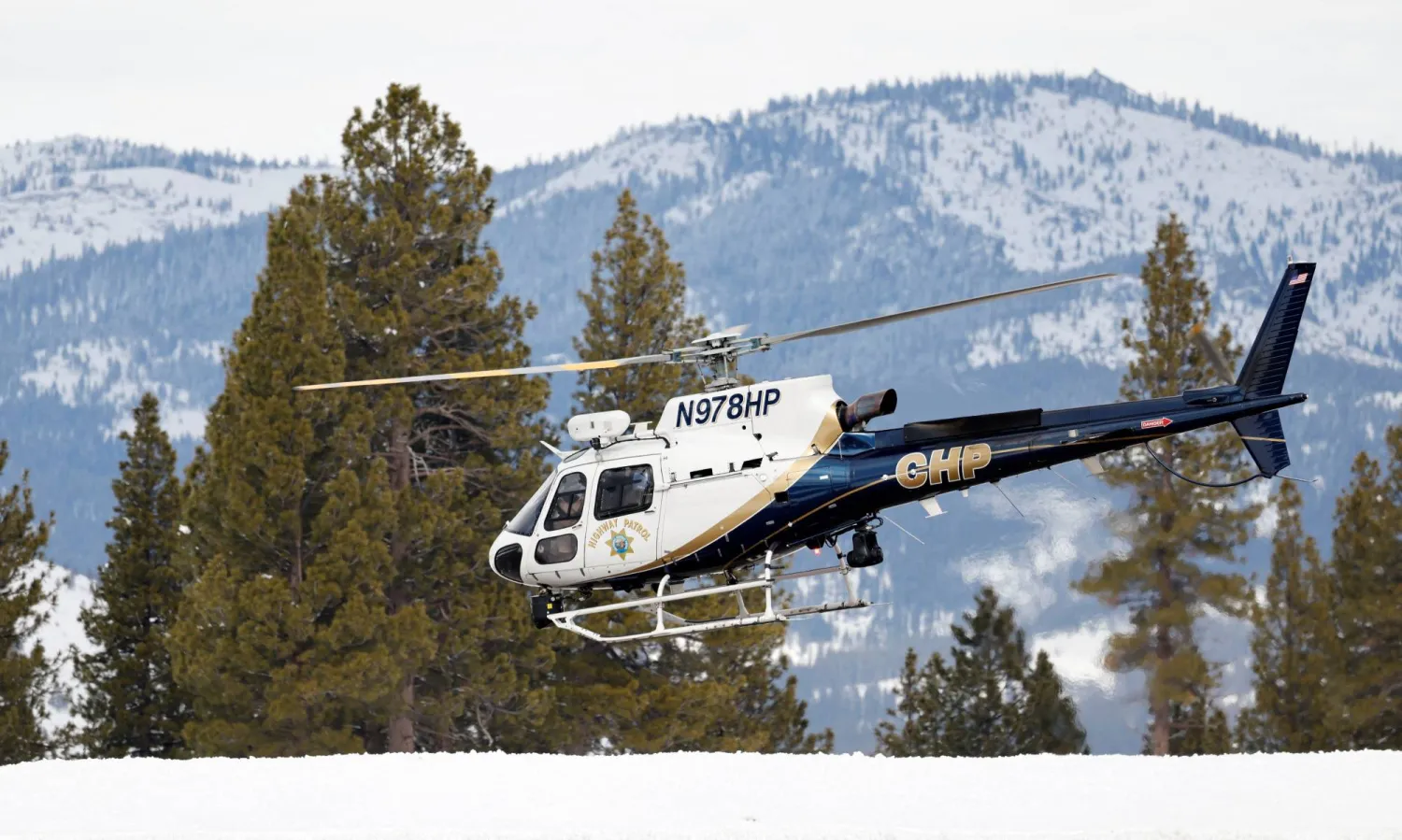
A California Highway Patrol helicopter lifts off from Truckee Tahoe Airport while taking part in recovery efforts for the skiers that died in an avalanche in the Sierra Nevada mountains, in Truckee, California, US February 21, 2026.  REUTERS/Fred Greaves
A California Highway Patrol helicopter lifts off from Truckee Tahoe Airport while taking part in recovery efforts for the skiers that died in an avalanche in the Sierra Nevada mountains, in Truckee, California, US February 21, 2026. REUTERS/Fred Greaves
TT

Crews Recover Bodies of 9 Backcountry Skiers Days after California Avalanche

A California Highway Patrol helicopter lifts off from Truckee Tahoe Airport while taking part in recovery efforts for the skiers that died in an avalanche in the Sierra Nevada mountains, in Truckee, California, US February 21, 2026.  REUTERS/Fred Greaves
A California Highway Patrol helicopter lifts off from Truckee Tahoe Airport while taking part in recovery efforts for the skiers that died in an avalanche in the Sierra Nevada mountains, in Truckee, California, US February 21, 2026. REUTERS/Fred Greaves

Crews recovered the bodies of nine backcountry skiers who were killed by an avalanche in California's Sierra Nevada, authorities said Saturday, concluding a harrowing operation that was hindered by intense snowfall.

A search team reached the bodies of eight victims and found one other who had been missing and presumed dead since Tuesday’s avalanche on Castle Peak near Lake Tahoe. The ninth person who was missing was found “relatively close” to the other victims, according to Nevada County Sheriff’s Lt. Dennis Hack, but was impossible to see due to whiteout conditions at that time.

At a news conference, Sheriff Shannon Moon praised the collective efforts of the numerous agencies that helped recover the bodies — from the California Highway Patrol to the National Guard to the Pacific Gas & Electric utility company — and 42 volunteers who helped on the last day of the operation.

“We are fortunate in this mountain community that we are very tight-knit, and our community shows up in times of tragedy,” The Associated Press quoted Moon as saying.

The sheriff named for the first time the three guides from Blackbird Mountain Company who died: Andrew Alissandratos, 34, Nicole Choo, 42, and Michael Henry, 30.

According to biographies on the company's website, Alissandratos was originally from Tampa, Florida, and moved to Tahoe roughly a decade ago. He enjoyed a wide array of adventure activities, from backcountry exploration to rock climbing.

Henry moved to Colorado in 2016 and then to Truckee three years later. He was described as “laid back” and devoted to sharing his knowledge and love of the mountains with others.

There was no bio for Choo on the website.

“This was an enormous tragedy, and the saddest event our team has ever experienced,” Blackbird Mountain founder Zeb Blais said Wednesday in a statement.

“We are doing what we can to support the families who lost so much,” he said, “and the members of our team who lost treasured friends and colleagues.”

The six other fatal victims were women who were part of a close-knit group of friends who were experienced backcountry skiers and knew how to navigate the Sierra Nevada wilderness, their families said this week.

They were identified as Carrie Atkin, Liz Clabaugh, Danielle Keatley, Kate Morse, Caroline Sekar and Kate Vitt, all in their 40s. They lived in the San Francisco Bay Area, Idaho and the Lake Tahoe area.

“We are devastated beyond words,” the families said in a statement. “Our focus right now is supporting our children through this incredible tragedy and honoring the lives of these extraordinary women. They were all mothers, wives and friends, all of whom connected through the love of the outdoors.”

The families asked for privacy while they grieve and added that they “have many unanswered questions.”

Two of the friends got out alive and were rescued along with four others, including one guide, after Tuesday’s avalanche. Their names have not been released.

The avalanche struck on the last day of the 15 skiers’ three-day tour, when the group decided to end the trip early to avoid the impending snowstorm.

Officials have said the path they took is a “normally traveled route” but declined to specify what that meant.

At around 11:30 a.m. Tuesday, the six survivors called for help, describing a sudden and terrifying slide that was approximately the length of a football field. In the aftermath they discovered the bodies of three fellow skiers, according to Hack.

Rescuers were not able to reach them until roughly six hours after the initial call for help, Hack said, and took two separate paths to arrive. They found five other bodies, leaving only one person unaccounted for.

But it was immediately clear to rescuers that it was too dangerous to extract the bodies at that time due to the heavy snowfall and threat of more avalanches.

Those conditions persisted on Wednesday and Thursday.

A breakthrough on Friday Authorities used two California Highway Patrol helicopters, with the help of Pacific Gas & Electric Company, to break up the snow and intentionally release unstable snowpack to reduce the avalanche risk.

Crews were then able to recover five victims that evening before it got too dark to access the last three.

Rescuers used helicopters and ropes to hoist the last four bodies from the mountain the following morning, fighting through severe winds that forced them to make multiple trips. The bodies were then taken to snowcats — trucks that are outfitted to drive on snow — for further transport.

“We cannot say enough how tremendously sorry we are for the families that have been affected by this avalanche,” Moon said.

Initial reports indicated that at least two of the surviving skiers were not swept away by the avalanche, Hack said. The others were standing separately and relatively close together and were hit.

Hack declined to offer information about what might have set off the avalanche.

Authorities close the area The terrain will be off-limits to visitors until mid-March, said Chris Feutrier, forest supervisor for the Tahoe National Forest. Officials intended to restore public access once the investigation is complete.

“This is the public’s land, and they love to recreate on it,” Feutrier said. “The Forest Service doesn’t close public land for every hazard or every obstacle. We trust the American people to use their best judgment when recreating.”



Riyadh Municipality Decorates Capital with Over 5,000 Lights for Founding Day

The capital's streets have transformed into vibrant displays of national pride, embodying 299 years of continuous development and progress - SPA
TT

Riyadh Municipality Decorates Capital with Over 5,000 Lights for Founding Day

The capital's streets have transformed into vibrant displays of national pride, embodying 299 years of continuous development and progress - SPA

The Riyadh Municipality has illuminated the capital's main streets, vital thoroughfares, and public squares with over 5,000 decorative lights in celebration of Saudi Founding Day.

The project involved installing 5,481 decorative lights across various locations to enhance the festive atmosphere throughout Riyadh's neighborhoods, giving the city a harmonious visual character that reflects profound pride in the nation's rich history, SPA reported.

As light and identity intertwine, the capital's streets have transformed into vibrant displays of national pride, embodying 299 years of continuous development and progress.

The transformation reflects the deep significance of Founding Day in the hearts of citizens and translates their loyalty to the leadership's blessed journey.


Residents in Australia’s Victoria State Urged to Evacuate as Bushfire Rages

This undated handout image received on December 26, 2024 from the State Control Center of the Victoria Emergency Services shows officials on a road near a bushfire in the Grampians National Park in Australia's Victoria state. (Handout / State Control Center of the Victoria Emergency Services / AFP)
TT

Residents in Australia’s Victoria State Urged to Evacuate as Bushfire Rages

This undated handout image received on December 26, 2024 from the State Control Center of the Victoria Emergency Services shows officials on a road near a bushfire in the Grampians National Park in Australia's Victoria state. (Handout / State Control Center of the Victoria Emergency Services / AFP)

An ‌out-of-control bushfire in Australia's Victoria state prompted an evacuation alert for residents near a remote mining settlement, authorities said on Saturday.

The alert, at the highest emergency rating, was for the area surrounding the A1 Mine Settlement in the Gaffney's Creek region, about 50 km (31 miles) ‌northeast of ‌state capital Melbourne.

"Leaving immediately is ‌the ⁠safest option, before ⁠conditions become too dangerous," Victoria Emergency said on its website, adding that the fire was not yet controlled.

Mountainous terrain was making it difficult for firefighters to battle ⁠the blaze from the ‌ground, the ‌Australian Broadcasting Corp. reported.

Since the 1860s gold ‌has been mined in the sparsely-populated ‌area, which is also popular with campers and tourists.

Three other bushfires were burning on Saturday at watch and act ‌level, the second highest danger rating, Victoria Emergency said.

In January, ⁠thousands ⁠of firefighters battled bushfires in Australia's southeast that razed homes, cut power to thousands of homes and burned swathes of bushland. They were the worst fires to hit the southeast since the Black Summer blazes of 2019-2020 that destroyed an area the size of Türkiye and killed 33 people.


Galapagos Park Releases 158 Juvenile Hybrid Tortoises on Floreana to Restore the Ecosystem

 Juvenile giant tortoises are loaded onto a boat on Santa Cruz Island for transport to Floreana Island for release as part of a project to reintroduce the Floreana giant tortoise to its native island in the Galapagos Islands, Ecuador, Thursday, Feb. 19, 2026. (AP Photo/Dolores Ochoa)
Juvenile giant tortoises are loaded onto a boat on Santa Cruz Island for transport to Floreana Island for release as part of a project to reintroduce the Floreana giant tortoise to its native island in the Galapagos Islands, Ecuador, Thursday, Feb. 19, 2026. (AP Photo/Dolores Ochoa)
TT

Galapagos Park Releases 158 Juvenile Hybrid Tortoises on Floreana to Restore the Ecosystem

 Juvenile giant tortoises are loaded onto a boat on Santa Cruz Island for transport to Floreana Island for release as part of a project to reintroduce the Floreana giant tortoise to its native island in the Galapagos Islands, Ecuador, Thursday, Feb. 19, 2026. (AP Photo/Dolores Ochoa)
Juvenile giant tortoises are loaded onto a boat on Santa Cruz Island for transport to Floreana Island for release as part of a project to reintroduce the Floreana giant tortoise to its native island in the Galapagos Islands, Ecuador, Thursday, Feb. 19, 2026. (AP Photo/Dolores Ochoa)

Nearly 150 years after the last giant tortoises were removed from Floreana Island in Ecuador’s Galapagos archipelago, the species made a comeback Friday, when dozens of juvenile hybrids were released to begin restoring the island’s depleted ecosystem.

The 158 newcomers, aged 8 to 13, have begun exploring the habitat they are destined to reshape over the coming years. Their release was perfectly timed with the arrival of the season’s first winter rains.

“They are large enough to be released and can defend themselves against introduced animals such as rats and cats,” said Fredy Villalba, director of the Galapagos National Park breeding center on Santa Cruz Island, noting that the best specimens with the strongest lineage were selected specifically for Floreana.

These released juvenile specimens, out of a total of 700 planned for Floreana, will be introduced gradually. According to Christian Sevilla, director of ecosystems of the Galapagos National Park, they carry between 40% and 80% of the genetic makeup of the Chelonoidis niger —a species that has been extinct for 150 years.

The lineage of these hybrids traces back to Wolf Volcano on Isabela Island, a discovery that still puzzles scientists today. By selecting adults with the strongest genetic makeup, said Sevilla, the breeding program aims to gradually bring the extinct Floreana species back to its former purity.

Two centuries ago, Floreana was home to approximately 20,000 giant tortoises. However, whaling, a devastating fire, and relentless human exploitation eventually led to their complete extinction on the island.

“In genetic terms, reintroducing a species to that island with a significant genetic component of the original species is vital,” biologist Washington Tapia told The Associated Press.

Tapia, a researcher and director of Biodiversa-Consultores — a firm specializing in the Galapagos Islands — emphasized that this process is about more than just numbers; it is about restoring a lost lineage.

Floreana, an island spanning approximately 173 square kilometers (67 square miles), is a volcanic landmass and the southernmost point of the Galapagos archipelago. Situated in the middle of the Pacific Ocean — roughly 1,000 kilometers (621 miles) from the mainland coast — it remains a remote and vital ecological site.

The tortoises reintroduced to Floreana will share their territory with a diverse population of nearly 200 people alongside flamingos, iguanas, penguins, sea gulls and hawks. However, they must also contend with introduced plant species such as blackberry and guava, as well as animals like rats, cats, pigs and donkeys. These non-native species, introduced by human activity, represent potential threats to the island’s newest inhabitants.

Floreana resident Verónica Mora described the release of the turtles as a dream come true. “We are seeing the reality of a project that began several years ago,” she said, adding that the community feels immense pride in the return of the giant tortoises.

The United Nations designated the Galapagos Islands as a Natural World Heritage Site in 1978. This honor recognizes the islands’ unique abundance of terrestrial and marine species found nowhere else on the planet.